Published On:
February 24, 2026
Updated On:
February 24, 2026
Driven by a record-breaking 31 million square feet of commercial leasing in 2025, Global Capability Centers are transforming India from a cost-saving destination into the core innovation engine for global corporations, fundamentally reshaping real estate across both megacities and emerging Tier II tech hubs.
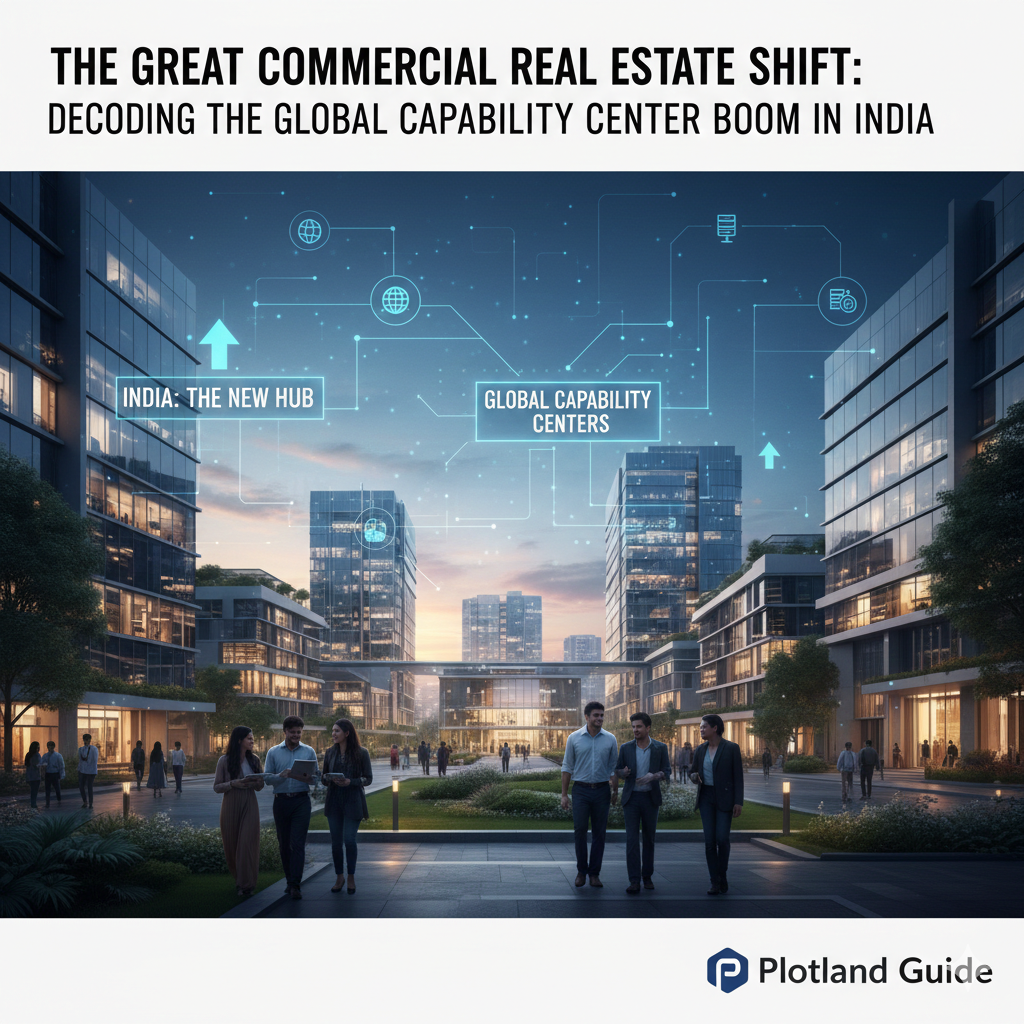
The physical footprint of multinational corporations within the Indian subcontinent is expanding at a historic and unprecedented pace. Entering 2025, the commercial real estate landscape is being entirely rewritten by the aggressive expansion of the Global Capability Center (GCC). For those analyzing the shifts in global business, a GCC represents a foreign-based subsidiary of a multinational corporation. However, unlike the back-office setups of previous decades, today’s centers are strictly dedicated to performing highly specialized, high-value functions such as complex research and development, advanced IT engineering, and intricate global business operations.
The sheer scale of this corporate migration is staggering. Last year, the Indian commercial real estate market witnessed a record-breaking 31 million square feet of office space leased specifically by these capability centers. This monumental figure marks one of the strongest, most aggressive expansion cycles ever recorded in the country's office market history. To put this into perspective, over the past decade, these centers have driven nearly 40% of all office leasing, firmly establishing their critical importance to the foundational stability and growth of commercial real estate in India 2025.
Currently, the vast majority of this corporate footprint—more than 90%—is concentrated within Tier I cities, which collectively command a massive Grade A office stock exceeding 263 million square feet. The momentum shows absolutely no signs of plateauing, with over 200 entirely new capability centers establishing their presence in the Indian market within the last two years alone.
To understand the magnitude of this GCC office space leasing surge, it is essential to understand why global companies are choosing India today. Historically, multinational enterprises looked toward South Asia primarily for cost arbitrage—outsourcing basic, repetitive tasks simply to save operational capital. That narrative is completely obsolete.
The growth recorded in the modern market is driven by a hunger for specialized city ecosystems, deeply entrenched talent pools, and sector-focused expansion strategies. Global enterprises are establishing physical footprints in India to spearhead artificial intelligence development, engineer the next generation of electric vehicle batteries, design advanced semiconductors, and manage complex global financial analytics. India is no longer just a destination for task execution; it has become the central nervous system for global corporate innovation.
This evolution demands a completely different caliber of infrastructure. Companies are actively seeking state-of-the-art, sustainable, and highly collaborative campus environments that foster creativity and attract top-tier STEM (Science, Technology, Engineering, and Mathematics) talent.
A defining characteristic of this current real estate cycle is the absolute dominance of companies headquartered in the United States. When analyzing the origin of this massive leasing demand from 2018 through 2025, a striking 70% of the total GCC footprint was acquired by American firms.
This heavy concentration underscores India's non-negotiable, strategic importance in modern global corporate planning. American Fortune 500 companies, ranging from innovative tech disruptors in Silicon Valley to legacy financial institutions on Wall Street, view the Indian ecosystem as a core capability-building hub across their entire value chain. By setting up massive localized operations, these firms are building long-term operational resilience, ensuring they have robust, around-the-clock innovation engines that are fully integrated into their worldwide operations.
The geographical distribution of this 31 million square foot expansion reveals highly specialized micro-economies developing across the country's major urban centers.
Bengaluru continues to reign supreme, commanding an impressive 34% to 39% market share of the national corporate footprint. The city currently hosts over 900 individual capability units, making it one of the largest and most dense innovation clusters anywhere in the world. Its sheer dominance is fueled by an incredibly mature startup ecosystem, a massive pre-existing global tech presence, and a highly reliable pipeline of elite engineering talent.
Multinational corporations flock to Bengaluru specifically for its established strengths in IT and IT-enabled services, Engineering Research & Development (ER&D), and advanced retail and digital operations. As a direct result of this relentless corporate influx, the local commercial property market is experiencing sustained upward pressure, driving developers to aggressively construct next-generation tech parks to keep pace with the insatiable demand.
Securing 20% to 23% of the overall market, Hyderabad has firmly established itself as the second most vital node in the national network. However, unlike Bengaluru's broad tech focus, Hyderabad has carved out a highly specialized, incredibly lucrative niche. It is widely recognized as India's premier destination for healthcare, biotechnology, pharmaceuticals, and life sciences.
Much of this leasing activity is anchored by massive, purpose-built infrastructure projects like Genome Valley. Furthermore, the city is rapidly emerging as a critical hub for semiconductor design and complex business analytics. Backed by proactive government policies and aggressive infrastructure upgrades, Hyderabad's real estate market is expanding rapidly, specifically catering to the complex laboratory, clean-room, and high-security requirements of deep-tech capability centers.
Pune currently commands a highly respectable 15% to 20% of the national activity. The city serves as a powerful magnet for firms operating in the automotive sector, advanced engineering services, and financial technology. Pune offers a distinct strategic advantage: an exceptionally high quality of life coupled with a dense concentration of premium educational institutions, making it an incredibly attractive alternative for professionals looking to avoid the infrastructural bottlenecks of the larger megacities.
Similarly, Chennai has experienced steady, robust growth in leasing demand over the last few years. Historically known for its massive automotive and manufacturing base, the city is successfully leveraging this legacy to attract corporate centers focused on industrial engineering, ER&D, and supply chain logistics. Companies are setting up massive operational hubs in Chennai to digitize their manufacturing processes and seamlessly integrate modern software with heavy industrial machinery.
In the northern region, Delhi NCR has evolved into a highly diversified corporate landscape. Its vast geographical spread allows it to absorb massive capability centers across a wide variety of sectors, including IT consulting, e-commerce, retail, healthcare, and education technology. The region's robust infrastructure and immediate connectivity to the national capital make it a strategic base for companies requiring a strong regulatory and administrative presence.
Meanwhile, Mumbai retains its undisputed crown as the commercial and financial capital of the nation. Despite its notoriously high real estate acquisition costs, it continues to attract strategic, high-value operations from major global banks, international financial institutions, and multinational conglomerates. In Mumbai, the banking and financial services vertical remains the absolute strongest driver of commercial leasing, with global entities taking up massive floor plates in premium business districts to house their complex financial modeling and quantitative trading teams.
One of the most fascinating trends defining the Global Capability Center boom in India in 2025 is the strategic migration beyond the traditional megacities. The expansion story is no longer confined to just the major metros. Tier II cities are rapidly emerging as the next massive frontier for global corporate leasing.
As multinational companies look to build operational resilience and sharply reduce their risk dependency on any single geographical location, they are increasingly adopting a distributed city model. Setting up operations in a Tier II city can offer companies substantial cost savings ranging from 10% to 35% on real estate leases and general operational expenses. More importantly, these cities provide immediate access to massive, untapped talent pools. With significantly lower costs of living and shorter commutes, professionals in these cities often exhibit much lower attrition rates compared to the hyper-competitive job markets of the Tier I hubs.
Cities like Ahmedabad, heavily bolstered by the development of GIFT City, are transforming into sophisticated financial and tech hubs. Similarly, Kolkata, Jaipur, Coimbatore, Mysuru, and Kochi are seeing an unprecedented surge in commercial leasing inquiries. These cities are undergoing rapid infrastructure and connectivity upgrades, building the modern airports, expressways, and digital networks required to support uninterrupted global corporate operations.
The monumental absorption of 31 million square feet of office space does not happen in a vacuum. This boom is acting as a massive catalyst that is fundamentally reshaping the entire surrounding real estate ecosystem. The traditional boundaries between commercial, residential, and retail real estate are blurring as developers rush to build integrated, self-sustaining micro-markets.
When a multinational corporation signs a lease for a massive capability center, it brings thousands of highly compensated professionals into a specific neighborhood. This immediate influx of purchasing power triggers a severe demand shock in the local residential market. Developers are pivoting away from standard housing projects to focus heavily on premium, lifestyle-oriented residential complexes. These modern professionals demand a high standard of living, seeking gated communities equipped with smart home technologies, expansive clubhouse facilities, co-working lounges, and extensive health and wellness amenities. Consequently, the micro-markets surrounding major capability hubs are witnessing a sharp appreciation in both property values and rental yields.
Furthermore, this demographic shift is completely revitalizing the local retail and hospitality sectors. The permanent presence of a massive corporate workforce necessitates the development of high-end shopping malls, organized retail high streets, premium dining establishments, and international hotel chains to cater to visiting global executives. The industry is witnessing the aggressive rise of the "walk-to-work" culture, where massive mixed-use developments seamlessly integrate the corporate office, luxury apartments, and retail entertainment zones into a single, cohesive master-planned community.
When analyzing the current velocity of the market, the projections for the near future are incredibly optimistic. Industry forecasts suggest that the total physical footprint of these capability centers across the country could easily cross the 350 million square feet mark within the next three to four years. This represents an unprecedented volume of physical space dedicated purely to corporate innovation and specialized operations.
The sustained future of this expansion will heavily depend on a few critical factors. Strategic city diversification will remain paramount, as companies balance their real estate portfolios between established Tier I hubs and emerging Tier II challengers. Sector-specific specialization will also deepen; we will likely see entire cities or business parks become globally recognized for highly niche operations, cementing their status on the global map.
Ultimately, India's multi-tier city framework is no longer just a convenient way to organize geography; it has emerged as a massive competitive differentiator on the global stage. As international enterprises continually rethink how to build resilience, drive innovation, and scale their operations efficiently, the Indian market offers an unparalleled combination of Grade A real estate capacity, talent density, and economic momentum. The record-breaking leasing figures of 2025 are a clear, undeniable indicator that the commercial real estate ecosystem is entering its strongest, most transformative growth decade yet.
