Published On:
January 27, 2026
Updated On:
February 11, 2026
The quintessential balcony is vanishing from Indian urban homes, particularly in Bengaluru and Delhi-NCR, driven by rising property costs, pollution, and shrinking floor plans. Once a leisure spot, balconies are now either being enclosed for utility or eliminated entirely in favor of larger internal living areas.
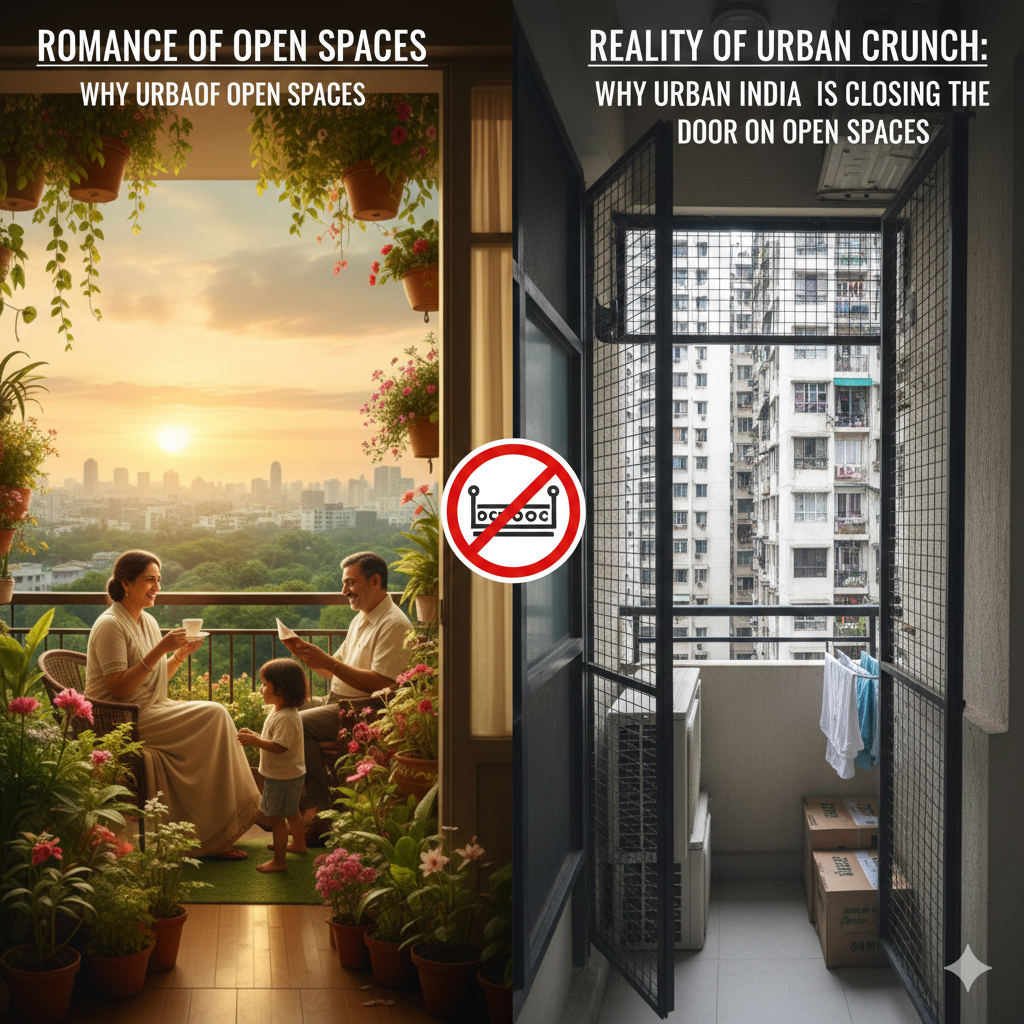
There was a time when the "balcony" was the heart of an Indian home. It was the morning tea spot, the grandmother’s winter sunning corner, and the default venue for evening conversations. But in the concrete jungles of 2026, that narrative is shifting. Walk through the newer mid-segment housing towers in Bengaluru or Delhi-NCR, and you will notice a stark change: balconies are shrinking, and in many cases, disappearing altogether.
This isn't just an architectural quirk; it is a response to a complex mix of economic pressure, environmental reality, and changing lifestyle priorities. The open verandah is becoming a luxury, while the enclosed "utility deck" is becoming the norm.
The primary culprit behind the shrinking balcony is the ruthless economics of real estate. As property prices in metro cities hit astronomical highs, every square foot counts.
In cities like Bengaluru, where the gap between "Super Built-Up Area" and actual "Carpet Area" can range from 15% to a staggering 45%, homebuyers are becoming acutely value-conscious. A 1,200 sq. ft. apartment might only yield 850 sq. ft. of usable floor space. In this scenario, paying for a 60 sq. ft. balcony—space that isn't "habitable" in the traditional sense—feels like a financial leak.
For mid-segment buyers, the choice is binary: pay an extra ₹15-20 lakh for a balcony you might rarely use, or trade that space for a larger living room or a dedicated study. Increasingly, the market is choosing the latter. Developers are responding by either reducing balcony sizes (from the standard 6ft depth to a cramped 4ft) or eliminating them in 2BHK configurations to keep the ticket price attractive.
While economics drives the builder, the environment drives the buyer. In Delhi-NCR, where the AQI frequently breaches the 400-mark, the romantic idea of an open balcony often clashes with the gritty reality of dust and smog.
Residents in high-density zones are finding that open balconies require constant cleaning and are often unusable during peak pollution months or extreme summers. This has led to a massive trend of "enclosure." Homeowners are illegally or quasi-legally grilling up their balconies and installing glass facades to keep the dust and noise out.
Recognizing this, architects are now designing "Juliet balconies" or sealed glass decks that offer the visual connection to the outdoors without the exposure to bad air. The balcony is no longer a place to be; it is just a place to see from.
Interestingly, the death of the balcony is not uniform across India. It varies wildly based on local building bylaws (FSI/FAR norms).
Even where balconies exist, their function has changed. The "lifestyle" balcony with potted plants and patio furniture is increasingly reserved for the ultra-luxury segment (homes priced above ₹3 crore).
In the mid-market, the solitary balcony often gets relegated to a "utility zone." It becomes the permanent home for the washing machine, the drying rack, and the external AC units. The privacy issue in high-density towers—where a neighbor is just 10 feet away—further discourages people from using balconies as social spaces.
Is the balcony dead? Not quite, but it is being gentrified. In the luxury segment, we are seeing a resurgence of massive "sky decks" and vertical gardens, marketed as private retreats. But for the average urban Indian homebuyer, the balcony is fast becoming a relic of a bygone era—sacrificed at the altar of affordability and air conditioning.
As we move forward, we might see a rise in "convertible spaces"—areas with sliding glass walls that can serve as a balcony in good weather and an extended living room when the AQI drops. Until then, the urban Indian home continues to turn inward.
