Published On:
May 3, 2026
Updated On:
May 3, 2026
The 594-km Ganga Expressway, stretching from Meerut to Prayagraj, is rapidly emerging as a transformative economic corridor designed to slash travel times, catalyze massive investments in decentralized logistics and warehousing hubs, and trigger unprecedented residential and commercial real estate growth across Tier II and III cities in Uttar Pradesh.
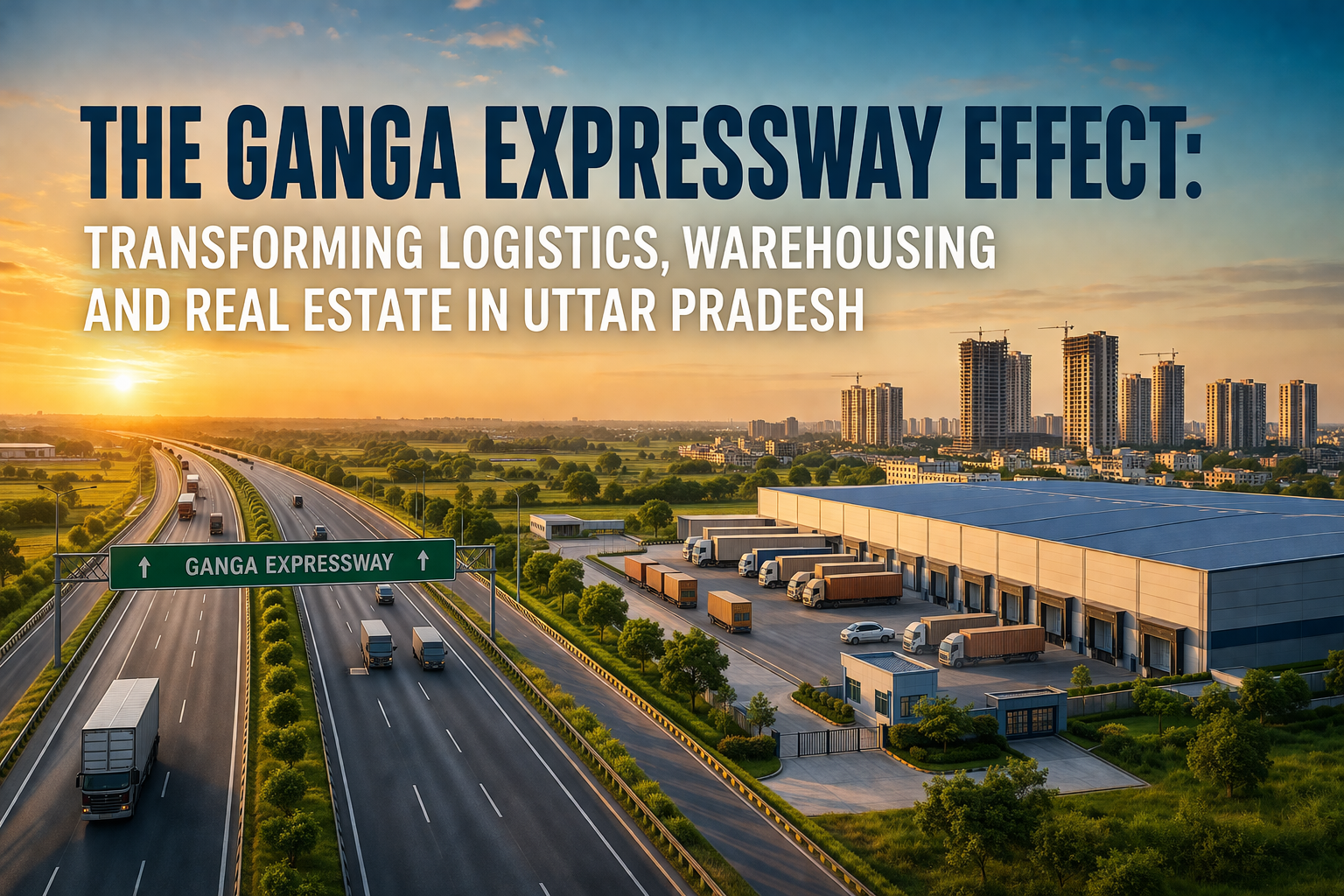
Uttar Pradesh is currently witnessing an unprecedented infrastructure metamorphosis, and at the absolute center of this transformation is the newly inaugurated Ganga Expressway. Stretching an impressive 594 kilometers, this monumental transportation corridor connecting the western hub of Meerut to the eastern cultural epicenter of Prayagraj is far more than just a high-speed transit route. It is a robust catalyst for immense economic revitalization, aimed at completely redefining the state’s commercial, industrial, and real estate footprint.
For decades, the state's economic and real estate narratives were heavily skewed toward the National Capital Region—specifically the urban sprawls of Noida, Greater Noida, and Ghaziabad—as well as the state capital, Lucknow. However, this newly operational mega-project is fundamentally rewriting that geography. It shifts the primary focus toward a much more decentralized, corridor-based growth model, unlocking the massive, untapped potential of Tier II and Tier III cities. The inauguration of this massive thoroughfare marks a definitive shift in how businesses view the heartland of India. By seamlessly linking the highly industrialized western regions of the state with the agricultural strongholds of central Uttar Pradesh and the historically rich, education-focused eastern districts, the expressway forms a uniquely cohesive economic zone.
To truly comprehend the sheer scale of the economic impact, one must first examine the structural and engineering magnitude of the Ganga Expressway itself. Designed for a maximum cruising speed of 120 kilometers per hour, the six-lane, fully access-controlled highway has been meticulously constructed with future-proof provisions allowing for an eventual expansion to eight lanes. Executed through a highly efficient public-private partnership framework, the expressway carves its path through 12 crucial districts: Meerut, Hapur, Bulandshahr, Amroha, Sambhal, Badaun, Shahjahanpur, Hardoi, Unnao, Rae Bareli, Pratapgarh, and Prayagraj.
The immediate and most tangible benefit of this sprawling network is the dramatic, almost revolutionary reduction in travel time between the western and eastern boundaries of the state. Commutes and freight transit routines that previously stretched upwards of twelve exhausting hours are now expected to be slashed by nearly fifty percent. This acceleration in transit is a game-changer for fleet operators, drastically improving vehicle turnaround times and reducing overall fuel consumption.
Furthermore, the strategic brilliance of the project extends well beyond its standalone length. Planners have meticulously designed the corridor to interlock seamlessly with an expansive, pre-existing web of major road networks. By linking directly with the Agra-Lucknow Expressway, the Purvanchal Expressway, the Bundelkhand Expressway, and the Gorakhpur Link Expressway, the project establishes a massive, unified grid. This interconnected matrix ensures that commercial vehicles, heavy freight transporters, and everyday commuters can efficiently bypass congested city centers, transforming the entire state into a highly permeable, frictionless transit environment.
Historically, real estate UP development followed a highly speculative, capital-city-adjacent model. Institutional investors and private developers historically flocked to areas immediately bordering Delhi or surrounding Lucknow, resulting in hyper-dense urban clusters while leaving vast expanses of the state's interior largely underdeveloped. The introduction of the Ganga Expressway entirely disrupts this outdated pattern. It introduces a highly structured, node-anchored methodology for value creation that operates on a foundation of tangible industrial utility.
Development along the new route is actively projected to cluster in concentric rings around 18 distinct interchange nodes spread systematically across the 12 districts. Rather than relying on the speculative sprawl of existing metropolitan boundaries, this new geographical growth is driven by the logic of superior connectivity and logistical necessity. Vast tracts of land that previously generated relatively low agricultural yields are now rapidly transitioning into high-value commercial, residential, and industrial zones.
Market analysis heavily suggests that this value creation will unfold in clearly defined, chronological phases. Over the initial three years of the expressway's operation, the immediate vicinity of these transit nodes will witness a massive, heavily capitalized influx of warehousing and logistics facilities. Following this critical period of industrial stabilization, the subsequent two to five years are expected to usher in robust residential and commercial real estate development, gradually transforming these once-isolated transit points into fully functional, self-sustaining micro-economies.
Perhaps the most significant and immediate beneficiary of this UP infrastructure development is the logistics and warehousing sector. In an era dominated by the rapid expansion of e-commerce platforms, third-party logistics providers, and ultra-fast quick-commerce delivery networks, the operational demand for strategically located, massive distribution hubs has reached unprecedented levels. The Ganga Expressway confronts this warehousing demand in UP head-on through the state-sanctioned development of 12 integrated manufacturing and logistics clusters positioned alongside the corridor.
These clusters are not merely open plots of land waiting for speculative buyers; they are meticulously envisioned as comprehensive economic ecosystems. Over 6,500 acres of prime land have been formally designated across pivotal central districts like Shahjahanpur and Hardoi specifically for the purpose of fostering logistics hubs in UP. This massive land allocation indicates a deliberate shift away from temporary infrastructure toward a model of sustained, long-term economic occupancy anchored by permanent industrial activity. Developers are moving rapidly to construct Grade-A warehousing facilities, advanced climate-controlled cold storage units, and highly specialized food processing hubs.
The strategic geographic placement of these clusters takes absolute full advantage of the region's existing agrarian strengths. For instance, agricultural belts in Pratapgarh, Unnao, and Hapur harbor immense, previously untapped potential for cold chain infrastructure development. Integrating massive cold storage facilities directly onto a high-speed Meerut to Prayagraj expressway ensures that highly perishable goods, regional dairy products, and specialized local agricultural outputs—such as amla harvests from Pratapgarh or unique botanical and rose processing outputs from Shahjahanpur—can be transported to larger, more lucrative markets exponentially faster. This direct market access drastically mitigates post-harvest waste and boosts local agrarian economies.
Furthermore, the expressway's operational strength is magnified by its alignment with other flagship national infrastructure initiatives. The deliberate integration with the Eastern Dedicated Freight Corridor and National Waterway 1 (which stretches from Haldia down to Varanasi) creates a highly efficient multimodal logistics paradigm. Manufacturers and major distributors can now seamlessly optimize their complex supply chains—utilizing the inland waterways for slow, heavy bulk transport, the dedicated rail corridors for massive long-distance freight, and the Ganga Expressway for ultra-swift, last-mile road distribution across northern India.
The cascading ripple effect of this vastly enhanced regional connectivity is actively setting the stage for an unprecedented urban renaissance across Tier II cities UP. Townships that were previously considered mere peripheral agricultural centers or temporary highway stopovers are actively evolving into strategic centers of distribution and specialized manufacturing.
Districts like Budaun, Shahjahanpur, and Sambhal are currently emerging as highly sought-after targets for large-scale warehousing investments. The drastic, tangible reduction in transportation costs and unpredictable transit times makes these specific locations incredibly attractive for massive national and multinational corporations looking to establish highly efficient regional distribution centers. Simultaneously, districts such as Amroha and Hardoi are bracing for significant manufacturing-led growth, heavily supported by proactive state initiatives designed to aggressively augment the micro, small, and medium enterprises ecosystem, particularly under the broader umbrella of industrial smart city missions.
At the western terminus, Meerut is uniquely and perfectly positioned to capitalize on this extraordinary economic boom. Benefiting heavily from the geographic and commercial spillover of the neighboring National Capital Region, the city is rapidly transitioning into a massive anchor hub. The newly established, high-speed connectivity guarantees that modern businesses can comfortably maintain extensive operations closely tied to the NCR market while simultaneously enjoying the immense cost benefits, affordable labor pools, and expansive land availability that Meerut readily offers.
The overarching commercial real estate landscape is also undergoing a profound, structural evolution. The post-pandemic business environment has already undeniably demonstrated the operational viability of decentralized work models, and the newly launched infrastructure provides the exact physical foundation required to make this a sustainable, long-term reality. Major urban centers along the route, specifically Kanpur, Prayagraj, and Meerut, are perfectly poised to shed their historical status as localized regional towns and confidently step into vital roles as secondary corporate office hubs. Corporations actively seeking to diversify their geographic risk, reduce their massive tier-one real estate overheads, and seamlessly tap into highly educated, high-potential talent pools in non-metro areas now possess the necessary connectivity to confidently establish robust regional headquarters.
This ongoing commercial decentralization is naturally driving an intense, parallel boom in the residential real estate sector. With average travel times between key endpoints effectively halved, the traditional concept of a manageable commutable distance has been completely redefined. Strategic catchment areas such as Hapur and Unnao are currently experiencing massive, fresh waves of institutional and retail housing demand. As thousands of professionals, engineers, and blue-collar workers secure employment in the newly established manufacturing clusters and modern logistics parks, the inevitable requirement for high-quality, reliable housing naturally leads to a massive urban spillover effect.
Real estate developers and large-scale builders are quickly recognizing and acting upon this immense potential. There is a palpable, aggressive shift in focus toward the creation of vast affordable housing projects, meticulously planned plotted developments, and highly organized, self-contained integrated townships across these newly emerging corridors. Unlike the notoriously cramped, hyper-dense residential projects that plague tier-one cities, these newly envisioned developments in tier-II districts offer a significantly higher quality of life. They feature expansive green spaces, superior civic planning, and modern amenities, making them immensely attractive to both end-user families seeking upgraded lifestyles and long-term speculative investors eyeing capital appreciation.
Moving beyond the immediate industrial and commercial impacts, this massive corridor also exerts a tremendously positive influence on the state's tourism and cultural sectors, a phenomenon most visibly apparent at its eastern terminus in Prayagraj. Globally recognized for its immense spiritual significance and functioning as a primary, historic center for religious pilgrimage, the city is currently undergoing massive, heavily funded civic and infrastructural upgrades.
The targeted capital injections geared specifically toward comprehensive temple town development are actively creating a highly synergistic economic environment. The introduction of enhanced, high-speed road connectivity ensures that millions of domestic travelers and international tourists can access these culturally vital landmarks with absolutely unprecedented ease and comfort. This highly anticipated, massive surge in tourist footfall is subsequently driving intense, sustained demand within the local hospitality sector, aggressively spurring the rapid development of new luxury and budget hotels, expansive retail spaces, and vastly improved, modern civic amenities. The noticeable, early signs of property value firming along this specific stretch serve as a direct, undeniable result of this dual momentum—where incredibly robust, modern industrial infrastructure perfectly and seamlessly complements deep-rooted cultural and tourism-driven economic expansion.
What truly differentiates this development from countless previous regional infrastructure projects is its unyielding, structural focus on balanced, geographically sustainable economic growth. By physically, rapidly linking the state's previously disparate and isolated economic zones, the massive corridor effectively ensures that immense wealth generation and prosperity are not simply confined to a small handful of historically privileged metropolitan pockets. The ensuing wealth generation, the creation of tens of thousands of direct and indirect employment opportunities, and the massive localized infrastructural upgrades are fairly distributed across multiple distinct districts, comprehensively uplifting local micro-economies that have historically been overlooked by massive institutional capital.
Furthermore, the deliberate integration of smart city development principles directly alongside the massive industrial corridors guarantees that this explosive growth is managed with efficiency and foresight. Modern urban planners and state architects are actively focusing heavily on implementing sustainable logistics models, mandating energy-efficient practices within massive warehousing complexes, and deploying advanced, technology-driven traffic management systems to guarantee that this period of rapid, unprecedented industrialization does not arrive at an unmanageable, detrimental environmental cost to the local agricultural ecosystems.
This inauguration undeniably represents far more than just the ceremonial opening of a new, long-distance road; it stands as the literal and metaphorical unlocking of Uttar Pradesh's vast, previously untapped economic capabilities. By drastically and permanently reducing geographical friction, the ambitious project has successfully laid down the permanent groundwork required for a highly integrated, incredibly modern northern economy.
From the massively expansive 6,500 acres of dedicated logistics parks aggressively facilitating the next generation of seamless e-commerce distribution, to the newly established, beautifully planned residential townships offering modern, premium living standards in previously rural agricultural districts, the economic impact is breathtakingly comprehensive and deeply multi-faceted. As the various, carefully planned phases of infrastructure and real estate development unfold steadily over the coming years, the colossal corridor will undoubtedly, firmly cement its lasting position as the primary, undisputed growth engine for the entirety of northern India.
Institutional investors, seasoned real estate developers, and massive multinational corporations are already clearly recognizing the shifting economic tides. The definitive, permanent move away from highly speculative, capital-adjacent real estate ventures toward fundamentally sound, infrastructure-backed, and industrially driven development marks a crucial maturing of the regional market. The region has officially transitioned from merely being an area boasting massive potential to actively, physically building the crucial economic arteries required to sustain long-term, decentralized, and utterly robust commercial dominance in the 21st century.
