Published On:
September 12, 2026
Updated On:
September 12, 2026
Real estate investment is rapidly shifting from conventional properties towards specialised alternative assets like data centres, senior living, and life sciences. Driven by digital transformation and demographic changes, these unconventional segments offer investors portfolio diversification and resilient, long-term income streams.
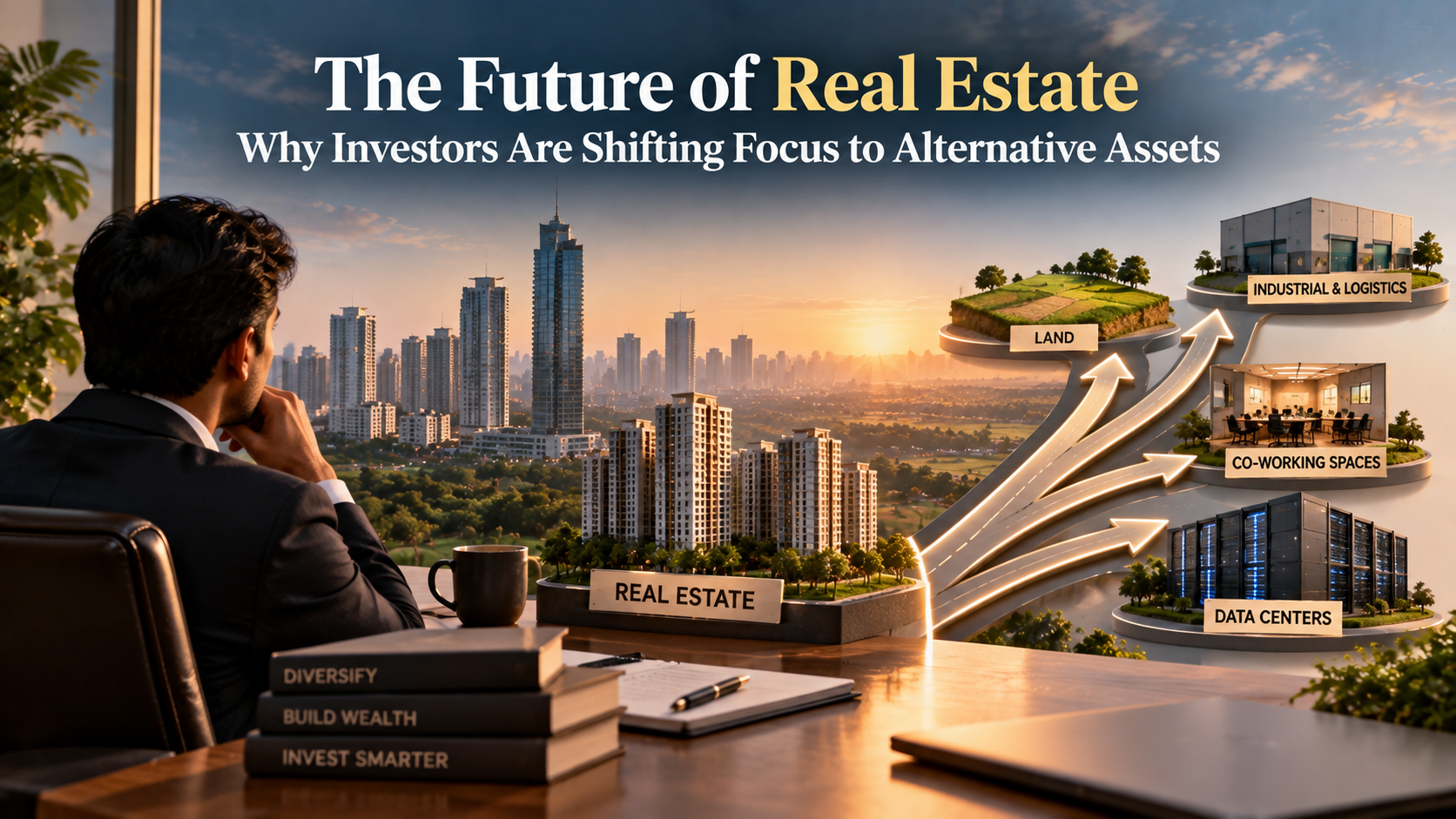
For decades, the standard playbook for real estate investment was straightforward and highly predictable. Capital flowed almost exclusively into conventional commercial office spaces, sprawling retail malls, and vast residential housing complexes. While these traditional assets have long served as the bedrock of wealth generation and portfolio stability, the global economic landscape is undergoing a profound transformation. Rapid technological advancements, major demographic shifts, and evolving consumer habits are rewriting the rules of the property market. Today, astute investors are looking beyond the traditional brick-and-mortar mainstays and aggressively pivoting towards alternative real estate assets.
Backed by long-term structural demand, specialised segments such as data centres, senior living communities, purpose-built student housing, and life science facilities are fast becoming the new frontiers of institutional investment. As the Indian market matures and global capital becomes increasingly comfortable with specialised formats, these unconventional asset classes offer a unique opportunity to hedge against traditional property cycles, secure recurring revenue, and capitalise on future-proof macro trends like digitalisation and healthcare expansion.
The modern economy runs entirely on data, making data centres one of the most prominent and aggressively pursued alternative real estate sectors today. The astronomical rise of artificial intelligence, the mass migration to cloud computing, the rollout of advanced telecommunications networks, and a general surge in digital consumption have created an insatiable demand for secure data storage and processing capacity.
A data centre is fundamentally different from a traditional office building. It requires massive, uninterrupted power loads, advanced cooling infrastructure, and extreme security measures. Consequently, site selection relies heavily on power grid reliability and extensive land availability rather than just geographical proximity to a central business district.
In India, the data centre sector is witnessing a massive influx of capital. Favourable government policies regarding data localisation, aggressive integration of renewable energy sources, and an AI-driven demand surge are supporting substantial capacity additions. Established metropolitan hubs like Mumbai, Chennai, Delhi-NCR, and Bengaluru currently dominate the market, functioning as the primary nodes for data infrastructure. However, as land becomes scarce and power requirements skyrocket, operators are increasingly moving into strategic Tier-II locations. These emerging markets offer the vital combination of expansive land parcels and robust power availability required to construct next-generation hyperscale facilities.
Demographic changes are fundamentally altering housing requirements, and the senior living sector is emerging as a massive real estate opportunity. With an aging global population and rising life expectancies, there is an escalating need for housing that caters specifically to elderly citizens. This is not about traditional retirement homes; the modern senior living sector encompasses a broad spectrum of professionally managed communities, including independent living, assisted living, and continuous care facilities.
In India, shifting family structures and growing affluence among elderly households are driving intense developer interest in organised senior living formats. Today’s retirees are seeking properties that go beyond simple accommodation. They demand integrated ecosystems that blend premium hospitality, dedicated healthcare support, active social engagement, and robust security. For investors, this sector is highly attractive because it addresses a fundamental human need that is practically immune to typical economic downturns. Once established, these facilities generate highly stable, long-term rental yields and service-based revenue, making them a cornerstone of a diversified real estate portfolio.
The days of students relying solely on cramped, unorganised rental apartments are rapidly fading. Purpose-built student accommodation has evolved into an increasingly recognised and highly specialised residential asset class. This sector’s demand is intricately linked to university enrolment rates and the geographic concentration of major educational hubs.
Student housing operates on a completely different rhythm compared to conventional residential properties. Leasing cycles are strictly defined by academic calendars, ensuring predictable tenant turnover and high occupancy rates during the educational year. These properties are meticulously designed to enhance the student experience, featuring communal study spaces, high-speed internet infrastructure, recreational zones, and tight security. As higher education continues to expand and student mobility increases, institutional investors are pouring capital into developing branded, high-quality student housing projects near premier university campuses, securing consistent, cycle-resistant cash flows in the process.
The life sciences real estate sector covers a highly specialised niche involving laboratories, pharmaceutical research and development centres, and medical manufacturing infrastructure. The investment appeal of this sector lies precisely in its complexity. These buildings require heavy structural reinforcements, specialised ventilation and exhaust systems, sterile environments, and complex waste management protocols. Because these facilities are incredibly difficult and expensive to convert into conventional office or industrial spaces, tenants tend to sign extremely long-term leases, resulting in excellent tenant retention and stable returns.
India is currently positioning itself as a global powerhouse in the pharmaceutical and biotechnology arenas. The rapid growth in high-value research and development, alongside the establishment of global capability centres by multinational healthcare firms, is supporting the development of massive life science clusters. A skilled STEM workforce, supportive government policies, and heavy foreign investment are acting as major catalysts, ensuring that specialised research facilities remain a highly lucrative and deeply resilient real estate asset.
Self-storage is another specialised property format that is quietly capturing significant investor attention. While it is a highly mature market in Western economies, the concept is rapidly gaining traction in urban centres worldwide as residential living spaces shrink and household consumption grows. The self-storage model is remarkably straightforward: it involves building or converting warehouses into smaller, secure units that can be rented out on flexible, short-term bases to individuals and businesses requiring extra space.
The financial beauty of self-storage lies in its fragmented, high-volume tenant base. A single facility might house hundreds of individual renters, meaning that the financial risk is widely dispersed. If a few tenants vacate their units, the overall revenue stream remains largely unaffected. Furthermore, the operational overheads are incredibly low compared to commercial offices or residential apartments. Investors view self-storage as a defensive asset class that performs exceptionally well even during economic recessions, as households downsizing their living arrangements often require immediate storage solutions.
As severe affordability pressures continue to plague conventional residential markets, manufactured housing communities are drawing serious institutional capital. Unlike standard apartment complexes or suburban tracts, investors in this sector typically own the land and the shared infrastructure, while residents purchase or rent the manufactured homes placed on designated sites.
These communities offer vital, affordable housing solutions for middle- and lower-income demographics without sacrificing access to shared amenities like clubhouses, parks, and recreational facilities. The sector is characterised by incredibly sticky tenancy; once a manufactured home is placed on a site, moving it is difficult and expensive. This dynamic guarantees the landowner a reliable, recurring stream of ground rent. As the gap between wages and traditional homeownership widens globally, manufactured housing stands out as a socially vital and financially rewarding real estate niche.
While concrete and steel dominate urban real estate, there is a growing movement of institutional capital flowing into productive farmland. Farmland offers investors direct exposure to a tangible, hard asset whose value is inherently tied to absolute land scarcity, agricultural productivity, and the fundamental global demand for food.
The returns from farmland are dual-pronged, comprising the steady income generated from crop yields or agricultural leases, coupled with the long-term capital appreciation of the land itself. While it is considered a deeply secure, inflation-hedging asset, investing in farmland requires highly specialised knowledge. The sector carries unique risks that do not affect urban real estate, such as unpredictable weather conditions, fluctuating global commodity prices, water availability, and shifting local agricultural policies. Consequently, it remains a domain for sophisticated investors looking to truly diversify away from traditional commercial property risks.
The boundaries between traditional real estate and core infrastructure are blurring. The investment universe is aggressively expanding to include the land and physical facilities that support modern telecommunications and energy networks. Cell tower sites are a prime example of this convergence. Investors acquire the parcels of land upon which telecom operators build their communication towers. These arrangements typically involve multi-decade ground leases with built-in rent escalations, generating an incredibly stable, passive income stream.
Beyond telecom, broader infrastructure real estate encompasses assets connected to energy distribution, transport logistics, and clean energy generation. Investors are actively seeking out assets that offer durable, uninterrupted demand while providing exposure to massive structural mega-trends like global digitalisation and the race toward industrial decarbonisation.
The surging popularity of these alternative sectors reflects a fundamental shift in how institutional investors evaluate risk and reward. The primary driver behind this pivot is the desire for decoupling. The demand patterns for data infrastructure, healthcare facilities, and specialised housing do not move in tandem with standard economic cycles. While a recession might cause office vacancy rates to spike or retail footfall to plummet, people will still grow older and require senior living, businesses will still generate massive amounts of data, and universities will continue to enrol students.
By reallocating capital away from traditional buildings and towards assets linked to essential human services and long-term macroeconomic trends, investors can effectively insulate their portfolios from short-term market volatility. Alternative real estate offers a unique blend of high-yield potential, tenant stickiness, and defensive resilience that conventional properties currently struggle to match.
As the Indian economy scales new heights, the domestic real estate market is on the cusp of a major structural evolution. The country is expected to witness a significant acceleration in institutional investment flowing into these specialised sectors. As regulatory frameworks become more transparent and the operational management of these niche assets becomes highly professionalised, global private equity firms and domestic institutional investors will deploy larger pools of capital into alternative real estate.
The transition from a property market dominated by standard housing and office spaces to a diverse, multi-asset landscape is already underway. From the sprawling hyperscale data centres powering the digital revolution to the serene, meticulously managed senior living communities catering to an aging demographic, the built environment is adapting to serve a changing society. For the forward-thinking real estate investor, looking beyond traditional assets is no longer just an experimental strategy for diversification; it is an absolute necessity for securing sustainable, long-term growth in the modern economic era.
