Published On:
September 12, 2026
Updated On:
September 12, 2026
India's real estate sector is projected to double its GDP contribution to 15-20% by 2047, potentially growing into a $10 trillion industry. However, achieving this monumental growth requires overcoming severe headwinds, particularly the shrinking supply of affordable housing and tightening capital availability.
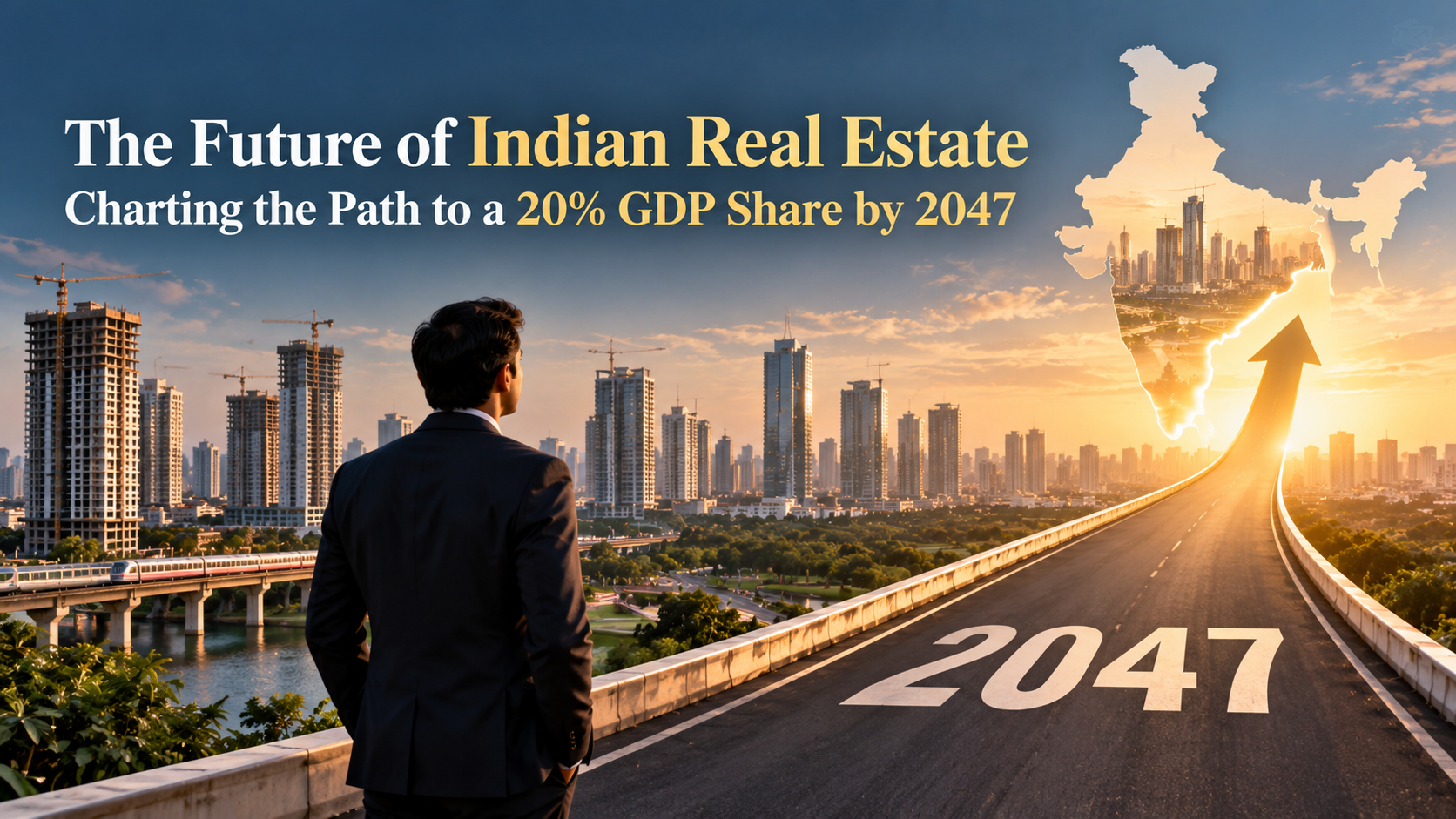
As India marches towards its 100th year of independence in 2047, the economic landscape is undergoing a massive transformation. At the heart of this evolution is the real estate sector, a traditional powerhouse that is currently on the brink of an unprecedented expansion. Today, the property market is an undeniable pillar of the national economy, but its future trajectory suggests it could soon become the definitive engine of Indian economic growth. Industry projections indicate that the sector's contribution to the gross domestic product could comfortably double over the next two decades, rising from the current baseline of eight to nine percent to a staggering fifteen to twenty percent.
The sheer scale of this ambition is difficult to overstate. Currently valued at approximately $600 billion, the Indian real estate market has immense room to maneuver. If the broader national economy expands to the anticipated $25 to $30 trillion mark by 2047, the property sector alone would need to scale up to an $8 to $10 trillion industry. This isn't just about building more homes; it requires a fundamental restructuring of urban spaces, encompassing residential complexes, massive commercial hubs, warehousing, logistics, and specialised infrastructure for education and healthcare.
Yet, this exponential growth story is not without its caveats. The road to 2047 is heavily layered with complex challenges that developers, policymakers, and financial institutions must collectively resolve. From a glaring affordability crisis to fluctuating foreign investments, the headwinds are as significant as the opportunities.
To understand where the property market is heading, one must look at what is currently being built. Over the last few years, the residential real estate market has witnessed a distinct structural shift. Organised developers have decisively pivoted away from mass-market affordable housing, channelling their resources, capital, and land banks into the mid-to-upper and luxury segments.
The rationale behind this pivot is purely driven by unit economics. Constructing and marketing a premium apartment complex yields significantly higher profit margins than building low-cost housing. For a developer, the operational effort required to sell one hundred luxury residences is vastly lower than the logistical and administrative burden of selling thousands of low-cost units to generate the exact same revenue. Consequently, the skyline of major metropolitan areas is increasingly dominated by high-end projects featuring world-class amenities, expansive clubhouses, and premium lifestyle offerings.
While this premiumisation trend has bolstered the balance sheets of major real estate firms, it has created a massive vacuum at the bottom of the pyramid. The affordable housing segment, which serves the largest demographic in the country, remains severely neglected.
The shift towards luxury has birthed one of the most pressing challenges for the sector's long-term sustainability: an acute affordability crisis. This issue is highly pronounced in the nation's premier urban markets, specifically Mumbai, the National Capital Region, and Bengaluru. In these cities, rapid infrastructure development, such as new metro lines and expressways, has triggered steep land appreciation.
When land costs spiral upwards, developers naturally build premium assets to recover their investments, effectively pricing the average middle-class homebuyer out of the core city limits. The result is a widening chasm between the type of inventory being produced and the actual purchasing power of the common citizen.
If the sector is to genuinely achieve a twenty percent share of the national economic output, it cannot rely solely on the luxury segment. The upper-tier market, while highly profitable, has a finite depth. True, sustainable scale can only be achieved by addressing the housing needs of the massive middle and lower-middle-income demographics. Broadening access to homeownership is not just a social imperative but a crucial economic necessity for the industry's volume-driven growth.
While the residential sector wrestles with the affordability dilemma, the commercial real estate landscape presents a distinctly optimistic narrative. In recent times, there has been widespread apprehension regarding the impact of artificial intelligence and automation on the white-collar job market. The underlying fear is that as AI takes over routine cognitive tasks, the demand for human capital—and consequently, the physical office spaces they occupy—would sharply decline.
However, the ground reality of the Indian office market is painting a very different picture. Instead of diminishing demand, technological advancement is actively restructuring it. While legacy roles associated with older, redundant technologies are indeed shrinking, the proliferation of AI and advanced computing is generating a massive wave of new, highly specialised employment.
The global tech industry requires armies of coders, data scientists, machine learning engineers, and system architects to build, maintain, and moderate these new AI models. A significant portion of these high-value jobs is being routed to India, keeping the nation firmly in a job-positive territory. This influx of tech-driven employment is acting as a powerful catalyst for the commercial property sector.
Furthermore, the expansion of Global Capability Centres remains a critical growth driver. Multinational corporations are no longer viewing India merely as a backend outsourcing destination. Instead, they are establishing massive, highly sophisticated hubs that drive global research, development, and strategic operations. These operational centres demand premium, Grade-A office spaces, ensuring that commercial real estate remains highly lucrative and resilient.
To hit the multi-trillion dollar mark, the industry must evolve beyond the traditional binary of residential and office spaces. The future of Indian real estate lies in heavy diversification. The rapid expansion of the e-commerce sector has fundamentally altered consumption patterns, triggering an insatiable demand for modern warehousing and robust logistics parks. Supply chain infrastructure is no longer an industrial afterthought; it is a premium real estate asset class that is attracting massive institutional capital.
Simultaneously, the foundational pillars of societal development—healthcare and education—are heavily driving real estate consumption. The push for world-class medical facilities, sprawling university campuses, and specialised research institutes requires massive land acquisition and specialised construction. As the broader economy scales, these emerging asset classes are broadening the overall real estate canvas, ensuring that growth is multi-dimensional and not overly reliant on housing cycles.
Even with booming demand across various segments, real estate is an inherently capital-intensive business. The velocity at which the sector can grow is directly proportional to the liquidity available in the market. Currently, capital availability is emerging as a critical bottleneck.
Over the past couple of years, the flow of foreign direct investment into the Indian property market has shown signs of contraction. Global macroeconomic uncertainties, fluctuating interest rates in western economies, and geopolitical tensions have prompted foreign institutional investors to adopt a cautious, wait-and-watch approach. This shrinking FDI footprint restricts the ability of developers to acquire massive land parcels and execute mega-projects.
To counter this, the domestic financial ecosystem must step up. Real Estate Investment Trusts were introduced to democratise property investment, allowing retail investors to pool their capital into commercial assets. While REITs have made a promising start and have successfully institutionalised commercial real estate ownership in India, they still have a long developmental runway ahead. The regulatory framework needs continuous refinement to broaden their appeal, and the market needs more listings to truly make REITs a mainstream, high-volume capital channel. Until domestic funding mechanisms can fully offset the fluctuations in foreign investment, liquidity will remain a persistent headwind.
Despite the overarching challenges regarding affordability and capital, the immediate performance of the residential market remains impressively robust. Market data from the first half of the current year indicates that housing sales have maintained a steady momentum. Across the top eight metropolitan cities, approximately one hundred and seventy-five thousand apartments were absorbed by the market, mirroring the strong performance recorded during the same period in the previous year.
This consistent absorption rate is a crucial indicator of market health. It clearly demonstrates that despite rising property prices and higher borrowing costs, underlying end-user demand remains intact. The sustained sales velocity also dispels any immediate concerns about the property cycle entering a sudden downturn. Real estate is inherently cyclical, characterised by periods of aggressive expansion followed by necessary consolidation. However, the current data suggests that the market is holding firm, supported by a growing aspirational middle class and a strong cultural preference for physical asset ownership.
Looking ahead, achieving a long-term annual growth rate of nine to ten percent is entirely plausible for the Indian real estate sector. However, this growth will not happen on autopilot. It requires a deliberate, strategic realignment by all industry stakeholders.
Developers must find innovative ways to re-enter the affordable housing market. This might involve adopting advanced, cost-efficient construction technologies like pre-cast concrete and 3D printing to lower building costs without compromising structural integrity. It also requires a geographic shift—moving away from saturated, ultra-expensive city centres and focusing on the development of satellite towns and peripheral areas where land acquisition is still economically viable.
From a policy perspective, urban planning authorities need to aggressively upgrade public transportation infrastructure. High-speed rail networks, expanded metro grids, and better highway connectivity can bridge the distance between affordable suburban housing and central business districts, making outer-city living a practical reality for the working class.
Furthermore, state governments must streamline the approval processes. The bureaucratic delays associated with securing construction permits add significant holding costs to any project, which developers inevitably pass on to the buyer. Implementing single-window clearance systems and digitising land records can drastically reduce project lifecycles, improving overall affordability.
The trajectory of the real estate sector is inextricably linked to India’s broader economic destiny. As the nation transitions from a developing economy to a global superpower by 2047, the built environment must reflect that status. We are not just talking about constructing individual buildings; we are talking about engineering the habitats for a highly urbanised, technologically advanced society.
The goal of expanding the sector's economic footprint to twenty percent is a testament to the immense untapped potential within the country. It envisions an India where world-class commercial hubs drive global innovation, where logistics networks seamlessly connect the vast geography, and where every citizen has access to safe, modern, and affordable housing.
The challenges—from the premiumisation skew and affordability gaps to capital constraints—are formidable but not insurmountable. They require the industry to mature, adopting a more inclusive development philosophy that looks beyond immediate profit margins towards long-term, sustainable value creation. By balancing the highly lucrative premium markets with a renewed commitment to affordable housing, and by leveraging new asset classes while securing diverse capital streams, the Indian real estate sector can successfully navigate the headwinds. In doing so, it will not just contribute to the GDP; it will actively build the physical foundation of the nation's future.
