Published On:
February 20, 2026
Updated On:
February 20, 2026
The upcoming 2026 opening of the Manjhawali Bridge is set to revolutionize NCR transit by establishing a direct, 30-minute link between Greater Noida and Faridabad. As a vital segment of the FNG Expressway, this new Yamuna crossing will finally divert heavy traffic away from Delhi, drastically decongesting the notoriously clogged Kalindi Kunj and Noida Expressway routes.
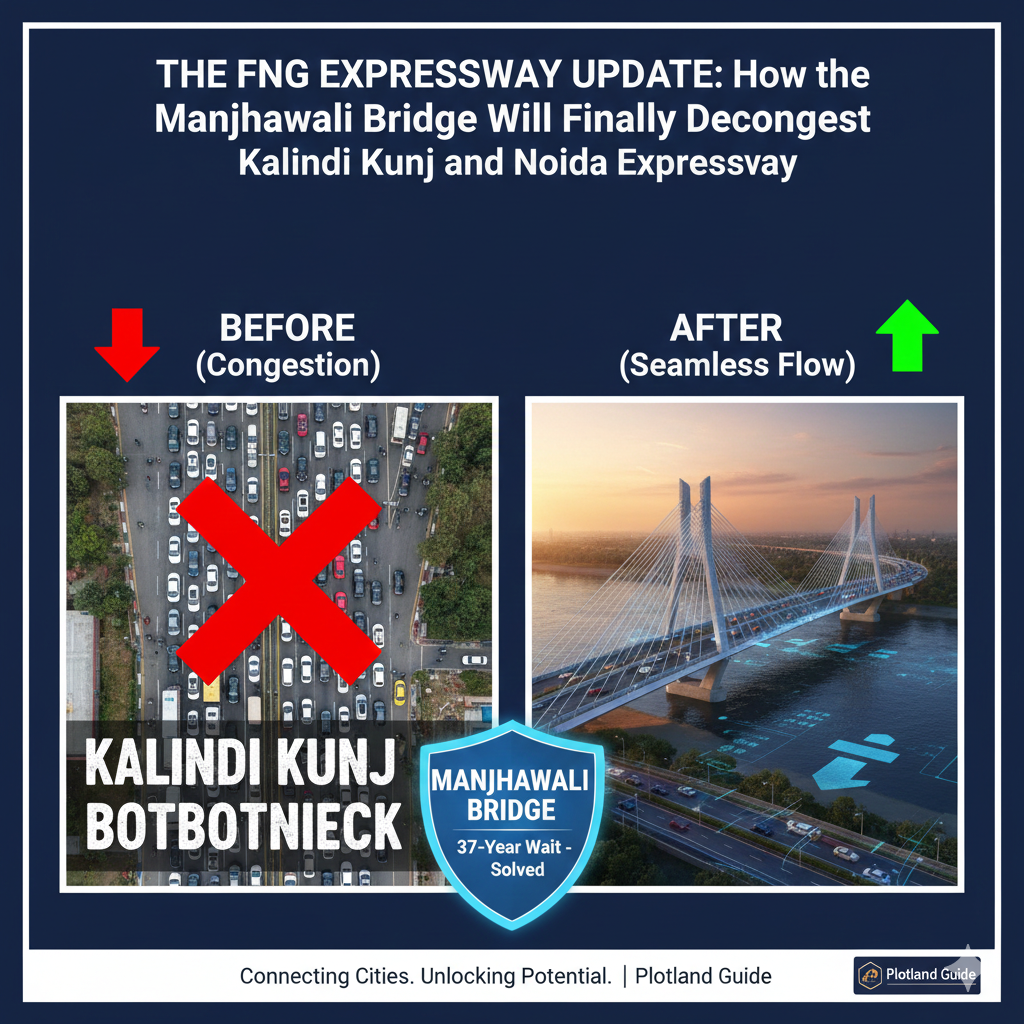
For anyone who navigates the National Capital Region on a daily basis, the mere mention of Kalindi Kunj or the Noida Expressway during peak rush hour is enough to induce sheer exhaustion. The gridlock is legendary, the delays are highly unpredictable, and the massive volume of cross-border traffic moving between Uttar Pradesh, Delhi, and Haryana has pushed the existing urban infrastructure to its absolute breaking point. However, a monumental infrastructural breakthrough is finally on the horizon. The long-awaited Manjhawali Bridge, a critical missing piece of the Faridabad-Noida-Ghaziabad (FNG) Expressway, is aggressively gearing up for a full operational opening in 2026.
This development is not merely another routine road paving project; it is the definitive, long-term solution to the NCR's most notorious traffic bottlenecks. By creating a direct, high-capacity corridor over the Yamuna River, the bridge promises to fundamentally alter the daily commute for hundreds of thousands of residents, shifting the transit dynamics of the entire region. The days of spending a significant portion of the morning idling in endless traffic jams are coming to a close, making way for a streamlined, high-speed regional network.
To truly understand the magnitude of this upcoming opening, one must look back at the incredibly long and complex history of the project. The story of the Manjhawali Bridge is a classic tale of grand urban planning colliding with the harsh realities of bureaucratic red tape, funding challenges, and inter-state jurisdictional friction. The initial proposal for a direct bridge over the Yamuna River to seamlessly connect Greater Noida and Faridabad was drafted way back in 1989. At that time, the NCR was on the cusp of a massive expansion, and forward-thinking planners recognized that forcing all inter-state commercial and passenger traffic through the dense heart of South Delhi would eventually lead to a logistical nightmare.
Yet, despite this early foresight, the project languished in administrative limbo for decades. The primary complications stemmed from the fact that the bridge required seamless coordination between the state governments of Haryana and Uttar Pradesh, along with central environmental clearances. While the Haryana government managed to complete its side of the structural work by 2014, the Uttar Pradesh side remained stalled. The primary roadblock was complex land acquisition involving farming communities along the Yamuna floodplains. However, with renewed political will and the pressing necessity to complete the FNG Expressway, the final roadblocks are being cleared, setting the stage for a historic 2026 launch.
To grasp why the Manjhawali bridge opening is generating such immense anticipation, we must analyze the current geographical dilemma. As it stands today, Greater Noida and Faridabad—despite both being massive industrial and residential hubs within the same metropolitan region—have absolutely no direct road connection.
If a commuter or a commercial freight truck needs to travel between these two cities, they are forced into a massive, forced detour. They must travel down the Noida Expressway, merge into the chaotic traffic of internal Noida, and slowly push their way toward the Kalindi Kunj bridge or the Delhi Noida Direct (DND) Flyway. This funneling effect forces tens of thousands of vehicles that have no actual business being in Delhi to enter the capital's borders simply to cross the river.
This structural flaw in the highway network is the exact reason why Kalindi Kunj experiences bumper-to-bumper traffic that can leave drivers stranded for over an hour just to cross a few hundred meters. The Noida Expressway, similarly, bears the brunt of this heavy, diverted traffic. The FNG Expressway was originally envisioned specifically as a bypass corridor to prevent this. Its core mission was to allow traffic to move fluidly between Faridabad, Noida, and Ghaziabad without ever touching Delhi’s crowded core. The Manjhawali Bridge is the physical manifestation of that bypass. Once operational, it will instantly siphon off a massive percentage of this cross-border traffic, providing immediate, highly visible relief to the choked arteries of Kalindi Kunj.
The most tangible and immediate impact of this infrastructure upgrade will be the drastic reduction in Greater Noida to Faridabad travel time. Currently, navigating the labyrinth of indirect routes, varying speed limits, and multiple toll plazas means a standard trip between the two cities takes anywhere from an hour and a half to well over two hours during peak weekday office timings.
When the four-lane Manjhawali Bridge and its newly constructed approach roads open to the public, this grueling journey will be compressed into a breezy, direct 30-minute drive. For the thousands of corporate professionals, factory supervisors, and business owners who make this inter-city trek daily, the reclamation of their personal time is invaluable.
This isn't just about saving time; it is about predictability. When a commute fluctuates between one and three hours depending on the mood of the Kalindi Kunj traffic police, planning a workday becomes incredibly stressful. The new direct Yamuna crossing removes the variables of urban detours and city intersections, offering a high-speed, uninterrupted glide between Uttar Pradesh and Haryana. Furthermore, the reduction in stop-and-go driving will lead to massive fuel savings for commuters and a significant drop in vehicular emissions, contributing to a much-needed reduction in the region's overall carbon footprint.
Moving beyond the surface-level benefits, the engineering and financial scope of the project is highly impressive. The Manjhawali Bridge itself is a robust, 630-meter-long structure designed to handle high-capacity daily traffic, including heavy logistics trucks, without compromising on speed or safety.
To ensure the bridge does not simply become an isolated structure, the Uttar Pradesh government has recently sanctioned an estimated Rs 66 crore specifically for the development of a comprehensive approach road network on the Greater Noida side. This integrated circuit involves the construction of a brand-new 1.7-kilometer, four-lane stretch that begins at Atta Gujran and stretches right up to the Haryana border where the bridge sits.
In addition to laying down new tarmac, the project scope includes the widening and strengthening of existing rural roads over a 3-kilometer stretch to ensure they meet modern expressway standards. The entire corridor is being outfitted with advanced drainage systems, heavy-duty crash barriers, and modern highway lighting to facilitate safe, 24-hour movement. The seamless integration of these approach roads with the broader Eastern Peripheral Expressway and the Yamuna Expressway ensures that the bridge will not just serve local commuters, but will act as a major node in the national highway grid.
Major infrastructure projects rarely exist in a vacuum; they act as powerful catalysts for regional economic transformation. The real estate markets in both Faridabad and Greater Noida are already experiencing a preemptive surge in anticipation of the 2026 opening.
For years, the sectors collectively known as Greater Faridabad (Neharpar) struggled to attract top-tier property valuations due to a perceived lack of premium connectivity to the employment hubs of Noida. Conversely, the residential clusters in Greater Noida West and along the Yamuna Expressway felt isolated from the established industrial zones of Haryana. The Manjhawali Bridge effectively erases this physical and psychological barrier.
Real estate experts project a sharp spike in demand for residential properties, commercial office spaces, and retail outlets in the immediate vicinity of the new corridor. With the travel time slashed, it becomes entirely feasible for an executive to live in a luxury apartment in Faridabad and commute daily to a corporate IT park in Noida, or vice versa. This walk-to-work adjacent culture will drive up property rentals and capital values. Additionally, the logistics sector is preparing for a massive efficiency boost. Freight carriers moving goods between the manufacturing belts of Haryana and the massive consumer markets of Uttar Pradesh will bypass the heavy toll taxes and entry restrictions of Delhi, drastically lowering supply chain costs and delivery times.
The strategic importance of the Manjhawali Bridge extends far beyond local city-to-city travel; it is a vital piece of the puzzle for the upcoming Noida International Airport at Jewar. As one of the largest aviation hubs currently under construction in Asia, the Jewar airport is expected to handle tens of millions of passengers annually once fully operational.
Ensuring that travelers from across the NCR have smooth, reliable access to the airport terminals is a top priority for state planners. The new FNG Expressway link via Manjhawali provides a direct, high-speed conduit for passengers originating from Faridabad, Gurugram, and other parts of southern Haryana. Instead of navigating the congested ring roads of Delhi to reach the airport, travelers from Haryana will simply cross the new bridge, merge onto the Yamuna Expressway, and enjoy a straight, uninterrupted drive to the departure gates. This seamless connectivity will make the Noida airport a highly attractive and viable option for a massive catchment area that traditionally relied solely on the Indira Gandhi International Airport in Delhi.
As the clock ticks closer to 2026, the focus has shifted entirely from blueprints to heavy ground execution. The structural integrity of the bridge over the Yamuna is already well-established. The critical path to completion now relies entirely on the rapid construction of the approach roads on the Uttar Pradesh side.
For years, the primary stumbling block was the acquisition of agricultural land necessary to lay the four-lane highway. The state administration has engaged in extensive dialogues with the local farming communities, navigating complex compensation models. Currently, reports indicate that over seventy percent of the required land parcels have been successfully acquired and registered, with compensation funds already being disbursed. The government has prioritized resolving the remaining land pockets, ensuring that the heavy earth-moving machinery can operate without interruption.
With the financial approvals in place and the administrative roadblocks largely cleared, the construction teams are working aggressively against the clock. The sense of urgency is palpable, driven by the clear understanding that the region's broader economic plans—including the airport launch and industrial park expansions—heavily depend on this specific road network becoming functional.
The story of the FNG Expressway and the Manjhawali Bridge is a testament to the transformative power of targeted infrastructure. For nearly four decades, the lack of a simple river crossing forced millions of people to endure millions of hours of unnecessary traffic, polluting the air and stifling regional economic synergy.
When the barricades are finally lifted in 2026, it will signify much more than the opening of a new road. It will mark the end of the Kalindi Kunj bottleneck era. It will merge two massive urban economies into a single, cohesive unit. Most importantly, it will give the residents of the National Capital Region something they have desired for years: a fast, peaceful, and highly predictable journey home. The wait has been undeniably long, but the ultimate reward—a fluid, interconnected, and modern metropolis—is finally within reach.
