Published On:
February 24, 2026
Updated On:
February 24, 2026
The completion of the Manjhawali Bridge and the rapid advancement of the FNG Expressway are set to bypass Delhi’s severe traffic bottlenecks, reducing the Faridabad to Greater Noida commute to just 30 minutes while unlocking unprecedented real estate growth across the region.
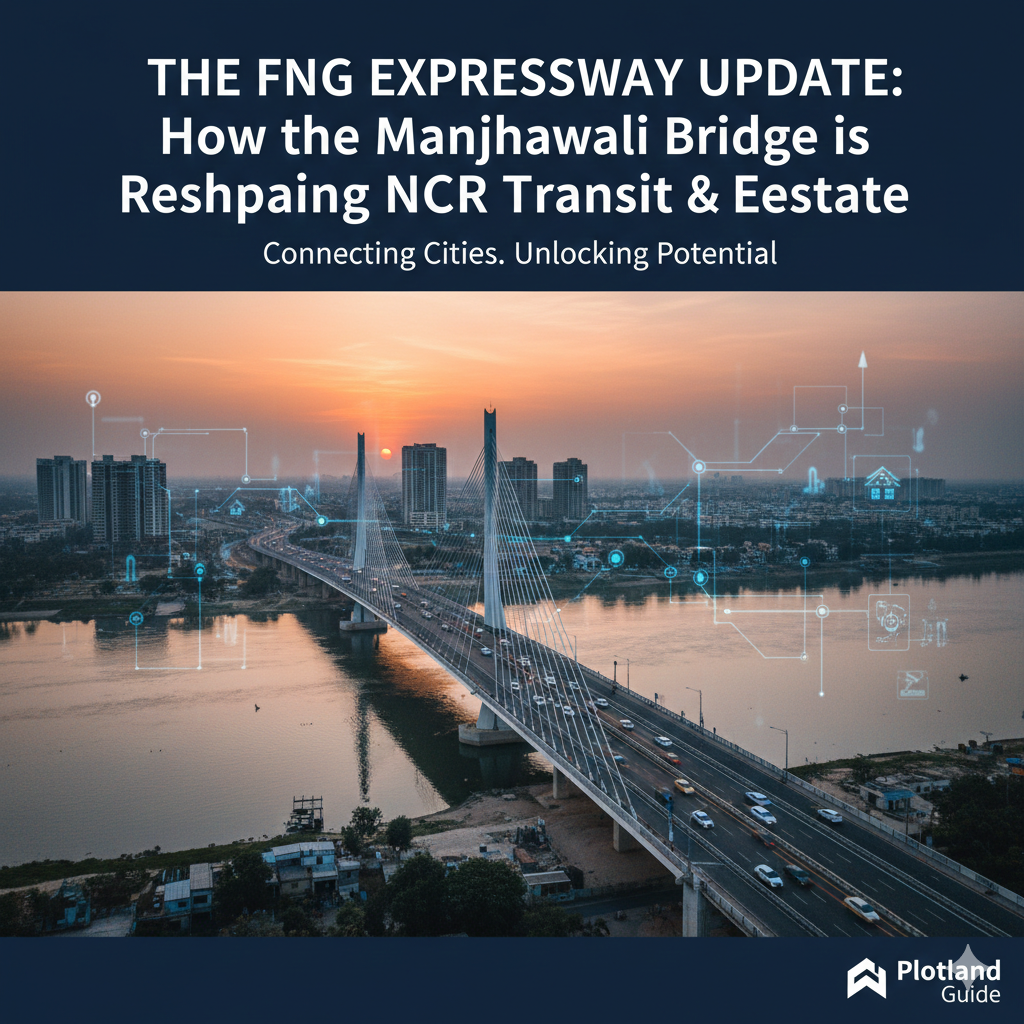
Anyone who frequently travels across the National Capital Region understands the daily logistical nightmare of moving between its major satellite cities. For years, the urban infrastructure has forced commuters into a frustrating geographic funnel. To travel from the industrial and residential hubs of Faridabad in Haryana to the rapidly expanding sectors of Noida and Greater Noida in Uttar Pradesh, vehicles have historically been forced to cross through the crowded borders of South Delhi. This reliance on a single, heavily congested corridor has choked economic efficiency, drained countless hours of productivity, and created one of the most notorious traffic bottlenecks in the country at Kalindi Kunj.
However, the regional transit map is currently undergoing a massive, highly anticipated transformation. The Faridabad-Noida-Ghaziabad (FNG) Expressway, a visionary infrastructure project designed to act as a sweeping bypass corridor, is finally moving from the drafting table to reality. More importantly, the critical linchpin of this entire network—the Manjhawali Bridge—is entering its final stages of functional completion. As approach roads are paved and land disputes are settled, 2026 is shaping up to be the watershed year when cross-border travel in the NCR fundamentally changes forever.
To truly appreciate the magnitude of the upcoming FNG Expressway, one must understand the severity of the current commuting crisis. The geography of the NCR places the Yamuna River as a natural barrier between Faridabad and the Noida-Greater Noida belt. Because direct river crossings have been practically non-existent in this specific southern stretch, all interstate traffic is pushed aggressively north toward Delhi.
Daily commuters, heavy freight trucks, and commercial transport vehicles all converge at the Kalindi Kunj bridge and the adjoining stretches of the Delhi-Noida Direct (DND) Flyway or the Eastern Peripheral Expressway. This massive convergence turns what should be a straightforward geographical hop into a grueling two-hour ordeal during morning and evening rush hours. The cascading effect of this traffic jams the internal city roads of South Delhi and completely overloads the Noida-Greater Noida Expressway.
The core philosophy behind the 56-kilometer FNG Expressway is to entirely eliminate this forced detour. By creating a high-speed, six-lane corridor (expandable to eight lanes) that skirts the outer edges of the capital, the expressway allows inter-city traffic to completely bypass Delhi. Engineered by top technical institutions with scalable infrastructure in mind, the corridor integrates multi-level flyovers, paved shoulders, and robust drainage systems to handle long-term urban growth. Once fully operational, it will distribute the vehicular load evenly, drastically reducing the pressure on older highway segments and offering a predictable, seamless drive.
While the FNG Expressway consists of several critical segments, no single piece of infrastructure has been more highly anticipated, or more heavily delayed, than the Manjhawali Bridge. This structure is the literal bridge between Haryana and Uttar Pradesh, spanning roughly 600 to 630 meters across the Yamuna River.
The history of this bridge is a classic tale of bureaucratic hurdles and complex interstate coordination. The initial proposal and foundation laying date all the way back to 1989. Over the decades, construction progressed unevenly. The Haryana government successfully completed its portion of the bridge and the corresponding approach roads leading up to the river several years ago. The physical structure of the bridge itself was largely finished, standing tall over the water but completely inaccessible.
The primary roadblock existed on the Uttar Pradesh side. Extending the road from the bridge into Greater Noida required acquiring agricultural land near villages like Atta Gujran and Mangroli. Disputes over land compensation rates with local farmers completely stalled the project, leaving the bridge as a multi-crore structure leading nowhere.
The massive breakthrough has finally materialized recently, breaking the deadlock and pushing the project toward the finish line. The Uttar Pradesh government decisively stepped in, clearing an essential budget of approximately Rs 65.5 crore specifically to develop the Greater Noida-Faridabad integrated circuit. This funding is dedicated to constructing a brand new 1.7-kilometer approach road from Atta Gujran straight to the Haryana border, alongside widening three kilometers of existing carriageway.
With compensation funds distributed to the affected landholders and registry agreements secured, the earthmovers have finally arrived. The foundation for this specific connecting road—slated to be named after former Prime Minister Atal Bihari Vajpayee—was ceremoniously laid, marking the definitive end to the decades-long waiting game.
The completion of this final approach road is not just an engineering milestone; it is a profound lifestyle upgrade for hundreds of thousands of daily commuters. When the asphalt dries and the barricades are removed, the impact on regional travel times will be immediate and staggering.
Currently, the circuitous drive through Delhi traffic and existing expressways eats up anywhere from 90 to 120 minutes of a commuter's day, heavily dependent on the unpredictable nature of Kalindi Kunj. The Manjhawali Bridge introduces the very first direct, high-speed road connection across the river in this zone.
By replacing multiple interlinked highways, confusing city detours, and frustrating traffic signals with a single, straight-line crossing, the travel time between Greater Noida and Faridabad will collapse to a mere 30 minutes. This is a revolutionary shift. It transforms two distinct, disconnected cities into immediate neighbors. A professional living in Greater Faridabad can now easily accept a daily reporting job in an IT park in Noida Sector 140 without sacrificing their personal life to the steering wheel. Similarly, logistics companies moving freight between the industrial clusters of Haryana and Uttar Pradesh will save massive amounts of fuel and turnaround time, directly boosting their operational profitability.
Infrastructure is the undisputed bedrock of real estate appreciation. When a government pours hundreds of crores into a new highway or bridge, smart capital immediately follows. The activation of the Manjhawali Bridge and the broader FNG Expressway is sending shockwaves through the regional property markets, specifically supercharging the demand in Noida, Greater Noida, and the Yamuna Expressway Industrial Development Authority (YEIDA) sectors.
For years, the real estate narrative in the NCR has been heavily skewed towards Gurgaon and central Noida. However, the new connectivity dynamics are rapidly shifting the spotlight to the peripheral and emerging sectors. The regions along the Noida-Greater Noida Expressway, such as Sectors 143, 150, and 168, which directly intersect with the FNG route, are experiencing a massive surge in residential demand. Buyers who were previously hesitant to invest in these areas due to the arduous commute to Haryana are now aggressively securing premium apartments and luxury villas. The promise of a 30-minute signal-free drive to Faridabad essentially erases the geographical isolation that previously held these sectors back.
The impact is even more profound when looking further south toward the YEIDA region. This massive land bank is already the epicenter of northern India's future economic growth, driven by the colossal Noida International Airport at Jewar and the upcoming International Film City. The Manjhawali Bridge acts as a direct funnel, channeling traffic, talent, and investment directly from Haryana into this booming corridor.
A business executive flying out of the upcoming Jewar airport, or a filmmaker commuting from Gurugram to the new film city, will no longer need to battle Delhi traffic. They can seamlessly take the Faridabad bypass, cross the Manjhawali Bridge, and glide straight down the Yamuna Expressway. This frictionless access makes the commercial plots, industrial parks, and residential townships within Greater Noida and YEIDA incredibly attractive to cross-border investors. Property analysts are already tracking a sharp upward correction in land values, anticipating that the operationalization of the bridge will trigger a substantial jump in both rental yields and capital appreciation. The area is rapidly shedding its legacy as a distant industrial outpost, transforming instead into a highly sought-after, premium destination for modern urban living.
Beyond residential housing, the economic multiplier effect of the FNG corridor will radically reshape the commercial landscape. Greater Noida and Faridabad both host massive, vital industrial clusters. Historically, moving raw materials or finished goods between these two manufacturing hubs required navigating heavy trucks through restrictive city borders, often subject to strict time-based entry bans in Delhi.
The new four-lane bridge is engineered specifically to support heavy vehicular loads alongside regular passenger traffic. This allows supply chains to operate with unprecedented efficiency. Small and medium-scale industries will benefit from highly predictable freight schedules, reduced transportation costs, and lower vehicle maintenance expenses.
Furthermore, this infrastructure creates an "accessibility premium" that attracts massive corporate interest. Companies looking to establish large-scale warehousing, data centers, or regional corporate headquarters naturally gravitate toward locations that offer seamless multi-state access. The intersection points where the FNG Expressway meets the Noida Expressway and the Eastern Peripheral Expressway are prime targets for this kind of commercial expansion, promising the creation of tens of thousands of new direct and indirect jobs over the next decade.
While the enthusiasm surrounding the Manjhawali Bridge is reaching a fever pitch, the broader FNG Expressway is a massive beast that will come online in strategic phases. Out of the total 56 kilometers, specific stretches within Noida and Faridabad are already seeing localized traffic flow. Nearly 70 percent of the designated 17-kilometer route within Noida's city limits has been completed, pushing past major intersections like Sector 63, Bahlolpur, and Soharkha.
The complete realization of the entire FNG corridor, stretching all the way to its Ghaziabad terminus near the Delhi-Meerut Expressway, is targeted for 2027. However, the immediate opening of the Yamuna river crossing is the most critical milestone. It represents the psychological and physical unlocking of the entire southern NCR route.
The successful completion of this project highlights a modern approach to urban planning, one that prioritizes forward-looking infrastructure over reactive problem-solving. By anticipating the massive population influx and commercial expansion slated for the Noida and Greater Noida regions over the next twenty years, authorities are building the necessary arteries today to ensure the heart of the NCR continues to beat efficiently tomorrow.
As the final layers of asphalt are laid on the UP approach road, the decades of delays are quickly fading in the rearview mirror. For the millions of residents navigating the complex geography of the National Capital Region, the Manjhawali Bridge is no longer just a distant promise on a master plan. It is a tangible reality that is about to give them their time, their energy, and their cities back.
