Published On:
June 2, 2026
Updated On:
June 2, 2026
Real estate in India is undergoing a profound structural transformation, shifting from a culturally driven emotional asset to a highly evaluated financial vehicle. With the meteoric rise of regulated investment vehicles, fractional ownership, and tech-driven platforms, modern investors are increasingly prioritising yields, liquidity, and portfolio diversification over traditional physical ownership.
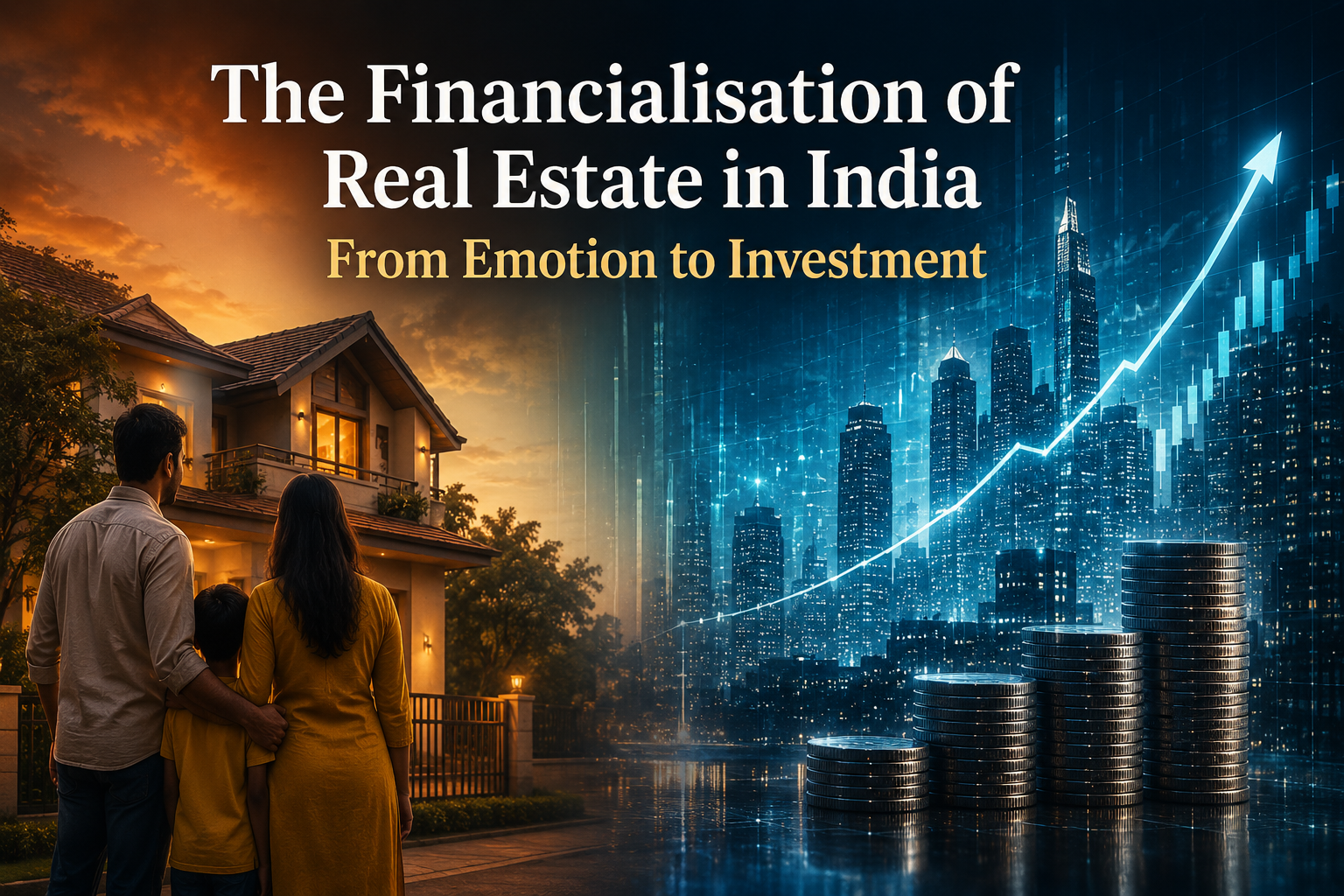
For generations, Indians have viewed property through a deeply emotional and cultural lens. Owning a home or a piece of land was never just about financial returns; it was intricately tied to social status, family security, and long-term aspirations. Families would save for decades to buy a home, measuring their life’s progress through the physical bricks and mortar they successfully accumulated. A physical house offered unparalleled psychological comfort, while land symbolised permanence and a generational legacy to be passed down. Rental income was viewed as a stable, predictable pillar for retirement. Real estate, in essence, was as much a foundational cultural institution as it was an investment.
Today, however, that relationship is fundamentally changing. A new, financially savvy generation is beginning to evaluate property not just as a symbol of security, but as a strategic asset meant to be judged purely on its financial merit. Investors are deliberately moving away from legacy asset accumulation and instead focusing on broader, more agile wealth-creation strategies. Real estate is becoming financialised. Decisions that were once driven by sentiment and the simple historical belief that property prices always move upward are now driven by strict yield analysis, capital appreciation metrics, diversification benefits, and liquidity assessments. This subtle but incredibly powerful shift has the potential to completely reshape how Indians invest, build wealth, and allocate capital over the coming decade.
Historically, property investment in India lacked structured financial analysis. It was predominantly an instinctual move backed by deep cultural conditioning. People bought residential plots or accumulated multiple apartments simply because physical real estate felt inherently safer than the volatile swings of the equity markets. Wealth was viewed as something to be stored physically, in an asset you could see, touch, and walk inside. The concept of liquidity rarely mattered to the traditional buyer because the very act of holding property provided immense reassurance.
However, India’s financial awareness has evolved dramatically over the last decade, sparking a sweeping behavioral revolution. The rapid mainstream adoption of systematic investment plans, the proliferation of accessible fintech platforms, the boom in retail investing, and widespread digital financial education have completely rewired how younger Indians evaluate their assets.
When looking at a property today, this demographic applies the exact same scrutiny they would to a mutual fund or a stock portfolio. They are actively comparing expected returns, tax efficiency, risk-adjusted performance, and the ease of entering or exiting the asset. Real estate is no longer exempt from these rigorous financial questions. Buyers are much less attached to the romanticised idea of simply owning a property and are instead asking highly specific questions about yield generation, capital deployment efficiency, and the role a specific asset plays in a globally diversified portfolio. Real estate is rapidly transitioning from a cultural milestone to an evaluated asset class.
At its core, the financialisation of real estate in India means transforming a traditionally illiquid, physically bound asset into a flexible, tradable, and highly transparent financial instrument. It is the definitive transition from landlord-driven ownership to investor-led decision-making.
In a mature economy, investing conversations are rarely polarised between aggressive equities on one side and static physical property on the other. Mature markets feature broad participation across a layered spectrum of diversified asset classes, including debt, infrastructure, alternatives, and income-generating real estate. India is moving rapidly in this exact direction. The market is becoming vastly more sophisticated, shedding its historical opacity in favour of structured, data-driven allocation.
This financialisation brings much-needed discipline, transparency, and regulatory accountability to the sector. As property is increasingly viewed as a consumption purchase secondary to its role as a strategic portfolio asset, developers and investment platforms are forced to maintain substantially higher governance standards. Capital circulates much more efficiently through the economy when assets are transparent and accessible to a broader base of the population. This evolution strongly mirrors the transformation of India’s equity markets over the last twenty years, shifting from an opaque, broker-led environment to a highly regulated, democratised, and tech-enabled ecosystem.
A major catalyst accelerating this transformation is the way commercial real estate operates compared to the traditional residential sector. Residential purchases have historically leaned heavily on emotion and speculation. Commercial assets, on the other hand, naturally encourage a highly institutional mindset. They are strictly evaluated based on income potential, occupancy levels, lease structures, tenant quality, and long-term cash flow predictability.
This institutional approach is reaching the everyday investor through Real Estate Investment Trusts. These vehicles have democratised access to institutional-grade assets that were historically the exclusive playground of ultra-high-net-worth individuals and massive institutional funds. By investing in these trusts, retail investors gain exposure to premium office parks, retail malls, logistics hubs, and data centres.
The Indian market has embraced this structure with remarkable enthusiasm. The total assets under management for top listed trusts have swelled substantially in recent years, representing billions of dollars in market capitalisation. By pooling capital to invest in large-scale commercial properties, these trusts allow retail investors to benefit from steady rental income distributions and capital appreciation without the monumental headaches of physical property management. The regulatory requirement to distribute the vast majority of net distributable cash flows to unitholders gives this asset class a highly visible and predictable income structure. Furthermore, the expansion of these vehicles into diverse, high-growth sectors like warehousing and sustainable data centres reflects the growing maturity and depth of the overall market.
While major listed trusts have opened the door to public market real estate investing, the private market is undergoing its own revolution through fractional ownership real estate in India. Traditional commercial real estate investment requires massive capital outlays, often running into several crores, creating an insurmountable barrier to entry for the average retail investor. Fractional ownership completely shatters this barrier by allowing multiple individuals to collectively own a share of a high-value asset, with minimum investments dropping to significantly more accessible levels, often starting between ten to twenty-five lakhs.
Investors now hold documented ownership percentages in premium properties, granting them proportionate rights to rental income and eventual capital appreciation. The mechanics usually involve the creation of a Special Purpose Vehicle that holds the physical asset, with investors purchasing shares in this entity. This model has gained tremendous traction among young professionals, tech-savvy millennials, and expatriates who want lucrative real estate exposure but refuse to accept the concentration risk, hefty capital requirements, and active management burdens of full direct ownership.
What has truly accelerated the institutionalisation of this space is the introduction of stringent regulatory frameworks. Recent regulatory mandates by market watchdogs have fundamentally altered the landscape, moving the fractional ownership market from a loosely structured environment onto a highly regulated footing. New frameworks for small and medium-sized real estate asset pools mandate independent trustees, registered investment managers, rigorous financial disclosures, and exchange listings for much-needed secondary market liquidity.
By demanding high distributions of net cash flows and ensuring uncompromising investor protections, these regulations have successfully bridged the trust gap. Assets held under these regulated fractional structures now offer safeguards similar to large publicly listed trusts, albeit with a focus on specific, single-asset investments rather than broad, multi-city portfolios. This regulatory maturity is a absolute cornerstone of the financialisation process, transforming fractional shares from a novel financial technology experiment into a mainstream, highly trusted wealth management tool.
Even within the residential sector, the financialisation trend is glaringly evident, driven largely by India’s active demographic dividend. With accelerating urbanisation and rising disposable incomes across major metropolitan hubs, the future of Indian housing is becoming heavily experience-driven. The modern homebuyer is evaluating real estate through an entirely different lens, moving away from simple location and configuration metrics to focus deeply on integrated living and lifestyle enablement.
Because housing is increasingly viewed as an experience rather than just a physical shelter, developers are being forced to adapt rapidly. Amenities are no longer supplementary marketing features; they are the absolute core of real estate design. Smart homes, robust digital infrastructure, energy-efficient buildings, and climate-responsive designs are rapidly becoming baseline expectations rather than luxury add-ons.
Crucially, modern buyers are factoring these experiential elements directly into their financial calculations. They recognise that sustainable, technologically integrated properties command vastly better rental yields, suffer lower vacancy rates, and offer superior long-term capital appreciation. The decision to purchase a home now involves calculating brand credibility, construction quality, and yield opportunities right alongside personal lifestyle preferences. Urban housing demand is being driven by a profound desire for long-term value creation, aligning perfectly with the broader trend of treating real estate as a strategic financial choice rather than a mere geographical necessity.
The sweeping financialisation of real estate does not mean that the Indian population will suddenly stop valuing physical property on an emotional level. The cultural desire to own a home, to have a piece of land to call one's own, runs incredibly deep and will undoubtedly continue to be a driving force in the residential market for decades to come. However, the next phase of the nation's wealth journey involves layering intense financial sophistication over these deep-seated cultural roots.
The market is irreversibly shifting from static, passive ownership to dynamic, intelligent participation. With the proliferation of regulated investment trusts, the accessibility of fractional ownership platforms, and the rise of a highly informed, data-driven buyer demographic, real estate is finally taking its rightful place as a structured, transparent, and liquid asset class.
This evolution from a sentiment-driven legacy purchase to a rigorously evaluated investment vehicle stands as one of the most significant financial shifts in the modern economic landscape. As the lines between physical property and financial assets continue to blur, the future of property investment in India promises to be more efficient, profoundly accessible, and dynamically aligned with global wealth creation standards.
