Published On:
February 3, 2026
Updated On:
February 3, 2026
The vision of affordable homeownership in Haryana’s National Capital Region is facing a crisis as skyrocketing land and construction costs render government-capped projects unviable. With no new licenses issued in Gurugram for nearly two years, this blog explores the economic deadlock threatening the future of middle-class housing.
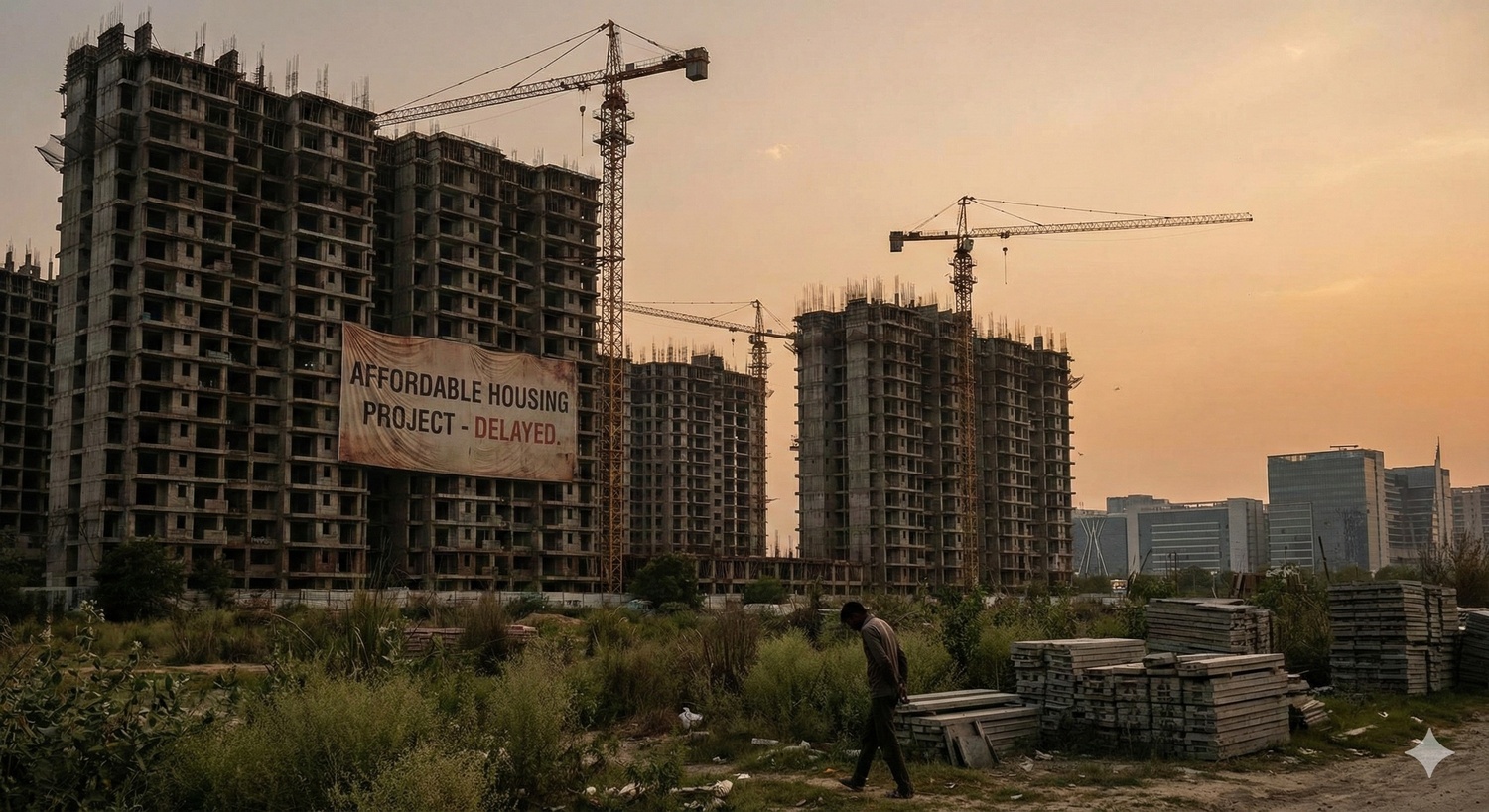
For years, the Haryana Affordable Housing Policy was hailed as a beacon of hope for the middle class. In a region where luxury high-rises dominate the skyline, this policy promised a foothold for the common man—a chance to own a home in prime economic hubs like Gurugram and Faridabad at a regulated, accessible price. But today, that promise is hitting a wall of economic reality.
Recent reports from the ground indicate a worrying trend: the affordable housing engine in the National Capital Region (NCR) has effectively stalled. For the past eighteen months to two years, the Town and Country Planning Department has not granted a single new license for affordable housing projects in the Gurugram-Manesar Master Plan area. This silence is not due to a lack of demand—homebuyers are still lining up—but rather a fundamental breakdown in the project's financial viability.
The dream of "Housing for All" is currently caught in a vice grip between rigid government price caps and a market that has moved on. To understand why the cranes have stopped moving, we need to look at the math that no longer adds up.
At the heart of the crisis is a discrepancy between policy and inflation. Under the current mandate, the government has capped the maximum sale price of affordable housing units at ₹5,000 per square foot in key districts like Gurugram and Faridabad. This translates to a ticket size of roughly ₹26 lakh to ₹35 lakh for a standard two-bedroom apartment.
Five years ago, this pricing structure offered developers a thin but manageable profit margin, driven by volume. Today, however, the cost landscape has shifted dramatically.
Land is the raw material of real estate, and in Gurugram, it has become a precious commodity. In several sectors designated for development, land prices have doubled over the last half-decade. The explosive growth of the city, fueled by infrastructure upgrades like the Dwarka Expressway and the expansion of the metro network, has driven land valuations to record highs. When the cost of the land itself consumes a massive chunk of the project budget, the room to build and sell at a capped rate vanishes.
It isn't just the land; building the structure has become significantly more expensive. Post-pandemic inflation has led to a surge in the cost of core materials like steel, cement, and labor. Industry estimates suggest that construction costs have risen by 25% to 30% in recent times. For a luxury project, these costs can be passed on to the buyer. In the affordable segment, where the sale price is fixed by the state, every rupee increase in input cost eats directly into the developer's viability.
The prevailing sentiment among industry watchers is that the policy, while well-intentioned, has become static in a dynamic market. The gap between the fixed returns mandated by the government and the soaring input costs has led to an exodus of developers from this segment.
Many builders who were once bullish on affordable housing are now pivoting back to the luxury and mid-segment markets, where pricing is deregulated and margins are healthier. The consensus within the real estate community is that without a significant upward revision in the price cap—many are calling for at least a 25% hike—the supply of new affordable inventory will remain choked.
Furthermore, there is a growing demand to make the licensing policy "open and continuous." Currently, the window-based application system creates bottlenecks and uncertainty. A more fluid system could encourage sustained participation, provided the financials make sense.
Adding fuel to the fire is the recent restructuring of External Development Charges (EDC). With a steep 20% hike introduced in early 2025, followed by mandated annual increases, the tax burden on development has grown heavier.
EDC is paid by developers to the government for the development of municipal infrastructure like roads, sewage, and streetlights. In affordable housing, where margins are razor-thin, a hike of this magnitude acts as a further deterrent. It effectively squeezes the last drops of profitability out of potential projects, making the decision to not apply for new licenses a simple matter of survival for many development firms.
The crisis isn't limited to high-rise apartments. The Deen Dayal Jan Awas Yojna (DDJAY), aimed at providing affordable low-rise independent floors and plots, is facing its own set of challenges. While initially successful in unlocking supply in "low potential" zones, this scheme is also grappling with the rising cost of land and infrastructure development.
Amendments allowing floor-wise registry gave this scheme a boost, but the subsequent rise in density—packing four families onto a plot designed for one—has raised serious infrastructure concerns regarding parking and water supply. As a result, the enthusiasm that once surrounded DDJAY is tempering as the realities of "densification without infrastructure" set in.
While developers and policymakers debate the numbers, the real loss is felt by the aspiring homeowner. The NCR region attracts a massive workforce of young professionals and service sector employees for whom a home under ₹40 lakh is the only entry point into the property market.
With no new launches, the waiting lists for existing projects are growing longer. The secondary market for affordable units is seeing premiums that defeat the very purpose of the scheme. For a resident renting in Sohna or Manesar, the dream of transitioning to homeownership is slipping away as the supply pipeline runs dry. The frustration is palpable, with many questioning whether the "affordable" tag will soon become a relic of the past in Gurugram.
The sector had pinned its hopes on the Union Budget 2026-27 to provide some relief, perhaps through tax incentives for affordable housing developers or interest subventions for buyers. However, the lack of concrete measures specifically targeting this bottleneck was met with disappointment. While infrastructure received a boost, the direct intervention needed to bridge the viability gap in affordable housing was notably absent.
This places the ball firmly back in the court of the State Government. The solution seems to lie in a localized recalibration of the policy rather than a central mandate.
The stalemate in Haryana’s affordable housing sector is a classic case of policy lagging behind market dynamics. The intent of the government—to prevent profiteering and ensure housing for the masses—remains noble. However, a policy that results in zero production serves no one.
For the cranes to return and for the "Sold Out" boards to be replaced by "Booking Open," a pragmatic middle ground must be found. This likely involves indexing the price cap to inflation or land rates, ensuring that the definition of "affordable" evolves in tandem with the economic reality of the region. Until then, the gates to affordable homeownership in the Millennium City remain firmly shut.
