Published On:
July 26, 2026
Updated On:
July 26, 2026
The rapid march of technology and modern lifestyles over the past two decades has rendered once-ubiquitous Indian household staples—from stackable steel tiffins and rooftop TV antennas to landlines and cassette players—almost entirely extinct, leaving behind a wave of nostalgic memories.
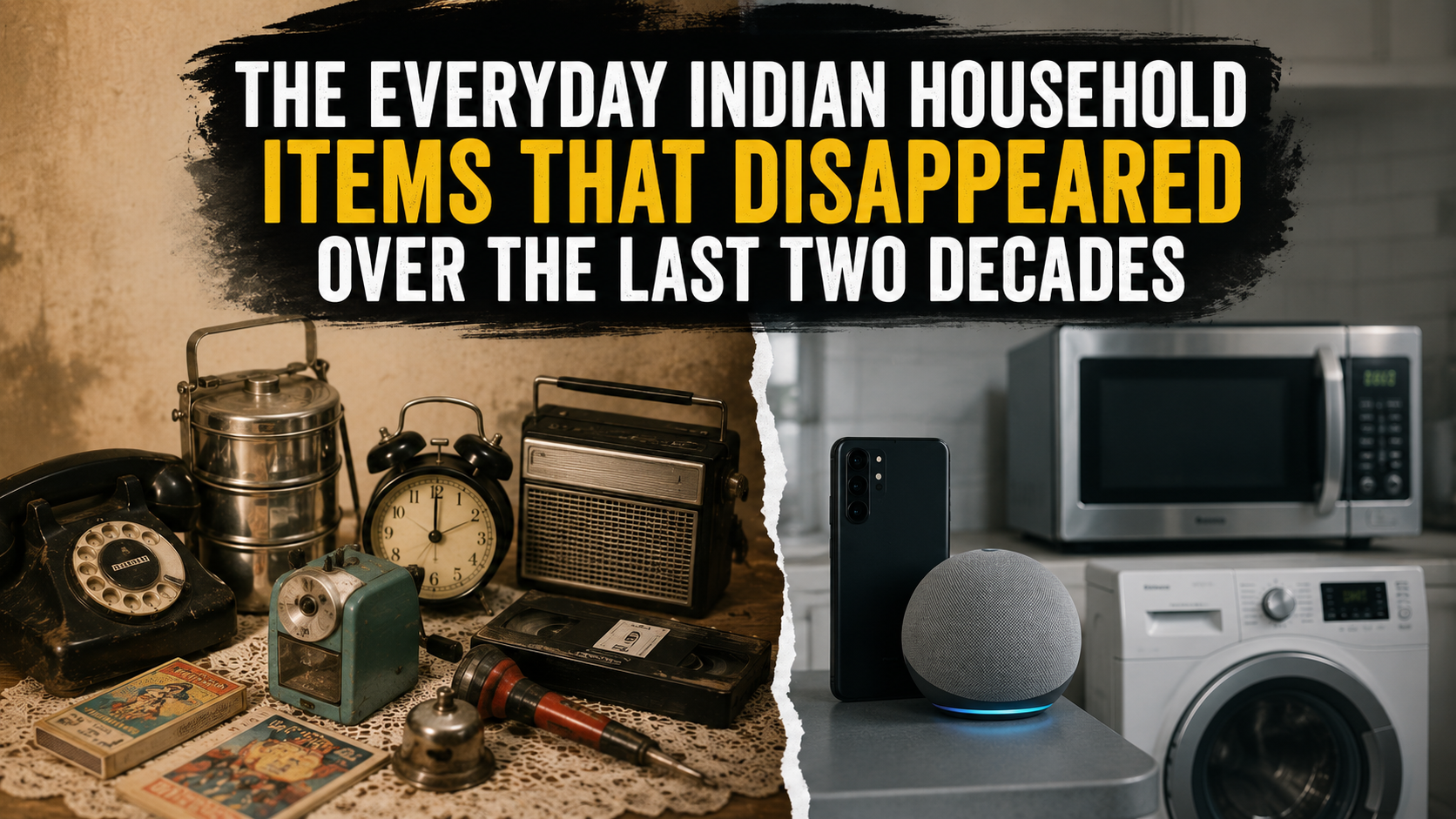
Time moves forward at an astonishing pace, and looking back across the past twenty years reveals a profound transformation in how Indian households function. Two decades ago, domestic life was defined by tangible objects, tactile experiences, and a distinct sense of collective routine. Today, sleek minimalism, digital automation, and pocket-sized supercomputers have thoroughly reshaped our living spaces.
When we peer into the homes of the 1990s and early 2000s, we encounter a treasure trove of items that were once absolute essentials. These were not merely utility objects; they were central pillars of daily family life, childhood innocence, and traditional routines. As urban spaces modernized, these iconic artifacts slowly faded away, replaced by smart gadgets and disposable conveniences. Walking down memory lane uncovers the classic Indian household items that have vanished from our homes over the last twenty years.
For anyone who grew up attending school or heading to an office during the turn of the millennium, the sight and sound of the traditional stackable steel tiffin box is instantly evocative. This was typically a cylindrical, multi-tiered container held together by a sturdy side-locking metal frame, allowing separate compartments for rotis, dry sabzi, dal, and rice.
The sheer durability of these stainless-steel containers was legendary; they could survive being dropped down concrete school staircases, tossed carelessly into bicycle baskets, and scrubbed vigorously with steel wool every evening. They were passed down through generations as reliable workhorses of domestic packing.
Yet, the modern era of kitchen conveniences has rendered the classic steel tiffin largely obsolete. In today's fast-paced corporate and educational environments, lightweight, colorful, leak-proof plastic and microwave-safe glass containers have completely taken over. With the widespread availability of office microwaves and the preference for sleek, insulated lunch bags, the metallic clinking of the old multi-layered tiffin has vanished from our commute.
Before fiber-optic cables, direct-to-home digital satellite dishes, and high-definition streaming services revolutionized home entertainment, catching your favorite Sunday morning serial or cricket match was an entire logistical event centered around the roof. The V-shaped aluminum rod antenna mounted on a tall mast atop the house was a defining silhouette of the neighborhood skyline.
These antennas were notoriously fickle. Whenever a sudden thunderstorm rolled through or strong winds swept across the locality, the television screen would instantly fill with a chaotic blanket of black-and-white snow, accompanied by a harsh static hiss.
This triggered a very specific ritual familiar to millions of families. One person would remain glued to the living room floor, shouting instructions upward—"Thoda aur left! Bas, ab theek hai!"—while another family member balanced precariously on the terrace, manually rotating the aluminum pole millimeter by millimeter until the picture cleared up. With digital satellite receivers and smart televisions delivering crystal-clear feeds instantly, the humble rooftop antenna has become a relic of architectural history.
Entertainment two decades ago required patience, physical media, and a communal gathering space. Long before music was streamed instantly via wireless earbuds or smartphones, the wooden-cased transistor radio or dual-deck cassette player served as the auditory heartbeat of the household. Families would gather around the radio to catch evening news bulletins, cricket commentaries, or late-night musical programs.
Owning a collection of magnetic audio cassettes, neatly stored in plastic library cases with handwritten track lists, was a point of pride. Unspooled ribbons were carefully wound back into place using pencils, and mixtapes recorded off the radio were treasured possessions.
Alongside audio gear, the bulky Video Cassette Recorder (VCR) and Video Cassette Player (VCP) ruled weekend family time. Renting magnetic video tapes from the local neighbourhood library on Saturday evenings was a weekly ritual. Today, high-speed internet, OTT platforms, and digital music apps have made physical media obsolete, leaving cassettes and VCRs relegated to antique shops or dusty storage boxes.
Before mobile phones became ubiquitous extensions of our hands, the rotary-dial or push-button landline phone held a place of absolute reverence in the living room. Often placed on a dedicated corner table alongside a telephone directory and a notepad, the landline was the singular gateway connecting the household to the outside world.
An incoming ring late at night immediately created a flutter of anxiety and curiosity, as the whole family wondered who could be calling at such an hour. Conversations required standing in a fixed spot, tethered by a long, coiled wire that invariably tangled into tight knots.
Children grew up memorizing the phone numbers of all their relatives, friends, and local vendors. There was no such thing as caller ID on early models, meaning picking up the receiver was always a surprise. As mobile networks expanded and smartphones offered personalized communication, landlines disappeared from residential spaces, surviving today primarily in corporate reception desks or as nostalgic vintage decor.
The modernization of the Indian kitchen is perhaps most visible in food preparation, where high-speed mixer-grinders, food processors, and automated appliances dominate the counter space. Decades ago, achieving the authentic flavors of traditional Indian gravies, fresh chutneys, and spice blends relied entirely on manual labor and the stone silbatta.
Consisting of a flat stone slab (sil) and a heavy, cylindrical stone roller (batta), this traditional tool required considerable physical effort, patience, and skill. Ingredients were ground down slowly by hand, releasing natural essential oils and achieving a coarse, rich texture that modern steel blades simply cannot replicate.
While culinary purists still argue that the taste of spices ground on a silbatta remains unmatched, the immense time and physical exertion required meant it was quickly abandoned in favor of electric grinders. Today, finding a functional stone silbatta in a modern urban apartment kitchen is a rare exception rather than the rule.
Childhood memories from the 90s and early 2000s carry a very distinct visual marker: the classic school water bottle equipped with a long strap designed to be slung diagonally across the chest. These plastic bottles featured a flexible sipping straw or a pull-up spout tucked beneath a small protective cap, accompanied by playful cartoon graphics or bright primary colors.
Carrying this bottle over your shoulder while marching to the school bus was a rite of passage. However, they were notorious for leaking if the rubber gasket wore out, often soaking notebooks inside the school backpack. Modern school children have transitioned entirely to sleek, insulated stainless-steel flasks, sippers, and vacuum-sealed thermal bottles that keep liquids cold or hot for hours, rendering the old strapped plastic bottles entirely extinct.
The disappearance of these everyday items highlights a much deeper cultural shift. As urban homes transitioned from sprawling independent houses to compact apartments, living spaces grew smaller, forcing a natural pruning of bulky domestic goods. The pursuit of convenience, efficiency, and seamless connectivity naturally pushed out objects that demanded manual upkeep, physical tuning, or shared family waiting times.
Yet, looking back at these vanished artifacts evokes a powerful wave of nostalgia. They represent an era when life moved at a slightly slower, more deliberate pace. While modern technology has undoubtedly made daily existence infinitely more efficient and convenient, the charm of gathering around a single radio, tuning a rooftop antenna in the rain, or sharing a meal from a sturdy steel tiffin remains etched into the collective memory of a generation. These items may no longer occupy space in our physical homes, but they continue to hold a permanent place in our personal histories.
