Published On:
March 2, 2026
Updated On:
March 2, 2026
Digital real estate is democratising property investment in India by converting physical assets into small-ticket, digitized units, allowing retail investors to enter the market with as little as ₹10,000. Through fractional ownership and blockchain technology, this shift resolves traditional real estate’s biggest flaws—high entry barriers and illiquidity—transforming property from a lifelong milestone into an accessible, agile financial asset.
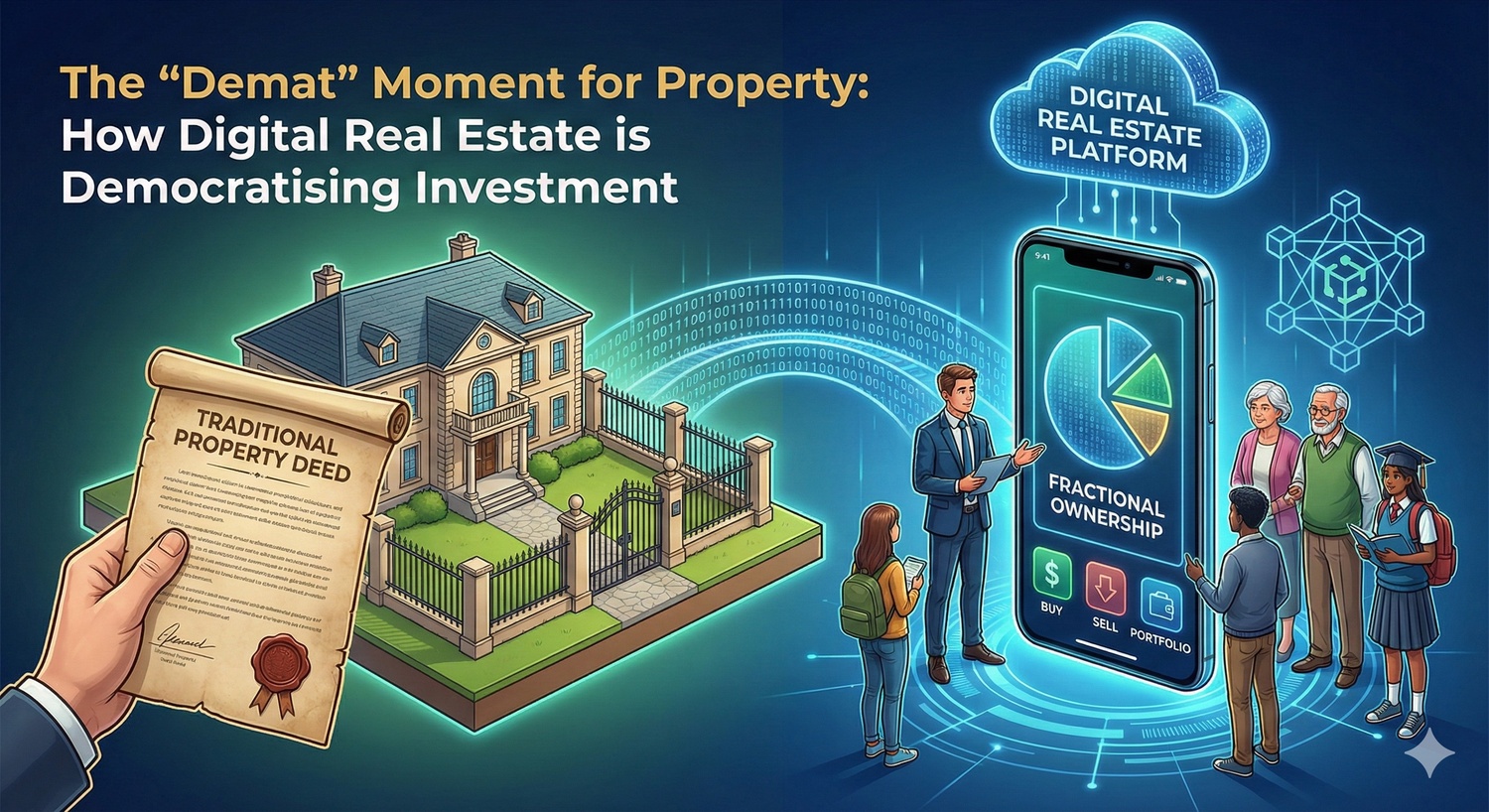
For generations, the Indian investment portfolio has been anchored by a single, undisputed heavyweight: physical real estate. It has always been viewed as the ultimate symbol of financial stability, social aspiration, and intergenerational wealth generation. However, the traditional property market has relentlessly harbored a massive, exclusionary barrier to entry. The ticket size required to own meaningful real estate has historically demanded crores in upfront capital or the willingness to shoulder crushing, decades-long home loan EMIs. This rigid financial structure effectively locked out the vast majority of the population, reserving the most lucrative asset class exclusively for high-net-worth individuals and deep-pocketed institutional funds.
But the financial landscape is currently undergoing a profound structural shift. Over the past couple of years, the market has witnessed the explosive rise of a completely new category that is rapidly rewriting the rules of property ownership: digital real estate. By intelligently converging financial technology, regulatory frameworks, and physical assets, digital real estate platforms are dismantling the high-ticket barrier and bringing millions of new retail investors into the fold. The days of treating property purely as a static physical asset are ending. We are now officially entering the era of digital property fractionalization, where accessing high-yield real estate is as simple, transparent, and swift as buying a stock on your smartphone.
At its core, digital real estate refers to highly secure, technology-enabled platforms that allow everyday investors to purchase fractional, digitised, or tokenised units of actual physical property. You are no longer required to buy an entire apartment, a sprawling commercial floor, or a massive plot of land outright. Instead, you purchase a specific, legally compliant fraction of that asset, represented entirely digitally.
This transition relies on a few core mechanisms. The most prominent is the fractional ownership of premium residential units, commercial spaces, or lucrative holiday homes. When an investor buys into these platforms, they are essentially buying digitized units that represent a proportional share of the underlying real-world asset. This is often executed through the tokenisation of real-world assets on blockchain networks, ensuring an immutable, highly secure ledger of ownership.
Pioneering platforms in this space, such as Alt DRX, have effectively built a robust gateway where the entire value chain is platform-managed. This means everything from the initial property selection and intensive legal due diligence to digital onboarding, performance tracking, and eventual exit facilitation is handled seamlessly through a centralized digital ecosystem.
To truly understand why digital real estate is gaining such massive traction, one must look at the shifting financial mindset of the modern Indian workforce. The younger demographic, primarily Millennials and Gen Z professionals, absolutely want exposure to the stability and capital appreciation of real estate. However, they vehemently reject the idea of being tied down by massive EMIs that dictate their career choices and geographical mobility.
In the traditional property landscape, the minimum investment threshold rarely dips below the ₹50 lakh mark, even in developing peripheral suburbs. Digital real estate platforms have completely shattered this ceiling. By establishing entry points as remarkably low as ₹10,000, platforms enable young professionals to build robust real estate exposure without committing their entire life savings or taking on heavy leverage.
This dramatic reduction in ticket size translates directly to higher market participation. First-time investors who were previously sidelined can now allocate a portion of their monthly savings to prime real estate, effectively treating it like a Systematic Investment Plan (SIP). This democratisation is arguably the most significant wealth-creation catalyst the Indian property market has seen in decades.
If the high cost of entry is traditional real estate’s biggest flaw, its severe lack of liquidity is a close second. Historically, physical property has been a deeply illiquid asset. When a traditional property owner faces a sudden financial emergency or spots a better investment opportunity, liquidating a physical asset involves months of finding buyers, negotiating prices, navigating complex legal paperwork, and waiting for bank loan disbursements.
Digital real estate fundamentally solves this exit friction. Because the property is unitised, liquidity becomes highly manageable. Leading digital platforms actively facilitate structured exit windows and secondary resale opportunities. If you own digitized shares of a premium villa in Goa and suddenly need capital, you do not have to sell the entire villa or wait six months to find a buyer. You can simply list your specific digital units on the platform's secondary marketplace.
This allows for much shorter investment durations and rapid capital agility. Investors can now track the value of their property holdings on a digital dashboard with the exact same ease and real-time visibility that they track their equity portfolios or digital gold investments. This platform-enabled liquidity is fundamentally shifting how property is perceived, transforming it from a rigid, illiquid anchor into an agile financial instrument.
For decades, the Indian real estate sector was plagued by opacity. Buyers often had to rely on the word of local brokers, opaque pricing structures, and complex, paper-heavy legal documentation that was incredibly difficult to verify. Digital real estate aggressively counters this legacy by hardwiring transparency into the investment process.
When a digital unit is sold, it represents a very real, legally defensible share in a physical property. To ensure absolute compliance and safety, reputable platforms structure these investments using Special Purpose Vehicles (SPVs) that are strictly governed by the Companies Act. The platform takes on the heavy lifting of institutional-grade due diligence, verifying land titles, securing necessary civic clearances, and modeling the projected financial yields before the property is ever listed for fractional investment.
For the end investor, this translates to a frictionless, fully digital onboarding experience. The investor base gets immediate access to digital dashboards, clear investor agreements, highly visible cash-flow projections from rental yields, and regular asset performance updates. This level of granular, transparent reporting makes digital real estate significantly more reliable and user-friendly than the stressful, opaque process of traditional physical property acquisition.
One of the most powerful wealth-building strategies in the equity markets is diversification—spreading capital across different sectors to mitigate risk. In traditional real estate, diversification is a luxury exclusively reserved for the ultra-wealthy. If you only have ₹1 crore to invest, you are forced to sink it entirely into one asset in one specific micro-market. If that particular neighborhood’s infrastructure stalls, your entire real estate portfolio suffers.
Digital real estate makes portfolio diversification highly practical and accessible for the everyday retail investor. Because the minimum investment is so low, an investor can take that same capital and spread it across multiple high-quality categories. You can simultaneously hold digital units in a commercial land parcel in Bengaluru, a high-yield holiday home in the hills of Uttarakhand, and a premium residential asset in a rapidly growing urban micro-market in Mumbai.
By utilizing platforms that focus on high-quality asset categories, investors can perfectly balance their exposure, capturing the high rental yields of commercial spaces while simultaneously enjoying the steady capital appreciation of residential land. This strategic diversification fundamentally insulates the investor from localized market shocks and ensures a much smoother, more resilient wealth creation journey.
With any new financial technology, the primary concern is the safety of the underlying capital. The shift towards digitized property is not an unregulated free-for-all; it is being built on highly robust financial guardrails designed specifically to protect retail investors.
The utilization of compliant SPV-based structures ensures that the physical asset is legally ring-fenced. Furthermore, the capital raised from investors is strictly managed through secure escrow accounts, preventing any commingling of funds and ensuring that money is solely deployed for the stated property acquisition. Rigorous KYC (Know Your Customer) onboarding protocols are standard across all major platforms, ensuring that the entire digital ecosystem remains secure, transparent, and fully compliant with national financial regulations.
As the regulatory environment in India continues to mature, particularly with the recent regulatory frameworks surrounding Small and Medium Real Estate Investment Trusts (SM REITs), the sector is gaining immense institutional credibility. These regulations are providing the necessary oversight to ensure that property tokenization and fractional ownership platforms operate with the highest standards of fiduciary responsibility.
Looking ahead, the intersection of real estate and technology is only going to deepen. We are rapidly approaching what industry experts are calling India's true "demat moment" for real estate.
In the near future, the market will witness highly liquid, on-platform buy and sell ecosystems that operate 24/7. Artificial intelligence will play a massive role in asset selection, utilizing predictive analytics to identify emerging micro-markets and accurately forecast rental yields before human analysts even spot the trend. Furthermore, the tokenization of rental streams will allow investors to receive their proportional share of monthly rental income deposited directly into their bank accounts via smart contracts, entirely automating the wealth generation process.
The narrative of Indian real estate is being rewritten from the ground up. Digital real estate brilliantly combines the historic, tangible stability of physical property with the unparalleled convenience, transparency, and liquidity of the modern digital financial world.
Platforms standing at the forefront of this revolution are doing much more than just selling property; they are financially empowering a completely new generation of investors. By prioritizing small ticket sizes, institutional-grade due diligence, and clear exit strategies, the industry is successfully tearing down the century-old barriers of the property market.
For the modern retail investor, the implications are profound. You no longer need to wait until your late forties or take on a crushing mortgage to claim your piece of the real estate market. Property ownership is no longer the final milestone of a successful career; through the power of digital real estate, it is now an accessible, highly agile starting point for long-term wealth creation.
