Published On:
May 14, 2026
Updated On:
May 14, 2026
The near-completion of the Delhi-Mumbai Expressway in 2026 is driving a massive real estate boom across seven key Tier-II cities, transforming them into lucrative investment hotspots fueled by logistics, manufacturing, and rapid residential expansion.
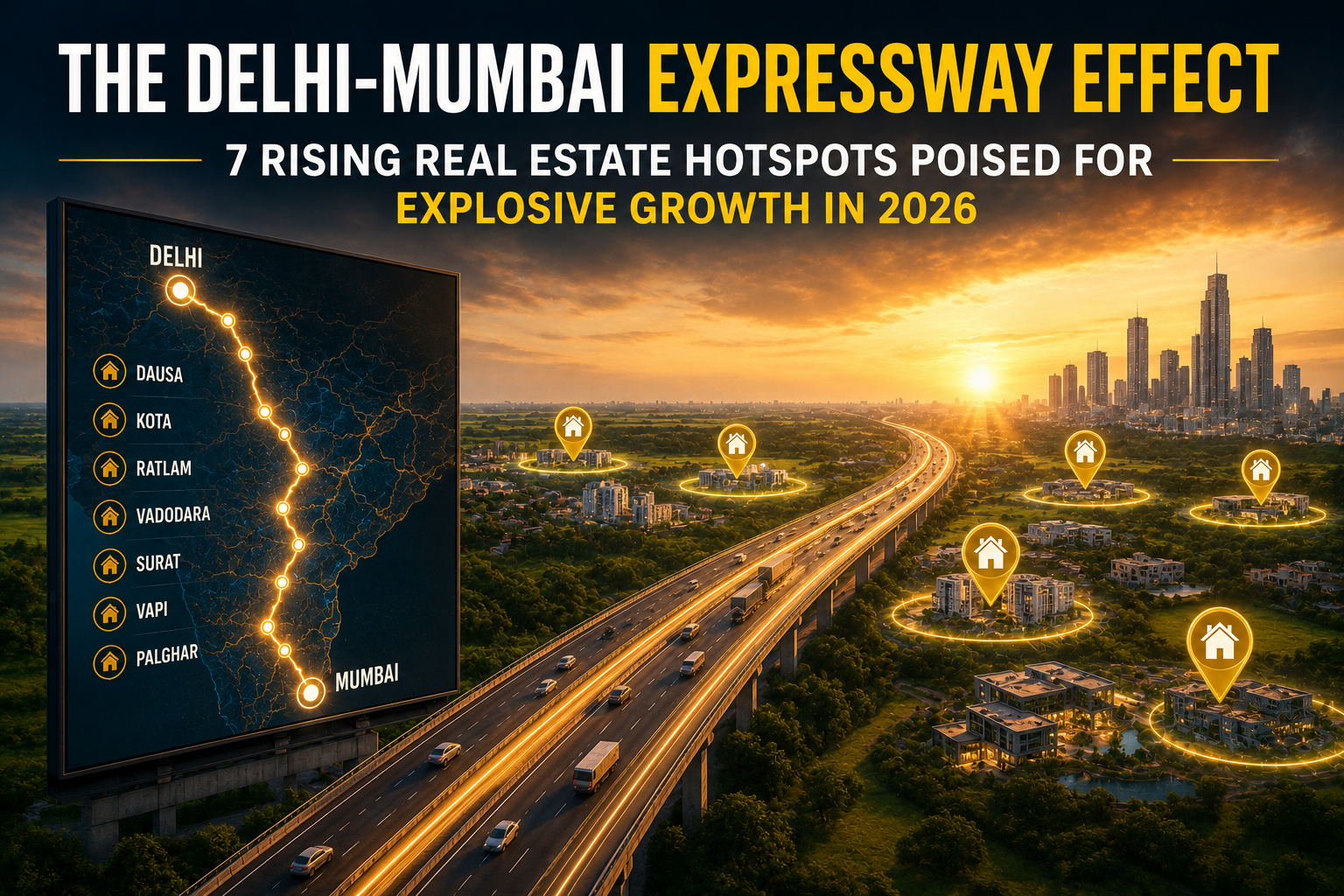
For decades, the Indian real estate narrative was dominated by the primary metropolitan giants. Investors poured their capital into the saturated markets of Mumbai, the sprawling suburbs of Delhi-NCR, or the tech corridors of Bengaluru. However, 2026 has brought a seismic shift in how and where property investments are being made. The catalyst for this monumental change is the impending full operational status of the Delhi-Mumbai Expressway.
Stretching over 1,380 kilometres and designed to cut travel time between the national and financial capitals by half, this eight-lane greenfield project is much more than a marvel of civil engineering. It is the central artery of the Delhi Mumbai Industrial Corridor (DMIC). As the tarmac stretches across Haryana, Rajasthan, Madhya Pradesh, Gujarat, and Maharashtra, it is fundamentally redrawing the property map of the country.
Instead of chasing high-entry-cost metro properties with stagnating yields, savvy investors and large-scale developers are following the infrastructure. The expressway has supercharged the real estate potential of several Tier-II cities along its alignment. The massive infusion of capital into logistics parks, smart industrial zones, and residential townships has turned these previously overlooked regions into the most dynamic property markets of the year. Let us explore the seven key cities emerging as the ultimate real estate investment hotspots driven by the expressway boom.
While many cities on this list are Tier-II, Sohna holds a unique position as a direct, high-value extension of the National Capital Region. Historically viewed as a distant cousin to Gurugram, Sohna's real estate market has been completely revitalised by its proximity to the expressway's starting nodes.
Sitting just a short drive from the Golf Course Extension Road, Sohna serves as the primary gateway to the massive transit corridor. The local property market here is heavily driven by actual end-user demand rather than pure speculation. With the expressway drastically cutting commute times to central business districts, massive residential townships and luxury plotted developments are springing up rapidly. Homebuyers who are priced out of central Gurugram are finding immense value in Sohna, securing premium, spacious homes at accessible prices. Furthermore, the region is witnessing a surge in Grade-A commercial developments, catering to companies that want to establish a base right at the starting line of the country's most vital freight and passenger corridor.
Moving slightly south into Rajasthan, Alwar has positioned itself as a critical industrial beneficiary of the new highway. The region encompassing Alwar, specifically the Bhiwadi and Neemrana belts, has long been recognized as a manufacturing hub. However, the historic logistical challenge was moving goods from these factories to the major ports on the western coast or the massive consumer markets in the capital.
The expressway completely eliminates this bottleneck. By providing a high-speed, signal-free route, transport times for heavy freight have been slashed. This logistical efficiency has triggered a rush of industrial real estate investments. Massive warehousing facilities, cold storage chains, and dedicated freight terminals are being acquired by multinational corporations. This commercial boom is simultaneously driving the residential market. As middle-management and factory workforces migrate to Alwar to support this industrial expansion, local developers are racing to build affordable housing complexes and mid-range apartment societies, resulting in solid, consistent rental yields for early investors.
Dausa represents one of the most fascinating micro-markets along the entire alignment. Before the highway project, Dausa was primarily known for its agricultural land and its proximity to the tourist heavyweights of Rajasthan. Today, it is experiencing a frantic wave of property appreciation, with land values skyrocketing as the physical road cuts through the district.
The investment dynamic in Dausa is currently heavily weighted toward large land parcels and plotted developments. Investors are aggressively purchasing agricultural tracts with the intention of converting them for commercial or hospitality use. Because Dausa sits at a highly strategic geographical pivot—offering rapid access not just to Delhi and Mumbai, but also acting as a feeder route to Jaipur—it is becoming a prime location for highway-oriented commercial real estate. Massive food courts, transit hotels, petrol stations, and rest-stop logistics hubs are being planned here. For investors looking to get in on the ground floor of raw land appreciation, Dausa offers a high-risk, high-reward frontier.
Jaipur was already a thriving Tier-II city known for its robust tourism, gem exports, and educational institutions. However, the expressway has acted as a massive accelerant, transforming the Pink City from a regional hub into a national corporate destination. Over the past year, Jaipur has witnessed residential property prices jump significantly—often by 12 to 18 percent—making it one of the top-performing real estate markets in North India.
The underlying reason for this boom is the influx of the IT sector and Global Capability Centres (GCCs). Companies are realizing that Jaipur offers a highly educated workforce and office rental rates that are a fraction of what they would pay in Delhi-NCR or Mumbai. The improved highway connectivity makes executive travel between the capital and Jaipur effortless. As top-tier companies set up massive campuses in areas like the Ajmer Road corridor and Jagatpura, the demand for premium residential spaces, luxury villas, and high-end apartments has skyrocketed. The real estate growth here is highly defensible, anchored by genuine job creation and a massive influx of young, affluent professionals.
Nationally famous as the premier coaching hub for engineering and medical entrance exams, Kota’s economy has traditionally been one-dimensional. The arrival of the expressway is diversifying its real estate portfolio in a profound way. The highway alignment significantly improves Kota's reach to the massive industrial bases of Madhya Pradesh and the ports of Gujarat.
Investors are looking at Kota with fresh eyes, focusing heavily on commercial and warehousing spaces. The local administration is actively pushing for the development of new industrial areas to capitalize on the transit corridor. Furthermore, the massive transient population of students and their visiting families creates a perpetual demand for organized, high-quality rental housing and service apartments. Developers are now building modern, tech-enabled student housing complexes and affordable flats, creating a highly lucrative rental yield market that benefits directly from the city's upgraded connectivity profile.
As the highway pushes through the heartland of India, Ratlam is emerging as a sleeper hit for long-term real estate investment. Geographically situated to serve as a vital crossroads, Ratlam already benefits from a strong railway junction infrastructure. The integration of the expressway creates a powerful multi-modal transport hub.
The real estate play in Ratlam is currently in its early, foundational stages, making it incredibly attractive for investors seeking lower entry points. The focus here is overwhelmingly on industrial and logistics real estate. The region is seeing early movements in the acquisition of land for agro-processing units, textile manufacturing, and massive transport depots. While the residential market is still developing, purchasing commercial plots near the proposed interchanges and planned industrial parks offers massive capital appreciation potential as the corridor fully matures over the next five years.
As the expressway enters Gujarat, it encounters Vadodara, a city that sits within one of the most aggressive and highly developed industrial belts in the country. Vadodara benefits from a trifecta of growth drivers: the new expressway, the upcoming Dholera Special Investment Region (SIR), and its deep integration with the Ahmedabad metropolitan area.
Real estate in Vadodara is not based on speculation; it is built on hard, industrial output. The region is a powerhouse for engineering, chemicals, and the automotive sector. The expressway essentially supercharges this existing infrastructure, making Grade-A logistics and commercial real estate the most defensible and profitable play in the city. On the residential front, the outskirts of Vadodara are seeing a massive surge in premium plotted developments and smart townships, catering to the highly paid executives and business owners operating within the Gujarat industrial corridor. The city offers the stability of a mature market combined with the explosive growth potential triggered by the new highway.
To fully understand the gravity of this real estate boom, one must look at how the expressway interacts with other massive infrastructure projects in the region. The expressway does not exist in isolation. Through strategic spurs and connecting links, such as the DND-Faridabad-KMP junction, the traffic and economic activity from the Delhi-Mumbai route seamlessly integrate with the eastern infrastructure networks.
This creates a massive, interconnected web of growth that spills over into adjacent high-growth zones like the Yamuna Expressway and the areas surrounding the upcoming Noida International Airport. For commercial logistics companies, the ability to move goods off the Delhi-Mumbai line and directly onto routes leading to massive aviation cargo hubs or eastern freight corridors is invaluable. This synergy is why land parcels situated at major interchanges or connecting state highways are witnessing record-breaking valuations. The entire region is operating as a unified, high-speed economic zone.
While the headlines surrounding the expressway boom are incredibly exciting, navigating this market requires a strategic approach. The days of simply buying a piece of agricultural land anywhere near a highway and waiting for it to double in price are over. The 2026 real estate market is highly organized, and buyers must look for actual demand drivers.
When looking at Tier-II cities like Jaipur or Vadodara, the focus should be on projects that are backed by solid job creation, IT parks, or established manufacturing zones. For early-stage markets like Dausa or Ratlam, verifying clear land titles, checking for proper zoning conversions from agricultural to commercial, and ensuring proximity to operational expressway interchanges are non-negotiable steps. Furthermore, with compliance taking centre stage, buyers should strictly engage with developers who maintain transparent RERA documentation and have a proven track record of delivering projects on time.
The infrastructure has been laid, the travel times have been slashed, and the economic corridors are officially open for business. The cities lining the Delhi-Mumbai Expressway are no longer just pit stops; they are the future engines of Indian real estate. For investors willing to look beyond the crowded metros and understand the dynamics of infrastructure-led growth, these seven cities offer the ultimate blueprint for long-term wealth creation.
