Published On:
February 24, 2026
Updated On:
February 24, 2026
With the 82-km Namo Bharat RRTS corridor now fully operational, travel time from Delhi to Meerut has shrunk to under an hour, instantly transforming sleepy tier-II towns into high-growth "bedroom communities" and triggering a massive surge in regional property values.
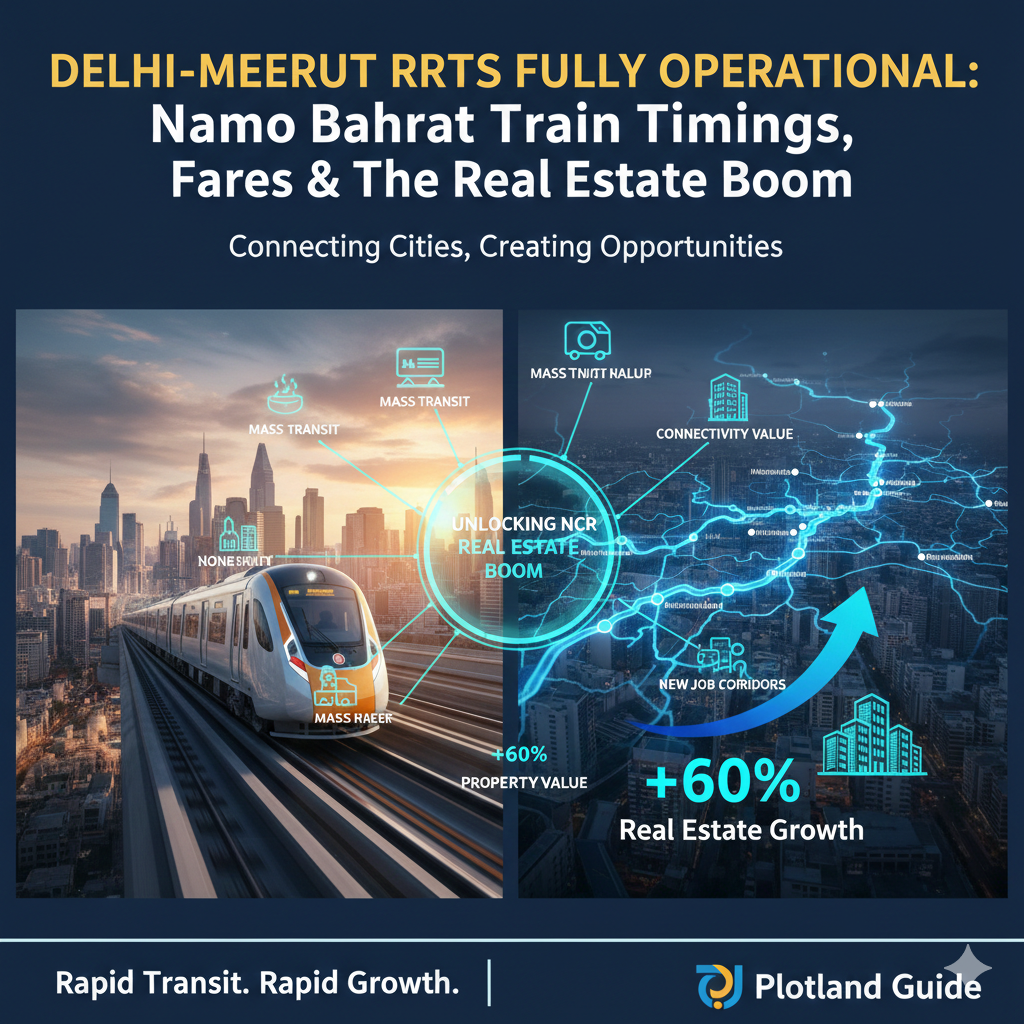
For decades, the National Capital Region's growth narrative followed a predictable pattern. Economic expansion was deeply concentrated within the immediate borders of Delhi, trickling slowly outwards to immediate suburbs like Gurugram and Noida. The areas further out, such as Ghaziabad, Modinagar, and Meerut, were largely viewed as distant, disconnected industrial towns. The arduous, unpredictable commute via the choked Delhi-Meerut highway served as a massive barrier, discouraging working professionals and serious real estate developers from venturing too far from the capital's core.
That geographic isolation officially ended on February 22, 2026. With the inauguration of the final segments—the critical 5-kilometer stretch from Sarai Kale Khan to New Ashok Nagar in Delhi, and the 21-kilometer section connecting Meerut South to Modipuram—the entire 82-kilometer Namo Bharat Regional Rapid Transit System (RRTS) is now fully operational. This is not just a triumph of civil engineering; it is a profound regional economic catalyst. By offering high-speed, reliable transit that cuts the Delhi-to-Meerut travel time to under 60 minutes, the RRTS is completely redrawing the real estate map of northern India. It is transforming previously peripheral districts into highly sought-after urban centers, unlocking massive land banks, and triggering an unprecedented boom in property demand across the corridor.
In real estate, location is traditionally defined by physical distance. However, the Namo Bharat corridor proves that location is actually defined by time. When the travel time to major employment hubs drops dramatically, buyer preferences shift overnight.
For the modern homebuyer and the NCR workforce, a shorter, stress-free commute on an air-conditioned, high-speed train completely outweighs the appeal of paying exorbitant property prices to live within the congested limits of Delhi. By collapsing the temporal distance between the capital and western Uttar Pradesh, the fully operational RRTS has expanded the viable residential catchment area of Delhi by dozens of kilometers.
The impact of this temporal shift is already visible. The earlier operationalization of the 55-kilometer priority stretch had already spurred incredibly strong residential demand across Meerut, Ghaziabad, Muradnagar, and Modinagar. Now, with the Sarai Kale Khan mega-hub connecting the entire network directly into the heart of Delhi, industry analysts anticipate a massive spurt in inquiries, sales conversions, and property prices. These peripheral areas are no longer being treated as far-off suburbs; they have officially arrived as well-connected, highly viable investment destinations.
The correlation between rapid transit infrastructure and real estate appreciation is undeniable, and the data emerging from the Delhi-Meerut corridor paints a staggering picture of wealth creation. Fueled by growing end-user demand and a massive influx of renewed investor confidence, property prices in the region are skyrocketing.
Over the past four years, as the physical pillars of the RRTS tracks were erected, the real estate market responded aggressively. Ghaziabad has witnessed an unbelievable 131% increase in property prices, pushing many of its micro-markets into premium pricing territory. Meerut, long considered a sluggish tier-II market, has experienced a robust 54% appreciation in property values.
Land rates specifically tell the story of this transformation. In Meerut, baseline land rates that previously hovered between ₹8,000 and ₹12,000 per square yard have rapidly climbed to between ₹12,000 and ₹20,000 per square yard. And the localized impact around specific transit nodes is even more pronounced. Areas near key RRTS stations like Modipuram and Shatabdi Nagar have reported property price jumps of 30% to 60%. With projected future growth of 30% to 40%, micro-markets such as Pallavpuram, Shatabdi Nagar, Partapur, and Shastri Nagar are currently leading the list of the most lucrative investment destinations in the region.
A fascinating demographic shift is occurring as a direct result of this improved connectivity. As housing affordability in central Delhi and established NCR hubs reaches a breaking point, the middle class is actively seeking viable alternatives. The RRTS provides the perfect escape valve, positioning Meerut and its surrounding towns as the ultimate "bedroom communities" for Delhi's massive corporate workforce.
Professionals are realizing they can purchase significantly larger, higher-quality homes in tier-II towns without sacrificing their Delhi-based careers. Developers are acutely aware of this shifting demographic and are pivoting their strategies accordingly. We are witnessing a clear transition away from haphazard, unorganized construction toward the development of upscale, highly secure gated townships designed specifically to cater to the lifestyle expectations of the modern Delhi professional.
Sensing this massive emerging opportunity, national-level developers are aggressively acquiring land and launching premium projects along the route. For instance, developers are introducing exclusive plotted developments near the Meerut Bypass Road, offering premium residential plots with direct access to both the Delhi-Meerut Expressway and the RRTS corridor. This allows families to build custom luxury homes in a clean, spacious environment, all while remaining within an easy, one-hour commute of the capital.
The operationalization of the Namo Bharat corridor is doing more than just selling homes; it is changing how regional cities are planned and built. To maximize the economic impact of the rail network, urban planners are heavily emphasizing Transit-Oriented Development (TOD).
TOD is a modern urban planning philosophy that encourages the creation of high-density, mixed-use, walkable neighborhoods located immediately within the influence zones of the RRTS stations. Instead of sprawling horizontally, cities grow vertically and densely around the transit hubs. This approach drastically improves land utilization and ensures sustainable urban growth by seamlessly integrating residential apartments, retail complexes, corporate office spaces, and vital social infrastructure within a short walk of the train station.
The local development authorities are not just hoping this happens; they are actively zoning for it. The Meerut Development Authority (MDA) has boldly earmarked 3,273 hectares specifically for TOD-based projects under its comprehensive Master Plan 2031. Within this massive allocation, 2,442 hectares have been strategically organized into seven distinct TOD zones and two special development areas surrounding the RRTS stations.
These zones are master-planned to function as entirely self-sufficient urban nodes. A prime example is the flagship New Meerut Township, a sprawling 350-hectare greenfield development positioned near the Meerut South station. By combining housing, commercial spaces, elite education centers, and healthcare facilities within a transit-accessible node, planners are ensuring that these new corridors curb unwanted migration into Delhi while fostering robust local economies. Similarly, Ghaziabad has rolled out a GIS-based Integrated Master Plan 2031, expanding its development area by 27% and actively carving out dedicated TOD zones along the major expressways and transit lines.
The success of a massive infrastructure project ultimately relies on the willingness of the public to adopt it. Recent behavioral surveys studying the "Commuter's Pulse" regarding the RRTS reveal a highly enthusiastic market.
A significant 67% of surveyed working professionals indicated a strong willingness to invest in real estate along the RRTS corridors. This highlights the absolute power of infrastructure-led connectivity in shaping modern investment decisions. Interestingly, the survey revealed that visible on-ground development plays a massive role in buyer psychology. Respondents who observed active commercial activity and real estate construction in an area were vastly more likely to invest compared to those who only heard about infrastructure announcements.
Furthermore, the data shows that beyond just the physical train, social infrastructure is the critical missing link required to pull migration from dense metropolitan regions. Nearly a third of aspirational RRTS users currently living in the NCR stated they would willingly relocate to smaller cities like Meerut if the robust transit connectivity was complemented by adequate local amenities, such as good schools, hospitals, and entertainment options.
If we look at international precedents, the future of the Delhi-Meerut corridor is incredibly bright. High-speed regional rail has historically transformed the economic fortunes of peripheral towns worldwide.
In Germany, the Cologne-Frankfurt high-speed corridor enabled smaller, intermediate towns to develop powerful regional offices and industrial clusters, fostering a highly dynamic two-way commuter flow. In Japan, cities connected to the Shinkansen bullet train network rapidly expanded their tourism, services, and light industries, operating in perfect economic harmony with major hubs like Tokyo and Osaka. Similarly, France's TGV corridors helped regional cities create highly specialized economic ecosystems through research parks and cultural centers.
The Delhi-Meerut RRTS is poised to replicate this global success story on an Indian scale. By providing the physical arteries for rapid movement, the corridor is ensuring that economic growth is no longer hoarded by the capital. As the trains reach their maximum operational speeds and the surrounding TOD zones rise from the ground, the Delhi-Meerut corridor will stand as the ultimate blueprint for sustainable, connected, and highly prosperous regional real estate development in the 21st century.
