Published On:
February 27, 2026
Updated On:
February 27, 2026
Over a decade after investing, thousands of homebuyers remain stranded in delayed WTC-backed projects across Noida and Greater Noida, victims of a massive financial diversion scheme involving "unlockable spaces." With investigations revealing hundreds of crores siphoned off and minimal construction on the ground, buyers are navigating a complex legal maze hoping for regulatory intervention and justice.
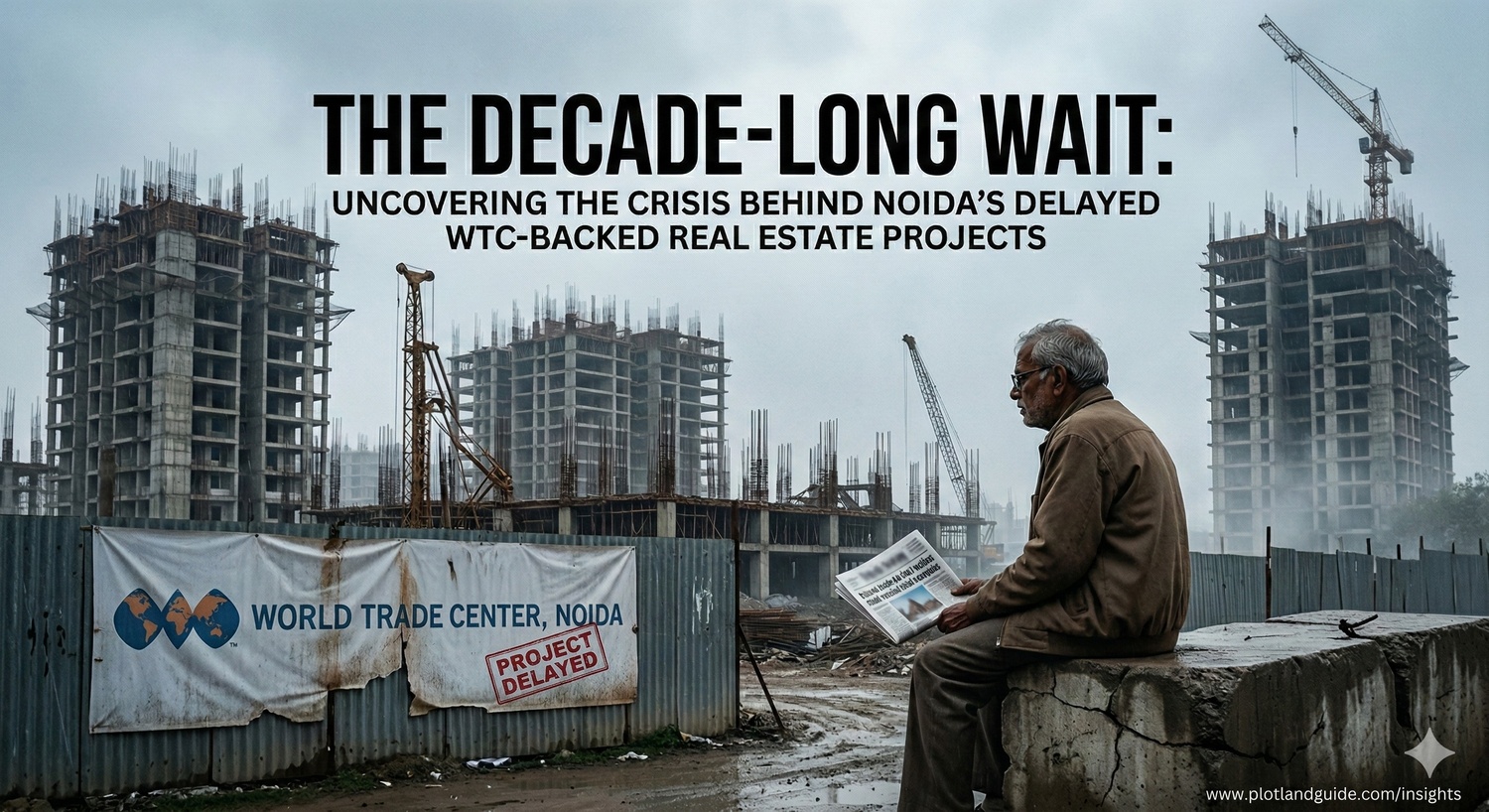
The real estate landscape of the National Capital Region has long been a complex mix of soaring ambitions and shattered dreams. For years, the skyline of Noida and Greater Noida promised world-class commercial hubs and premium residential spaces. Yet, beneath the glossy brochures and aggressive marketing campaigns lies a grim reality for thousands of investors. A glaring example of this systemic failure is the ongoing saga of delayed projects backed by the World Trade Centre (WTC) group in the region.
More than a decade after the initial bookings, thousands of buyers are still waiting for the possession of their properties. Instead of receiving the keys to their commercial spaces or residential apartments, these investors have been handed a seemingly endless cycle of extended deadlines, regulatory loopholes, and empty construction sites. The crisis highlights severe regulatory blind spots and exposes the devastating financial impact on buyers who invested their life savings into what was marketed as a highly secure, globally recognized real estate venture.
To understand how so many investors were drawn into this crisis, one must look at the marketing strategies employed by the developers. The core of the issue revolves around the aggressive selling of a concept known as "unlockable spaces." This strategy was designed to create the illusion of a lucrative real estate investment without the immediate burden of physical property delivery on the developer.
Investors were convinced to put their money into these virtual or conceptual spaces with the promise of guaranteed, high-yield returns. The marketing pitched these spaces as a modern, hassle-free way to own a piece of a massive commercial ecosystem. However, the reality was entirely different. Regulatory documents and legal scrutiny later revealed that these so-called unlockable spaces do not even qualify as standard apartments or physical units under the fundamental definitions of the Real Estate (Regulation and Development) Act (RERA) of 2016. Because they lack physical boundaries and cannot be physically handed over to a customer, the entire premise of the investment was flawed from the start.
Buyers were essentially purchasing thin air, operating under the assumption that their capital was funding the construction of a tangible asset that would eventually yield rental income or capital appreciation. By the time the realization dawned that these spaces could not be legally or physically transferred, the funds had already been locked in, leaving investors financially stranded.
The true scale of the disaster becomes evident when examining the specific projects located in the Tech Zone and other areas of Greater Noida. Official reports, including those from the Serious Fraud Investigation Office (SFIO) under the Ministry of Corporate Affairs, paint a staggering picture of financial mismanagement and zero ground-level execution.
Across multiple WTC-backed projects, the disparity between the funds collected from allottees and the money actually spent on construction is alarming. For instance, in the highly publicized WTC Noida CBD project, which involves over three thousand allottees, the developer collected upwards of ₹600 crore. However, a shocking revelation by investigative agencies showed that less than ₹30 crore was utilized for actual construction. Today, the project sits at a meager 10% completion rate, with only a few lakh rupees left in its designated bank accounts.
The situation is identical, if not worse, across other developments in the portfolio. The WTC One E project collected nearly ₹370 crore from buyers, yet progress remains highly unsatisfactory, with the project timeline continually pushed back, currently sitting at a projected 2026 completion date.
In projects like the WTC Noida Quad and the WTC Noida Riverside Residences, the situation moves from delayed to completely stagnant. Despite collecting tens of crores for the Quad project and nearly ₹100 crore for the Riverside Residences, ground reports and RERA website updates confirm that absolutely no construction activity has taken place. The timelines for these projects were conveniently extended under the guise of pandemic-related force majeure clauses, pushing delivery dates to mid-2025. Yet, with empty bank accounts holding just a few thousand rupees, the prospect of these sites ever seeing a brick laid remains highly improbable. Similarly, the WTC Noida Cubit project amassed over ₹110 crore from hundreds of buyers, only to have its accounts drained, leaving a nominal balance and no tangible progress.
The disappearance of hundreds of crores of rupees is not merely a case of poor project management; it is a textbook example of severe regulatory violations and systemic fund diversion. Under RERA guidelines, developers are strictly mandated to maintain 70% of the funds collected from homebuyers in a separate, designated escrow account. This rule was specifically designed to ensure that the capital raised for a particular project is used exclusively for land cost and construction of that exact project, preventing builders from using the money to buy new land or fund other ventures.
However, investigations have revealed illegal and unauthorized withdrawals from these RERA-designated accounts on a massive scale. The funds meant to build commercial towers and residential suites in Greater Noida were systematically siphoned off. In 2022, the Uttar Pradesh Real Estate Regulatory Authority (UP-RERA) took note of this massive diversion and issued multiple notices to the development group. The directives were clear: return the diverted funds to the designated project accounts. Unfortunately, these directives often face prolonged legal resistance, while the construction sites remain deserted.
The blatant disregard for RERA mandates by utilizing funds for purposes other than completing the promised structures has left buyers bearing the ultimate financial brunt. Investors who took out heavy loans to finance these purchases are now caught in a dual trap—paying monthly installments to banks for properties that do not exist, while simultaneously funding endless legal battles to recover their principal amounts.
Frustrated by the lack of progress and the apparent apathy of the developers, buyers have organized and moved across various legal and consumer forums in a desperate search for justice. The fight has transitioned from the construction site to the courtrooms, with multiple agencies now involved in unravelling the complex web of real estate fraud.
There have been some significant legal victories that offer a glimmer of hope. Recently, the Chandigarh State Consumer Disputes Redressal Commission delivered a decisive ruling against the developers of the WTC Noida project. Holding the company strictly liable for the non-delivery of commercial units, the commission ordered a full refund of the principal amount, coupled with interest and additional financial compensation for the severe mental agony and harassment inflicted upon the buyers.
Furthermore, the repercussions of these business practices have extended beyond the National Capital Region. In Gujarat's GIFT City, authorities took stringent action by completely terminating the development agreement with the WTC Noida Development Company for similar stalled projects. The local real estate regulatory authority noted massive possession delays and numerous investor complaints, leading to the decision to oust the developer and explore substitute entities to finish the work. Adding to the gravity of the situation, key promoters of the development company have faced severe legal action, including arrests by the Enforcement Directorate in connection with broader allegations of real estate fraud and money laundering.
Despite these rulings and actions, the execution of refund orders remains a monumental challenge. When developer accounts are already drained, enforcing a financial penalty or securing a refund becomes an arduous, multi-year legal marathon.
The plight of the WTC project investors is symptomatic of a much larger, deep-rooted crisis plaguing the Noida, Greater Noida, and Yamuna Expressway real estate markets. For over a decade, this region has been synonymous with stalled infrastructure, broken promises, and distressed homebuyers.
According to various industry estimates and regulatory surveys, there are thousands of buyers trapped in under-construction or zero-construction projects across Gautam Buddha Nagar. The total funds collected and locked in these incomplete ventures amount to thousands of crores. The reasons for these delays are multifaceted, ranging from aggressive land acquisition by developers without the necessary financial backing, to prolonged litigation over land dues with local development authorities, and widespread fund diversion.
While the introduction of RERA was hailed as a watershed moment that would clean up the sector, legacy projects launched before 2016 continue to exploit transitional loopholes. Furthermore, while RERA authorities have the power to issue recovery certificates and mandate project completions, they often lack the immediate enforcing mechanisms to compel bankrupt or fraudulent developers to resume work or refund the money.
The local authorities have attempted various rehabilitation packages, including recent committee recommendations aimed at delinking builder dues from flat registrations and bringing in co-developers to finish stalled towers. However, for projects where the fundamental financial structure has been hollowed out—like those with drained escrow accounts and zero physical progress—these policy interventions offer little immediate relief.
For the individuals who invested in the WTC-backed projects, the path forward is fraught with uncertainty. The primary demand from buyer associations is the immediate intervention of state and central investigative agencies to trace and recover the siphoned funds. There is also a growing push for the authorities to cancel the existing leases of the defaulting developers and bring in robust, government-backed construction agencies to take over the land parcels and deliver the promised spaces.
The concept of bringing in a substitute entity, much like the approach being considered in other states, is gaining traction as a viable solution for the stalled projects in Greater Noida. By allowing an association of allottees to take control of the project or inviting a financially sound third-party developer to step in, there is a remote possibility that some value can be salvaged from the deserted sites.
However, any such resolution requires a strong, proactive stance from the local administration, the judiciary, and the real estate regulators. The focus must shift from merely issuing notices to taking punitive action against the personal assets of the promoters who orchestrated the fund diversions.
The decade-long wait for possession in Noida’s WTC-backed projects is a stark reminder of the vulnerabilities that persist within the Indian real estate market. The devastating combination of deceptive marketing tactics like "unlockable spaces," massive financial diversion, and sluggish regulatory enforcement has left thousands of hard-working individuals financially crippled.
As the legal battles rage on and investigative reports continue to expose the depth of the irregularities, the focus must remain squarely on achieving tangible justice for the homebuyers. The real estate sector in the National Capital Region cannot fully regain investor confidence until the ghosts of these delayed projects are laid to rest, and developers are held unequivocally accountable for the promises they failed to keep. For the buyers who have spent the last ten years fighting for their rightful properties, the wait for keys—or at the very least, a return of their hard-earned money—continues.
