Published On:
March 28, 2026
Updated On:
March 30, 2026
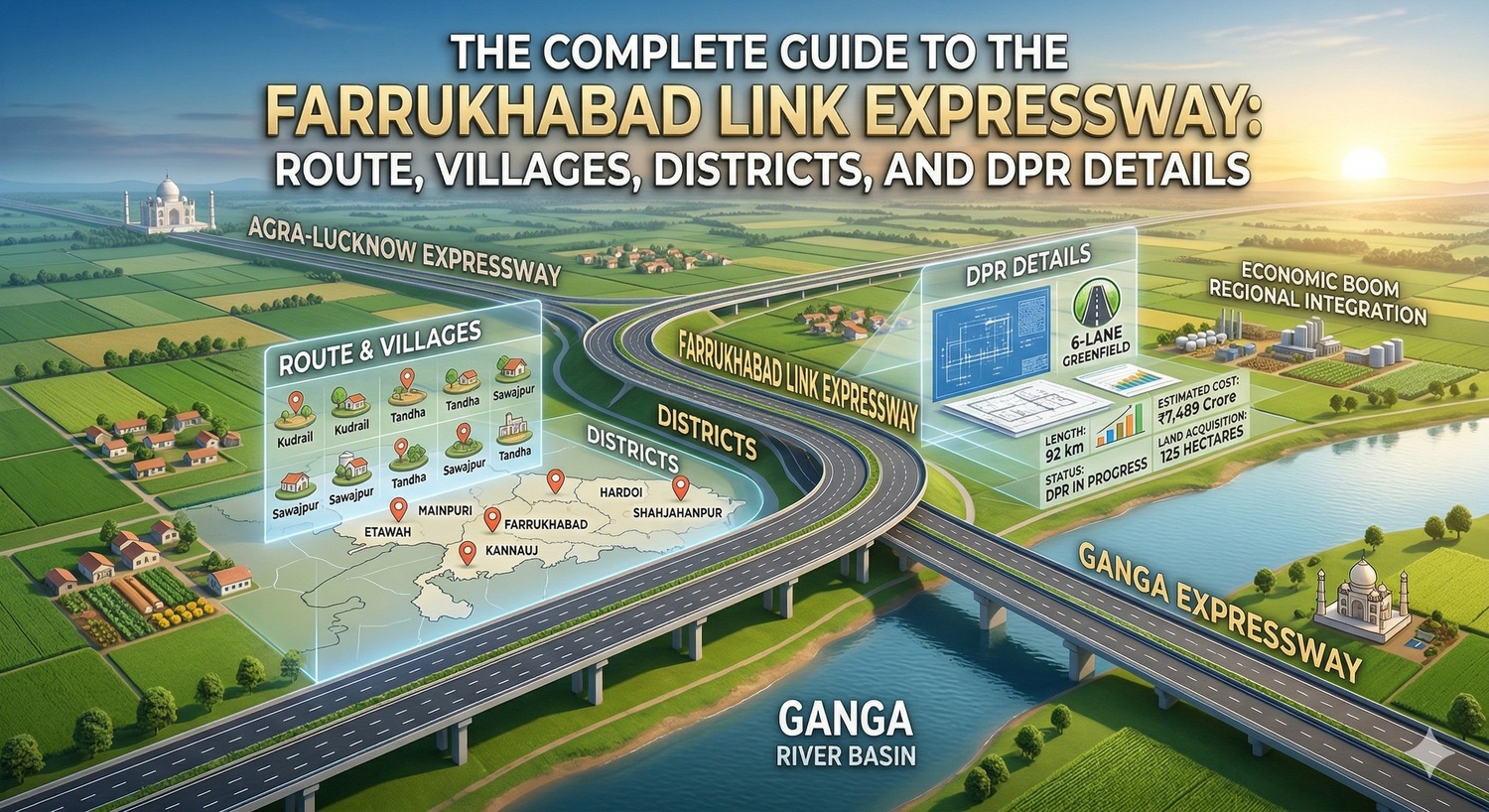
The Farrukhabad Link Expressway is a proposed 92-kilometer, six-lane greenfield corridor in Uttar Pradesh that will seamlessly connect the Agra-Lucknow Expressway with the Ganga Expressway. Set to pass through six districts and trigger massive land acquisition across rural belts, this Rs 7,489-crore project will drastically cut travel times and ignite a major real estate boom across the central-western region.
The infrastructure landscape of Uttar Pradesh is shifting at a rapid pace, evolving from a patchwork of congested state highways into a highly integrated, modern grid of access-controlled corridors. Over the last decade, massive projects have actively reshaped the state's economy, yet certain historic and agriculturally rich districts remained slightly disconnected from this high-speed revolution. That narrative is changing entirely with the introduction of the Farrukhabad Link Expressway.
Designed to act as a critical economic artery rather than just a standalone road, this new greenfield project is poised to bridge a massive connectivity gap in the central-western region of the state. By linking two of the state's most prominent mega-highways, it promises to pull the entire Farrukhabad region out of geographical isolation and plug it directly into the national economic mainstream. For local residents, farmers, and heavy-hitting real estate investors alike, the finalization of the project's framework signals the start of a massive regional transformation.
At its core, the Farrukhabad Link Expressway is a highly ambitious, access-controlled greenfield highway project spearheaded by the Uttar Pradesh Expressways Industrial Development Authority. It spans approximately 92 kilometers and is engineered as a robust six-lane corridor, built with the structural flexibility to expand to eight lanes if future traffic volumes demand it.
The primary objective of this massive piece of engineering is straightforward yet economically profound: to seamlessly connect the operational Agra-Lucknow Expressway with the under-construction Ganga Expressway. By serving as a high-speed bridge between these two giant arteries, the new link ensures that traffic moving from the National Capital Region, central Uttar Pradesh, and the eastern borders can flow without the friction of winding city roads.
Backed by a massive state cabinet budget, this is not merely a surface-level paving job. The project involves elevated stretches, heavy land acquisition, smart tolling systems, and advanced traffic management infrastructure, making it a state-of-the-art addition to the country's growing highway network.
The strategic alignment of this highway is what makes it such a game-changer for regional mobility. The Farrukhabad Link Expressway route is meticulously planned to traverse the rural heartlands, starting from the southern end and moving northeast to merge with the Ganga basin network.
The journey officially begins near Kudrail village in the Etawah district, where the new road will branch off directly from the Agra-Lucknow Expressway. From this starting point, it cuts a path through the agricultural belts of Mainpuri and Kannauj, eventually reaching its primary namesake district, Farrukhabad. Instead of terminating there, the route pushes further north, crossing into Shahjahanpur and ultimately merging with the massive Ganga Expressway near Sawaijpur in the Hardoi district.
By passing through these six specific districts—Etawah, Mainpuri, Kannauj, Farrukhabad, Shahjahanpur, and Hardoi—the expressway effectively unifies a massive chunk of the state that previously suffered from fragmented road networks. For a daily commuter or a commercial fleet operator, this alignment means that reaching Delhi, Lucknow, or Prayagraj from Farrukhabad will soon take a fraction of the time it currently does.
While the macro-level district connectivity is impressive, the true ground-level impact of the Farrukhabad Link Expressway is being felt in the rural communities it will pass through. According to the project blueprints, the highway will heavily impact dozens of villages across its 92-kilometer span.
The land acquisition machinery is already operating in high gear. Authorities have been on the ground mapping out plots and serving notices in key administrative zones, particularly focusing on the Sawajpur and Amritpur tehsils. To make this greenfield project a reality, hundreds of hectares of land are being targeted for acquisition across the entire corridor.
For the farmers and landowners in these villages, the compensation framework is highly lucrative. But the financial windfall does not stop at direct compensation. The state government is actively ensuring that these rural areas are not simply bypassed by high-speed traffic. The project design includes continuous service roads running parallel to the main expressway, guaranteeing that local village connectivity remains robust and that farmers have easy, localized access to transport their daily goods.
For a long time, the project was floating in the conceptual phase, but recent administrative pushes have solidified its reality. The Detailed Project Report for the Farrukhabad Link Expressway provides absolute clarity on the engineering specifications, environmental mitigation strategies, and financial outlays.
One of the most fascinating engineering aspects detailed in the project is the strategic use of elevated corridors. Because the expressway route heavily traverses the Ganga river basin—a region notoriously prone to heavy seasonal flooding—laying flat asphalt would have been a long-term maintenance nightmare. To counter this, developers are building significant portions of the highway on elevated pillars. This ensures year-round, uninterrupted, all-weather connectivity and massively reduces the flood risk for surrounding agricultural lands by not obstructing natural water flow.
The corridor is also being designed as a heavily tech-enabled driving experience, to be executed under the engineering, procurement, and construction model, ensuring world-class execution and maintenance standards post-construction.
Infrastructure projects of this scale require patience, but the momentum behind this specific link road is highly encouraging. Currently, the Farrukhabad Link Expressway sits squarely in the aggressive land acquisition phase, backed by strong budgetary allocations from the state.
The construction timeline is aggressive. Once the main civil engineering contracts are fully awarded and the heavy machinery hits the dirt, the target for physical completion is strictly set between 18 to 36 months. While exact ribbon-cutting dates depend on the speed of land clearances, market observers and administrative officials fully expect the region to be transformed well before the end of the decade.
The true value of laying down thousands of tons of concrete and asphalt lies in the economic chain reaction it triggers. Farrukhabad and its neighboring districts have long been agricultural powerhouses. However, the lack of high-speed logistical routes meant that farmers often struggled to get their perishable goods to broader national markets efficiently.
The new expressway solves this logistical nightmare overnight. By plugging directly into the state's broader industrial corridors, the region is bracing for an influx of heavy investments in food processing units, warehouses, and dedicated agricultural logistics hubs.
Beyond agriculture, the route is a massive win for regional tourism. The expressway will act as a direct, high-speed conduit for religious tourism, specifically enhancing accessibility to internationally renowned spiritual sites in the area. The new route not only sanitizes these journeys but also creates a broader tourism circuit by indirectly linking the tourist hubs of Agra to the spiritual centers of Chitrakoot.
Whenever a massive infrastructure project moves from the drawing board to the dirt-moving phase, the real estate market is the first to react. The greenlighting of the Farrukhabad Link Expressway has triggered an absolute gold rush in the regional property markets.
In the villages dotting the planned route, land prices are experiencing a massive upward trajectory. What was once purely agricultural farmland is now being viewed through the lens of prime commercial and residential real estate. Investors from major cities are aggressively scouting the region, looking to secure large land parcels near key interchanges and access points before the heavy construction machinery arrives.
The demand is not just speculative; it is rooted in concrete future development plans. As industries set up shop and create thousands of local jobs, the demand for organized, modern housing and commercial properties in nearby hubs like Lucknow and Farrukhabad will explode. For anyone looking at long-term wealth creation, the plots and land parcels flanking this upcoming greenfield corridor represent one of the most lucrative investment windows in the state today.
The execution of the Farrukhabad Link Expressway represents a highly mature phase of infrastructure planning. The government is moving past the era of simply building roads to connect two major cities; they are now actively weaving a dense, highly interconnected web that ensures no district is left behind.
By strategically tying the Agra-Lucknow Expressway to the Ganga Expressway, the authorities are creating a massive, high-speed economic loop. As land acquisition wraps up and the first layers of asphalt are poured, the Farrukhabad region is officially stepping out of the shadows and taking its rightful place on the map of modern, rapidly developing India.
