Published On:
December 4, 2025
Updated On:
February 4, 2026
New Gurugram prices soar 25% to ₹14k/sq. ft.; Affordable housing faces margin pressure. 20% EDC hike in 2025 increases costs; DDJAY amendment unfreezes 50% inventory to boost supply. Infrastructure gaps (missing sector roads) remain a critical risk for affordable projects.
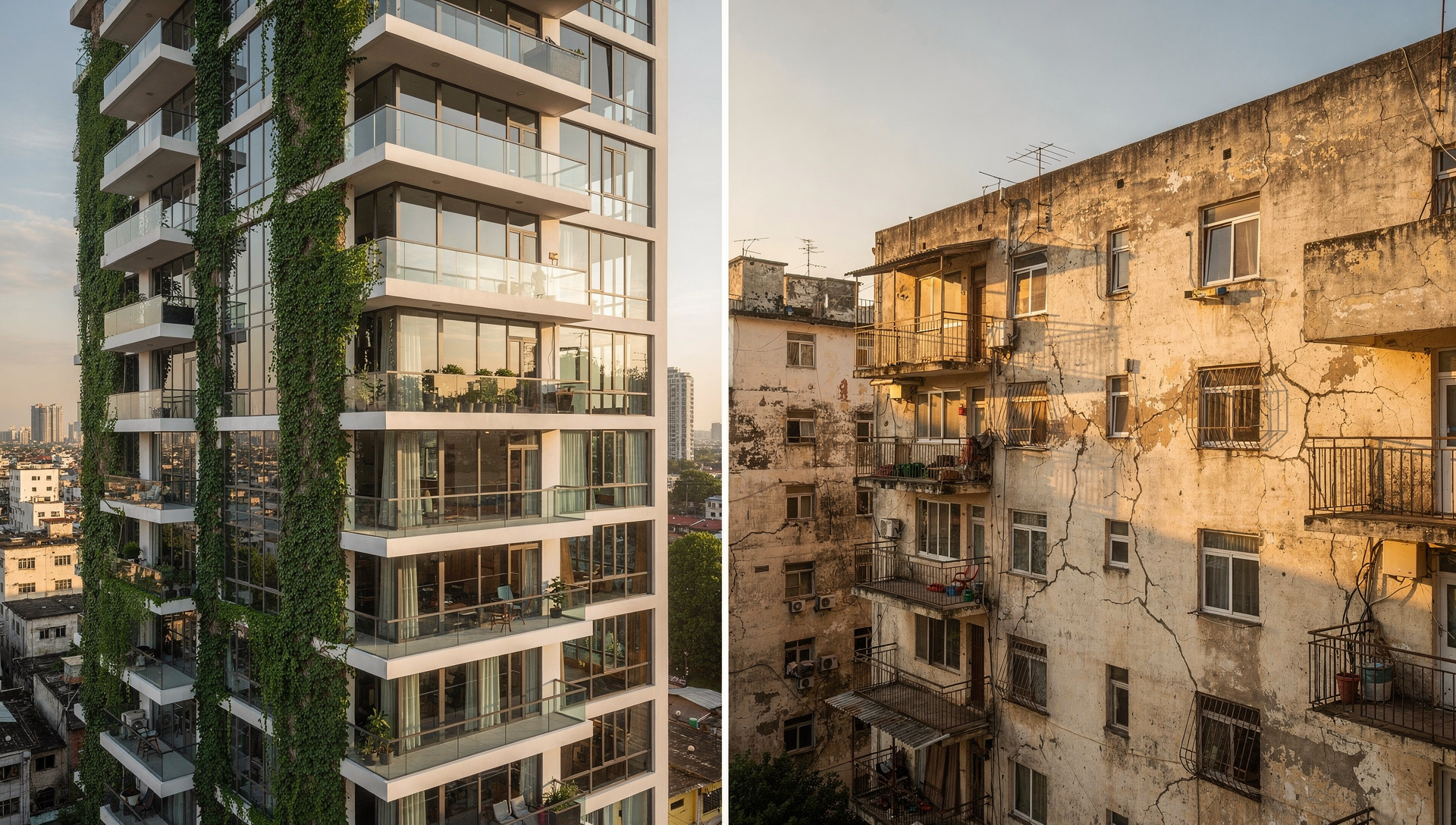
Gurugram, often hailed as the Millennium City, has long been the crown jewel of the National Capital Region’s (NCR) property market. For two decades, it served as the aspirational destination for the corporate middle class—a place where a double-income couple could stretch their budget to afford a decent three-bedroom apartment in a gated community. However, as we navigate through 2026, the fundamental character of this market has altered irreversibly.
The days of the ₹80 lakh to ₹1.2 crore apartment in a prime Gurugram sector are effectively over. The city is rapidly transforming into a playground for the ultra-rich, characterized by ₹100 crore penthouses, ₹5 crore entry-level apartments, and a policy environment that is inadvertently squeezing out the budget homebuyer.
This shift is not merely a function of demand and supply; it is a structural change driven by government policy (External Development Charges hikes), land acquisition costs, and a pivot in developer strategy. In this comprehensive analysis, we explore the factors rewriting the real estate rulebook of Gurugram and what the future holds for those trying to buy a piece of this concrete goldmine.
One of the most significant, yet often misunderstood, drivers of the recent price escalation is the hike in External Development Charges (EDC) and Infrastructure Development Charges (IDC).
Understanding the ChargesEDC is the fee developers pay to the government for the development of major infrastructure like highways, master sewerage lines, and drainage systems surrounding the project. IDC covers the internal infrastructure within the sector. Historically, these charges were a manageable component of the total project cost.
The Recent HikeThe Department of Town and Country Planning (DTCP) has aggressively revised these rates to fund the massive infrastructure overhaul of the city, including the Dwarka Expressway completion and the Southern Peripheral Road (SPR) upgrade. While better roads are necessary, the financial burden has been passed directly to the end consumer.
For a developer, a hike in EDC means the "landing cost" of the project increases significantly. In a high-rise project, this can translate to an additional burden of hundreds of rupees per square foot. Consequently, developers have stopped launching projects in the lower price bands because the input costs (Land + EDC + Construction + Approval) have exceeded the sales price cap mandated for affordable housing. The result? The "Affordable Housing" category is becoming mathematically unviable for builders, forcing them to pivot to luxury where margins can absorb these government levies.
If policy is the push, then "The Camellias" is the pull. The unprecedented success of DLF’s super-luxury project on Golf Course Road—where secondary market transactions have famously crossed ₹100 crore for a single unit—has created a psychological ripple effect across the entire city.
The Psychology of PremiumizationDevelopers have realized that there is an insatiable appetite for "lifestyle" products. The post-pandemic buyer in Gurugram is not looking for four walls; they are looking for low density, concierge services, heated pools, and expansive decks.
This has led to the "Camellias Effect," where every new launch in sectors like 76, 77, or along the Dwarka Expressway is benchmarking itself against the highest standards. Features that were once considered premium—like Italian marble flooring, VRV air conditioning, and modular kitchens—are now standard specs.
The Price RecalibrationThis premiumization has reset the price floor. Areas along the Golf Course Extension Road, which were trading at ₹9,000-₹11,000 per sq. ft. just a few years ago, are now seeing launches at ₹18,000-₹22,000 per sq. ft. The definition of "Luxury" has moved from ₹3 Crore to ₹8 Crore, leaving a massive vacuum in the ₹1.5 Crore to ₹3 Crore segment.
In 2013, the Haryana Government launched the Affordable Housing Policy (AHP), which capped prices (e.g., ₹4,000 per sq. ft.) and waived EDC to encourage budget homes. It was a massive success, delivering thousands of homes to genuine end-users.
The Current CrisisIn 2026, this policy is gasping for air. The cap on sales price has not kept pace with the explosive rise in land prices.
For the middle-class buyer, this is a severe blow. The supply of sub-₹50 lakh homes within municipal limits is drying up, pushing them further out to the fringes of Sohna or Bhiwadi.
The Dwarka Expressway, once the poster child for delayed infrastructure, is now the hottest real estate corridor in North India. With the road fully operational and the "Cloverleaf" connecting it seamlessly to the airport and NH-48, the arbitrage opportunity here has closed.
The Diplomatic Enclave FactorThe proposed Diplomatic Enclave in Sector 24, Dwarka (bordering Gurugram), has added a layer of geopolitical prestige to the area. Investors are betting that this corridor will mimic the diplomatic zones of Chanakyapuri. Consequently, sectors like 102, 106, 109, and 113 are witnessing prices that rival the established Golf Course Extension Road.
The Commercial ShiftIt is not just residential. The Expressway is seeing a surge in high-street retail and commercial SCO (Shop-cum-Office) plots. The "Global City" project planned near Sector 36B/37B is acting as another magnet, promising a central business district (CBD) that could rival Cyber Hub. This commercial growth ensures that residential prices remain sticky on the higher side.
As high-rise apartments become prohibitively expensive due to super-area loading and high maintenance, a significant demographic has shifted towards independent floors.
The DDJAY Success StoryThe Deen Dayal Jan Awas Yojna (DDJAY) allowed developers to sell plots and floors on smaller land parcels. This segment has exploded. Buyers prefer owning the land (or a significant share of it) and having lower monthly maintenance bills.
An often-overlooked consequence of skyrocketing property prices is the surge in rentals. As buying becomes difficult, more professionals are forced to rent.
The Yield ReversalHistorically, residential rental yields in India were abysmal (1.5-2%). In Gurugram 2026, we are seeing yields inching towards 3.5-4%.
If Gurugram is becoming Manhattan, where are the boroughs?
South of Gurugram (Sohna):Sohna has effectively become "Gurugram Extension." The elevated corridor has reduced travel time to Rajiv Chowk to 20 minutes. This is the only zone where reputed developers are still launching inventory in the ₹80 Lakh - ₹1.5 Crore bracket. It is the new haven for the upper-middle class.
New Gurgaon (Sector 81-95):Once considered remote, New Gurgaon is stabilizing. With the removal of the Kherki Daula toll (via GNSS technology) and better internal roads, this area is absorbing the demand spilling over from the center. It offers a balanced mix of ready-to-move inventory which, while expensive, is still cheaper than Golf Course Road.
The changing face of Gurugram is a story of maturity. The market is consolidating. The days of hundreds of small builders launching projects are gone; the market is now controlled by 5-6 corporate giants who dictate pricing.
For the investor, the strategy must change. The "quick flip" game is over because entry prices are high. The new game is "Capital Preservation and Rental Yield." Gurugram is no longer a speculative market; it is a wealth-parking market.
For the end-user, the advice is grim but practical: Buy now if you can. The trajectory of land prices, fueled by EDC hikes and infrastructure upgrades, suggests that waiting for a correction is futile. The "Affordable" label has left the building; what remains is a premium city demanding a premium price tag.
