Published On:
March 16, 2026
Updated On:
March 16, 2026
The Bulandshahr Greenfield Link Expressway will soon seamlessly connect the Yamuna Expressway (near Jewar Airport) to the Ganga Expressway over a 74.3 km stretch. Scheduled for construction beginning mid-2026, the 6-lane high-speed corridor has already triggered a massive 40% surge in land prices, positioning the surrounding YEIDA sectors as the next big real estate and logistics goldmine.
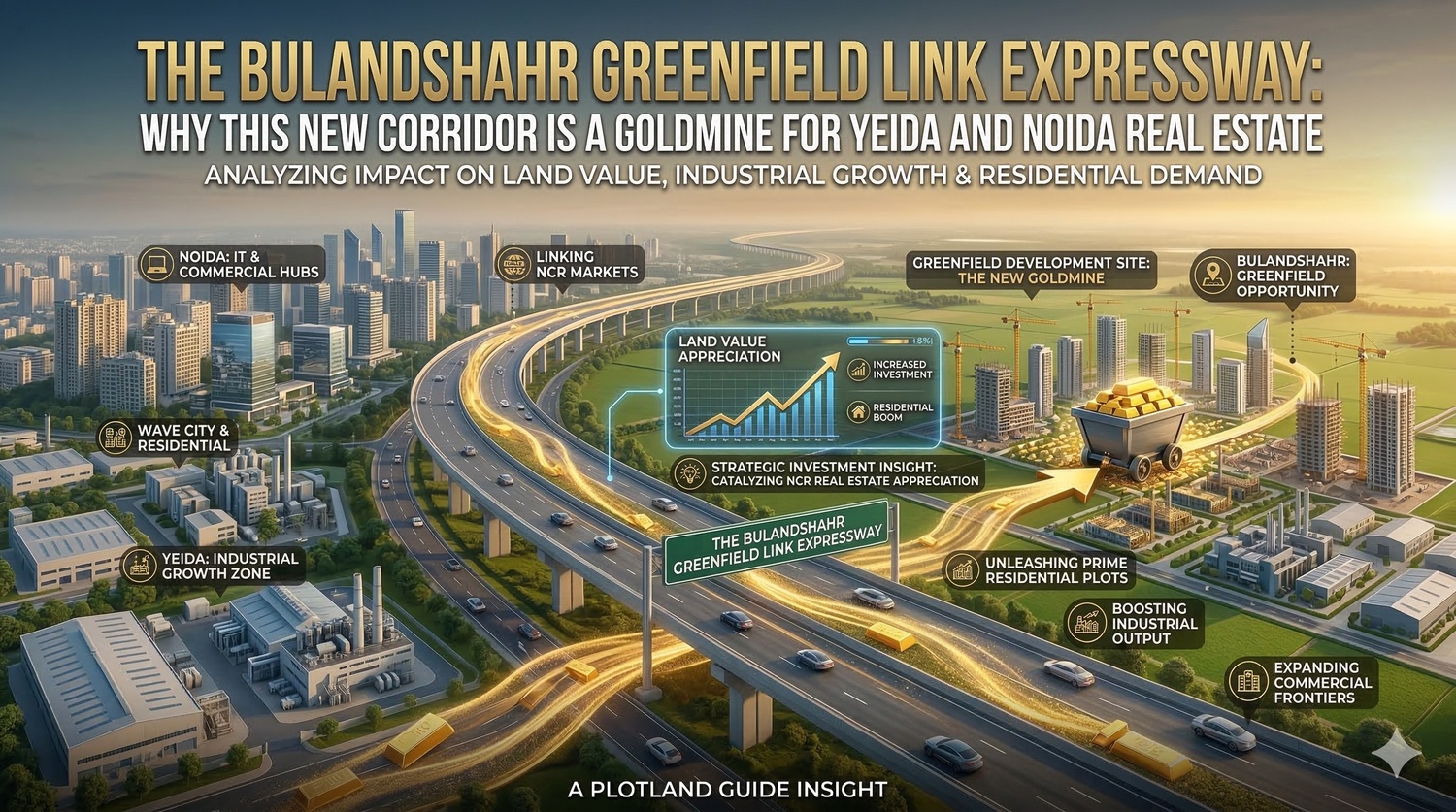
The infrastructure landscape of Western Uttar Pradesh is transforming at a breakneck pace, and real estate investors have their eyes locked on one particular megaproject that promises to redefine connectivity and property values. The government of Uttar Pradesh has recently finalized the technical designs and greenlit the development of the highly anticipated Bulandshahr Greenfield Link Expressway.
This ambitious high-speed corridor is much more than just a road. It is the crucial missing piece of the puzzle that will finally bridge the Yamuna Expressway with the Ganga Expressway, creating a seamless transit web across the state. Stretching exactly 74.3 kilometres, this project is poised to drastically slash the travel distance from various parts of UP to the upcoming Noida International Airport in Jewar.
For those looking at the real estate dynamics of the region, specifically around the Yamuna Expressway Industrial Development Authority (YEIDA) sectors, Greater Noida, and Bulandshahr, this development is a clear signal of an incoming boom. With land prices already reacting aggressively to the news, understanding the scope, features, and timeline of the Bulandshahr Greenfield Link Expressway is critical for anyone looking to capitalize on this emerging property hotspot.
At its core, the Bulandshahr Expressway is a completely greenfield project, meaning it is being built entirely from scratch on newly acquired land rather than expanding an existing, rugged local road. This ensures that the structural integrity, alignment, and speed limits meet the highest global standards for modern expressways.
Initially designed as a 6-lane wide corridor, the authorities have demonstrated remarkable foresight by securing enough right-of-way to easily expand it into an 8-lane expressway should future traffic volumes demand it.
Spearheaded by the Uttar Pradesh Expressways Industrial Development Authority (UPEIDA), the master plan envisions the creation of a seamless "Golden Triangle" that effectively links Meerut, Noida, and Bulandshahr. This strategic alignment is primarily aimed at facilitating rapid freight movement. A massive volume of agricultural goods and factory products originating from Bulandshahr and its surrounding industrial belts will soon be able to reach the cargo terminals of the Jewar Airport in record time, bypassing the traditional bottlenecks of older highway networks.
The engineering and planning of this expressway are designed to prioritize high-speed transit while simultaneously ensuring the safety and convenience of the local rural populations along its route.
Massive Right of Way and Land AcquisitionTo accommodate the grand scale of the project, the government is actively acquiring a massive 130-meter-wide strip of land along the entire alignment. Within this wide corridor, the primary high-speed carriageway will occupy a central 80-meter span.
Dedicated Local Service RoadsOne of the most common issues with expressways in India is the intrusion of slow-moving local traffic, such as tractors and two-wheelers, onto high-speed lanes, which often leads to fatal accidents. To combat this, the authorities are constructing dedicated 25-meter-wide service roads on both sides of the main expressway. This guarantees that local villagers have smooth, uninterrupted access for their daily commutes without interfering with the high-speed transit lanes.
Elevated Corridors to Preserve Existing InfrastructureBuilding an expressway through a densely populated state inevitably intersects with existing railways, canals, and residential colonies. To avoid mass demolitions and terrain-related delays, approximately 10 kilometres of the Bulandshahr Greenfield Link Expressway will be completely elevated.
The Mega Yamuna City InterchangePerhaps the most crucial feature for real estate investors is the massive interchange planned near Sector 21 in Yamuna City. Situated right next to the site of the highly anticipated new Film City, this interchange will act as a colossal junction allowing motorists to switch seamlessly between the Yamuna Expressway and the Ganga Expressway without ever having to stop at a toll plaza or a red light.
Smart Underpasses and FlyoversThe finalized technical design includes multiple smart underpasses, particularly around the Chola area, along with several flyovers designed to vault over busy railway crossings. This ensures that the expressway maintains its promise of signal-free, uninterrupted travel from start to finish.
The alignment of the Bulandshahr Expressway has been meticulously planned to maximize economic utility and connect key industrial hubs.
The route begins exactly at the 24.8-kilometre mark on the Yamuna Expressway. This starting point is strategically located just minutes away from the proposed aviation hub in Jewar. From there, it cuts a straight path eastward, eventually merging with the Ganga Expressway at its 44.3-kilometre point, culminating near the town of Siyana in the Bulandshahr district.
Along this 74.3-kilometre journey, the expressway will pass through 56 different villages. While the majority of these—48 villages—fall within the Bulandshahr district, eight crucial villages are located within the Gautam Buddh Nagar (Noida/Greater Noida) district.
More importantly, this corridor acts as a direct lifeline for several massive industrial zones currently under development. It will provide a dedicated high-speed route for the proposed Japanese and Korean industrial townships taking shape in YEIDA Sectors 5A and 4A, as well as the ambitious Fintech Hub planned for Sector 11.
For a project of this magnitude, the timeline is moving at an impressive pace. If you were to drive past the proposed alignment today, the physical construction of the road might not be immediately visible, but the administrative machinery is working in overdrive.
Currently, the primary focus is on land acquisition. The Uttar Pradesh government has allocated a staggering budget of approximately Rs 1,246 crore specifically to compensate local landowners and secure the necessary right-of-way.
The heavy machinery and physical construction work are officially slated to commence by the middle of 2026. Assuming the contractors adhere to the strict deadlines set by UPEIDA and there are no unforeseen regulatory hurdles, the Bulandshahr Greenfield Link Expressway is projected to be fully operational and open for public use by the end of 2027 or early 2028.
In the Indian real estate market, the announcement of an expressway acts as an immediate catalyst for price appreciation, and the Bulandshahr Link is proving to be a textbook example of this phenomenon. The entire belt surrounding the proposed route is currently experiencing a massive real estate boom, drawing the attention of institutional investors, logistics giants, and individual plot buyers alike.
Skyrocketing Land and Plot PricesThe most immediate and dramatic impact has been on land rates. In key YEIDA sectors like Sector 28 and Sector 32, which sit adjacent to the Yamuna Expressway and close to the starting point of the new link, plot prices have skyrocketed by nearly 40% in just the last twelve months. Savvy investors recognize that once the road is operational, these specific nodes will become prime real estate for massive logistics parks, warehousing facilities, and commercial complexes due to their unmatched connectivity to both the Jewar Airport and the hinterlands of UP.
The Residential and Township ShiftIt is not just commercial real estate that is feeling the heat. The combined gravitational pull of the new Film City, the upcoming industrial parks, and the airport has shifted the residential focus toward Sector 5 and its surrounding village clusters. Areas that were previously characterized by quiet farmland are now being aggressively scouted by Grade-A developers for the construction of luxury townships, integrated gated communities, and high-rise apartments to house the incoming workforce.
Regulatory Interventions and Buyer ConfidenceThe speculative frenzy surrounding the Bulandshahr Expressway became so intense that local authorities had to step in to cool the market. To prevent rampant land flipping—where investors buy agricultural plots only to resell them at double the price weeks later—temporary bans on land registries were enforced in several key villages along the route.
Far from deterring investment, these regulatory interventions actually underscore the immense confidence the market has in the project. It validates the fact that the land here is viewed as a high-yield asset class. For individuals looking to invest in plots, navigating these localized regulations while securing clear-title land in the approved YEIDA sectors is currently the most lucrative play in the NCR real estate market.
The Bulandshahr Greenfield Link Expressway is set to fundamentally rewrite the economic geography of Western Uttar Pradesh. By bridging the Yamuna and Ganga Expressways, it effectively turns the Jewar Airport into a hyper-connected global transit hub, easily accessible from the deepest parts of the state.
For the real estate sector, particularly in the Noida, Greater Noida, and YEIDA regions, the window of opportunity is currently wide open. While prices have already seen a significant uptick, the historical trajectory of similar infrastructure projects suggests that the steepest appreciation curve occurs right as the heavy construction machinery hits the ground—an event scheduled for mid-2026.
Whether it is acquiring commercial land for future warehousing, investing in residential plots near the Film City, or securing acreage near the proposed Japanese and Korean industrial townships, the smart money is moving in fast. As the physical contours of this high-speed corridor begin to take shape over the next two years, the region is undoubtedly preparing to become the most dynamic and profitable real estate corridor in Northern India.
