Published On:
March 12, 2026
Updated On:
March 12, 2026
By 2031, India's gated communities are projected to transform into highly lucrative "micro-cities," driving a massive $900 billion in annual consumption. This structural shift in urban living is creating unprecedented opportunities for digital commerce, SaaS platforms, and hyper-local digital marketing by consolidating high-intent, affluent households into predictable demand clusters.
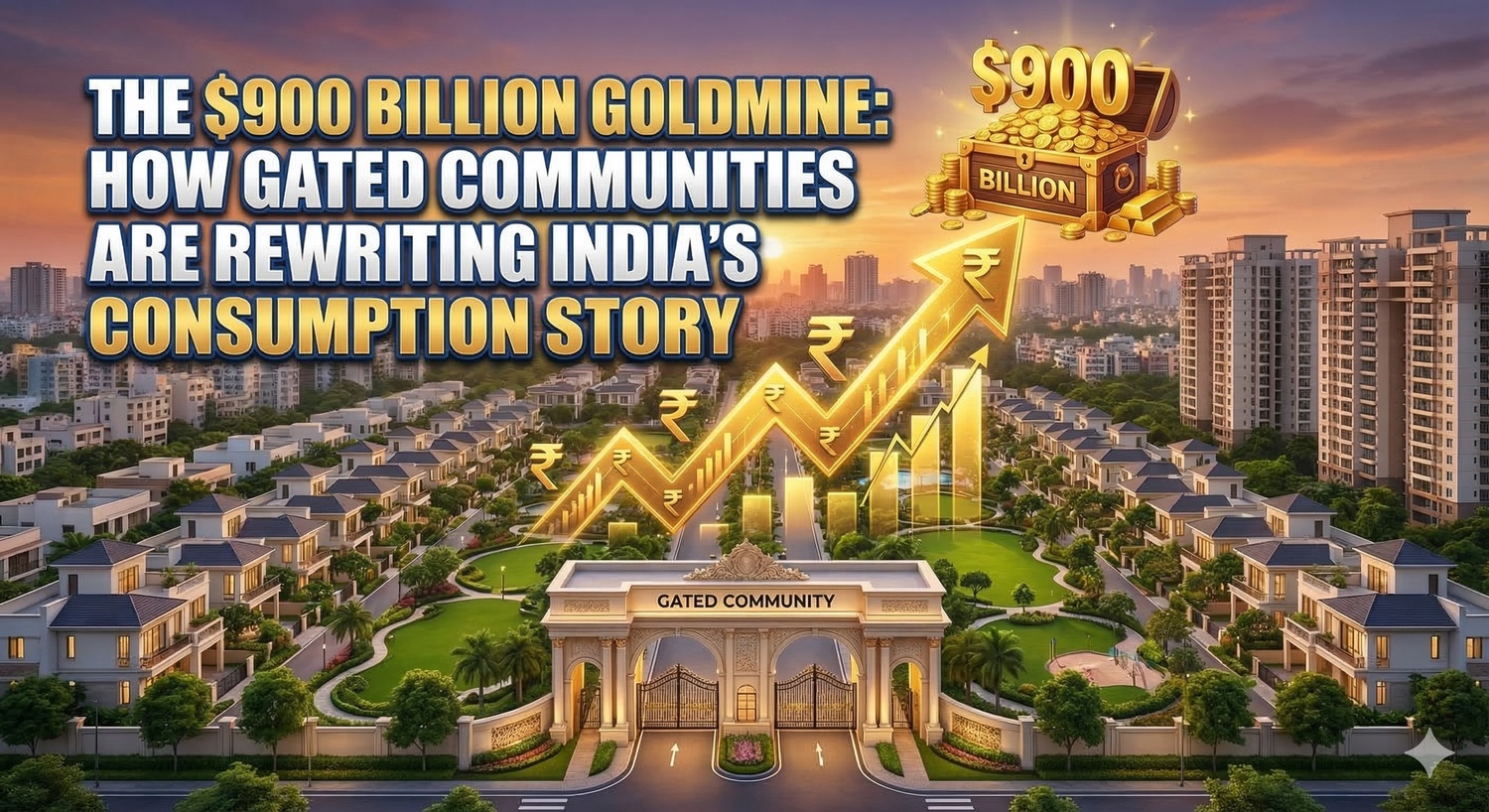
The urban landscape of India is undergoing a profound and silent structural transformation. For decades, urban retail and service demand was heavily scattered, fragmented across sprawling, unorganized neighborhoods and high-street markets. Today, the blueprint of city living has fundamentally changed. The modern Indian urbanite is increasingly gravitating toward structured, heavily managed residential ecosystems. These gated communities are no longer just secure places to live; they have rapidly evolved into privately governed, highly lucrative consumer markets.
Recent comprehensive market studies mapping out the next decade of urban growth highlight a staggering projection: these digitally integrated residential hubs are on track to generate nearly $900 billion in annual consumption by the fiscal year 2031.
This is not simply a real estate trend; it is a fundamental reorganization of the country's urban economy. As the nation premiumizes, consumer spending is consolidating. By understanding the underlying mechanics of these affluent clusters, brands, digital marketers, service providers, and logistics companies are unlocking a highly predictable and scalable economic goldmine.
To grasp the sheer scale of this $900 billion consumption unlock, one must first look at the underlying demographics and the massive shift toward community living. Within the next decade, managed townships and premium gated complexes are expected to house approximately 32 million households. To put that into perspective, that figure represents almost half of all homes across India's top fifty cities. Driven by a rising preference for nuclear family setups, the demand for top-tier security, and an appetite for resort-style amenities, we are witnessing the birth of localized micro-cities. These hubs operate with their own internal economies, social infrastructures, and digital networks.
The true economic power of these clusters lies in their concentrated affluence. The residents living within these secured perimeters possess a spending capacity that completely dwarfs the national average, typically earning five to seven times more. Currently, the per capita income in these premium pockets sits comfortably between $14,000 and $15,000. As India's broader economy expands and corporate wealth scales, this figure is projected to climb to an impressive $17,000 to $18,000 by 2031.
This creates premium consumption pockets that rival global standards in terms of disposable income. When you place thousands of high-earning, high-spending individuals inside a single, geographically confined area, the economic density becomes magnetic for businesses. Brands no longer have to cast a wide, inefficient net across an entire metropolitan city to find their target audience. The audience has neatly organized itself behind the gates of these townships.
Nowhere is the impact of this dense affluence more visible than in the realm of digital commerce. Gated communities are rapidly becoming the primary engine for online retail and rapid-delivery ecosystems. By the end of the decade, the households within these complexes are projected to drive an astonishing $80 billion to $90 billion in online retail spending. This means that a relatively small geographic footprint will account for roughly forty percent of India's total online market.
For quick-commerce platforms, grocery delivery services, and major e-commerce aggregators, these residential clusters solve the most expensive and complex puzzle of logistics: the last mile. Delivering single packages to scattered, independent houses is historically time-consuming and fuel-intensive. However, when a delivery executive enters a managed township, they can drop off ten, twenty, or even fifty orders in a single trip, often within the same high-rise tower.
E-commerce companies are actively optimizing their entire supply chains and inventory models around these specific hubs. Dark stores and micro-fulfillment centers are being strategically positioned right outside the walls of major gated communities to guarantee ultra-fast delivery. The high volume of repeat consumption—whether it is daily grocery drops, electronics, or premium fashion—ensures that the unit economics for delivery fleets improve dramatically. Efficiency in these clusters does not just increase; it compounds.
The operational backbone of the modern gated community is no longer a physical ledger and a lone security guard; it is a sophisticated, digital community management platform. These Software-as-a-Service (SaaS) applications have seamlessly integrated themselves into the daily lives of the residents, acting as the digital gatekeepers to the micro-city. From digitizing access control and managing visitor vehicle logs to processing monthly maintenance payments and booking recreational amenities, these platforms hold the ecosystem together.
Currently, the penetration of these digital management layers sits at around twenty-five percent. However, as more real estate developers mandate digital integration and older societies upgrade their infrastructure to modern standards, platform penetration is expected to surge past forty percent by 2031. This digital expansion will actively connect more than 12 million high-intent households onto standardized, highly active applications.
This digital infrastructure presents an enormous, largely untapped opportunity for the SaaS sector. The core market for providing these management tools is highly lucrative in its own right, estimated to reach upwards of $550 million. But the true financial windfall comes from the ancillary services built on top of these platforms. By aggregating demand for home cleaning, appliance repair, interior design, and even property management, these platforms are evolving into comprehensive lifestyle super-apps. The combined market opportunity for community management software and integrated home services is projected to hit an incredible $1.8 billion to $2 billion by 2031.
With millions of affluent consumers logging into their community management apps multiple times a day to approve visitors or pay utility bills, a massive new distribution channel for digital advertising has emerged. Digital marketers are rapidly recognizing that traditional online advertising often suffers from heavy ad fatigue, privacy restrictions, and unpredictable algorithmic targeting. In stark contrast, advertising within a gated community ecosystem offers unparalleled precision and zero wasted spend.
Brands know exactly the demographic they are reaching: high-income urbanites living in specific pin codes with known consumption habits. The performance metrics of this hyper-local digital marketing approach are remarkable. Integrated marketing campaigns that combine digital banner placements within the community app with physical, on-ground activations inside the clubhouse are yielding digital click-through rates (CTRs) of twelve to fifteen percent. Furthermore, the return on advertising spend (ROAS) in these environments routinely hits eight to twelve times the initial investment, a metric that far outpaces conventional social media advertising channels.
The addressable advertising market within these walled gardens is currently in its infancy, sitting at an estimated $25 million to $30 million. But as modern social media management and digital ad strategies pivot toward concentrated, high-intent audiences, this specific advertising vertical is forecasted to explode. Analysts project this market will reach approximately $800 million by the end of the decade. From luxury automobile test drives organized inside the complex to bespoke financial services pitched directly through the app, the marketing playbook is being completely rewritten for the micro-city.
For the real estate sector, this data entirely validates the shift toward massive, integrated township models. Developers are acutely aware that modern buyers are not just purchasing square footage; they are buying into a managed lifestyle ecosystem. The promise of quality urban living within secure premises, backed by a robust digital and physical infrastructure, is the absolute primary driver of premium property sales today.
By heavily investing in shared infrastructure, top-tier schools within the township, advanced healthcare facilities, upscale retail arcades, and expansive recreational amenities, developers enable dense and recurring consumption patterns without the resident ever needing to navigate city traffic. This holistic approach to urban planning not only attracts premium buyers but also significantly supports property pricing and aggressive long-term capital appreciation.
The realization that gated communities function as independent economic zones also forces urban planners and municipal bodies to rethink broader city development. As these private ecosystems become increasingly self-sufficient, the surrounding public infrastructure must evolve to support the heavy logistical flow of delivery fleets, service professionals, and transit networks feeding into these massive hubs.
The projection of a $900 billion consumption boom is a powerful testament to the changing fabric of Indian society. The traditional, sprawling chaos of the urban neighborhood has been digitized, gated, and economically optimized. As consumption rapidly premiumizes and consolidates within these structured residential ecosystems, businesses that recognize and adapt to this new geography of demand will reap massive rewards.
For digital platforms aiming to optimize last-mile density, marketers seeking precision targeting with unprecedented CTRs, and brands looking for the most lucrative distribution channels, the gated community is no longer just a residential address. It is the ultimate gateway to the future of India's urban economy. The businesses that integrate themselves seamlessly into these privately governed micro-cities today will undoubtedly be the ones dominating the consumer landscape of tomorrow.
