Published On:
April 14, 2026
Updated On:
April 14, 2026
The ₹2,000 crore, 86-km Paniyala-Barodameo Expressway is a six-lane greenfield project that will drastically reduce Delhi-Jaipur travel time to under two hours by completely bypassing the congested NH-48. Serving as a crucial link between the Trans-Haryana and Delhi-Mumbai expressways, the corridor is set to ignite massive logistics and real estate growth across the Khairthal and Alwar regions in Rajasthan.
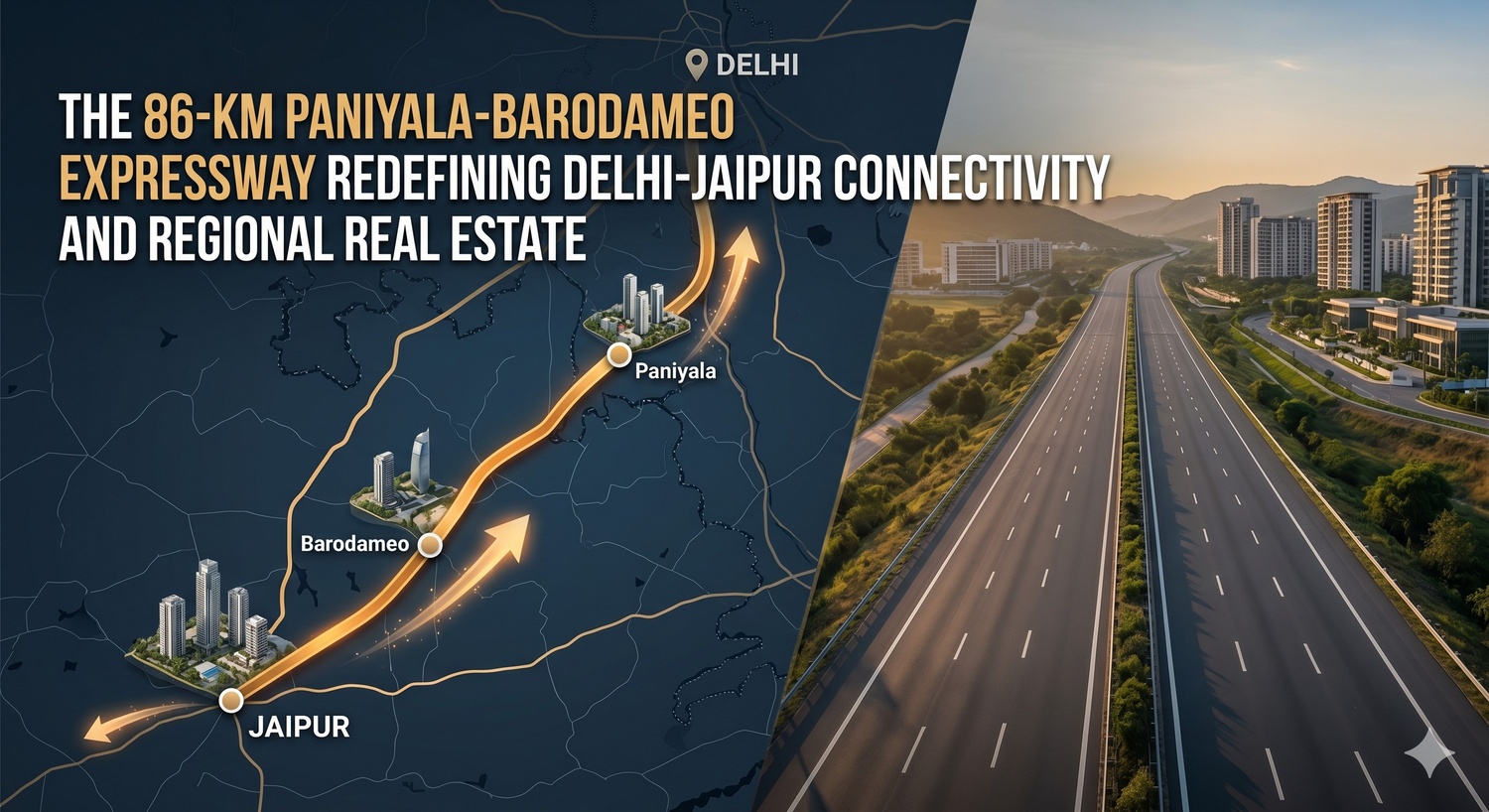
The transit corridor connecting the national capital to the Pink City is historically one of the most heavily traversed routes in the country, handling an immense daily volume of commercial freight, daily commuters, and international tourists. For decades, the entire burden of this massive vehicular movement has fallen squarely on National Highway 48. Anyone who frequently drives this route understands the inherent unpredictability of the journey. Navigating the heavy industrial traffic bottlenecks around Gurugram, Manesar, and Dharuhera routinely turns what should be a straightforward highway drive into an exhausting, start-and-stop ordeal. Even under the best traffic conditions, the trip stretches to nearly three hours.
However, a massive structural shift in regional infrastructure is currently underway in the state of Rajasthan, promising to permanently alter this transit equation. The Paniyala-Barodameo Expressway, an 86-kilometre access-controlled greenfield highway, is rapidly moving toward completion. By offering a direct, high-speed bypass that seamlessly connects major national corridors, this ₹2,000 crore project is engineered to cut the Delhi-Jaipur travel time down to a highly predictable 1.5 to 2 hours. Beyond just passenger convenience, this new tarmac is poised to unlock immense, previously untapped real estate and logistics potential deep across the interior districts of Rajasthan.
To fully grasp the regional impact of this new highway, it is necessary to look at its specific technical alignment. The Paniyala-Barodameo route is not a widening or a patchwork expansion of an existing state road; it is a completely new greenfield alignment. Built entirely from the ground up through previously unconnected agricultural landscapes, this six-lane expressway spans exactly 86.13 kilometres.
The corridor originates at Paniyala, located near the Kotputli area in the Jaipur district. From this northern starting point, it cuts a direct, diagonal path southeast, terminating at Barodameo in the Alwar district. Along its path, the highway integrates several key geographic and administrative zones, passing directly through the limits of Behror, Bansur, Khairthal, Alwar city, and Ramgarh.
Designed under the central government's overarching Bharatmala Pariyojana scheme, the highway is built for absolute vehicular efficiency. It features a strictly enforced top speed limit of 120 km/h for passenger cars. Because it is a greenfield project featuring heavily controlled access, vehicles utilizing this route will not face the constant, dangerous interruptions of local town traffic, random pedestrian crossings, or unregulated rural intersections that currently slow down the older NH-48 route.
The true long-term value of the Paniyala-Barodameo Expressway extends far beyond simply getting cars to Jaipur faster. Its primary function is to serve as a massive infrastructural bridge. It does not exist in isolation but operates as a vital missing link designed to merge two of India’s most expansive transportation networks.
At its northern origin point in Paniyala, the highway connects directly to the southern termination of the Trans-Haryana Expressway, also known as the Ambala-Kotputli Economic Corridor. On its southern end at Barodameo, it merges straight into the massive, high-capacity Delhi-Mumbai Expressway.
For the national logistics and supply chain sector, this integration is nothing short of revolutionary. A commercial heavy truck carrying manufactured export goods from the industrial belts of Punjab or Haryana can now completely bypass the heavily congested, pollution-restricted zones of the National Capital Region. The transport vehicle can travel rapidly down the Trans-Haryana corridor, merge onto the Paniyala-Barodameo link, and seamlessly transition onto the Delhi-Mumbai route heading straight for the deep-water ports of Gujarat and Maharashtra. This unbroken chain of high-speed, access-controlled tarmac drastically reduces freight transit times, significantly lowers fuel consumption, and optimizes supply chain economics for the entire northern manufacturing sector.
For the daily commuter or the frequent weekend traveler, the immediate, tangible benefit of this project is the return of highly predictable travel times. While Jaipur is geographically quite close to Delhi, the heavy reliance on the outdated NH-48 infrastructure has always made scheduling a gamble. A minor fender bender or heavy commercial truck movement near the massive factory hubs of Manesar can easily add an hour or more to the journey.
By providing a highly viable, parallel alternative, the new expressway effectively splits the massive traffic load. Drivers originating from South Delhi, Gurugram, or Faridabad can utilize the entry points of the Delhi-Mumbai Expressway, transition smoothly onto the Paniyala-Barodameo link, and arrive in the Jaipur district with unprecedented speed.
Cutting the travel time to under two hours transforms Jaipur from a purely weekend getaway destination into a highly feasible day-trip location. For certain business executives and corporate teams, it even opens up the possibility of long-distance daily commuting. It removes the baseline stress of unpredictable highway congestion, offering a smooth, barricaded, and controlled-access drive from the moment the vehicle leaves the city limits until it arrives at its destination.
Managing high-speed traffic transitions between massive national highways and local district road networks requires highly specialized civil engineering. To ensure smooth ingress and egress without causing localized bottlenecks, the project incorporates several heavily engineered interchanges.
The most notable of these engineering feats is currently under construction at Gajuki. Locally referred to as the "Jalebi Circle" due to its intricate, looping visual design, this massive spiral-style flyover and interchange spans across approximately 20 hectares of land. This sprawling, multi-level structure is specifically designed to completely separate conflicting traffic streams. It allows heavy commercial trucks and fast-moving passenger cars to merge, exit, and change directions without heavy braking, thereby completely avoiding the gridlock typical of traditional cloverleaf highway intersections.
Beyond the massive Gajuki structure, the expressway features several other strategically placed access points, including Taharki, Mandir, Nangla Wazirka, and Jugrawar. These junctions are incredibly critical because they act as the primary gateways for the local regional economy. They allow residents, local farmers, and businesses in the surrounding rural villages and smaller towns to directly access the national corridor, integrating the deep interiors of Rajasthan into the broader, fast-paced national economy.
Real estate markets follow infrastructure development with absolute certainty. Whenever an access-controlled expressway connects a previously peripheral region to a major metropolitan hub, a massive surge in land acquisition and property development inevitably follows. The Paniyala-Barodameo project is actively opening up a brand-new, highly lucrative growth corridor across the Khairthal, Bansur, and Alwar belts.
For decades, the real estate market in these specific areas was relatively subdued, primarily restricted to localized agricultural land sales, small-scale industrial plots, and slow-paced urban expansion. However, the prospect of having direct, signal-free access to both the Trans-Haryana and Delhi-Mumbai Expressways is completely altering the land economics of the region. Investors who have historically focused their capital on the highly saturated, expensive markets of Gurugram, Noida, or the Yamuna Expressway are now aggressively turning their attention to the Alwar belt, hunting for large, unzoned land parcels situated near the upcoming highway interchanges.
The demand profile emerging in this region is highly diversified. In the commercial and industrial sectors, major logistics companies, third-party freight operators, and e-commerce giants are actively scouting for massive tracts of land to establish state-of-the-art warehousing hubs and regional fulfillment centers. The underlying financial logic is incredibly straightforward: land acquisition costs in the Alwar district are currently a fraction of what they are in the National Capital Region, yet the new highway provides the exact same high-speed logistical access to the massive consumer markets of North India.
On the residential front, the region is witnessing a sharp, sustained uptick in interest for plotted developments, gated communities, and weekend farmhouses. Buyers from Delhi NCR, seeking permanent relief from severe urban air pollution, extreme traffic density, and exorbitant metropolitan property prices, are viewing the Alwar and Khairthal regions as highly attractive alternative investment zones. The ability to purchase a large, sprawling plot of land for a very reasonable price, while remaining just over an hour's drive away from the capital, is an extremely compelling proposition for affluent urban families.
Local and regional real estate developers are actively adapting to this shift in consumer interest. They are currently drafting plans for secure gated communities, expansive luxury farmhouses, and integrated commercial retail spaces situated right along the approach roads of the expressway junctions. They are banking heavily on the anticipated massive influx of transient highway traffic and the eventual migration of new residents seeking a quieter lifestyle. While the real estate market here is still in the early stages of its transformation, property prices across these micro-markets are already beginning to adjust upwards as they factor in the imminent reality of the connectivity upgrade.
Executing an 86-kilometre greenfield highway is a monumental task that requires years of massive land acquisition efforts, complex environmental clearances, and heavy earthmoving operations. Despite the inherent complexities of building across varied terrain, physical construction progress on the ground is moving at an impressively aggressive pace.
Currently, approximately 40 percent of the physical construction work has been fully completed. Heavy machinery and engineering teams are actively deployed across the entire stretch of the alignment. Structural work on the major vehicular underpasses, railway overbridges, and the critical, massive interchanges like the Gajuki circle is progressing simultaneously to ensure no single structure delays the overall launch.
The central highway authorities have set a strict, non-negotiable target to have the entire expressway fully operational by the end of 2026. However, in a bid to provide immediate relief to localized traffic and begin generating utility from the completed sections, the project is being executed in workable phases. There are strong indications from executing agencies that certain continuous sections of the highway could be opened for partial public use as early as September of this year. This phased rollout strategy will allow commercial freight vehicles and local daily commuters to begin utilizing the completed stretches immediately, instantly easing the heavy burden on the parallel, deteriorating state highways.
The Paniyala-Barodameo Expressway is far more than just a new stretch of smooth tarmac; it is a highly strategic, calculated infrastructural intervention. By intelligently bypassing the chronic congestion of NH-48 and physically linking the northern industrial manufacturing belts directly with the western shipping ports, it solves a massive logistical puzzle that has hindered regional economic growth for years.
For the frequent traveler or the weekend tourist heading to the heritage sites of Rajasthan, it promises a welcome return to stress-free, high-speed driving between Delhi and Jaipur. But its most lasting and profound legacy will undoubtedly be felt in the real estate markets and local economies of Alwar, Khairthal, and Bansur. By drastically cutting down travel times, it is transforming these traditionally quiet, agricultural districts into bustling, highly connected economic hubs. As heavy construction speeds towards its late 2026 completion date, this 86-kilometre corridor stands as a prime, indisputable example of how targeted, high-quality infrastructure can completely redefine the geography of regional real estate and drive sustained economic growth.
