Published On:
March 13, 2026
Updated On:
March 13, 2026
The newly approved 31.42-kilometer greenfield corridor will directly link Faridabad and the Delhi-Mumbai Expressway to the upcoming Jewar Airport. Backed by a massive ₹3,630 crore investment, this project is designed to eliminate regional mobility bottlenecks and ignite explosive real estate growth across the surrounding industrial zones.
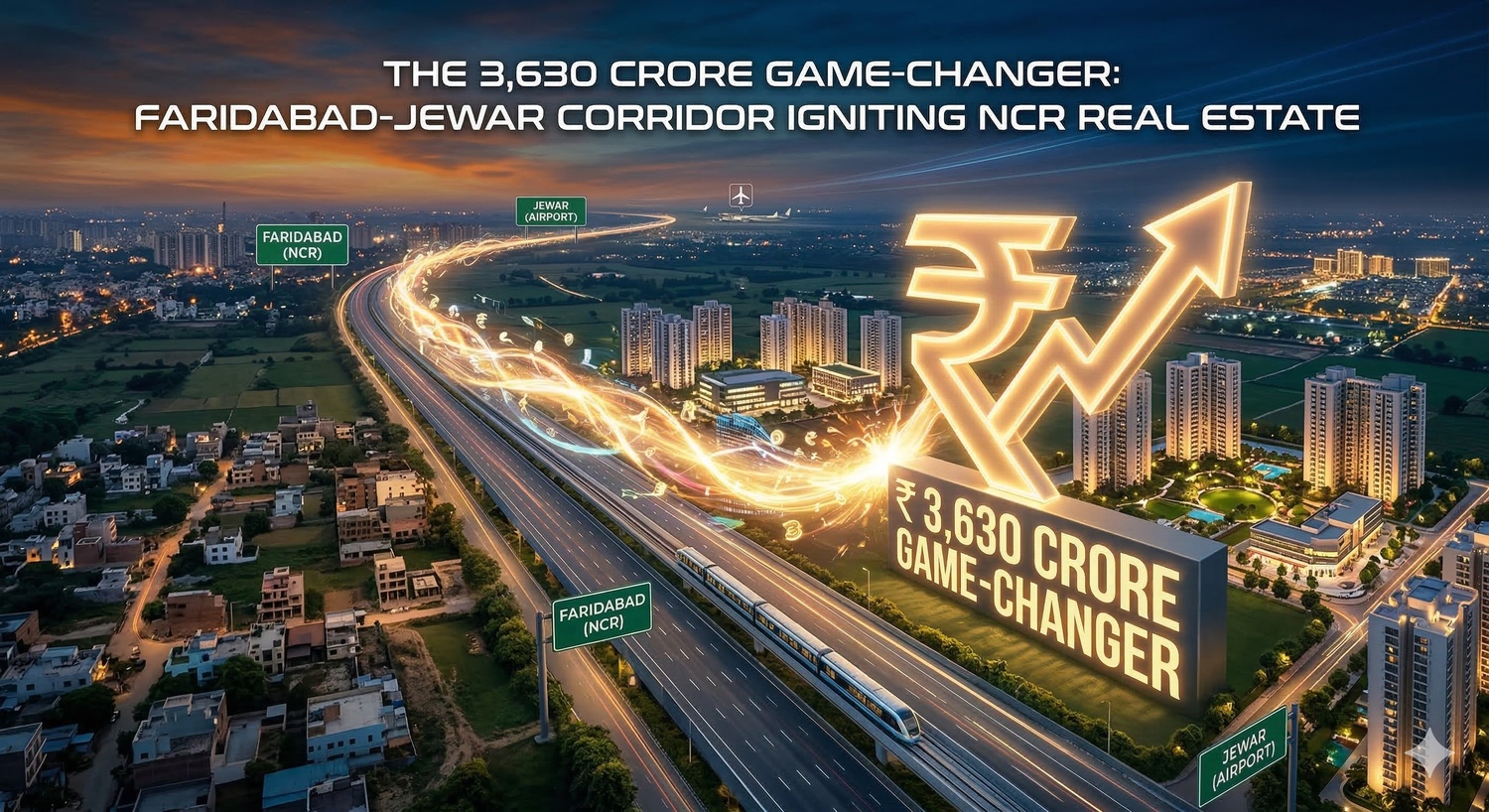
The National Capital Region is currently undergoing an infrastructural metamorphosis that will permanently redefine its economic geography. For decades, the region relied on a centralized mobility model heavily anchored around the congested arteries of central Delhi. However, as the urban sprawl aggressively expands outward, the demand for decentralized, high-speed connectivity has never been more urgent. The upcoming Noida International Airport at Jewar serves as the heavy anchor for this massive geographic shift, and the central government is ensuring that traveling to this mega-airport is as smooth as flying out of it.
In a highly anticipated move, the Cabinet Committee on Economic Affairs, chaired by the Prime Minister, officially approved a colossal ₹3,630 crore road corridor designed specifically to connect Faridabad with the Jewar Airport. This project is not a simple road widening exercise; it is a highly strategic, 31.42-kilometer greenfield expressway that will bridge the Delhi-Mumbai Expressway network directly to the new aviation hub. By erasing the physical friction between the heavily industrialized sectors of Haryana and the rapidly expanding real estate corridors of Uttar Pradesh, this infrastructure marvel is setting the stage for an unprecedented regional economic boom.
Executing a project of this massive magnitude requires a surgical approach to urban planning. The approved alignment involves constructing a brand-new, high-speed greenfield corridor that branches directly off from the Delhi-Faridabad-Ballabhgarh-Sohna spur of the Delhi-Mumbai Expressway. From there, it cuts a precise path across the borders of Haryana and Uttar Pradesh, creating a direct, zero-signal conduit straight to the airport terminals at Jewar.
The construction of this road will be developed across the two states, creating a unified mobility grid that ignores state borders. By carving out a completely new greenfield route rather than attempting to expand existing, heavily encroached local roads, the planning authorities are guaranteeing a world-class, uninterrupted driving experience that meets international highway standards.
Building a greenfield highway through heavily populated and rapidly expanding urban zones is notoriously complex. One of the primary engineering challenges faced by the project planners was navigating the dense residential and commercial landscape laid out in the Faridabad Master Plan 2031. To bulldoze a surface-level highway through these specific areas would mandate massive, highly expensive land acquisitions and severely disrupt existing local communities.
To bypass this hurdle entirely, the master blueprint includes the construction of a massive 11-kilometer elevated highway section between the DND-Ballabgarh Bypass and Jewar Airport. This elevated stretch is an absolute masterclass in spatial efficiency. By elevating the high-speed transit, the planners are actively preserving the ground-level real estate for future urban expansion, localized commercial development, and essential internal city transit networks.
The financial breakdown for this specific elevated structure highlights the collaborative, high-priority nature of the project. The 11-kilometer viaduct alone is projected to cost approximately ₹689 crore. Recognizing the immense, long-term economic value this link brings to its side of the border, the Haryana state government has committed an impressive ₹450 crore directly toward the construction of this elevated section. This financial synergy between state and central authorities proves exactly how critical this specific bottleneck-busting structure is to the overall success of the corridor.
The true economic power of any major infrastructure project lies in its ability to integrate flawlessly with existing and upcoming networks. The Faridabad-Jewar greenfield corridor is intelligently designed to function as a master interchange, crossing and connecting with several of Northern India's most critical transport arteries.
As the corridor stretches eastward toward the airport, it will strategically intersect with the Eastern Peripheral Expressway, the Yamuna Expressway, and the Dedicated Freight Corridor. This is a deliberate, highly calculated engineering decision. For passenger vehicles coming from South Delhi, Gurugram, or Faridabad, this means they can easily transition onto the new spur, bypass the suffocating traffic of central NCR, and arrive at their boarding gates in record time.
However, the implications for commercial freight are even more profound. Having the Dedicated Freight Corridor cross paths with an expressway leading directly to an international air cargo terminal creates a frictionless, multi-modal logistics loop. Heavy trucks carrying manufactured goods from the industrial estates of Haryana can now transition smoothly onto the rail freight network or head straight to the airport tarmac for global export. This drastically reduces turnaround times, slashes localized transportation costs, and turns the entire region into a highly competitive global supply chain hub.
In the real estate sector, there is a fundamental rule: where massive infrastructure goes, immense capital appreciation inevitably follows. For property investors who have been closely tracking the Yamuna Expressway Industrial Development Authority (YEIDA), Greater Noida, and Noida markets, the approval of this road project serves as a massive, immediate demand catalyst.
Over the past few years, the entire YEIDA zone has transitioned from an ambitious concept into a heavy construction site. The state government has aggressively allotted massive land parcels for specialized projects, including the International Film City, the Medical Device Park, and sprawling apparel and toy manufacturing hubs. However, for these massive industrial zones to function profitably, they need a frictionless way to transport their workforce and their physical goods to and from the neighboring states.
This new 31.42-kilometer greenfield corridor entirely solves the west-to-east mobility puzzle. By directly connecting the affluent, high-density corporate populations of Gurugram, South Delhi, and Faridabad to the Jewar region, the demand for premium residential and commercial real estate in the YEIDA sectors is poised for explosive, sustained growth. As the physical distance is compressed by high-speed tarmac, corporate executives working in Haryana will view the sprawling, low-density luxury townships and plotted developments emerging in Greater Noida and along the Yamuna Expressway as highly viable, primary residences.
Furthermore, commercial developers are aggressively acquiring land banks near the planned interchanges of this new corridor. Multinational corporations, logistics operators, and luxury hospitality brands recognize the immense value of establishing their headquarters right at the intersection of a major interstate expressway and an international airport. The transition of the YEIDA and Greater Noida regions into execution-driven, premium real estate powerhouses is now completely locked in, with raw land and finished asset valuations expected to reflect this newly approved infrastructure almost immediately.
The ripple effects of this connectivity project extend far beyond localized real estate and housing. It acts as a massive force multiplier for the ambitious Delhi-Mumbai Industrial Corridor (DMIC). This mega-infrastructure program aims to create a globally competitive manufacturing and investment destination spanning the vast distance between India's political and financial capitals.
The Faridabad-Jewar road link essentially plugs the upcoming aviation hub directly into the DMIC ecosystem. Industrial sectors located in Faridabad and Ballabhgarh have long suffered from congested logistics routes that choked their export potential and delayed shipping schedules. Now, manufacturing units producing everything from automotive components to consumer electronics will have a dedicated, high-speed channel to export their goods internationally via Jewar Airport.
This industrial connectivity will inevitably trigger a massive influx of corporate investment into the surrounding areas. Businesses will rush to set up massive warehousing facilities, cold storage units, and heavy fulfillment centers along the fringes of the new corridor. As these commercial entities break ground, they will generate tens of thousands of localized white-collar and blue-collar jobs. This employment explosion guarantees a permanent, organic demand for housing, retail centers, and social infrastructure, creating a highly sustainable cycle of regional wealth creation.
While the spotlight often shines on the Uttar Pradesh side of the border due to the airport, it is essential to analyze how this corridor completely revitalizes Faridabad and benefits Gurugram. Faridabad has historically been the underdog of the NCR, heavily overshadowed by the glittering high-rises and massive corporate parks of Gurugram and Noida. The primary reason for this slower growth was a distinct lack of high-speed connectivity to the region's major economic anchors.
The new ₹3,630 crore project single-handedly fixes this historical disadvantage. Faridabad is suddenly positioned as the primary gateway connecting the entire Haryana industrial belt to the Jewar Airport. This enhanced geographic relevance is already prompting major real estate developers to launch premium residential projects and modern commercial complexes within the city boundaries. For Gurugram residents, who currently face a grueling, unpredictable commute to the Indira Gandhi International Airport in Delhi, the new corridor offers a highly attractive, signal-free alternative to reach an international aviation hub.
Executing a ₹3,630 crore project requires highly disciplined financial structuring to ensure the highway does not stall halfway through construction due to a lack of funds. The government has smartly opted to develop this corridor using the Hybrid Annuity Model (HAM). For those tracking infrastructure development, this model is a masterclass in risk mitigation and rapid execution.
Under this financial framework, the government absorbs a significant portion of the initial financial burden by releasing forty percent of the project cost during the active construction phase. This upfront injection of public capital ensures that the private developer has the continuous cash flow needed to deploy heavy machinery, procure raw materials, and pay contractors without relying entirely on expensive, high-interest commercial bank loans.
The remaining sixty percent of the project cost is not paid as a single lump sum. Instead, it is disbursed by the government as fixed annuity payments spread out over the operational lifecycle of the highway, typically spanning fifteen years. This completely removes the paralyzing toll-collection risk from the developer's shoulders. Because the private entity knows their return on investment is guaranteed by the state through these annuities, they can focus entirely on delivering high-quality, durable construction on a highly aggressive timeline, knowing they will not be penalized by unpredictable traffic volumes.
The aggressive push to build this connecting road corridor aligns perfectly with the rapid progress happening on the tarmac at Jewar. The Noida International Airport is steadily moving from a massive construction site to a fully operational aviation facility. In a major milestone for the project, the airport delegation recently presented the official aerodrome license to the Chief Minister of Uttar Pradesh, indicating that the facility has met the rigorous safety and operational standards required to host commercial flights.
When the very first phase of the airport officially launches, it will feature a state-of-the-art terminal building and a single, highly advanced runway capable of handling the largest commercial passenger and cargo aircraft. Initially, the airport is designed to manage an impressive 12 million passengers annually.
If the connecting road infrastructure was delayed, this massive 12-million passenger capacity would result in immediate, paralyzing ground-level traffic jams across the existing expressway network. By approving and funding the Faridabad connection right now, the central government is ensuring that the ground transportation network is fully capable of absorbing the massive influx of international travelers, transit passengers, and heavy cargo trucks the exact moment the first commercial flight takes to the skies.
The National Capital Region is far too massive and economically important to rely on piecemeal, reactive road widening. It requires a bold, calculated vision for urban mobility that anticipates future bottlenecks years before they happen. The Faridabad to Jewar greenfield corridor is the physical embodiment of this proactive planning philosophy.
It takes an immense level of administrative coordination to align a central cabinet approval, a hybrid financing model, a multi-state financial contribution for an elevated highway, and the physical intersection of four separate massive expressways. Yet, the successful orchestration of these moving parts proves that regional infrastructure execution is entering a highly mature, sophisticated phase.
The approval of the ₹3,630 crore Faridabad-Jewar greenfield corridor is the definitive linchpin that will tie the entire southern NCR together. By directly connecting the heavy industrial zones of Haryana with the hyper-modern aviation and real estate hubs of Uttar Pradesh, this 31.42-kilometer stretch of tarmac will unlock billions of dollars in economic value. As the heavy machinery mobilizes to lay down the first layers of this greenfield highway, the future of NCR mobility—and the massive real estate boom that will inevitably follow it—is officially taking shape.
