Published On:
April 23, 2026
Updated On:
April 23, 2026
A recent incident involving a Noida resident deeply regretting his massive real estate investment due to crumbling building exteriors and severe pest infestations has ignited a massive debate regarding the abysmal construction quality and lack of accountability within the NCR premium housing market.
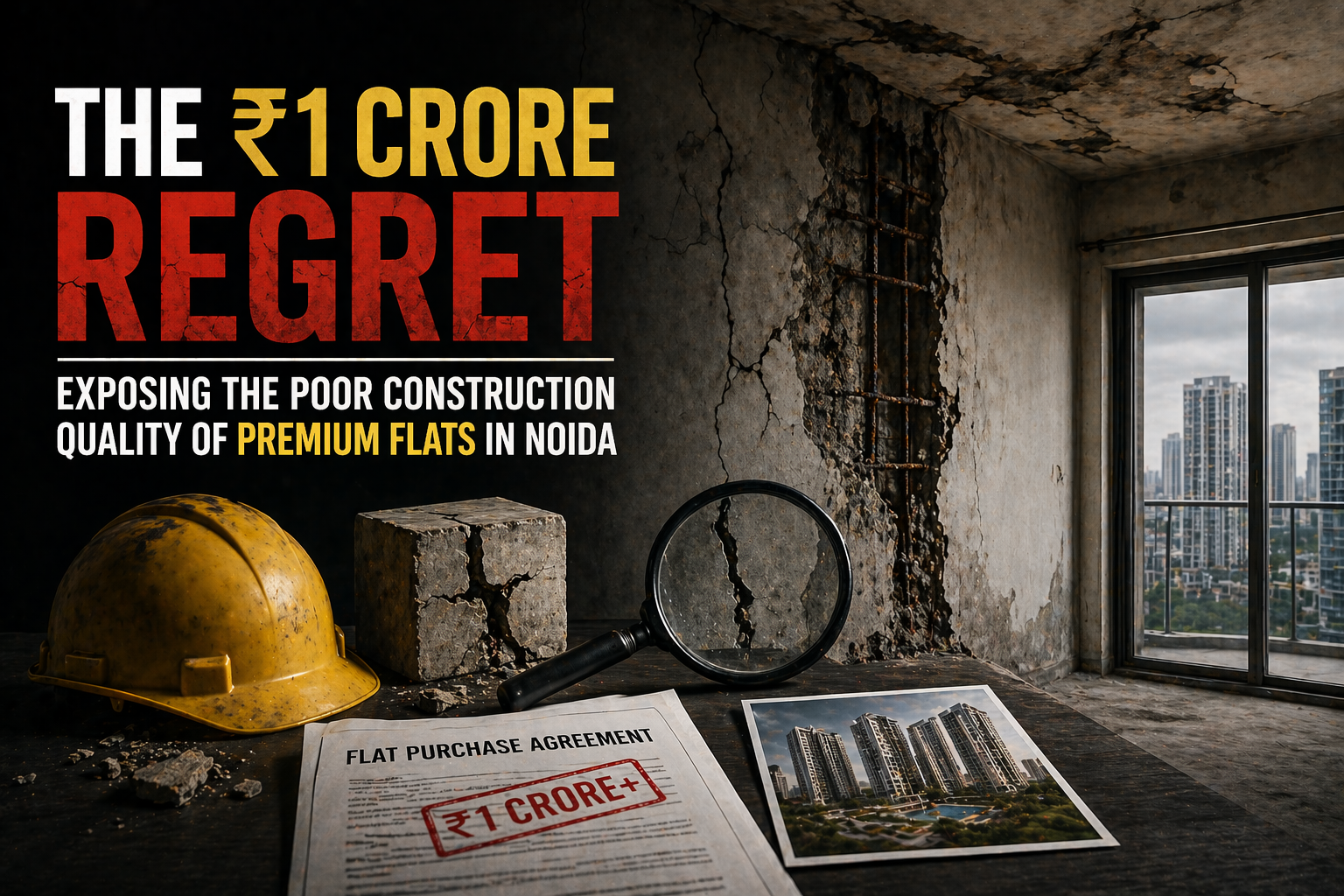
The dream of owning a premium home in the National Capital Region is heavily marketed as the ultimate milestone of personal and financial success. For years, real estate developers have sold the vision of elevated, resort-style living, complete with sprawling clubhouses, manicured landscapes, and high-tech security. In markets like Noida and Greater Noida, the psychological benchmark for this luxury lifestyle has firmly established itself around the massive eight-figure mark. However, a deeply frustrating reality is beginning to shatter this carefully curated illusion. Thousands of homebuyers are discovering that an exorbitant price tag no longer guarantees basic structural integrity, peace of mind, or even a hygienic living environment.
A recent wave of intense public frustration was triggered when a homebuyer documented the deeply depressing state of his newly acquired high-rise apartment. After sinking a massive sum into a property situated high up on the twenty-second floor of a supposedly premium society, the buyer was met with a living experience that felt more like a compromise than a luxury. The core of his grievance highlighted a sentiment that resonates with countless residents across the region: the sheer agony of paying top-tier prices only to be handed a product riddled with fundamental flaws.
+1
To understand the depth of this buyer frustration, one must look at the rapid evolution of the Noida real estate market. Just a decade ago, investing such a massive amount of capital in this region would have easily secured a sprawling, independent villa or an ultra-luxury penthouse with bespoke finishes. Today, due to skyrocketing land valuations and aggressive inflation, that same amount often only buys a standard three-bedroom apartment in a densely packed high-rise cluster.
Buyers willingly pay these massive premiums, assuming that the high cost acts as an insurance policy against poor craftsmanship. The reality on the ground is drastically different. Upon taking possession, many owners are greeted by crumbling exterior plaster, heavily discolored facades, and visible structural cracks before the building has even weathered a single monsoon season. In the specific case that recently caught the public's attention, the exterior walls of the premium tower were already shedding layers of construction material, making the brand-new residential complex look like a decades-old, dilapidated structure.
+1
This creates a deeply jarring contrast for the homeowner. Inside their private apartments, buyers spend additional lakhs on custom interior design, imported flooring, and modular kitchens to create their perfect sanctuary. Yet, the moment they step onto their balconies or look at the building from the ground, the decaying exterior completely betrays the premium nature of their investment. The underlying issue stems from builders aggressively cutting corners on essential raw materials, utilizing subpar cement mixtures, and rushing the curing process to meet tight delivery deadlines and maximize their profit margins.
Structural decay is only the first layer of the nightmare for many new homeowners. Living in a massive, multi-tower residential complex introduces a unique set of hygienic challenges that buyers rarely anticipate during the purchasing phase. One of the most prevalent and deeply frustrating issues plaguing high-rise societies in Noida and Gurugram is the uncontrolled pigeon population and the subsequent sanitation crisis it creates.
In many newly delivered projects, a significant percentage of the apartments are purchased purely for investment purposes. These flats often remain locked, unfurnished, and entirely unoccupied for years as the investors wait for capital appreciation. These abandoned balconies quickly become safe havens and nesting grounds for urban birds. Without regular cleaning, the accumulated waste turns these adjacent, empty units into massive biological hazards.
+1
The homeowner dealing with the crumbling plaster also documented the severe consequences of living next to one of these abandoned units. The unchecked accumulation of waste next door created a breeding ground for strange, unidentifiable insects that eventually infested his own home. Despite installing safety nets, the sheer volume of the infestation made his expensive apartment virtually uninhabitable. The biological hazard escalated to the point where the unhygienic environment allegedly caused a severe medical issue, resulting in a painful eye infection for the resident.
+1
This scenario highlights a massive failure in facility management. When a buyer pays heavy monthly common area maintenance charges, they expect the estate management to intervene in such crises. However, facility managers often refuse to clean locked private balconies, citing trespassing rules, leaving the active residents to suffer the health consequences of their absent neighbors.
When incidents of poor construction and massive hygienic failures surface, the immediate question turns to accountability. Who is responsible when a highly expensive real estate asset begins to physically degrade within months of handover? In a perfectly regulated market, the developer would be legally bound to rectify these structural defects immediately.
Unfortunately, the real estate ecosystem in the National Capital Region is notorious for its lack of swift grievance redressal. While regulatory bodies were established to protect buyer interests and enforce defect liability periods, the actual process of holding a massive development firm accountable is exhausting. Homeowners are often trapped in an endless loop of raising maintenance tickets, arguing with localized facility managers who have no real authority, and waiting for structural audits that rarely materialize.
The overwhelming sentiment among disillusioned buyers is that developers simply abandon the project once the final payment is cleared and the possession letters are handed over. The flashy marketing brochures that promised a world-class lifestyle are quickly replaced by the harsh reality of fighting for basic patchwork repairs. This lack of accountability forces many residents to dip into their own pockets, or heavily deplete the society's sinking fund, to fix structural issues that should never have existed in a newly constructed tower.
The sheer volume of structural complaints emerging from premium high-rises has reignited a long-standing debate among Indian real estate investors regarding the true value of apartment ownership. For generations, the ultimate measure of property security in India was owning a piece of independent land. The shift towards apartment living was driven by the promise of better security, community amenities, and hassle-free maintenance.
However, as the quality of high-rise construction continues to decline, many buyers are heavily regretting their transition to apartment living. The core argument against sinking massive capital into a flat is the total loss of control over the asset. When you own a high-rise apartment, your ownership is essentially limited to the airspace between your interior walls. You have absolutely no control over the quality of the exterior facade, the structural integrity of the foundation, the maintenance of the common corridors, or the hygienic habits of the people living immediately above or beside you.
Many frustrated residents are publicly advising prospective buyers to pivot their investment strategies entirely. The emerging consensus suggests that purchasing a smaller plot of independent land or opting for a builder-floor arrangement offers significantly better long-term security. With an independent property, the owner retains total control over the construction materials used, the quality of the plumbing, and the maintenance of the exterior facade, ensuring that the heavy financial investment actually results in a durable, high-quality asset.
There is a growing realization that the pricing of real estate in hubs like Noida is increasingly detached from the actual cost and quality of construction. The valuation of these premium properties is driven almost entirely by location, perceived brand value, and aggressive speculative marketing, rather than the tangible quality of the brick and mortar.
Buyers are essentially paying millions for a specific zip code and access to a clubhouse, while the actual structural shell they live in is built using the most cost-effective, mass-production methods available to the contractor. This aggressive profit optimization by developers results in the exact scenarios being heavily criticized today: paper-thin walls, hollow-sounding tiles, poorly sealed windows that leak during heavy rain, and exterior paint that fades and peels under the harsh summer sun.
The psychological toll on the buyer is immense. Securing a massive home loan and committing a significant portion of one's lifetime earnings to an asset, only to watch it physically deteriorate before the first few EMI payments are even completed, causes profound financial anxiety. It shatters the feeling of security that homeownership is supposed to provide.
The rising tide of buyer regret serves as a massive cautionary tale for anyone looking to enter the premium real estate market. Navigating this landscape requires completely abandoning emotional purchasing decisions and adopting a highly critical, investigative approach. Relying purely on the visual appeal of a fully furnished sample flat or a beautifully rendered digital brochure is a guaranteed path to disappointment.
Prospective buyers must conduct exhaustive due diligence that goes far beyond checking the property's legal titles and location benefits. The most critical step is to thoroughly investigate the developer's historical track record regarding construction quality and post-possession maintenance. This requires physically visiting older projects delivered by the same builder, specifically those that have been operational for five to seven years. Inspecting the current condition of the exterior facades, the basement parking levels, and the common area plumbing in these older societies provides a highly accurate preview of how a new project will age.
Furthermore, engaging directly with the current residents of those older societies is invaluable. Buyers should actively seek out the local resident welfare associations to inquire about hidden maintenance costs, the responsiveness of the facility management team, and any recurring structural issues like severe water seepage or electrical faults.
It is also highly advisable to hire an independent structural engineer or a professional home inspection service before finalizing the purchase or taking physical possession of the unit. These professionals utilize specialized equipment to detect hollow tiling, uneven flooring gradients, poor wall alignments, and hidden moisture accumulation that the untrained eye will easily miss. Identifying these defects before signing the final handover documents forces the developer to rectify the issues at their own cost.
The growing visibility of these real estate nightmares highlights a desperate need for systemic reform within the housing sector. While real estate regulatory authorities have successfully cracked down on project delays and financial mismanagement, the focus must urgently shift toward enforcing strict, uncompromising standards for construction quality.
Developers must be held to rigorous, scientifically backed material testing standards, and the penalties for delivering structurally deficient buildings need to be severe enough to deter the practice of cutting corners. Furthermore, the defect liability period, which currently forces builders to fix structural issues for a limited time post-possession, needs to be monitored and enforced much more aggressively.
Until these systemic changes are implemented, the burden of ensuring quality falls entirely on the shoulders of the consumer. Buying a premium home in the current market environment requires a healthy dose of skepticism and an uncompromising demand for quality. The harsh reality of modern real estate is that a massive price tag is no longer a guarantee of a premium living experience. It is merely the cost of entry, and securing a truly high-quality home requires rigorous investigation, extreme patience, and the willingness to walk away from a bad deal, no matter how attractive the marketing brochure might appear.
