Published On:
February 13, 2026
Updated On:
February 13, 2026
The Uttar Pradesh government has earmarked a massive ₹750 crore in its 2026-27 budget specifically for the Noida International Airport at Jewar, driving its expansion from a two-runway facility to a five-runway global hub. With the bulk of funds dedicated to rapid land acquisition, this strategic financial push is set to transform the Yamuna Expressway region into India's premier aviation, logistics, and real estate powerhouse.
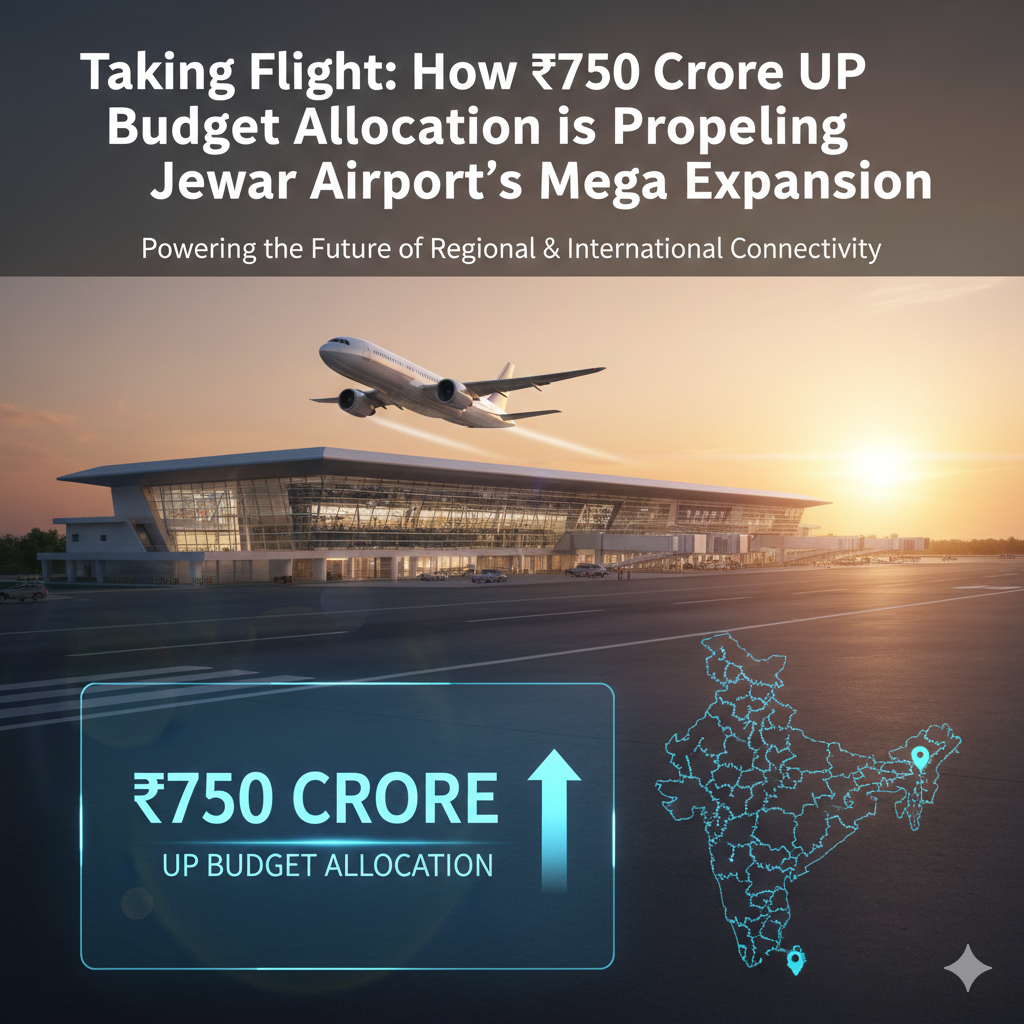
The infrastructure narrative of Uttar Pradesh is undergoing a historic rewrite. A state once scrutinized for its lack of basic connectivity is now aggressively positioning itself as the undisputed aviation capital of India. In a definitive move that underscores this ambition, the state government recently unveiled its budget for the financial year 2026-27. While the overarching financial blueprint touched upon various developmental sectors, the spotlight shone brightest on civil aviation, which received a staggering proposed outlay of ₹2,111 crore.
At the very heart of this financial masterplan lies the Noida International Airport (NIA) in Jewar. Earmarked for a dedicated capital injection of ₹750 crore, this greenfield project is rapidly evolving from a regional transit alternative into a colossal, multi-runway international aviation hub. For real estate investors, logistics corporations, and the everyday commuter in the National Capital Region (NCR), this budget allocation is not just a line item; it is a clear signal that the economic center of gravity is shifting decisively toward Western Uttar Pradesh.
To understand the sheer scale and intent of this budget, it is crucial to break down how the ₹750 crore will be deployed on the ground. A cursory glance at an airport budget might lead one to assume the funds are destined for glass facades, baggage carousels, or tarmac paving. However, the reality of the UP government’s strategy is far more foundational and forward-looking.
Out of the total allocation, a massive ₹700 crore—amounting to over 93% of the funds—has been strictly reserved for land acquisition. The remaining ₹50 crore is set aside for immediate construction-related works and finishing touches.
Why is such a disproportionate amount being spent on buying land when the first phase of the airport is already built? The answer lies in a radical expansion of the project's long-term scope. Initially, the master plan for the Jewar facility was designed around a twin-runway system. However, recognizing the explosive, sustained growth in both domestic and international passenger traffic, along with the booming e-commerce logistics sector, the state government has officially revised the blueprint. The new mandate is to accommodate an unprecedented five runways.
To achieve this, the government is securing the necessary space now, effectively future-proofing the project before surrounding land prices skyrocket out of reach or become entangled in complex red tape.
The development of the Noida International Airport is structured across four meticulously planned phases, executed under a public-private partnership (PPP) model by Yamuna International Airport Private Limited—a subsidiary of the globally renowned Zurich Airport International AG. The recent budget allocation is the financial fuel required to transition seamlessly between these phases.
The first phase, sprawling across 1,334 hectares and built at an estimated cost of ₹4,588 crore, is a testament to rapid execution. The primary infrastructure, including the state-of-the-art passenger terminal, the air traffic control tower, and the first Code 'E' runway, is structurally complete. Designed to handle 1.2 crore (12 million) passengers annually, this initial phase is currently navigating its final security checks and is awaiting its crucial aerodrome license from the Directorate General of Civil Aviation (DGCA). With successful trial runs already concluded, commercial operations are slated to commence imminently in early 2026.
Simultaneously, the groundwork for the second phase has been solidified. Spanning 1,365 hectares, the land acquisition for this phase is already complete, with compensation distributed to the farming communities. This tract is vital as it will house an additional runway and the foundational infrastructure for specialized aviation services.
This is where the newly allocated ₹700 crore comes into play. The third and fourth phases are incredibly ambitious, requiring a combined total of 2,053 hectares of land. The administration has identified 14 surrounding villages from which 1,889 hectares will be acquired, with the remaining land already under government possession.
To ensure a smooth and equitable transition, the government has set a compensation rate of ₹4,300 per square meter for the displaced landowners. By deploying the budget to swiftly acquire this land, the authorities are paving the way for the third, fourth, and fifth runways. Once all four phases are fully realized, the airport's passenger handling capacity will scale up to a staggering seven crore (70 million) flyers every single year, placing it in the elite tier of global mega-hubs.
The vision for Jewar extends far beyond merely moving people from one city to another. The state intends to position the Noida International Airport as a comprehensive, self-sustaining aviation ecosystem.
A central pillar of this strategy is the planned establishment of an aviation innovation and research center, coupled with a massive Maintenance, Repair, and Overhaul (MRO) hub. Currently, a significant portion of the Indian commercial aviation fleet is flown overseas to countries like Singapore or the UAE for major servicing and repairs, draining valuable foreign exchange and increasing aircraft downtime.
By establishing a dedicated, world-class MRO facility within the Jewar complex—specifically utilizing the land acquired in Phase 2—India can domesticate these highly specialized engineering services. This move will support ancillary industries, generate thousands of highly skilled technical jobs, and attract international airlines looking for cost-effective maintenance bases in South Asia.
While the mega-airport at Jewar rightfully dominates the headlines, the FY 2026-27 budget demonstrates a holistic approach to civil aviation across Uttar Pradesh. The government acutely understands that a single international hub is only as strong as the regional network feeding into it.
Out of the total ₹2,111 crore civil aviation budget, a hefty ₹1,100 crore has been proposed for the construction, expansion, and strengthening of airstrips across the entirety of the state. This massive secondary allocation is heavily focused on land acquisition for smaller, regional airports, working in tandem with the central government’s Regional Connectivity Scheme (UDAN). The goal is to democratize air travel, ensuring that citizens in Tier-2 and Tier-3 cities have rapid, reliable access to the state capital and the national capital region.
Furthermore, targeted micro-allocations highlight the state's meticulous attention to detail. For instance, the rapidly growing Ayodhya Airport has been granted an additional ₹7 crore. This includes ₹5 crore specifically for the construction of critical approach roads for its upcoming second terminal, and ₹2 crore for land acquisition to establish a dedicated police outpost. This targeted funding ensures that religious and cultural tourism corridors remain robust, safe, and easily accessible to the millions of pilgrims visiting the state annually.
The injection of ₹750 crore into the Jewar airport project transcends the boundaries of transportation; it acts as a profound economic catalyst. For Western Uttar Pradesh, the operationalization and continuous expansion of the airport is triggering a renaissance in urban development and real estate, often referred to by market analysts as the "Velocity Factor."
The immediate vicinity of the airport, particularly along the Yamuna Expressway, is rapidly transforming into a highly sought-after commercial destination. The presence of a five-runway international airport, complete with high-efficiency cargo terminals, provides businesses with an unmatched logistical advantage. Multinational corporations, e-commerce giants, and electronics manufacturers are securing large land parcels to set up global capability centers, warehousing hubs, and industrial parks. They recognize that proximity to a major global transit hub dramatically reduces supply chain friction.
Industrial growth does not happen in a vacuum; it requires a vast supporting ecosystem. The massive job creation spurred by the airport—ranging from pilots and ground crew to logistics managers and hospitality staff—is flooding the region with a high-quality professional workforce.
Consequently, the real estate markets in Greater Noida, Greater Noida West (Noida Extension), the Yamuna Expressway sectors, and Jewar town are witnessing sustained, robust appreciation. Property prices in these zones have already surged by 25% to 40% over the last two years. As the airport transitions from construction to active operation, this appreciation momentum is expected to accelerate. End-users and investors are snapping up premium residential townships, anticipating higher rental yields (projected to hit 4% to 6%) and massive long-term capital gains.
For the residents of Noida and Greater Noida, the airport also brings an immediate, tangible lifestyle upgrade: the end of the grueling, unpredictable three-to-four-hour drives through heavy city traffic to reach Delhi's Indira Gandhi International (IGI) Airport.
To support this massive influx of people and cargo, the region is seeing simultaneous transport upgrades. Plans are actively progressing for metro rail connectivity linking Noida directly to Jewar, alongside proposed High-Speed Rail corridors and the widening of existing expressways. This web of connectivity ensures that the airport does not become an isolated island but functions as the beating heart of a highly integrated regional economy.
The Uttar Pradesh budget for the financial year 2026-27 is a masterclass in infrastructural foresight. By allocating ₹750 crore specifically for the expansion of the Noida International Airport, the state government has moved beyond the initial excitement of launching a new facility. Instead, it has laid the concrete financial foundation required to build India’s largest aviation hub.
The strategy to secure over 2,000 hectares of land today for the runways of tomorrow proves a commitment to long-term, uninterrupted growth. As the first commercial flights prepare to take to the skies from Jewar in the coming months, the region stands on the precipice of unparalleled connectivity. The dust at the construction sites along the Yamuna Expressway is not just the byproduct of building an airport; it is the undeniable sign of a massive economic engine roaring to life, ready to propel Uttar Pradesh onto the global stage.
