Published On:
May 29, 2026
Updated On:
May 29, 2026
Discover how to effortlessly perform an online land ownership check and verify Khasra Khatauni records through state-specific digital portals. This comprehensive guide explains the modernization of property verification in India, helping buyers and landowners secure their investments, expedite loan approvals, and avoid real estate fraud.
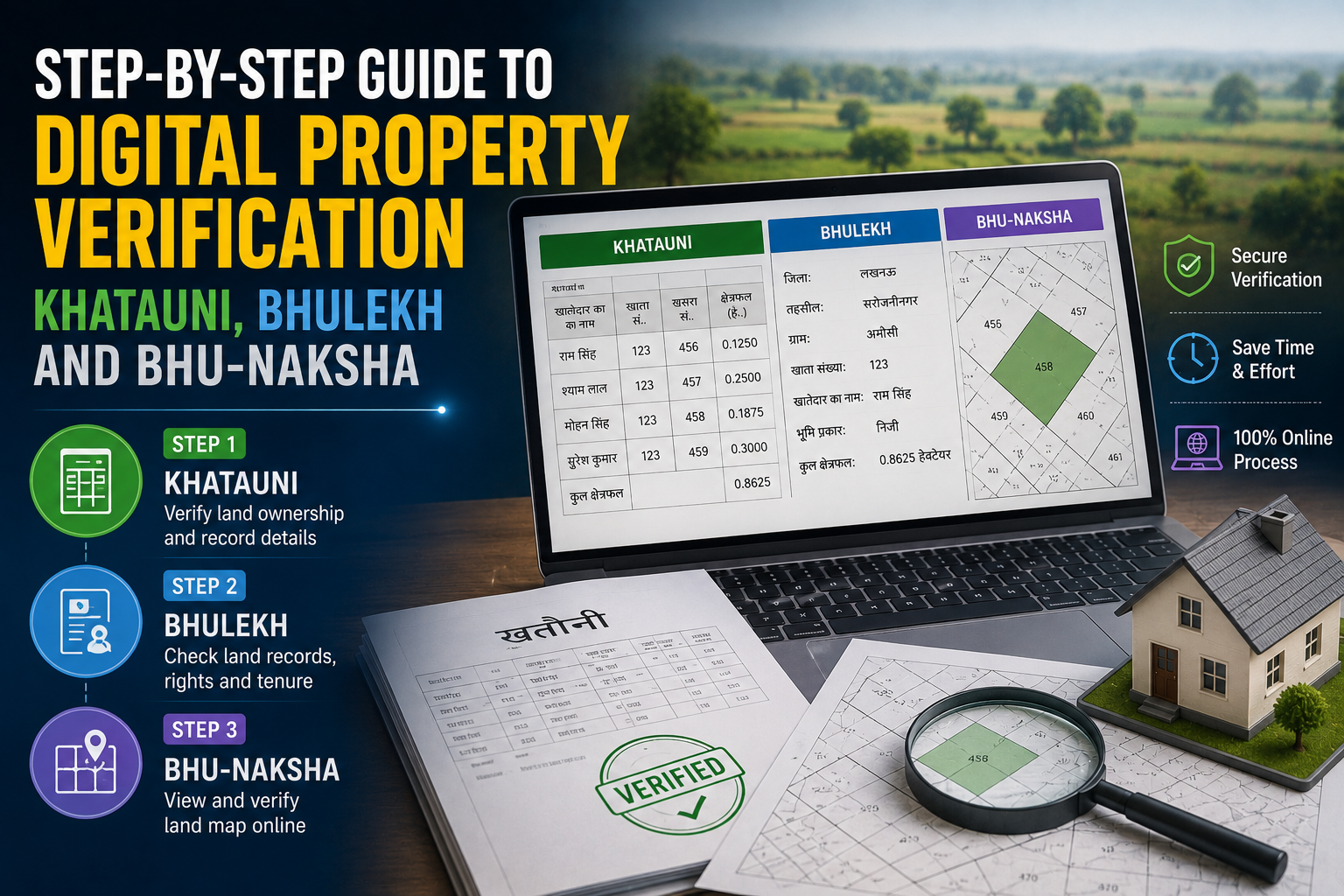
For decades, purchasing a plot of land or verifying property ownership in India was synonymous with bureaucratic delays, endless paperwork, and multiple trips to local revenue offices. The traditional system heavily relied on physical ledgers maintained by local officials, making the process of property verification incredibly tedious and, unfortunately, prone to human error and tampering. Today, the landscape of real estate transparency has undergone a massive transformation. Thanks to sweeping technological advancements and nationwide digitization efforts, conducting an online land ownership check is now a streamlined, accessible, and highly secure process.
At the very core of this digital revolution are two crucial documents: Khasra and Khatauni. Understanding these records is absolutely essential for anyone looking to buy land, apply for a property loan, or resolve a boundary dispute. Whether you are a first-time homebuyer, a seasoned real estate investor, or a farmer looking to secure agricultural credit, navigating the digital land record systems can safeguard your investments and grant you immediate peace of mind. This comprehensive guide explores everything you need to know about accessing and interpreting Khasra Khatauni records online, the mechanics of digital property verification, and how modern government portals are permanently changing the real estate ecosystem.
Before diving into the online verification process, it is vital to understand the specific terminology used in Indian land administration. The terms Khasra and Khatauni trace their origins back centuries, deeply rooted in the historical revenue systems of the subcontinent. While the words might sound complex, they represent straightforward concepts regarding land geography and ownership.
A Khasra is fundamentally the identity card of a specific piece of land. It is a detailed legal document that assigns a unique plot number, known as the Khasra number, to a surveyed parcel of land within a village. This record goes far beyond mere ownership; it contains exhaustive geographical and agricultural details. A typical Khasra document will outline the total area of the plot, the specific dimensions and boundaries, the type of soil, and the geographical coordinates. For agricultural land, it also records the types of crops grown during different seasons, the trees planted on the property, and the primary source of irrigation. Essentially, if you want to know the physical reality of a land parcel, the Khasra is the definitive source of truth.
On the other hand, a Khatauni is a legal revenue record that details the ownership patterns and cultivation rights associated with the land. If the Khasra describes the land itself, the Khatauni describes the people who own or cultivate it. A single individual or a joint family might own multiple different Khasras (plots) scattered across a village. The Khatauni aggregates all these separate Khasra numbers under a single family holding or account, providing a comprehensive overview of an entity's total landholding within that specific jurisdiction. It lists the names of the owners, the respective shares of joint owners, and any specific rights or encumbrances attached to the property. Together, the Khasra Khatauni records form the foundational bedrock of the Record of Rights, which legally establishes property ownership.
The ability to access these historical documents from a smartphone or laptop is the direct result of a massive, coordinated effort known as the Digital India Land Records Modernization Programme. Launched with the primary objective of minimizing property disputes and enhancing absolute transparency, this initiative has systematically overhauled how land data is stored and distributed across the country.
Historically, the manual maintenance of land ledgers left immense room for fraudulent transactions. It was not uncommon for unsuspecting buyers to purchase land that was already sold to someone else, or worse, land that belonged to the government or was locked in severe legal litigation. The modernization programme tackles these vulnerabilities head-on by creating a modern, comprehensive, and tamper-proof integrated land information management system.
The scope of this digitization is staggering. It involves the complete computerization of all Record of Rights across hundreds of thousands of villages. Furthermore, it mandates the computerization of Sub-Registrar Offices and the seamless, real-time integration of property registration with land records. This means that the moment a property is legally sold and registered, the ownership change is automatically reflected in the digital Khasra Khatauni records. By removing the lag time between registration and record mutation, the digital ecosystem effectively chokes off the opportunity for double-selling and title fraud.
Engaging in any real estate transaction without first conducting a rigorous property verification is a monumental financial risk. The availability of online land records has shifted the power back into the hands of the buyer, making due diligence faster and significantly more reliable.
The most immediate benefit of an online land ownership check is the prevention of real estate fraud. By independently verifying the seller's name against the official Khatauni records, a buyer can instantly confirm whether the person offering the land actually possesses the legal right to sell it. Furthermore, these digital portals often highlight any ongoing civil court cases, revenue disputes, or existing bank mortgages tied to the specific Khasra number. Discovering a hidden bank lien or a family ownership dispute before handing over a booking amount can save a buyer from years of agonizing legal battles.
Beyond fraud prevention, accessing Khasra Khatauni records is a mandatory step for securing financial assistance. Whenever a landowner applies for a home loan, a loan against property, or agricultural credit, financial institutions require certified copies of the Record of Rights. Banks rely on these documents to verify the collateral's legitimacy and to assess the total landholding capacity of the borrower. Being able to download these verified documents online drastically reduces the processing time for loan approvals.
Additionally, for urban planners, developers, and corporate investors, the digital availability of these records assists in large-scale project planning. Verifying the land use category—whether a plot is designated for agricultural, residential, or commercial use—ensures that future developments strictly comply with local zoning laws and environmental regulations.
While the exact user interface varies from state to state, the core architecture of online land record portals remains remarkably consistent. The process of retrieving property details is designed to be user-friendly, requiring only basic information about the land's location.
To begin the verification process, users must first navigate to the official Bhulekh or land record website dedicated to the specific state where the property is located. Because land is a state subject in India, there is no single centralized portal for the entire country; instead, each state maintains its own robust digital database.
Once on the homepage, the user will typically find options labeled as viewing the Record of Rights, checking Khatauni, or verifying Khasra details. Selecting this option will open a search dashboard heavily reliant on geographic filtering. The database is vast, so the system requires the user to narrow down the search parameters. This involves selecting the specific District from a dropdown menu, followed by the Tehsil or Taluka, and finally the exact Village or Mouza where the plot is situated.
After pinpointing the village, the portal will offer multiple ways to retrieve the specific document. The most accurate method is to search directly by entering the Khasra number or the Khata number. Because these numbers are unique identifiers within a village, they immediately pull up the exact land parcel without any ambiguity. If the plot numbers are unknown, most state portals also allow users to search by the legal owner's name. However, searching by name can sometimes yield multiple results, especially in areas where several individuals share common family names, requiring careful cross-referencing of father's names and total land areas to ensure accuracy.
Upon hitting the search button, the portal generates a digital copy of the Khasra Khatauni record. Users can instantly view the ownership details, land area, and any associated encumbrances directly on their screen. For official use, such as submitting documents to a bank or a court, the portals provide an option to download and print digitally signed, legally valid copies of the records, completely eliminating the need to visit a local revenue office.
The success of the digital land records initiative relies entirely on the localized portals developed by individual state governments. While they all serve the same fundamental purpose, they operate under different regional names and offer slightly varied localized services.
In Uttar Pradesh, the Bhulekh UP portal has become the ultimate destination for property verification. It allows citizens to view their Khatauni, check the status of revenue court cases, and verify property tax dues with exceptional ease. Similarly, in Madhya Pradesh, the MP Bhulekh system provides comprehensive access to land records alongside integrated digitized cadastral maps.
Moving to western India, Gujarat operates the AnyRoR platform, which stands for Any Records of Rights Anywhere. This portal is celebrated for its highly intuitive design, allowing users to access land records for both rural and urban properties seamlessly. In neighboring Maharashtra, the Bhulekh Mahabhumi portal acts as the central repository for the state's intricate land data, offering features like online mutation applications and digital property cards.
In the south, Karnataka was one of the early pioneers of digitization with its Bhoomi online system, which drastically reduced the time required to obtain property documents and minimized bureaucratic corruption. Telangana’s Dharani portal is widely recognized for its advanced integration, seamlessly combining land registration and administration services into a single, highly efficient digital window. Other notable platforms include Tamil Nadu's Patta Chitta, West Bengal's Banglarbhumi, and Bihar's Bihar Bhulekh, all of which continue to empower millions of citizens with instant, unrestricted access to their property data.
While the textual data found in Khasra Khatauni records provides essential details regarding ownership and land use, real estate verification is incomplete without spatial awareness. This is where the concept of Bhu-Naksha, or digital cadastral mapping, becomes incredibly important.
A cadastral map is a detailed visual representation of a village's land parcels, accurately outlining the exact boundaries, shapes, and geographical positioning of every single Khasra. In the past, these maps were drawn on large cloth sheets, which were susceptible to wear, tear, and physical manipulation. Today, these maps have been entirely digitized and are seamlessly integrated with the online land record portals.
Accessing the Bhu-Naksha allows a prospective buyer to cross-verify the textual dimensions mentioned in the Khatauni against the actual visual layout of the land. It provides critical insights into the property's immediate surroundings. A buyer can easily identify adjoining plot numbers, verify access to public roads, and check the proximity of the land to natural water bodies or government-owned infrastructure. This visual verification is absolutely paramount when purchasing agricultural land or large development plots, as it decisively prevents boundary disputes and ensures that the physical land being sold perfectly matches the legal description on paper.
Despite the high level of accuracy in modern digital records, historical data entry errors or outdated information can occasionally surface. A misspelled owner's name, an incorrect calculation of the land area, or a failure to update the records after an inheritance can cause significant legal hurdles. Fortunately, the digital ecosystem also provides streamlined mechanisms for rectifying these errors and updating ownership through a process known as mutation.
Mutation is the official process of changing the title ownership in the local revenue records following a property transaction, inheritance, or partition. In the digital age, applying for a mutation or a record correction no longer requires standing in endless queues. Landowners can initiate the process directly through their respective state land portals.
If a discrepancy is found in the Khasra Khatauni records, the owner must submit an online application accompanied by a formal affidavit. This affidavit must explicitly state the nature of the error, provide the correct details, and typically needs to be notarized and signed by gazetted officers. Alongside the application, the user must upload supporting legal documents, such as a registered sale deed, a death certificate in the case of inheritance, or previous historical records.
Once the application is submitted online, it is digitally routed to the concerned revenue authorities for strict verification. Officials review the uploaded documents, conduct necessary field inquiries if required, and subsequently update the master digital database. Once the mutation is approved, the updated Khasra Khatauni records are immediately reflected on the public portal, ensuring that the property's legal standing is completely accurate and up to date.
The continuous evolution of the digital land record ecosystem is paving the way for unprecedented transparency in the Indian real estate market. The government is rapidly pushing towards even more advanced technological integrations to secure property rights.
One of the most groundbreaking future initiatives is the comprehensive rollout of the Unique Land Parcel Identification Number, often referred to as Bhu-Aadhar. This system assigns a unique 14-digit alphanumeric identification number to every single surveyed land parcel in the country, completely standardizing land identification across state borders. By heavily integrating this unique ID with high-resolution satellite imagery, geo-referencing, and the biometric databases of landowners, the system will effectively create a foolproof, tamper-evident registry of property ownership.
The shift from dusty record rooms to dynamic, real-time digital portals represents a massive victory for citizen empowerment. The ability to perform an online land ownership check and instantly verify Khasra Khatauni records has fundamentally democratized access to vital property information. For landowners, it guarantees the security of their most valuable assets. For buyers and investors, it illuminates the path to safe, secure, and legally sound real estate transactions. As these digital platforms continue to evolve, integrating modern technologies for dispute resolution and immutable record-keeping, the vision of a completely transparent, friction-free real estate market is rapidly becoming a tangible reality.
