Published On:
February 17, 2026
Updated On:
February 17, 2026
South Delhi’s luxury real estate market is witnessing a historic comeback, with independent floor prices surging by up to 34% in 2025. Driven by a massive redevelopment boom and a scarcity of premium inventory, ultra-wealthy buyers are flocking back to iconic neighborhoods like Vasant Vihar and Golf Links, re-establishing the capital’s dominance over suburban markets.
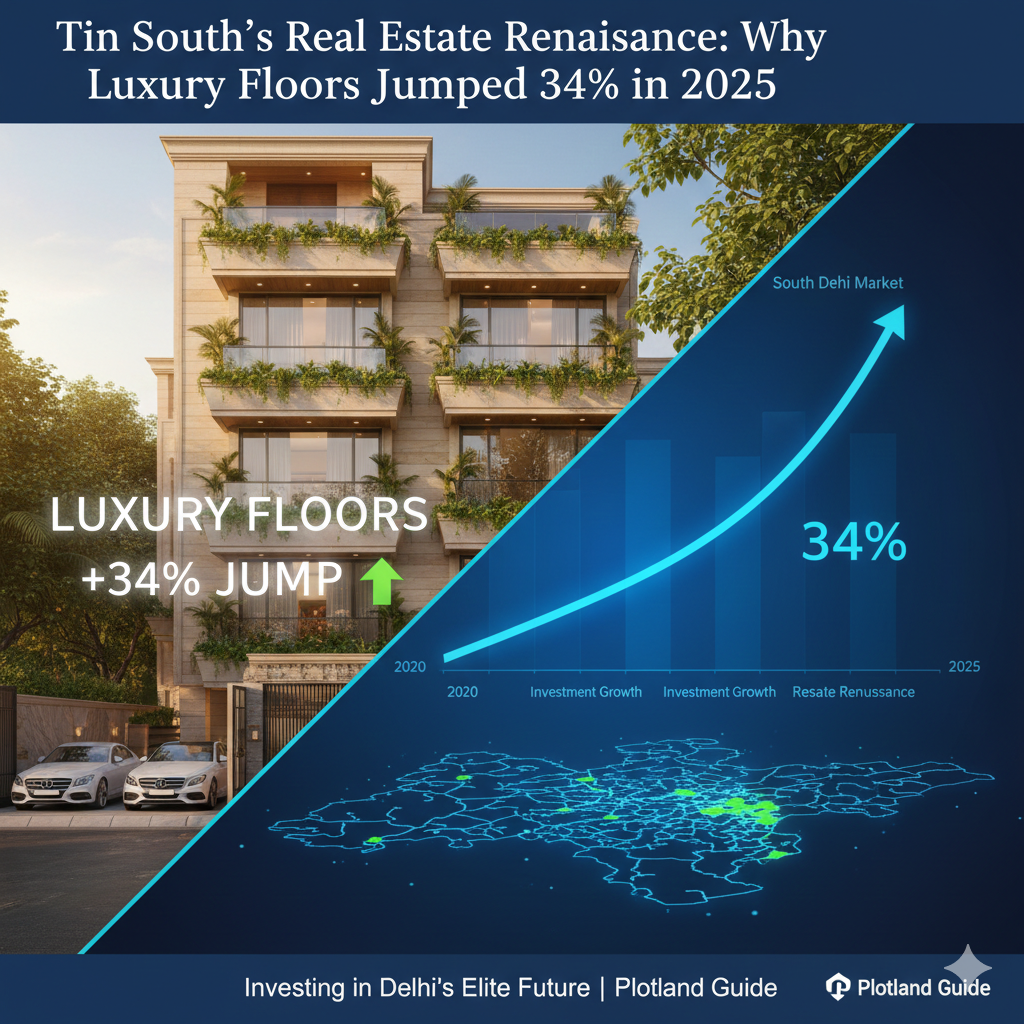
For the better part of the last decade, the real estate narrative in the National Capital Region (NCR) has been dominated by the glittering high-rises of Gurugram and the expansive expressways of Noida. The conventional wisdom was that the "old money" charm of South Delhi was fading, plagued by aging infrastructure and a lack of modern amenities.
However, 2025 has flipped the script entirely.
A new wave of ultra-luxury demand has swept through the leafy avenues of the capital, triggering a staggering 34% price jump for independent luxury floors in South Delhi’s premium colonies. This isn't just a market correction; it is a full-blown renaissance. From the diplomatic enclaves of Chanakyapuri to the bustling elite hubs of Greater Kailash, the verdict is clear: South Delhi is back, and it is more expensive than ever.
Recent market reports paint a picture of aggressive capital appreciation that has outperformed almost every other asset class in the region. The surge is most visible in the "Category A" colonies—the absolute crème de la crème of Delhi’s residential map.
Neighborhoods like Vasant Vihar, Golf Links, Jor Bagh, Shanti Niketan, and Panchsheel Park have seen the sharpest incline.
The growth isn't limited to the top tier. "Category B" neighborhoods like Defence Colony, Greater Kailash (GK), Gulmohar Park, and Neeti Bagh have witnessed a robust 22-26% appreciation.
What is fueling this sudden explosion in value? The primary catalyst is redevelopment.
For years, South Delhi was stuck in a time warp. Beautiful plots were occupied by dilapidated, 50-year-old bungalows that lacked parking, elevators, and modern security. However, a collaborative shift between landowners and boutique developers has unlocked billions in value.
Developers are now maximizing the Floor Space Index (FSI) to replace single-family bungalows with four ultra-luxury independent floors (Stilt + 4). This transformation allows a single plot to generate four times the inventory, but with a twist: the quality is world-class.
These aren't the builder floors of the early 2000s. The new wave of redevelopment in South Delhi offers amenities that rival Gurugram’s penthouses:
This modernization has removed the one major objection wealthy buyers had against South Delhi—the lack of "condo-style" living. Now, they get the best of both worlds: the privacy of a floor and the luxury of a 5-star hotel.
The demographic driving this surge is a mix of "Old Delhi" wealth and "New Economy" money.
The 34% jump in 2025 has reignited the debate: Is South Delhi a better investment than Gurugram?
The Case for South Delhi:
The Case for Gurugram:
However, the 2025 trend suggests that for the ultra-wealthy, the prestige of the pin code is currently outweighing the allure of the clubhouse.
For investors and homebuyers, the 34% jump is a wake-up call. The window of "affordable luxury" in South Delhi has firmly closed. The market has transitioned into a mature, high-value phase where entry barriers are steep.
However, the ceiling hasn't been reached. As the redevelopment cycle continues, and as more Grade-A developers enter the boutique floor segment, the gap between "old" and "new" properties will widen further. For those holding onto aging bungalows, now is the golden era to collaborate for redevelopment. For buyers, the message is simple: South Delhi is no longer just a place to live; it has once again become India’s most robust asset class.
