Published On:
April 27, 2026
Updated On:
April 27, 2026
The upcoming construction of crucial flyovers and underpasses at key Outer Ring Road junctions in South Delhi promises to eliminate notorious traffic bottlenecks, delivering signal-free commutes while simultaneously triggering a significant boom in the surrounding luxury real estate markets.
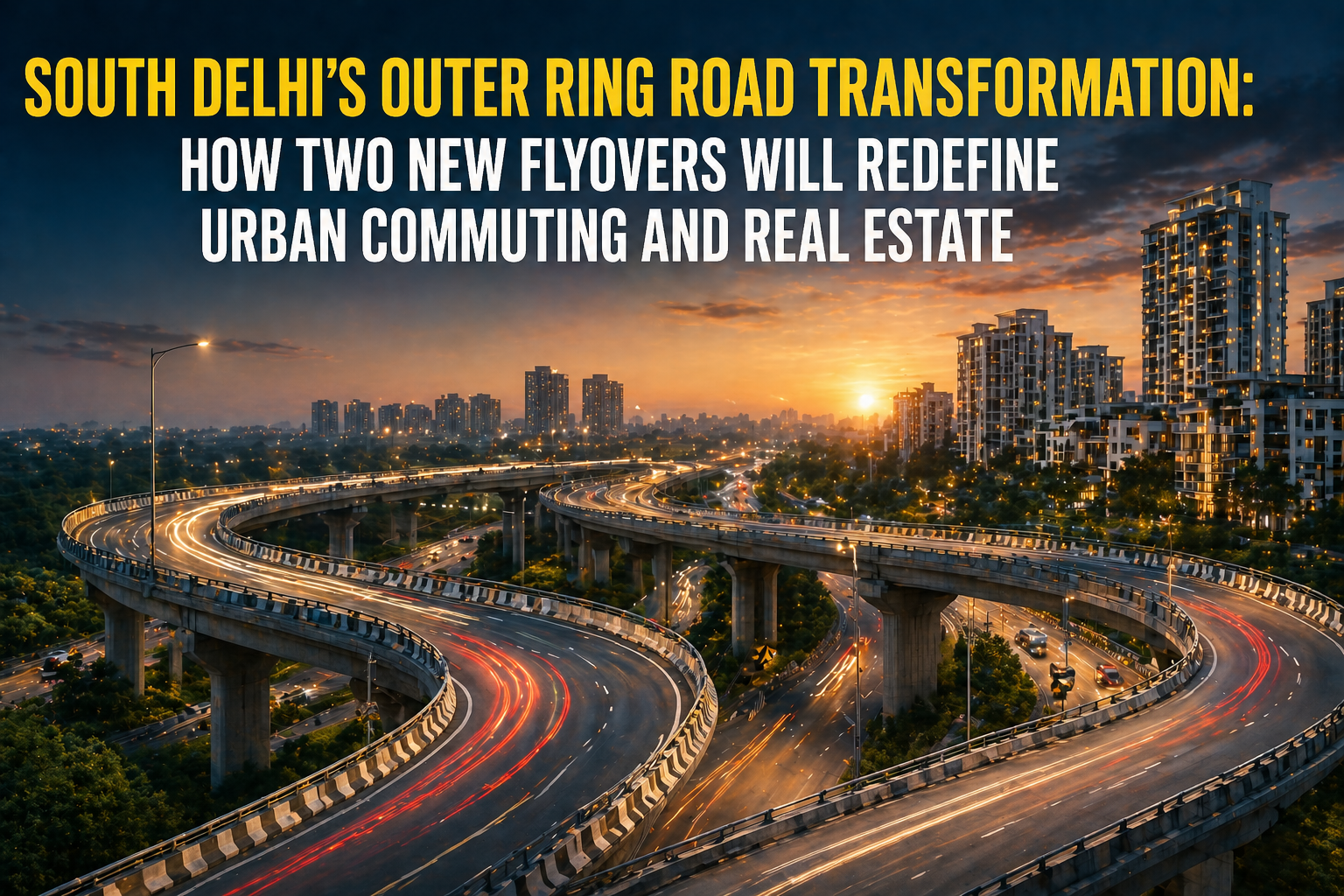
For anyone navigating the bustling streets of the national capital, the mere mention of the Outer Ring Road in South Delhi is enough to evoke memories of endless red lights, blaring horns, and frustrating gridlock. This critical arterial stretch, particularly around iconic landmarks like the IIT-Delhi campus and Savitri Cinema, has long functioned as a severe bottleneck. Thousands of daily commuters, spanning corporate professionals heading to Gurugram to families navigating local school runs, have accepted the sluggish traffic as an unavoidable part of city life. However, a massive infrastructure overhaul is finally on the horizon, promising to rewrite the daily commuting narrative for millions.
The public works department has officially initiated groundwork on an ambitious project designed to create a seamless, signal-free corridor across some of the most congested intersections in South Delhi. By green-lighting the construction of new flyovers and expansive grade separators, urban planners are taking a decisive step toward unclogging the capital's southern arteries. The goal is straightforward yet transformative: separate transit traffic from local neighborhood traffic, thereby breathing life back into the surface-level streets while allowing highway-bound vehicles to maintain their momentum. Beyond the immediate relief to exasperated drivers, this development is sending massive ripples through the premium housing sector, turning nearby residential pockets into some of the most closely watched real estate markets in the region.
The cornerstone of this infrastructural revamp involves highly targeted engineering solutions at two historically problematic intersections. The Savitri Cinema crossing, a crucial junction that manages the massive vehicular outflow from affluent neighborhoods like Greater Kailash I and II, as well as Chittaranjan Park, has been a chronic pain point. The existing single-carriageway flyover, constructed over two decades ago in 2001, simply cannot handle the sheer volume of modern-day traffic, often leading to severe tailbacks that spill over into the GK Enclave metro station area.
To resolve this, the blueprint outlines the construction of a brand-new, nine-hundred-meter-long, one-way grade separator. Designed with three wide lanes, this structure will run completely parallel to the older flyover. It features roughly four hundred and thirty-5 meters of raised roadway, ensuring seamless integration with the existing loops. By adding this massive supplementary capacity, the constant stop-and-go friction that currently plagues residents pulling out of Greater Kailash will be entirely eliminated. The design is meticulously planned to include dedicated bus bays and two specific ramps for smooth entry and exit, ensuring that public transit vehicles do not obstruct the fast-moving private car lanes.
Simultaneously, the IIT-Delhi junction is set to receive a major upgrade. This intersection serves as a primary funnel for traffic moving toward the international airport and the Delhi-Gurugram border. The sheer density of vehicles converging at this single point has routinely caused delays stretching for kilometers. The upcoming elevated bypass at the IIT junction is a masterstroke in urban flow management. The design strategy prioritizes efficiency without demanding widespread demolition of the surrounding commercial and institutional structures. By elevating the through-traffic, commuters bypassing the immediate neighborhood can sail over the intersection, leaving the ground-level roads completely free for local residents and pedestrian movement.
While the IIT and Savitri Cinema structures are the most visible components of this overhaul, the government's approach extends far beyond isolated fixes. The overarching strategy involves a comprehensive package sanctioned at a combined cost of approximately three hundred and seventy-one crore rupees. A massive portion of this investment is dedicated to the sprawling expansion of the Modi Mill flyover.
This particular expansion is an engineering marvel in its own right. The plan aims to stretch the current flyover by an impressive one and a half kilometers all the way up to Kalkaji. Upon completion, this elevated corridor will feature six broad lanes, with carriageways measuring nine meters on either side. It is designed to glide seamlessly over a series of notorious choke points, including Captain Gaur Marg, Lotus Temple Road, Maa Anand Mai Marg, and the heavily congested Nehru Place bus depot intersection.
In addition to the elevated roadways, the master plan incorporates a vital underpass near Gagan Cinema on Mangal Pandey Marg. By pushing certain traffic streams below ground level, planners are effectively utilizing three dimensions of urban space. The entire project, which was recently awarded to a prominent construction firm, is operating on a strict timeline, with officials targeting completion within twenty-four to thirty months from the commencement of ground operations. This swift execution window is a clear indicator of the urgency with which the local administration views the South Delhi traffic dilemma.
The benefits of this massive infrastructural injection extend well beyond simply shaving twenty or thirty minutes off a daily office run, although that alone is a life-changing improvement for the average commuter. There is a profound environmental and civic angle to creating a signal-free corridor along the Outer Ring Road.
Every single day, thousands of internal combustion engines idle endlessly at the red lights of Savitri Cinema and the IIT junction. This idling burns a staggering amount of fuel, directly contributing to the localized spikes in exhaust emissions and deteriorating air quality. By enabling a continuous, uninterrupted flow of vehicles, these flyovers will drastically cut down on localized greenhouse gas emissions. The reduction in stop-and-go acceleration will inherently make the air cleaner for the residents living in the immediate vicinity.
Furthermore, the public works department is not merely pouring concrete into the sky; they are heavily overhauling the ground-level infrastructure. The project mandates the comprehensive repair and development of service roads, dedicated cycle tracks, and broad footpaths. New foot overbridges and modernized bus shelters are being integrated into the design to prioritize the safety of pedestrians and public transit users. Recognizing the perennial issue of waterlogging that plagues the capital during the monsoon season, a completely new, high-capacity drainage system is being developed alongside the roadwork. This will be seamlessly linked to the broader neighborhood networks, ensuring that the newly minted roads remain completely free from water stagnation all year round.
Infrastructure and real estate share a deeply symbiotic relationship. Whenever a major transit bottleneck is permanently resolved, the intrinsic value of the surrounding neighborhoods experiences a significant and immediate upward trajectory. As the heavy machinery rolls in to begin the foundation work for these flyovers, the South Delhi property market is already exhibiting a strong, positive reaction.
For decades, the sheer density of traffic acted as a subtle deterrent for some homebuyers looking at specific pockets of the south. Even premium localities suffered when residents realized they would be trapped in a sea of cars the moment they exited their driveway. The promise of a rapid, signal-free Outer Ring Road changes this equation entirely. The prospect of living in an affluent neighborhood with instantaneous, high-speed access to the airport, the commercial hub of Nehru Place, and the corporate parks of Gurugram is an incredibly attractive proposition.
Localities such as Greater Kailash I and II, Chittaranjan Park, and Panchsheel Park are sitting directly on the cusp of this real estate renaissance. We are already witnessing an elevated level of interest from luxury flat buyers who want to secure a footprint in these areas before the flyovers become fully operational and the inevitable price correction takes place. While sprawling, vacant plots are exceptionally rare in these mature neighborhoods, the demand for builder floors, premium apartments, and redevelopment projects has surged. Any available inventory in the vicinity of these newly upgraded junctions is currently fetching a massive premium.
It is not just the capital appreciation that is catching the eye of seasoned investors; the rental market is equally poised for a major boom. High-net-worth professionals, expatriates, and top-tier corporate executives constantly seek rental accommodations that offer a delicate balance of lifestyle amenities and effortless commutes. Areas like Kalkaji, which offer the dual advantage of robust metro connectivity and immediate access to the soon-to-be-expanded Modi Mill flyover, are becoming prime targets for long-term lease agreements.
Furthermore, the commercial landscape is bound to reap substantial rewards. Ground-level retail spaces, boutique storefronts, and local neighborhood markets often suffer when the roads in front of them are perpetually gridlocked. The noise, pollution, and lack of parking discourage foot traffic. By elevating the heavy transit vehicles onto the new flyovers, the surface roads will revert to serving their original purpose: facilitating local, community-driven movement. The service lanes will become safer, pedestrian access will dramatically improve, and the overall environment will become far more conducive to leisurely shopping and dining. Small and medium businesses situated along these stretches are likely to see a notable increase in organic customer engagement.
Naturally, an undertaking of this magnitude will require a degree of patience from the local populace. Constructing multi-lane elevated corridors in the middle of one of the world's most densely populated urban centers is an incredibly complex logistical challenge. The authorities have already begun extensive surveys to identify and safely reroute highly sensitive underground utilities, ranging from high-tension electrical cables to critical water pipelines.
During the twenty-four to thirty-month construction window, there will inevitably be temporary traffic diversions, lane closures, and modified transit routes. However, a comprehensive traffic management plan is being deployed to ensure that the daily disruption is kept to an absolute minimum. For the residents of South Delhi, the temporary inconveniences posed by cranes and barricades represent the final hurdle before achieving a truly modernized, world-class transit experience.
The aggressive push to overhaul the Outer Ring Road through these strategic flyovers at the IIT junction, Savitri Cinema, and Modi Mill represents a definitive maturation in the capital's urban planning philosophy. It moves away from reactionary, short-term patching and embraces a long-term vision designed to handle the inevitable vehicular load of the next two decades.
This project is a testament to the fact that resolving urban congestion requires multi-dimensional thinking. By pushing traffic up into the sky and down into underpasses, South Delhi is reclaiming its surface spaces. The result will be a city sector that moves faster, breathes easier, and offers an exponentially higher quality of life. As the foundational pillars of these massive structures begin to rise from the asphalt, they carry with them the promise of a revitalized South Delhi—one where the dream of a smooth, signal-free commute finally becomes an everyday reality, simultaneously driving the local real estate market to unprecedented new heights.
