Published On:
February 20, 2026
Updated On:
February 20, 2026
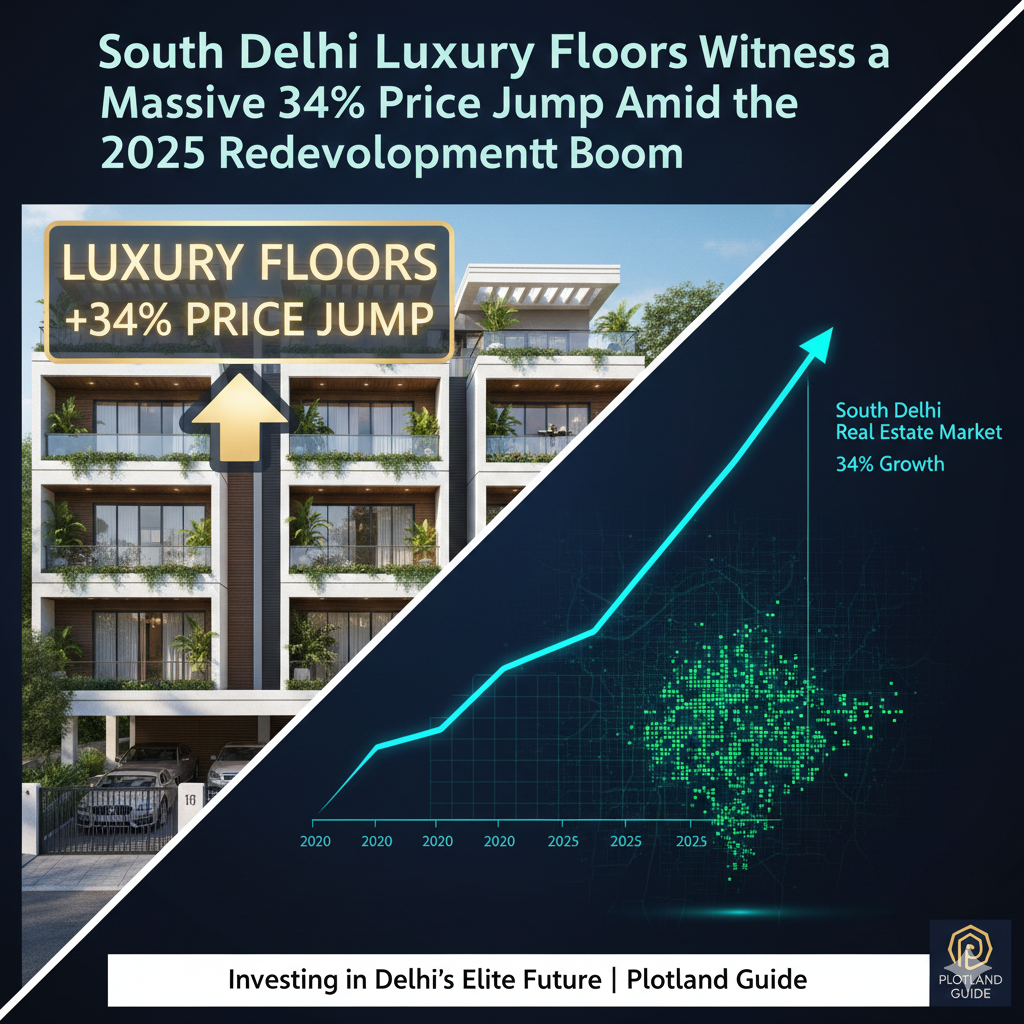
South Delhi’s luxury independent floors have recorded a staggering year-on-year price appreciation of up to 34% in 2025, fueled by a massive redevelopment wave, severe land scarcity, and an influx of high-net-worth buyers seeking premium, low-density living. With an estimated ₹6 lakh crore redevelopment potential waiting to be unlocked, the capital’s most exclusive neighborhoods are undergoing a historic real estate transformation.
The National Capital Region has always been a hotspot for dynamic real estate movements, but the spotlight has firmly shifted back to the historic and affluent heart of the city. While suburban markets like Gurugram and Noida have dominated the skyline with towering high-rises and integrated townships, South Delhi is quietly executing a multi-billion dollar transformation of its own. Driven by an unprecedented wave of urban renewal and a shifting preference among ultra-high-net-worth individuals, the South Delhi luxury real estate market is breaking historical records.
Recent market intelligence and comprehensive real estate analyses from 2025 paint a vivid picture of a market in overdrive. The prices of luxury independent floors in South Delhi’s most coveted residential colonies have surged by an astonishing 22% to 34% on a year-on-year basis. This is not merely a post-pandemic market correction or a temporary speculative bubble; it is a fundamental restructuring of property values fueled by a severe supply crunch, the aggressive migration of affluent households, and a sweeping redevelopment boom that is modernizing aging infrastructure.
For investors, developers, and legacy homeowners, this micro-market has evolved into one of the most lucrative asset classes in the country. To understand the sheer scale and velocity of this price appreciation, we must look deeper into the neighborhood classifications, the mechanics of the current redevelopment wave, and the evolving psychology of the modern luxury homebuyer.
The staggering appreciation in property values is best understood by looking at the stark difference between 2024 and 2025 transaction rates. The Municipal Corporation of Delhi classifies all residential colonies into eight distinct tax and circle rate categories, ranging from A to H. Categories A and B represent the absolute pinnacle of luxury living in the capital, and it is precisely these zones that are witnessing the most aggressive price escalation.
In the ultra-premium Category A colonies, the capital appreciation has hovered between 25% and 34% over a single year. To put this into a financial perspective, a standard 2,500 square foot independent floor that commanded a price bracket of ₹10 crore to ₹19 crore in 2024 has aggressively escalated to between ₹14 crore and ₹25 crore in 2025. The numbers become even more striking when analyzing larger footprints. Expansive 6,000 square foot builder floors, which are highly sought after by large business families and joint households, have seen their valuations jump from an already steep ₹19 to ₹45 crore bracket up to an incredible ₹25 to ₹55 crore range.
Category B colonies, which serve as the immediate alternative for buyers priced out of the absolute top tier, are experiencing a parallel boom. These neighborhoods have recorded a robust 22% to 26% year-on-year price growth. Here, a 2,500 square foot floor has appreciated from the ₹7 to ₹10 crore mark to a new baseline of ₹9 to ₹12.5 crore. Similarly, larger 3,200 square foot units have comfortably breached the ₹19 crore ceiling.
This sustained, compounding growth across both categories highlights a market that is highly resilient to broader macroeconomic headwinds. The persistent low-supply and high-demand dynamics in these legacy neighborhoods ensure that every new high-quality asset that hits the market is rapidly absorbed, almost always at a premium.
Understanding where this capital is flowing requires a geographical breakdown of South Delhi’s most exclusive pin codes. The 34% peak appreciation is heavily concentrated in Category A colonies, which carry an unmatched legacy, diplomatic proximity, and iconic social status. Neighborhoods such as Chanakyapuri, Golf Links, Jor Bagh, Shanti Niketan, Vasant Vihar, Anand Niketan, and Panchsheel fall into this elite bracket.
These areas are characterized by sprawling plot sizes, wide tree-lined avenues, and an extreme scarcity of available inventory. Because generational homeowners in these colonies rarely liquidate their assets, the introduction of a newly constructed, modern luxury floor triggers intense bidding among affluent buyers. The appeal of these neighborhoods is not just structural; it is deeply tied to the social capital and prestige associated with the address.
Trailing closely behind in terms of capital appreciation are the Category B colonies, which include highly desirable locales like Defence Colony, Greater Kailash, Gulmohar Park, Anand Lok, Neeti Bagh, and Chirag Enclave. These areas offer a vibrant mix of high-end retail proximity, excellent metro connectivity, and robust civic infrastructure. The 26% price jump in these zones is largely driven by a spillover effect. As Category A prices touch astronomical heights, wealthy professionals, successful entrepreneurs, and migrating affluent families from other parts of Delhi are actively consolidating their wealth into Category B assets, ensuring the price momentum remains uniformly strong across the entire South Delhi premium belt.
The most powerful catalyst behind this historic price surge is the rapid acceleration of neighborhood redevelopment. For decades, South Delhi was characterized by sprawling, single-family bungalows built in the 1970s and 1980s. However, as families expanded and the structures aged, the maintenance of these massive properties became economically inefficient.
Today, local landowners are increasingly partnering with boutique luxury developers to tear down these aging structures and replace them with state-of-the-art, four-story independent floors. Market intelligence estimates that the total redevelopment potential across South Delhi’s regulated colonies currently sits at a staggering ₹6 lakh crore. This represents a massive gold rush for developers and a unique wealth-creation event for original plot owners.
The economics of this redevelopment are highly compelling. By utilizing permissible Floor Space Index regulations to their absolute maximum, developers can construct larger, highly efficient living spaces. A plot that previously housed one family can now comfortably accommodate four affluent households, complete with essential modern upgrades like dedicated stilt parking, private elevators, and reinforced security perimeters. For the original landowner, this model unlocks immense dormant capital, providing them with brand new living spaces, high-yielding rental assets, and substantial upfront cash premiums.
Furthermore, these newly redeveloped floors are unrecognizable from the builder floors of the past decade. Modern developers are integrating international design standards, including Italian marble flooring, VRV centralized climate control, smart home automation, imported modular kitchens, and private terrace gardens. This massive upgrade in construction quality directly justifies the premium price tags and satisfies the refined tastes of globe-trotting buyers.
A major underlying trend driving the South Delhi real estate market is a definitive shift in the lifestyle preferences of India's ultra-wealthy. While the broader NCR market, particularly regions like Gurugram and Noida, has seen massive success with luxury high-rise condominiums, a significant segment of high-net-worth individuals strongly prefers the low-density living offered by independent floors.
The appeal lies in exclusivity and privacy. A high-rise apartment, regardless of its luxury tag, often requires sharing common spaces, lobbies, and amenities with hundreds of other families. In contrast, an independent builder floor in a neighborhood like Vasant Vihar or Defence Colony offers a much higher degree of seclusion. Buyers effectively own the entire floor plate, ensuring complete privacy, zero shared walls with neighbors, and a highly controlled living environment.
Additionally, the lingering behavioral shifts from recent global events have cemented a desire for larger, self-contained living spaces. Real estate data across major Indian cities shows that average apartment sizes have grown significantly, with the NCR region alone witnessing a 30% increase in average home sizes over the last two years. South Delhi builder floors perfectly cater to this demand for expansive living, offering massive layouts that seamlessly accommodate home offices, private gyms, and entertainment lounges without compromising on traditional bedroom and living spaces.
The social infrastructure of South Delhi also plays a massive role in this preference. The area boasts the city's finest international schools, premier healthcare facilities, elite members-only clubs, and high-end dining districts. For affluent families, the convenience of having this world-class infrastructure within a five-minute drive heavily outweighs the gated amenities of a distant suburban high-rise.
The 34% surge in property values is not solely driven by end-users; smart institutional capital is aggressively entering the South Delhi market. Historically, investing in builder floors was an unorganized, localized affair heavily reliant on personal networks and fragmented capital. Today, the landscape is becoming highly professionalized.
Real estate-focused Alternative Investment Funds are pooling vast amounts of capital from domestic high-net-worth individuals, Non-Resident Indians, and corporate family offices to systematically invest in South Delhi’s redevelopment cycle. These funds target prime aging properties, manage the complex regulatory approvals, execute the construction through premium contractors, and sell the finished floors at high margins.
Because the gestation period for a builder floor project is relatively short—typically around eighteen to twenty-four months from demolition to handover—these funds can turn over capital rapidly. Investors are reportedly seeing annualized returns in the high double digits, making South Delhi real estate a highly attractive asset class for wealth preservation and aggressive growth. The continuous injection of this organized capital ensures that development never stalls due to lack of funding, keeping the supply of ultra-luxury floors moving, albeit never quite fast enough to satisfy the overwhelming demand.
The unprecedented 34% price jump in 2025 serves as a clear indicator of the enduring power of prime location value. As we look toward the future, the trajectory for South Delhi luxury floors appears highly secure. Unlike suburban markets where massive tracts of vacant land can be released by development authorities to balance supply and demand, South Delhi’s land availability is absolutely finite.
There will never be another Golf Links or Chanakyapuri created. This inherent scarcity guarantees that property values in these legacy neighborhoods will continue to compound. While the aggressive 34% annual growth rate may stabilize into a more sustainable double-digit trajectory in the coming years, the baseline prices have been permanently elevated.
This boom is also creating a significant ripple effect in the rental market. Expatriates, top-tier corporate executives, and diplomats are constantly seeking modern, secure housing in central locations. As older housing stock is replaced by premium redeveloped floors, average rental yields in South Delhi are experiencing a corresponding upward revision, further sweetening the deal for long-term investors.
Ultimately, the transformation of South Delhi is a testament to the evolving Indian luxury narrative. It highlights a market that respects heritage and location while demanding modern, uncompromising quality. As the ₹6 lakh crore redevelopment machinery continues to turn, South Delhi will firmly retain its crown as the most exclusive, expensive, and aspirational residential destination in the National Capital Region.
