Published On:
September 6, 2026
Updated On:
September 6, 2026
Gurugram’s chronic waterlogging is a complex mix of geographical disruption and infrastructure deficits that can only be resolved by integrating natural drainage systems and securing long-term funding through strategic public-private partnerships and municipal bonds.
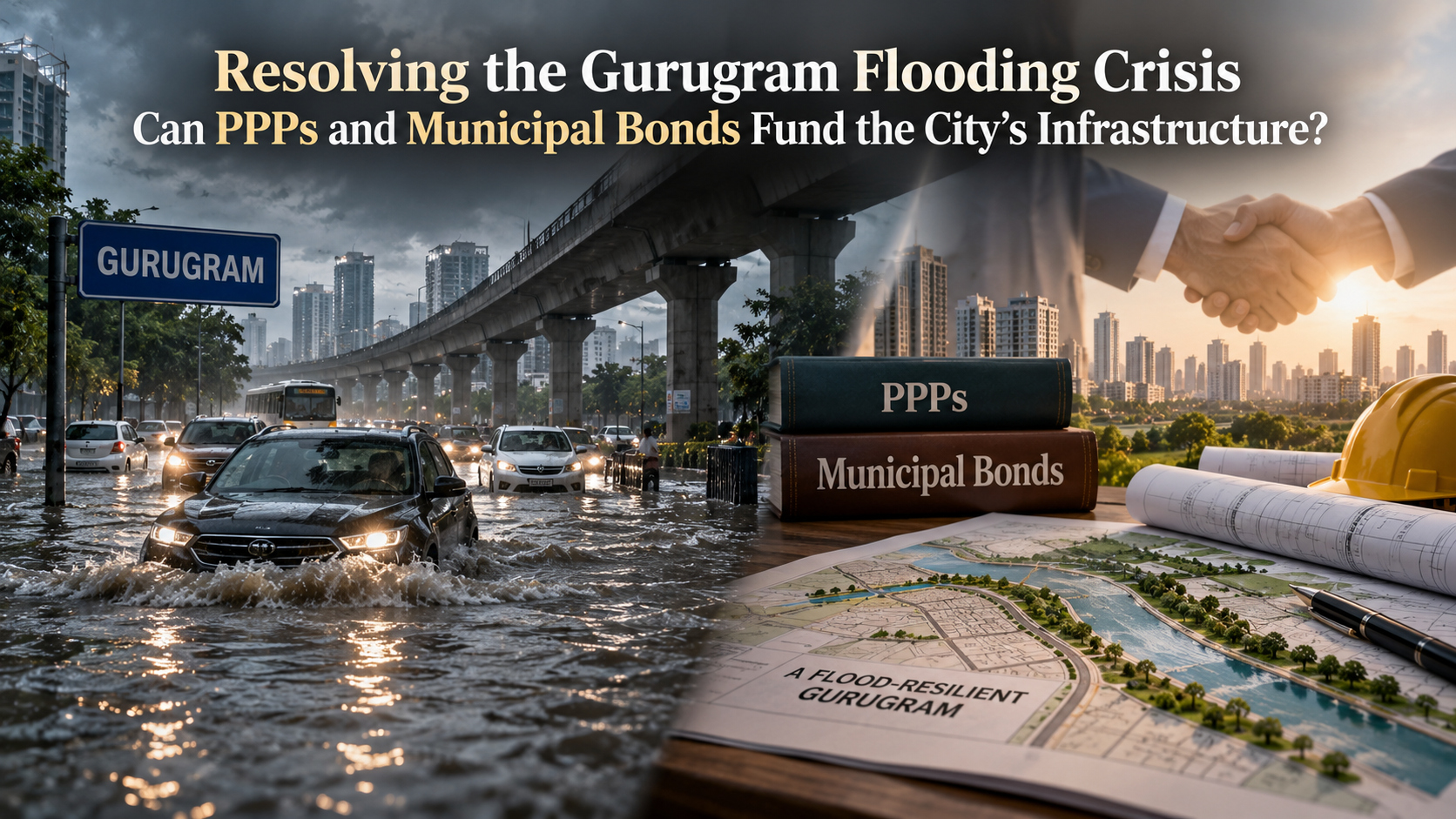
Every time the monsoon arrives, Gurugram finds itself grappling with a familiar and deeply frustrating reality. A city that houses some of the world's top multinational corporations, boasts a gleaming residential skyline, and drives significant economic growth across the region comes to an absolute standstill after just a few hours of heavy rainfall. Streets transform into rivers, traffic bottlenecks stretch for kilometres, and the real estate market’s premium facade is temporarily washed away by muddy water. Despite massive public funds being funneled into stormwater drainage and emergency pumping systems over the years, the situation remains largely unchanged on the ground.
This recurring nightmare forces stakeholders to look beyond immediate, reactionary fixes. The city’s waterlogging is not merely a localized drainage issue. It is the cumulative result of decades of hyper-urbanisation, unchecked concretisation, and the systematic erasure of natural water pathways. More importantly, the Gurugram flooding crisis exposes a deep-rooted financing flaw in how the city is built and maintained. To genuinely solve this infrastructural bottleneck, the narrative must shift from deploying temporary emergency pumps to reimagining how large-scale civic funding is secured, designed, and executed for the long haul.
To understand why this premium real estate hub floods so severely, one must look closely at its historical geography. The city is situated just below the Aravalli ridge, meaning it naturally acts as a massive catchment area for water flowing down the slopes. Historically, this natural runoff moved seamlessly towards the Najafgarh basin. Before the aggressive real estate development boom transformed the landscape, the rainwater had numerous escape routes and resting places. The terrain was heavily dotted with natural depressions, seasonal water channels, expansive agricultural fields, and local ponds. These natural elements functioned together as a giant ecological sponge. Water would spread out over the land, slow its velocity, and gradually percolate into the groundwater reserves.
However, rapid urban expansion completely disrupted this fragile ecosystem. The relentless drive to build commercial hubs and high-rise townships led to the paving over of highly permeable earth. Natural drainage corridors were encroached upon or completely blocked by deep concrete foundations. The ponds and wetlands that once safely held excess runoff were systematically filled in to create lucrative real estate parcels. Without these natural retention systems, the monsoon water has nowhere to go but onto the asphalt roads, underpasses, and into the basements of luxury high-rises. The city essentially replaced its ecological safety nets with impermeable surfaces, ensuring that every heavy downpour translates immediately into severe surface flooding.
For years, the default administrative response to waterlogging has been to construct wider concrete drains and install high-capacity emergency water pumps at critical junctions. Yet, urban planners and architectural experts consistently point out that rigid engineering solutions alone cannot resolve a fundamental ecological crisis. Pumping water from one flooded intersection to another merely shifts the problem downstream, eventually overwhelming main arterial channels like the Badshahpur drain. The sheer volume of surface runoff generated by a heavily concretised city far exceeds the carrying capacity of conventional underground pipe networks.
A far more sustainable approach involves evaluating the city catchment by catchment rather than treating the entire municipal area as a single, homogenous problem. This requires a paradigm shift towards integrating blue-green infrastructure. This concept relies on nature-based solutions to manage stormwater drainage at the source. Instead of relying solely on concrete pipes, urban infrastructure must incorporate bioswales alongside arterial roads, which are landscaped elements designed to concentrate and convey rainwater while naturally removing debris and pollution.
Expanding urban green cover, creating dedicated rain gardens, and mandating the use of permeable paving in parking lots and residential societies can significantly reduce the speed and volume of surface runoff. Aggressively reviving the lost water bodies and strictly protecting the remaining natural flood paths are crucial steps for the city's survival. By restoring the land’s natural sponge capacity, roads can return to their primary function of moving vehicles rather than acting as unintended urban canals. This ecological approach not only mitigates extreme flooding but also helps recharge the region’s severely depleted groundwater table, addressing the twin crises of urban flooding and water scarcity simultaneously.
The physical reconstruction of the city’s drainage network brings the conversation to the core of the problem: financing. Gurugram represents a highly unique development model where the sprawling skyline has been almost entirely built by private capital. Real estate developers have constructed enormous residential townships, sprawling commercial complexes, and world-class office districts, generating immense private wealth and elevating local land values exponentially.
However, a glaring mismatch exists in the urban infrastructure equation. While the private sector handles internal project development with high efficiency, the massive external infrastructure required to sustain these isolated pockets of urban density—such as trunk roads, metropolitan-level stormwater drainage, regional sewage systems, and municipal water supply—remains the sole financial and operational responsibility of public agencies.
This uneven distribution of responsibility places an immense, unsustainable financial strain on local civic bodies. Public agencies are expected to fund, build, and maintain long-life metropolitan infrastructure using highly limited annual government budgets and standard tax collections. The result is a perpetual developmental lag. Real estate projects are completed and occupied far faster than the public sector can upgrade the surrounding civic amenities to handle the increased population load. When multiple high-density developments channel their runoff into a municipal drain built decades ago for a fraction of the current population, systemic failure is absolutely inevitable. Fixing this requires tapping into the financial resources generated by the real estate boom to fund the very civic infrastructure that makes that real estate valuable in the first place.
If the future growth of this economic hub is to be sustainable, the financial mechanisms supporting it must evolve rapidly. A structured Public-Private Partnership (PPP) model offers a viable and equitable path forward, ensuring that developers contribute meaningfully to the civic infrastructure serving their larger catchment areas, rather than just focusing on the internal, gated amenities of their standalone projects.
One highly effective model could involve multiple real estate developers within a specific urban cluster pooling their financial resources to co-fund a common, high-capacity stormwater management system. Alternatively, civic authorities could implement a transparent infrastructure impact fee on all large new real estate developments. This fee would be calculated directly proportional to the additional burden the new project places on the existing municipal roads, drainage networks, and water systems. Crucially, the funds collected through this mechanism must be strictly allocated to upgrading the infrastructure in that specific development zone, rather than disappearing into a general municipal fund.
There is also immense potential for creating special-purpose vehicles that bring together municipal authorities, metropolitan development bodies, and private real estate firms to finance and execute specific infrastructure corridors. Performance-based contracts could be introduced, allowing private engineering firms to design, build, and maintain regional drainage systems over long-term concession periods of ten to fifteen years. In this modern setup, payments to the private operators would be strictly linked to measurable outcomes, such as maintaining zero waterlogging on critical arterial roads during peak monsoon events.
Adopting a PPP model does not mean the government abdicates its civic duties. Public agencies must retain absolute regulatory control over land-use planning, environmental regulations, the preservation of drainage corridors, and inter-agency coordination. Developers cannot be expected to solve legacy planning disasters created over thirty years, but they must become active financial participants in building a resilient urban future.
Moving beyond developer contributions, the city must fundamentally change how it borrows and spends public money for large-scale upgrades. Relying on piecemeal annual government allocations is entirely insufficient for building complex, long-life civic infrastructure. This is exactly where municipal bonds emerge as a critical financial tool for the city's future.
Municipal bonds are debt securities issued by local government bodies to fund vital public works projects. They allow cities to raise massive amounts of capital upfront from institutional and retail investors, which can then be deployed to execute heavy engineering projects without waiting for years of tax revenue accumulation. Given Gurugram’s substantial economic base, high per capita income, and robust corporate presence, it is a highly logical candidate for exploring municipal borrowing. The capital raised through these bonds could be targeted specifically at solving the flooding crisis, funding the construction of metropolitan-scale stormwater systems, large-scale detention ponds, advanced sewage treatment facilities, and upgraded underground utilities.
Issuing bonds is not a magic wand, and borrowing should never become a mechanism to merely postpone financial problems for the next generation. For a municipal bond programme to be successful, it requires rigorous financial discipline and operational transparency. The local government must present clearly identified, shovel-ready infrastructure projects to investors. The funds raised must be strictly ring-fenced, meaning they cannot be legally diverted to pay for general municipal salaries or unrelated administrative expenses.
Most importantly, the civic body must demonstrate a credible, predictable revenue stream to service the debt and repay the bondholders over the specified time period. This revenue could be generated from enhanced property tax collections, dedicated utility cesses, or the aforementioned developer impact fees. Investors will only park their capital in city bonds if they have absolute confidence in the local government’s ability not just to raise money, but to execute complex engineering projects transparently and maintain them efficiently for decades.
While the infrastructural challenges here are unique to the local geography and rapid growth trajectory, civic planners do not need to reinvent the wheel when it comes to urban flood management. Several global megacities have successfully tackled similar, if not more severe, geographical challenges through a combination of engineering marvels and financial innovation.
The Japanese approach to urban water management provides a masterclass in treating flooding as a multi-disciplinary challenge. Tokyo, for instance, does not just rely on surface drains; the city has invested heavily over the decades in massive underground reservoirs and deep diversion channels. Their infrastructure includes subterranean facilities capable of storing millions of cubic metres of excess runoff during severe cyclonic storms. These mammoth structures safely hold the floodwater below ground and slowly discharge it into major rivers only after the peak storm has passed, effectively protecting vulnerable, highly populated urban centres from catastrophic inundation.
While an Indian city cannot simply replicate Tokyo’s multi-billion dollar infrastructure overnight, the underlying lesson is vital. The Japanese model treats urban flooding not as an unavoidable annual natural disaster, but as a highly manageable logistical challenge requiring a seamless blend of heavy civil engineering, meticulous environmental planning, robust long-term financing, and relentless maintenance. By adopting a similar holistic mindset, urban planners can begin conceptualising underground detention basins and diversion tunnels to protect high-value real estate and corporate hubs from going under water every July.
The recurring images of submerged luxury cars and flooded arterial intersections in one of the country's wealthiest cities serve as a stark, unavoidable reminder that pure economic prosperity cannot outrun poor civic planning. The flooding crisis is a deeply multifaceted problem that demands an equally multifaceted solution. Temporary emergency concrete channels and rented water pumps are merely band-aids on a civic wound that requires major reconstructive surgery.
The path forward requires a total overhaul of the city’s relationship with its natural environment. Restoring the ecological balance through blue-green infrastructure, aggressively protecting the remaining natural water bodies, and respecting original catchment slopes are non-negotiable prerequisites for survival. Simultaneously, the financial architecture supporting the city must be completely restructured to match its ambitions. The immense wealth generated by the private real estate development sector must be channeled back into public utilities through equitable partnerships and calculated impact fees.
By unlocking the massive financial potential of municipal bonds and embracing structured public-private partnerships, civic authorities can finally secure the long-term, dedicated capital necessary to build resilient metropolitan infrastructure. The core institutional framework, in the form of existing municipal and metropolitan development authorities, is already firmly in place. The true test of governance lies in executing a bankable pipeline of interconnected, city-wide projects rather than continuing with fragmented, isolated road repairs. Only through this precise combination of ecological mindfulness and financial innovation can the city hope to conquer its monsoon misery and secure its position as a truly modern, sustainable metropolis.
