Published On:
May 3, 2026
Updated On:
May 3, 2026
Under Section 14(3) of the RERA Act, homebuyers are protected by a mandatory five-year warranty against structural defects and poor construction quality, forcing developers to rectify issues within thirty days at no extra cost or face severe compensation claims.
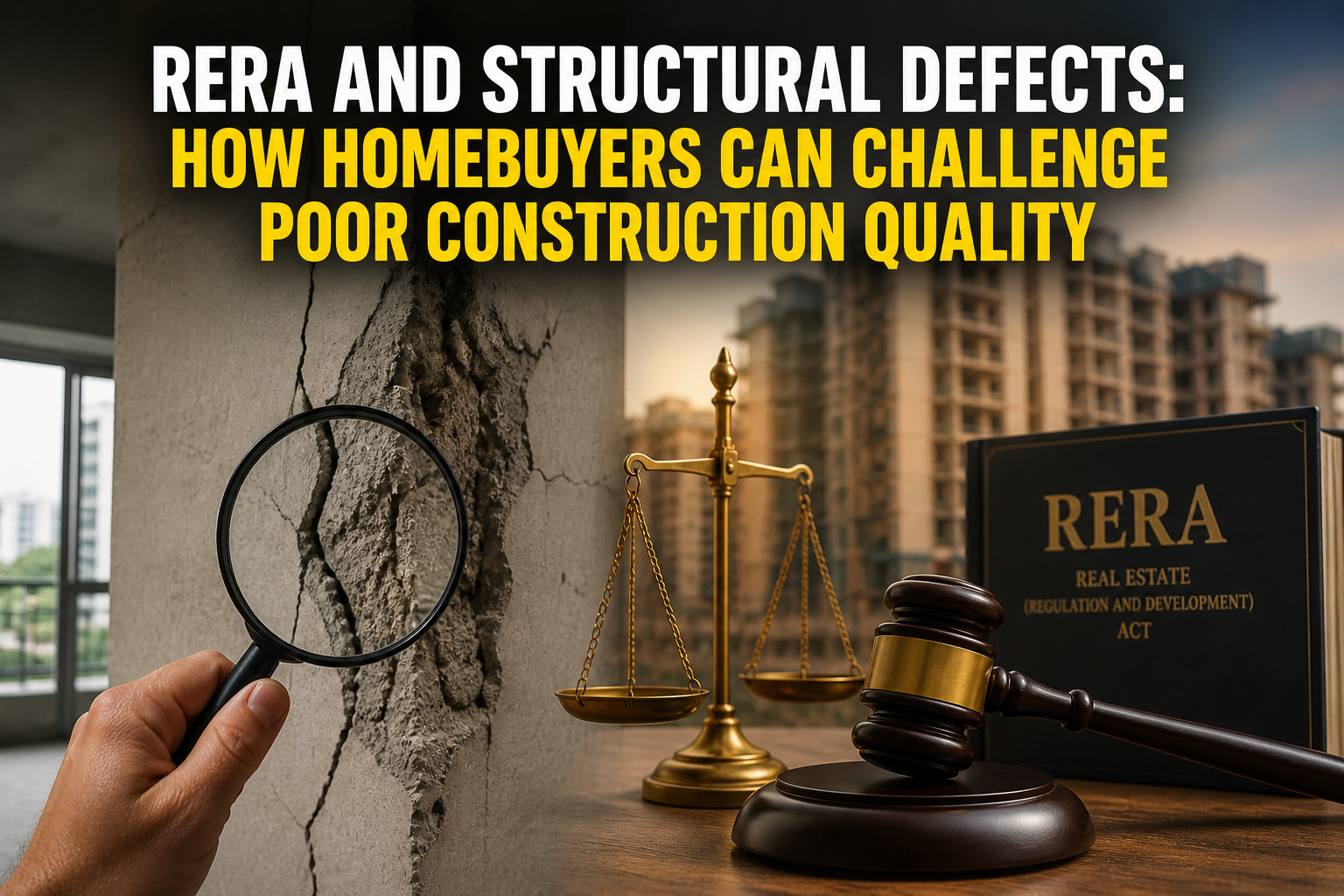
The Indian real estate market has experienced an unprecedented surge over the past decade, with premium residential high-rises dominating the skylines of metropolitan and tier-two cities alike. Millions of citizens invest their life savings and commit to decades of heavy equated monthly installments with the simple expectation of securing a safe, high-quality living space for their families. Yet, for an alarming number of homebuyers, the highly anticipated moment of finally taking possession of their dream apartment quickly turns into an exhausting, ongoing nightmare of endless repairs. The persistent, widespread issue of poor construction quality in housing projects has become a glaring concern across the country. Buyers paying top-tier, premium rates frequently find themselves staring at crumbling plaster, damp walls, and persistent plumbing issues within mere months of moving in. Fortunately, the legal landscape has evolved, and the law is no longer a silent spectator to these malpractices. The Real Estate Regulation and Development Act, universally known as RERA, has introduced strict, uncompromising provisions designed specifically to hold developers fully accountable for substandard work. For homebuyers currently grappling with the distressing reality of poor build quality, thoroughly understanding their robust rights under this legislation is the first and most crucial step toward securing a permanent, legally backed resolution.
The Growing Crisis of Compromised Real Estate Quality
This is a familiar story playing out in massive housing societies from the dense urban corridors of the National Capital Region to the booming technology hubs of southern India. The visibly widening gap between soaring property prices and the actual physical quality delivered by developers is causing massive, justified frustration among consumers. Recently, the harsh reality of this gap was laid completely bare when a homeowner in Noida utilized social media to publicly highlight the distressing state of an ultra-premium apartment. Despite shelling out nearly a crore for a unit located high up on the 22nd floor, the property suffered from immediate, noticeable exterior discoloration and actively crumbling plaster. To make matters worse, the resident also faced severe hygiene and health concerns stemming from a massive insect infestation, which was directly linked to unmanaged pigeon waste accumulating in an adjacent, developer-owned vacant unit.
Similarly, in another major metropolitan hub, a buyer who invested heavily in a top-floor luxury apartment in Pune found themselves dealing with severe, unmanageable ceiling leakages just two short months after taking possession, right as the seasonal monsoons hit the state. When formal complaints were raised to the builder's management team, the response was a casual, unacceptable assurance that repairs would only be carried out months later, after the rains stopped and the concrete walls completely dried out. These deeply frustrating incidents are far from being isolated anomalies. They represent a deep, systemic issue where the industry-wide rush to complete massive projects on tight schedules, combined with the desire to maximize corporate profit margins, frequently results in heavily compromised construction standards. Buyers are consistently left feeling cheated, financially burdened by their housing loans, while physically living in properties that are actively deteriorating around them.
Decoding the Five-Year Statutory Warranty
Before the nationwide implementation of modern real estate regulations, homebuyers possessed very little practical recourse when faced with serious construction flaws. They often found themselves forced into fighting prolonged, mentally draining, and highly expensive legal battles in deeply backlogged consumer courts. Developers would routinely and aggressively wash their hands of any physical responsibility the exact moment the apartment keys were handed over, cleverly citing obscure fine print buried within heavily skewed, one-sided builder-buyer agreements. This unfair landscape shifted entirely with the introduction of specific accountability clauses within the modern regulatory framework. The most critical of these is the legal provision that effectively serves as a mandatory, non-negotiable five-year statutory warranty on all registered real estate properties.
According to current laws, if a homebuyer discovers any structural defects, or uncovers any other serious defect related to general workmanship, material quality, or the provision of basic building services as explicitly promised in the original sale agreement, the developer is legally bound to fix it. This ironclad liability period extends for five solid years, calculated from the exact date the buyer officially takes possession of the property. What makes this specific provision so incredibly powerful for the common citizen is that the developer is strictly prohibited from charging the buyer a single rupee for these necessary repairs. Furthermore, the law explicitly and intelligently prevents builders from drafting contracts that attempt to bypass, dilute, or waive this five-year responsibility. Any hidden clause in a builder-buyer agreement attempting to limit this post-possession liability is immediately considered legally invalid and entirely unenforceable in court. This ensures that the heavy financial burden of rectifying faulty construction, replacing poor materials, or re-doing bad plumbing falls squarely on the massive corporate entity responsible for building the structure, rather than the innocent consumer who paid in full for a finished, safe, and fully functional home.
Defining the Scope of a Structural Defect
There is frequently a fierce, drawn-out debate between defensive builders and frustrated buyers regarding what actually constitutes a legitimate defect. Developers frequently attempt to legally dismiss serious structural flaws as expected, normal wear and tear, or brush them off as merely superficial cosmetic issues that do not warrant a massive repair operation. However, state regulatory bodies have provided very clear, comprehensive guidelines to completely eliminate this corporate ambiguity. A structural defect fundamentally includes any physical issue that compromises the core integrity, stability, and fundamental safety of the residential building. This naturally involves severe flaws in the deep foundation, the primary load-bearing columns, internal and exterior support beams, heavy concrete slabs, and other essential, immovable structural components.
However, the legal protection does not conveniently stop at the building's bare skeleton. The law is drafted to be comprehensive enough to cover widespread defects in everyday workmanship and the overall quality of the materials used throughout the finishing process. This translates to the fact that if a newly constructed living room wall exhibits deep, recurring cracks that reappear even after a fresh coat of paint, if the expensive floor tiles are severely uneven or spontaneously popping out of the cement, or if there is persistent, damaging water seepage due to failed terrace waterproofing, all of these specific scenarios fall securely under the developer's direct liability. Even highly disruptive issues concerning the provision of basic, promised services give the homebuyer valid legal grounds to demand immediate rectification. This includes chronically malfunctioning building elevators caused by poor initial installation, highly dangerous faulty internal electrical wiring, or fundamentally defective plumbing systems that cause spreading damp patches across multiple floors. The regulatory framework absolutely ensures that buyers are not left footing the bill for a builder’s unethical decision to cut project costs by utilizing substandard cement mixtures, low-grade structural steel, or highly unskilled, uncertified labor.
The Strict Thirty-Day Rectification Mandate
The primary, overarching goal of real estate regulatory authorities is to provide swift, actionable, and tangible relief to the common buyer, rather than dragging basic property disputes out over years of tedious litigation. To forcefully enact this, the law dictates a very strict, legally binding timeline for developers to address any raised complaints. Once a homebuyer formally brings a structural defect, a significant workmanship flaw, or a material quality issue to the promoter’s official notice within the protected five-year window, the developer has exactly thirty days to fully rectify the problem. This prompt, mandatory turnaround time is legally enforced to ensure that the family's living conditions do not deteriorate any further and that residents do not have to dangerously navigate unsafe or highly unhygienic environments for extended periods.
If a developer blatantly ignores the formal complaint, maliciously delays the repair work beyond this thirty-day limit, or attempts to provide a cheap, temporary, and superficial fix that fails to actually solve the root engineering problem, the homebuyer is far from helpless. In the event of a builder's failure or outright refusal to act responsibly, the aggrieved buyer immediately becomes legally entitled to receive heavy, appropriate financial compensation. State regulatory authorities take these specific timeline violations incredibly seriously. They possess the immense judicial power to not only legally force the developer to physically carry out the necessary repairs under strict supervision but also to levy substantial financial penalties against the real estate company. Furthermore, they can direct heavy financial compensation straight to the homeowner to cover the intense mental agony, the damage to interior furnishings, and the overall massive inconvenience caused by the substandard construction and the builder's subsequent operational delays.
The Strategic Guide to Legally Challenging Poor Construction
While the existing law is firmly, undeniably on the side of the homebuyer, successfully navigating the formal complaint process requires a highly strategic, emotionless, and heavily documented approach. The immediate first instinct for many angry residents is to engage in heated, unproductive verbal arguments with the local facility management staff or the developer's on-site sales representatives. However, legal experts who specialize in real estate disputes strongly advise a much more methodical, formal route. When significant, undeniable construction quality issues arise in a new property, the absolute best, most legally sound course of action is to immediately commission an independent, professional structural audit.
Homeowners are strongly advised to hire a qualified, state-licensed structural auditor or a highly experienced civil engineer to thoroughly and objectively inspect the entire property. This unbiased professional will generate a comprehensive, highly technical report that clearly and undeniably highlights all specific construction deficiencies. Crucially, the auditor will identify the hidden root causes of complex problems, proving whether a persistent leakage is due to a cracked exterior wall or failed internal plumbing, and will explicitly outline the precise, necessary corrective measures required to permanently fix the building. This formal audit report serves as undeniable, expert-backed technical evidence that completely strips away the developer's standard ability to casually dismiss the resident's issue as a minor, insignificant complaint.
Once this technical report is securely in hand, the homeowner must formally share the complete document with the developer's official corporate office through easily tracked correspondence. Sending a legally drafted registered letter or an official, timestamped email is the perfect way to explicitly request that the necessary, specified rectification work be initiated and completed within the statutory thirty-day timeframe. If the developer completely fails to initiate the required repairs, or refuses to acknowledge the communication within this protected period, the buyer then possesses incredibly solid, legally unshakeable grounds to file an official, formal complaint before their respective state's regulatory tribunal. Armed with the irrefutable audit report, a clear log of all ignored communications, and the original, signed sale agreement, buyers can confidently approach the authority to seek aggressive, binding legal directives that will force the developer's hand.
The Importance of Extreme Pre-Possession Vigilance
While successfully fighting for structural repairs post-possession is entirely possible and legally supported, exercising extreme vigilance and practicing strict prevention before ever accepting the apartment keys remains the absolute smartest strategy a buyer can employ. Regulatory bodies continually and strongly urge property buyers to exercise a massive amount of caution during the highly critical final handover phase. Before signing any binding possession documents or accepting the final settlement, it is absolutely imperative to personally verify that all legal, municipal, and technical paperwork is flawlessly in order.
Buyers must aggressively insist on viewing the original, government-issued Occupancy Certificate. This single document acts as the ultimate legal confirmation that the local municipal planning authorities have physically inspected the completed building and have officially deemed it structurally sound, entirely safe, and legally fit for human habitation. Without a valid Occupancy Certificate, taking physical possession of an apartment is not only a massive risk regarding unseen construction quality but is also technically illegal in a vast majority of jurisdictions. Furthermore, highly proactive buyers should take the time to log onto their state's official regulatory portal to personally ensure that all mandatory architectural, engineering, and quality assurance documents are publicly uploaded and officially verified by the state.
Additionally, recent landmark tribunal rulings in various states have heavily reinforced the financial responsibility of the builders, stating that developers are legally bound to physically provide all mandatory project insurance documents directly to the homebuyers during the handover phase. If the builders fail to provide this transparent documentation, legal precedents dictate that the developers must bear the entirety of all future repair and structural maintenance costs themselves.
Refusing to Settle for Compromised Standards
The historical era of Indian homebuyers silently, passively accepting poorly constructed, deeply flawed apartments as simply an unavoidable part of the chaotic real estate process is officially over. With highly stringent, consumer-focused laws now firmly in place across the nation, the overarching power dynamic between massive corporate builders and individual citizens has fundamentally and permanently shifted. Purchasing a home is almost universally the single largest financial investment a person will make in their entire lifetime, representing decades of hard-earned savings and an immense future financial commitment. Because of this, buyers have every absolute right to aggressively demand that the final, delivered physical product strictly and flawlessly matches the high-quality promises made in the developer's glossy marketing brochures and pristine model apartments.
By taking the time to stay highly informed about the mandatory five-year defect liability period, by proactively and meticulously documenting every structural flaw the moment it appears, and by bravely utilizing the robust, powerful legal framework provided by state real estate regulatory authorities, buyers can successfully and permanently challenge poor construction quality. Property developers are now actively operating in a highly scrutinized environment where physical accountability is strictly, legally enforced. If a newly built residential building is proven to be structurally unsound or is deeply plagued by corners cut through shoddy workmanship, the law provides a very clear, highly effective, and entirely accessible pathway to ensure that the developer is forced to fix their mistakes. This ensures that a family's ultimate dream of peaceful, secure homeownership does not rapidly crumble along with the building's substandard plaster.
