Published On:
April 27, 2026
Updated On:
April 27, 2026
The Real Estate (Regulation and Development) Act, 2016, provides a robust legal shield for homebuyers facing poor construction quality, mandating that developers fix structural and workmanship defects free of charge within five years of possession. If a developer fails to resolve these issues within thirty days, buyers have clear legal avenues to file formal complaints and claim financial compensation.
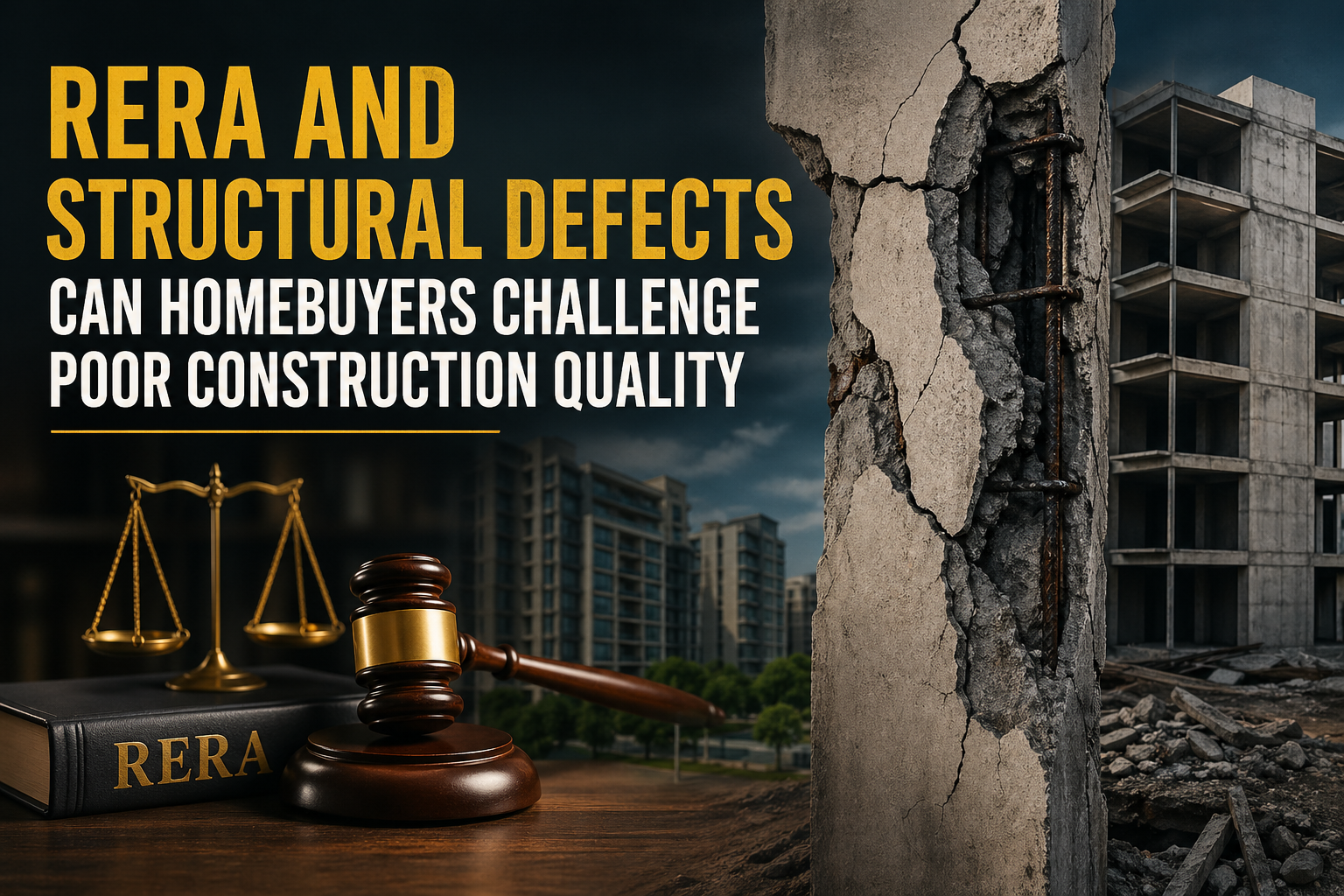
The journey to homeownership is often the most significant financial commitment a person will make in their lifetime. Years of diligent saving, rigorous financial planning, and endless property visits culminate in the handover of the keys. However, the dream of stepping into a flawless new home is frequently shattered by the harsh reality of poor construction quality. Peeling paint, leaking roofs, uneven flooring, and deep structural cracks have become alarmingly common, even in premium housing projects commanding exorbitant price tags.
Historically, buyers were largely left to fend for themselves, trapped in endless negotiations with apathetic developers or forced into lengthy legal battles in consumer courts. The landscape shifted dramatically with the implementation of the Real Estate (Regulation and Development) Act, 2016. This legislation completely overhauled the power dynamics within the real estate sector, introducing strict accountability for property developers and a clear framework for homebuyer rights in India. Understanding the specific legal mechanisms available to challenge substandard construction is no longer just optional knowledge; it is a fundamental necessity for anyone investing in the property market.
The rapid urbanization across major metropolitan areas has led to a massive surge in high-rise developments and luxury housing projects. Despite the soaring property prices, the actual quality delivered by developers often falls drastically short of expectations. The frustration among buyers is palpable and increasingly visible across various consumer forums and social media platforms.
Consider a recent incident in Pune involving a mid-segment apartment purchased for an estimated sixty lakh rupees. The property was situated on the top floor of a newly constructed residential building. Within a mere two months of taking possession, the homeowner was confronted with severe water leakage issues in one of the primary bedrooms. Upon raising a formal complaint, the developer offered a classic delay tactic, suggesting that repairs could only be undertaken after the monsoon season had entirely passed and the affected areas had dried. Such responses leave buyers living in compromised, deteriorating conditions while waiting for the builder to take action.
A parallel situation recently gained widespread attention in the National Capital Region. A resident of a premium high-rise in Noida purchased an apartment on the twenty-second floor, investing nearly one crore rupees. Almost immediately, the property began showing signs of severe degradation. The interior plaster was crumbling, and the exterior walls displayed noticeable discolouration, pointing to the use of highly substandard materials. Beyond the structural flaws, the resident was forced to deal with severe hygiene hazards. An adjacent vacant unit had become a nesting ground for pigeons, leading to an insect infestation that spread into the occupied apartment. These are not isolated incidents but rather symptomatic of a systemic issue where the rush to complete projects and maximize profit margins results in severe compromises in construction quality and residential safety.
The cornerstone of homebuyer protection against poor construction quality is embedded in Section 14(3) of the Real Estate (Regulation and Development) Act, 2016. This specific provision was drafted specifically to hold developers accountable for the physical integrity and livability of the spaces they build and sell.
Under this section, the concept of a defect liability period is firmly established. If a homebuyer discovers any structural defect, or any other flaw related to workmanship, overall quality, or the provision of services as promised in the original agreement for sale, they have a powerful legal recourse. This protection window remains active for a period of five years, starting from the exact date the buyer takes official possession of the property.
The mandate placed on the property developer is strict and time-bound. Once a defect is brought to their notice within this five-year timeframe, it becomes their absolute duty to rectify the issue. The law stipulates that these repairs must be carried out without levying any additional charges on the homebuyer. Furthermore, the developer does not have the luxury of an open-ended timeline; the rectification must be completed within thirty days of the complaint being registered.
Should the developer ignore the complaint, offer inadequate repairs, or fail entirely to resolve the structural defect within the stipulated thirty days, the aggrieved homebuyer is legally entitled to receive appropriate compensation. This ensures that buyers are not left financially burdened by necessary repair work that should have been the builder's responsibility from day one.
To effectively utilize the protections offered under the law, buyers must understand what exactly qualifies as a structural defect or an issue of poor workmanship. Regulatory authorities across various states maintain a consistent interpretation of these terms to prevent developers from dismissing genuine complaints as minor wear and tear.
A structural defect fundamentally involves any compromise to the core physical integrity of the building. This includes issues originating in the building's foundation, the load-bearing columns, the supportive beams, and the concrete slabs. If any of these core structural components show signs of distress, cracking, or inadequate load management, it is classified as a severe defect requiring immediate developer intervention.
Beyond the raw skeleton of the building, the law also covers defects in workmanship and the quality of provisioned services. This encompasses a wide range of issues that affect the daily livability of the apartment. Inferior plumbing that leads to internal wall dampness, faulty electrical wiring that poses safety hazards, poorly laid flooring, malfunctioning elevators, and the use of low-grade cement or paint all fall under this umbrella. Even if the building is structurally sound from an engineering perspective, the failure to deliver the quality of finish and functional services promised in the marketing brochures and the sale agreement constitutes a direct violation of developer obligations.
Various state-level Real Estate Regulatory Authorities have taken a proactive stance in interpreting and enforcing the defect liability rules, consistently ruling in favor of consumer protection and long-term building safety.
In regions experiencing a massive boom in high-rise constructions and comprehensive redevelopment projects, the long-term structural durability of buildings is a critical urban concern. For instance, regulatory bodies overseeing real estate in Maharashtra have repeatedly clarified the scope of developer liability, ensuring that the burden of post-construction flaws does not shift to the newly formed resident welfare associations or individual buyers. The expectation is clear: developers must deliver a structurally sound product and remain accountable for a half-decade post-delivery.
Similarly, legal tribunals handling real estate disputes in Karnataka have set strong precedents regarding structural safety and financial accountability. Recent rulings have legally bound real estate developers to provide mandatory insurance documents related to the structural safety of the project. If a developer fails to secure and hand over these specific insurance details, they are legally forced to bear the entire cost of any structural repairs themselves. These stringent state-level enforcements close the loopholes that builders previously exploited to evade their post-possession responsibilities.
The most effective way to handle structural defects is to identify and document them before the final handover of the property. The period immediately preceding possession is critical, and buyers must exercise extreme diligence rather than rushing to accept the keys.
Comprehensive document verification is the first line of defense. Buyers must ensure that all legal paperwork is in perfect order. The most vital document is the Occupancy Certificate. This certificate is issued by the local municipal authority only after they have verified that the building has been constructed in accordance with the approved plans and complies with all civic and safety regulations. Accepting possession of an apartment without a valid Occupancy Certificate is highly risky and can severely complicate future claims regarding construction quality.
Additionally, buyers should verify the presence of architectural completion certificates, which are often required to be uploaded to the respective state's regulatory portal. These documents serve as an official declaration by the project's architect and structural engineer that the building meets the necessary safety standards.
A thorough physical inspection of the property is equally vital. Buyers should ideally conduct a detailed walkthrough of the apartment, checking for visible cracks, testing plumbing fixtures for leaks, inspecting the alignment of doors and windows, and verifying that the electrical systems are fully functional. Any discrepancies, no matter how minor they may seem, should be immediately documented in writing and shared with the developer's handover team before signing the final acceptance letters.
When a developer refuses to acknowledge structural defects, delays repairs indefinitely, or provides superficial fixes that fail to solve the underlying problem, the homebuyer must escalate the issue through formal legal channels. The Real Estate Regulatory Authority provides a structured, digital-first grievance redressal mechanism designed to resolve disputes efficiently without requiring buyers to navigate the complexities of traditional civil courts.
The escalation process begins with internal communication. The buyer should first send a formal, written legal notice to the developer. This notice must clearly detail the exact nature of the structural defects, list the substandard materials used, or highlight the specific deviations from the approved architectural plans. The notice should demand a timely resolution, typically referencing the thirty-day mandatory repair window.
If the developer ignores the legal notice or provides an unsatisfactory response, the next step is to initiate a formal complaint through the respective state's online regulatory portal.
Gathering robust evidence is crucial for a successful claim. Homebuyers must compile a comprehensive dossier that includes a sealed copy of the original sale agreement, the letter of allotment, the official possession letter, and clear photographic or video evidence of the structural defects. Additionally, all communication trails with the developer, including emails, text messages, and ignored repair requests, should be meticulously organized.
The online filing process requires the complainant to create a user account on the state-specific portal and complete their personal profile. Once logged in, the buyer must select the appropriate complaint category. Depending on the exact relief sought, different forms are utilized. For standard regulatory intervention aimed at forcing the builder to complete the repairs, a specific administrative form is used. If the buyer has already suffered financial loss or mental agony and is seeking monetary compensation, a separate designated form must be filed for adjudication.
The complaint form requires detailed information, including the exact details of the developer, the registered project number, the specific nature of the poor construction quality, and the exact relief being requested—whether that is immediate rectification, financial compensation, or a refund with interest.
After uploading the necessary scanned documents and identification proofs, a nominal filing fee must be paid through the portal's integrated payment gateway. Upon successful submission, a unique complaint reference number is generated, allowing the buyer to track the real-time status of their grievance.
The regulatory authority will then issue a formal notice to the developer, demanding their official response to the allegations. A hearing date is subsequently scheduled, which may be conducted physically or virtually. During this hearing, both parties are given a fair opportunity to present their evidence. If the evidence of structural failure or poor workmanship is conclusive, the authority will issue a legally binding resolution order. This order can compel the developer to execute the repairs under strict supervision, or mandate that they pay heavy financial compensation directly to the buyer.
Real estate investments require immense capital, and buyers have an absolute right to demand the exact quality they paid for. The era of developers washing their hands of a project the moment the final payment clears is over. With strong legislative backing and active state regulatory bodies, the balance of power has fundamentally shifted, ensuring that the dream of a perfect home is protected by the full force of the law.
