Published On:
November 3, 2025
Updated On:
November 3, 2025
India’s construction industry depends heavily on contractors, yet they operate outside any formal accountability system. While the Real Estate (Regulation and Development) Act 2016 (RERA) monitors developers, contractors face no oversight on safety, quality, or timelines. A national licensing framework and contractor registry could fill this gap, reduce project risks, and restore buyer confidence across India’s growing cities.
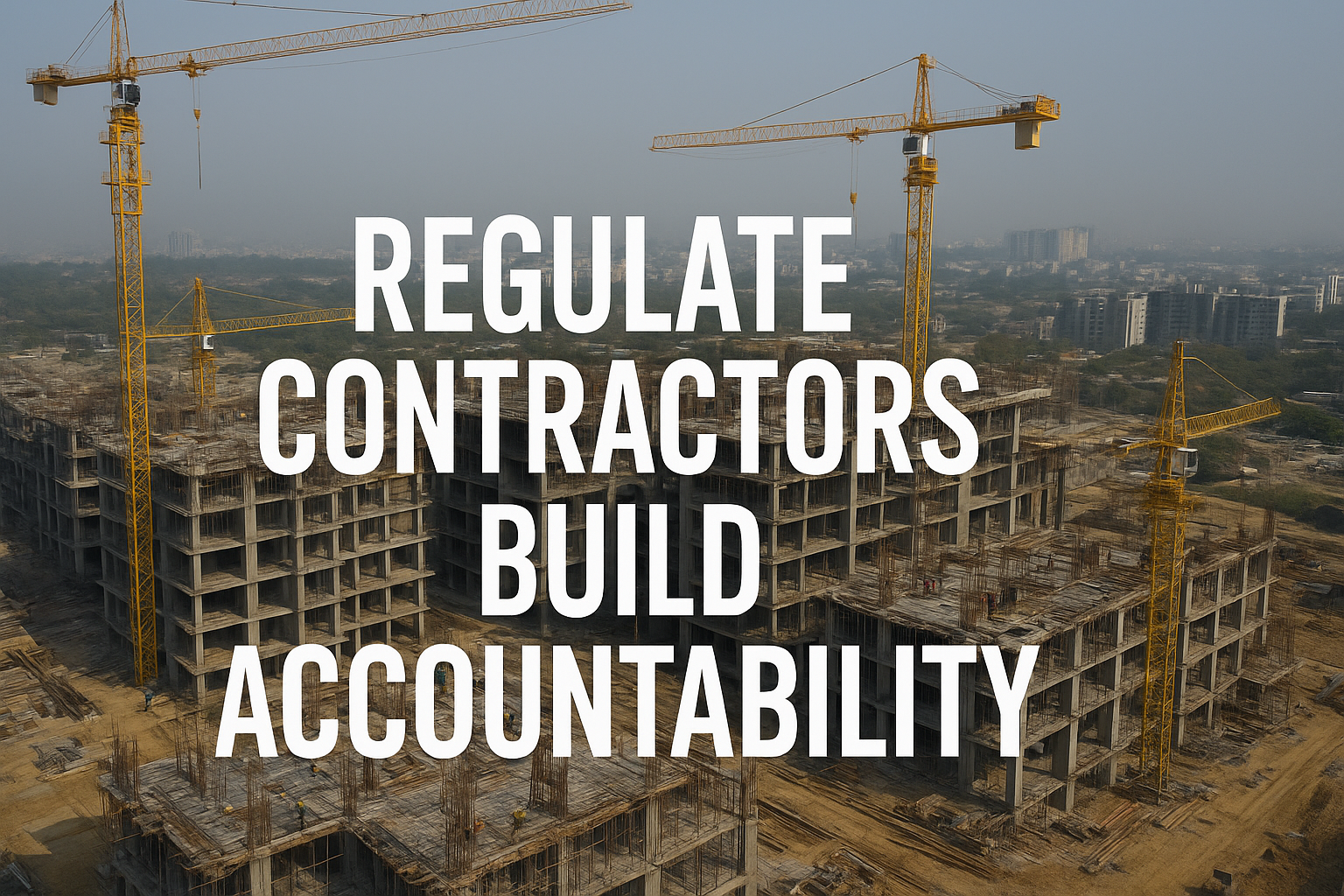
India’s real estate market—valued at over USD 265 billion in 2024—is expanding rapidly, especially in Tier 2 and Tier 3 cities. Urbanisation and infrastructure projects under Smart Cities Mission, PM Awas Yojana, and metro expansions have driven an unprecedented construction boom.
However, one critical stakeholder remains unregulated—the contractor. Developers conceptualise and sell projects, but it’s the contractor who translates the blueprint into physical reality. Yet, no legal mechanism holds them directly accountable for quality, safety, or timelines.
The Real Estate (Regulation and Development) Act 2016 (RERA) was designed to protect homebuyers and bring transparency by registering developers and real-estate agents. It mandates escrow accounts, delivery timelines, and defect liability for five years after possession.
But contractors—who actually construct—are outside its scope. Current oversight relies on scattered provisions:
A national contractor registry should be established—similar to RERA’s developer database—to record licensing, grading, and blacklisting.
Each licence could depend on:
Registered contractors could receive performance scorecards, publicly accessible to regulators, developers, buyers, and lenders. Grading metrics might include:
A mandatory declaration of contractor details on every project under RERA would bring transparency. Linking contractor payments to verified milestones via escrow mechanisms can deter negligence and encourage compliance.
India’s ambition to build safe, sustainable housing depends on ensuring that those physically constructing it are accountable. A regulatory system covering contractors will complete the RERA framework, strengthen buyer confidence, and raise construction standards to global levels.
