Published On:
November 30, 2025
Updated On:
February 23, 2026
The Raya Heritage City is a flagship cultural and tourism development initiated by the Yamuna Expressway Industrial Development Authority (YEIDA) in the Mathura district, Uttar Pradesh. Conceived as the "Raya Urban Centre," the project is inspired by the Braj culture and the life of Lord Krishna, aiming to create a global-class destination.
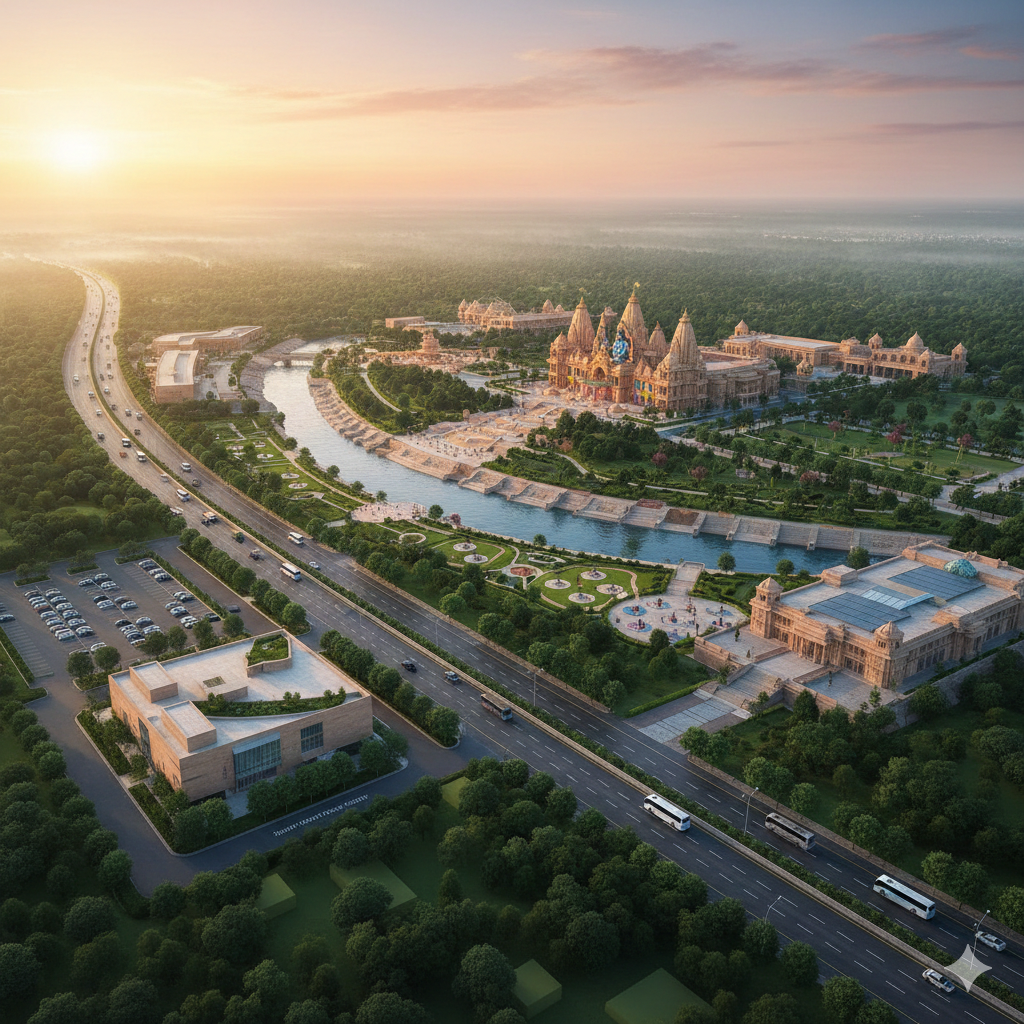
In the heart of India's spiritual geography, where the legends of Lord Krishna permeate every grain of sand and ripple of the Yamuna River, a transformative urban experiment is taking shape. The Raya Heritage City is not merely a construction project; it is a visionary attempt to bridge the gap between millennia-old devotional heritage and the exigencies of 21st-century urban planning. Spearheaded by the Yamuna Expressway Industrial Development Authority (YEIDA), this massive undertaking in the Mathura district of Uttar Pradesh promises to redefine the concept of a "Temple Town" for the modern world.
As India stands on the cusp of a spiritual tourism renaissance, the Raya Heritage City emerges as a flagship development. It is designed to serve as a glorious, congestion-free gateway to the Braj region—the playground of Lord Krishna—while offering world-class infrastructure, wellness retreats, and a highly sustainable living environment. This comprehensive exploration delves into the strategic vision, master planning, real estate dynamics, economic implications, and cultural significance of this monumental project, which is set to become a global destination by the late 2020s.
To understand the necessity of Raya Heritage City, one must first look at the current state of Mathura and Vrindavan. These twin cities are the beating heart of Vaishnavism, attracting tens of millions of pilgrims annually. During major festivals like Janmashtami, Radhashtami, or Holi, the footfall reaches astronomical numbers, placing immense, often unsustainable strain on the existing, centuries-old infrastructure. Narrow lanes, severe traffic congestion, parking nightmares, and a lack of organized amenities frequently challenge the spiritual experience of the devotee.
Recognizing this critical bottleneck, YEIDA conceived the "Raya Urban Centre" with a dual core objective: De-congestion and Elevation. The idea was to create a satellite counter-magnet that could absorb the massive tourist influx, provide high-quality accommodation and transit facilities, and offer a curated cultural experience that flawlessly complements the traditional pilgrimage.
The project is explicitly inspired by the rich cultural tapestry of Braj. It is not designed to be a concrete jungle, but a living homage to the pastoral and architectural heritage of the region. The vision involves a cityscape where modern amenities—uninterrupted power, decentralized sewage treatment, and smart traffic management—coexist harmoniously with the aesthetics of traditional ghats (riverbanks), stone-carved temples, and floral landscapes reminiscent of the mythological Vrindavan forests.
The success of any new urban centre hinges entirely on its location, and Raya Heritage City sits on a goldmine of connectivity. The project spans a colossal planning area of approximately 11,653 hectares, with the immediate phase-one development focusing on a notified cluster of roughly 735 to 753 acres. This land is strategically situated right along the Yamuna Expressway, India's premier industrial and transit corridor connecting the National Capital Region (Delhi-NCR) to Agra.
Perhaps the most critical infrastructural component of this project is the proposed 7-kilometer greenfield expressway. This new, dedicated arterial road is designed to directly connect the Yamuna Expressway to the precincts of the Banke Bihari Temple in Vrindavan, effectively acting as a bypass. For a pilgrim traveling from Delhi, Noida, or the upcoming Noida International Airport, this is revolutionary. It means one can bypass the congested, narrow peripheral roads of old Mathura and land virtually at the doorstep of the main temple complex in a fraction of the current travel time.
The development is timed perfectly with the rapid rise of the Noida International Airport at Jewar. Located just a short drive away via the Yamuna Expressway, the airport will open the gates of Braj directly to the international community. Foreign tourists and NRI devotees interested in Indian spirituality, yoga, and history will find Raya Heritage City to be the most accessible, hassle-free entry point, bypassing the logistical chaos of traversing through New Delhi. The synergy between the massive aviation hub at Jewar and the Heritage City creates a robust tourism corridor that is expected to rival global spiritual destinations like the Vatican or Mecca in terms of sheer organized footfall.
Executing a mega-project of this magnitude requires a delicate balance of public oversight and private efficiency. To achieve this, YEIDA has smartly adopted a Hybrid Development Model to ensure the project meets strict international standards.
Under this framework, the heavy lifting of basic infrastructure—laying arterial roads, utilities, deep drainage systems, and the complex task of land acquisition—remains the purview of the Authority (YEIDA). This ensures that the foundational grid of the city is robust, legally secure, and free of title disputes. However, the "soul" of the city—the thematic elements, hospitality ventures, wellness centers, and specialized tourism zones—will be developed through Public-Private Partnerships (PPP).
By engaging global consultants like CBRE South Asia to manage the rigorous bidding and tender processes, YEIDA is signaling its clear intent to attract top-tier international and national real estate developers. This approach allows for the infusion of global expertise in managing theme parks and hospitality districts, ensuring that the "Heritage City" doesn't just look the part but functions with the clockwork efficiency of a modern European or Singaporean tourist hub.
The Master Plan of Raya Heritage City is a fascinating study in thematic, purpose-driven zoning. The notified area is dissected into specific sectors, each serving a unique purpose in the pilgrim's journey. This is not a monolithic residential zone, but a carefully curated collection of experiences.
The absolute crown jewel of the project is the massive 350-acre Heritage Zone. While architectural details are continually evolving, the core vision for this area is akin to a "Living Museum." Unlike a static museum with glass cases, this sprawling zone is expected to feature highly immersive recreations of mythological locations—replicated pastoral villages from the Dwapara Yuga, interactive, tech-driven exhibitions on the life of Lord Krishna, and grand, open-air performance arenas specifically designed for the traditional Raas Leela. It serves as an educational and cultural anchor, allowing visitors, especially the younger generation, to immerse themselves in the stories of the Mahabharata and the Bhagavata Purana before they step foot in the actual historical temples.
Recognizing the massive global shift towards holistic health and mindfulness, YEIDA has dedicated over 100 acres to a tranquil Wellness Zone. This is where the "Heritage" aspect seamlessly meets "Modern Wellness." The master plan envisions a cluster of high-end yoga retreats, vipassana meditation centers, and naturopathy institutes. Set against a lush backdrop of extensive greenery and strictly designed to be a noise-free zone, this area caters to the "spiritual tourist"—the traveler who seeks not just the brief darshan of a deity, but also the deep, sustained rejuvenation of the self.
Complementing the wellness zone is a highly specialized, dedicated hub for Ayurveda. This sector is planned to host authentic Ayurvedic hospitals, ancient medicine research centers, and vast herbal gardens cultivating indigenous medicinal plants. It strategically positions Raya not just as a place of worship, but as a premier destination for medical tourism rooted entirely in ancient Indian science.
In a respectful nod to the legendary, sacred forests of Vrindavan (like Nidhivan and Seva Kunj), the city plans for nearly 100 acres of open green parks and water bodies. These are not merely decorative patches of grass but vital, engineered ecological zones designed to maintain a cooler microclimate, manage extensive groundwater recharge, and provide a serene, natural environment for pilgrims to rest. The urban planners have been careful to align these green zones away from the river's active floodplains while utilizing them as a natural buffer to shield the city's inner sanctum from highway noise and vehicular pollution.
To handle the intense logistics of mass tourism efficiently, 46 acres are strictly set aside for a state-of-the-art Tourist Transit Facility. This will likely function as a multi-modal transport hub where interstate buses, private taxis, and the city's internal electric shuttles converge. Adjacent to this transit hub is a 42-acre Convention Centre Zone. This facility opens up an entirely new, highly lucrative market for Mathura: "MICE" tourism (Meetings, Incentives, Conferences, and Exhibitions). Corporate houses, international yoga alliances, and large religious organizations can host massive summits here, perfectly combining business conferences with spiritual retreats.
The financial blueprint of Raya Heritage City is just as impressive as its cultural vision. With an estimated initial investment exceeding ₹6,300 crore for the notified heritage cluster alone, the project is set to be a massive economic engine for Western Uttar Pradesh, driving unprecedented real estate demand.
For savvy real estate investors and developers, Raya Heritage City represents a frontier market with guaranteed footfall. The organized influx of millions of tourists will necessitate a massive, immediate supply of hotel rooms—ranging from budget-friendly dharmshalas and hostels to 5-star luxury boutique resorts. The master plan explicitly includes generous provisions for commercial hotels and serviced apartments, creating highly lucrative, high-yield opportunities for hospitality brands and commercial real estate investors.
A highly specific, rapidly growing niche that Raya Heritage City is perfectly positioned to serve is the "Senior Living" demographic. Culturally, many elderly Indians express a deep desire to spend their twilight years in the holy land of Braj. However, the lack of modern medical facilities and organized housing in old Mathura has often deterred them.
Raya’s planned infrastructure—safe, gated communities, pedestrian-friendly roads, expansive parks, world-class healthcare facilities, and immediate proximity to the temples—makes it the ultimate, ideal location for premium retirement communities. This specific sector is expected to be a massive driver of long-term residential real estate value, alongside a surge in demand for vacation properties and weekend second homes from wealthy Delhi-NCR residents.
Beyond real estate appreciation, the city will generate tens of thousands of direct and indirect jobs. The service sector—tour guides, hospitality staff, retail workers, and transport operators—will see immediate, explosive growth. Furthermore, the strong focus on arts and crafts within the Heritage Zone promises to completely revive local cottage industries. It will provide local Mathura artisans with a global, organized platform to sell authentic Braj-style paintings, intricate embroidery, brassware, and stone sculpture at fair market prices.
Developing a brand-new city on the banks of the ecologically sensitive Yamuna River requires extreme environmental stewardship. The planners have reportedly taken significant, data-driven measures to ensure the city is entirely flood-resilient. The site selection process deliberately and carefully excluded active floodplains to prevent the kind of devastating water-logging issues frequently seen in other poorly planned riverside developments across India.
Furthermore, the "Green" aspect of the expressway and the city's internal transport puts a heavy, non-negotiable emphasis on electric mobility. The overarching vision is to drastically reduce the carbon footprint of the traditional pilgrimage. By strictly encouraging (and potentially mandating) visitors to park their private, combustion-engine vehicles at the peripheral Transit Hub and solely use zero-emission electric shuttles to enter the temple and heritage zones, Raya Heritage City could become the ultimate model for pollution-free, sustainable tourism zones in India.
As of late 2025 and moving into 2026, the project has successfully transitioned from the drawing board to the active tendering and notification stage. The necessary land has been identified, the developmental authority is firmly in place, and the complex financial models have been approved by the state cabinet. The next few years will be absolutely critical as the PPP partners are finalized, global tenders are awarded, and ground is officially broken.
The timeline for a mega-project of this unprecedented scale is naturally long-term. While the basic, arterial infrastructure and the greenfield expressway bypass might be ready within a few years, the full maturation and operationalization of the Heritage and Wellness zones will likely take the better part of a decade.
However, for the astute real estate observer and investor, the trajectory is crystal clear. The convergence of immense government political will (with both state and central governments hyper-focused on developing heritage corridors), the massive economic boom of the NCR and YEIDA region, and the timeless, unwavering pull of Mathura-Vrindavan ensures that Raya Heritage City is not a question of "if," but "when."
Raya Heritage City is a bold, unapologetic statement of intent. It asserts that India does not need to choose between preserving its ancient past and embracing its modern future. It demonstrates that a city can be deeply, authentically rooted in the mythology of the Dwapara Yuga while being built with the cutting-edge technology, sustainability standards, and infrastructure of the Digital Age.
For the devotee, it promises a pure, elevated pilgrimage free of squalor, danger, and chaos. For the global tourist, it offers a safe, world-class cultural immersion into the vibrant, colorful world of Krishna. And for the investor, the real estate developer, and the economist, it represents a massive new growth pole in Uttar Pradesh's rising economic story. As the first bricks are laid and the greenfield expressway begins to carve its path toward Banke Bihari, Raya Heritage City stands as a towering beacon of how India plans to honor its soul while profoundly upgrading its body. It is, truly, a visionary gateway to Braj culture and modern wellness.
