Published On:
February 10, 2026
Updated On:
February 10, 2026
Noida Sector 62 is set to undergo a major infrastructural upgrade with the foundation stone laid for a new 530-meter circular skywalk. This ₹26 crore project aims to decongest the busy Model Town roundabout, offering safe passage to over 50,000 daily commuters and ensuring seamless connectivity between Sector 62, 63, and the Delhi-Meerut Expressway.
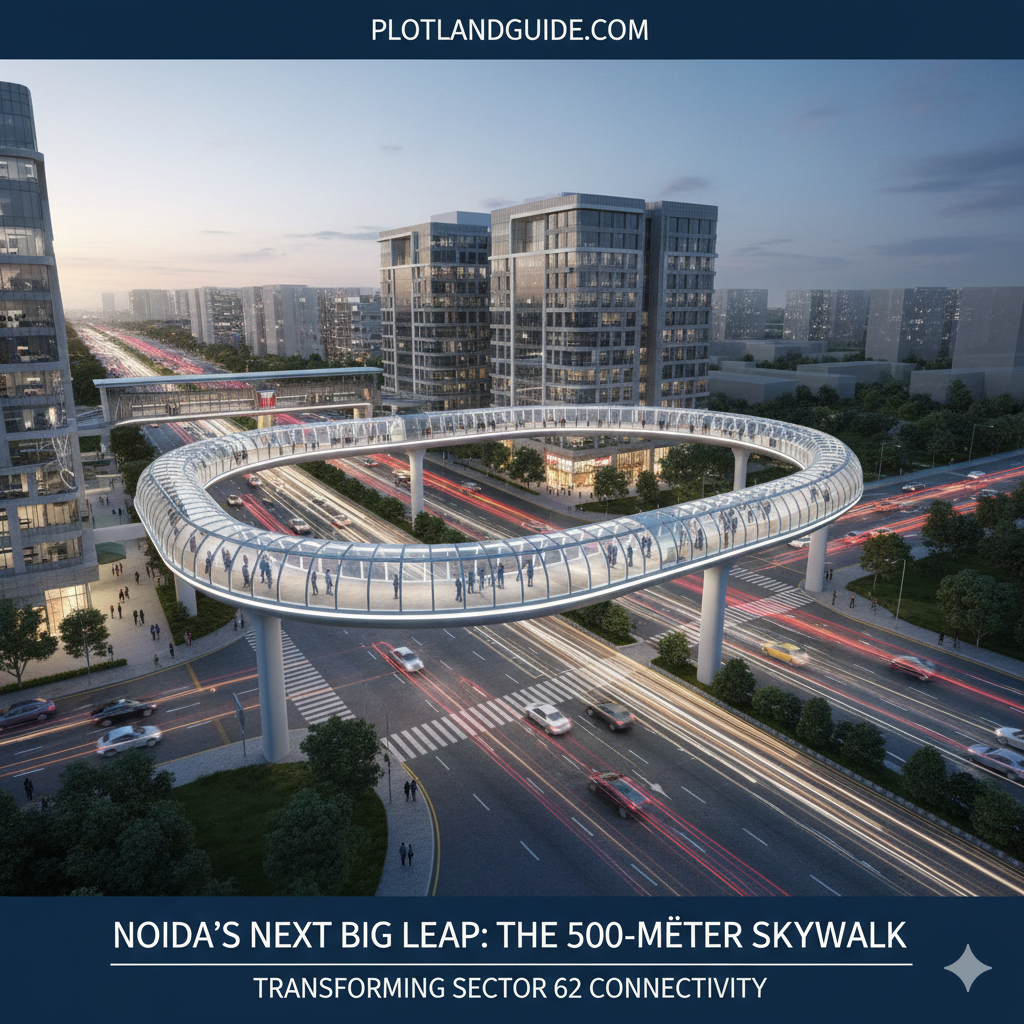
Noida has long been the crown jewel of the National Capital Region’s (NCR) urban expansion. From wide expressways to a rapidly expanding metro network, the city has consistently set benchmarks for modern infrastructure. However, as the city has evolved from a residential suburb into a bustling commercial and industrial powerhouse, the pressure on its arterial nodes has grown exponentially. Nowhere is this more evident than in the twin sectors of 62 and 63—the beating heart of Noida’s IT and institutional economy.
For years, the intersection connecting these sectors to National Highway 9 (NH-9) has been a chokepoint, a chaotic mix of high-speed vehicular traffic and thousands of pedestrians navigating a dangerous crossing. But a solution is finally underway. In a decisive move to prioritize pedestrian safety and unclog one of the city’s busiest arteries, the Noida Authority has commenced work on a massive, state-of-the-art skywalk project. This isn't just a foot overbridge; it is a 530-meter engineering marvel designed to redefine how the city moves.
This development marks a significant shift in urban planning, moving away from a vehicle-centric approach to one that balances the needs of the pedestrian workforce with the flow of highway traffic. As the foundation stone is laid and excavators begin their work, we take a deep dive into what this project entails, why it is critical for the region, and how it will reshape the daily lives of thousands.
To appreciate the solution, one must first understand the problem. The Model Town roundabout, often referred to as the Sector 62 Golchakkar, is a critical junction. It sits at the convergence of three major traffic streams: the internal city traffic from Noida’s residential cores, the industrial heavy-lifters from Sector 63, and the high-speed inter-state traffic exiting the Delhi-Meerut Expressway (NH-9).
Every morning, this junction witnesses a tidal wave of humanity. Sector 62 is home to some of India’s largest software parks, multinational corporations, and educational institutions. Sector 63, on the other hand, houses hundreds of industrial units and MSMEs. The workforce powering these sectors relies heavily on public transport—buses dropping them off on the highway, shared autos, and the metro.
The result has historically been a perilous dance. Pedestrians, numbering over 50,000 daily, are forced to jaywalk across multiple lanes of moving traffic. This not only puts lives at risk—leading to frequent accidents—but also forces vehicles to slow down, creating long tailbacks that spill over onto the national highway. The absence of a dedicated grade-separated crossing meant that traffic signals were often rendered useless by the sheer volume of people crossing on foot. The new skywalk is the direct answer to this specific, high-stakes logistical challenge.
The proposed skywalk is a departure from the conventional, linear foot overbridges (FOBs) that dot Indian cities. Recognizing the multi-directional flow of traffic and pedestrians at a roundabout, the planners have opted for a sophisticated "zero-loop" or circular design.
The Design PhilosophyThe structure will span a total length of approximately 530 meters. The centerpiece of this infrastructure is a 350-meter circular ring that hovers above the roundabout itself. This loop ensures that a pedestrian can enter from any corner of the intersection—be it the Sector 62 institutional area, the Sector 63 industrial hub, or the highway stops—and exit at any other point without ever touching the road surface.
Complementing the circular loop is a 180-meter straight spur that connects the ring to further catchment areas, ensuring that the "last mile" is truly covered. The design is not just functional; it is aesthetic, meant to serve as a landmark entry point into Noida for travelers coming from Ghaziabad and Delhi.
All-Weather AccessibilityOne of the key criticisms of older FOBs is their usability during harsh weather. In peak summer or monsoon, open-air bridges often go unused as pedestrians prefer the risk of crossing the road to the discomfort of the bridge. Addressing this, the Sector 62 skywalk will feature a robust, all-weather roof. This shelter ensures that the workforce can commute in comfort, shielded from the scorching sun and heavy rains.
Universal AccessModern infrastructure must be inclusive. The project specifications include the installation of high-capacity elevators and escalators at all four major entry and exit points. This is a game-changer for the elderly and the differently-abled, who previously found the intersection nearly impassable. By mechanizing the ascent and descent, the authorities are ensuring that the skywalk becomes the path of least resistance, naturally encouraging its use over jaywalking.
The impact of this skywalk extends far beyond the immediate roundabout. The Model Town junction is a primary feeder for the Delhi-Meerut Expressway (NH-9). When traffic jams occur at the roundabout due to pedestrian movement, the queue often extends back onto the highway service lanes, causing friction for inter-city travelers.
By completely segregating the pedestrian traffic to an elevated level, the ground level is freed up exclusively for vehicular movement. Traffic engineering studies suggest that "conflict-free" junctions—where pedestrians and vehicles never intersect—can increase vehicular throughput by up to 40%.
For the daily commuter driving from Delhi to Indirapuram or Greater Noida via this route, this translates to a smoother, signal-free drive. The skywalk effectively acts as a pressure valve, releasing the pent-up congestion that plagues the NH-9 exit ramps during peak evening hours. This project is a crucial component of the larger mandate to keep the National Highway corridor free of local urban bottlenecks.
It is important to view the Sector 62 skywalk not as an isolated project but as a cog in a larger machine. The Noida Authority has embarked on an ambitious plan to develop a "Model Road" stretching 3.5 kilometers from Sector 62 to Mamura.
This corridor is being reimagined to meet international standards. The skywalk is the anchor project, but it will be complemented by widened carriage ways, designated parking bays for auto-rickshaws (which are currently a major cause of chaos), and landscaped pedestrian pathways. The vision is to create a seamless transit corridor where public transport, private vehicles, and pedestrians coexist in organized lanes rather than competing for the same asphalt.
The integration with the "Model Road" also implies better lighting, signage, and drainage systems. Once completed, this stretch will serve as a template for other high-density corridors in the city, showcasing how retrofitted infrastructure can solve modern urban problems.
Infrastructure is the backbone of real estate value. In the world of commercial real estate, "connectivity" is the single most important currency. Sector 62 is already one of the most premium office markets in NCR, commanding high rentals and hosting prestigious tenants. However, the perennial traffic issues have often been a dampener, cited frequently by HR heads concerned about employee commute times.
Commercial ViabilityThe completion of the skywalk will directly boost the attractiveness of office spaces in Sector 62 and 63. A safer, faster commute makes the location more desirable for top-tier talent. We can expect to see a hardening of rental yields in the commercial towers situated in the immediate vicinity of the roundabout. The "walk-to-work" concept becomes a reality when the walk is safe, covered, and mechanized.
Retail and Residential BoostThe improved flow of traffic will also benefit the residential pockets of Sector 62 and neighboring Indirapuram (across the highway). For residents, the reduction in noise pollution from constant honking and the elimination of traffic snarls improves the overall livability index. Furthermore, organized movement often leads to the development of organized retail. The footfall that currently scatters across the road will now be channeled through the skywalk, creating potential opportunities for kiosks and convenience retail at the landing points, adding vibrancy to the area.
With the foundation stone laid, the clock has officially started ticking. The project, with an estimated budget of approximately ₹26 crore, comes with a strict deadline. Authorities have set a target of 18 months for completion.
The construction phase will likely involve the use of pre-fabricated steel structures to minimize disruption to live traffic. Unlike traditional concrete bridges that require massive on-site casting and long road closures, modern skywalks are often assembled like giant Lego sets—steel girders are fabricated in factories and hoisted into place overnight. This methodology should ensure that the daily agony of commuters is not exacerbated during the construction period.
Residents and commuters can expect to see barricading and piling work commence shortly. While there will be some temporary diversions, the promise of a permanent solution on the horizon is likely to keep morale high.
For too long, Indian urban planning has prioritized the car over the person. Roads are widened, flyovers are built, and underpasses are dug, often leaving the pedestrian with a sliver of broken pavement. The Noida Sector 62 skywalk represents a welcome reversal of this trend. It is an acknowledgment that a city’s efficiency is measured not just by how fast a car can move, but by how safely a person can walk.
This project is a testament to the fact that density is not the problem; mismanagement of space is. By utilizing the vertical space above the road, Noida is reclaiming the ground for smooth traffic while giving pedestrians a dedicated, dignified corridor.
The 530-meter skywalk at Sector 62 is more than just steel and concrete; it is a lifeline for the thousands of people who power Noida’s economy. It represents a maturity in the city’s governance—a shift from reactive patchwork to proactive, world-class infrastructure development.
As we look forward to the inauguration 18 months from now, the image of a chaotic, dangerous crossing will likely fade into memory, replaced by the sleek silhouette of a circular skywalk. For the IT professional rushing to a meeting, the factory worker heading for a shift, and the student traveling to college, the journey is about to get a whole lot safer, and a whole lot faster. Noida is rising, and this time, it is taking its pedestrians along for the ride.
