Published On:
March 18, 2026
Updated On:
March 18, 2026
The Noida Authority has proposed a 710-meter, six-lane underpass at the Parthala junction on the FNG Expressway, an 85.5 crore project designed to eliminate peak-hour congestion, ensure signal-free movement, and significantly boost real estate valuations across Noida and Greater Noida.
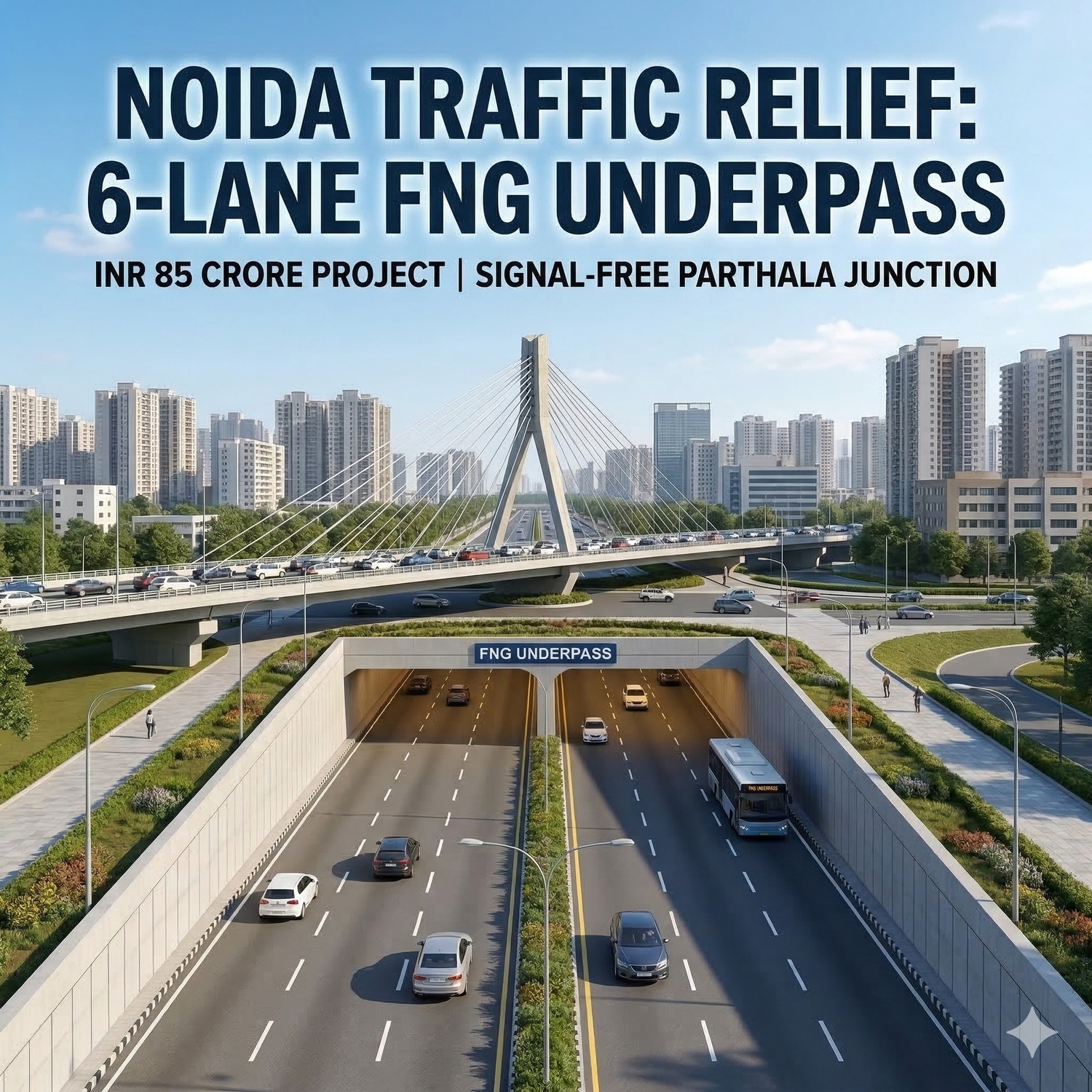
Anyone who drives through Noida on a daily basis understands the unique frustration of the Parthala roundabout. Despite recent infrastructural upgrades, navigating this massive intersection during the morning rush or the evening return commute often feels like a test of endurance. At specific hours, the rotary near the towering Parthala Signature Bridge transforms into a chaotic, slow-moving sea of vehicles. Cars inch forward, two-wheelers weave aggressively through tight gaps, heavy interstate buses dominate the lanes, and commute times stretch unpredictably.
As the residential density in nearby sectors continues to explode, local authorities have recognized that surface-level traffic management is no longer sufficient. To resolve this persistent bottleneck, the Noida Authority has drawn up a highly anticipated solution: a massive, six-lane underpass situated directly on the Faridabad-Noida-Ghaziabad (FNG) corridor. This infrastructure project, carrying an estimated budget of 85.50 crore rupees, is not just a minor road tweak. It is a fundamental redesign of how vehicular movement will flow between three major cities, promising to hand thousands of daily commuters their valuable time back.
To understand why an underpass of this magnitude is necessary, one must look at the geographical and demographic shifts that have occurred in the region over the past decade.
The Parthala junction is the central nervous system for traffic moving between central Noida, Ghaziabad, and the rapidly expanding residential hub of Greater Noida West, commonly known as Noida Extension. Over the last ten years, Greater Noida West has witnessed an unprecedented influx of residents. Hundreds of high-rise societies have been occupied, bringing tens of thousands of private vehicles onto the roads. The vast majority of these residents travel toward central Noida or Delhi for work, meaning they must cross the Parthala intersection twice a day.
A few years ago, the government constructed the visually striking Parthala cable-stayed bridge. This elevated structure successfully lifted the east-west traffic flowing directly between Sector 71 and Kisan Chowk, allowing those vehicles to bypass the roundabout entirely. However, the bridge only solved half the equation.
The north-south traffic—specifically the vehicles traveling along the alignment of the FNG Expressway from the Chhijarsi side toward Sorkha and Phase 2—still has to navigate the at-grade rotary right below the cable bridge. When this heavy flow of FNG traffic collides with the local surface traffic trying to access nearby service lanes, the result is a massive daily gridlock. The rotary simply cannot handle the sheer volume of cars pouring in from multiple directions simultaneously.
The proposed six-lane underpass is an engineering solution designed to segregate local, short-distance traffic from long-haul, interstate vehicles.
According to the project outlines prepared by the planning agencies, the underpass will stretch for approximately 710 meters. It will be constructed directly beneath the existing Parthala cable-stayed bridge, specifically aligning with the Chhijarsi-Sorkha stretch of the FNG corridor.
By pushing the FNG traffic underground, vehicles traveling straight from the National Highway 9 (NH-9) side in Ghaziabad toward the Noida Special Economic Zone (NSEZ) or Faridabad will no longer need to stop or slow down at the Parthala roundabout. They will experience a completely signal-free transit under the junction. Meanwhile, the surface-level rotary will be freed up exclusively for local traffic and vehicles needing to make turns into adjacent sectors.
The financial blueprint for this structural upgrade is set at 85.50 crore rupees. This budget encompasses the extensive civil engineering required to dig beneath an active bridge, the construction of reinforced retaining walls, advanced water drainage systems to prevent monsoon flooding, high-visibility service lighting, and the overall strengthening of the approach roads. The Detailed Project Report (DPR) has already been drafted by the Delhi Integrated Multi-Modal Transit System (DIMTS), the agency tasked with formulating the technical and financial feasibility of the project.
This underpass is a highly critical component of a much larger, highly delayed vision: the Faridabad-Noida-Ghaziabad Expressway. Conceived decades ago, the 56-kilometer FNG corridor was designed to serve as a massive bypass, allowing heavy commercial and passenger traffic to travel seamlessly between Haryana and Uttar Pradesh without ever entering the heavily congested borders of Delhi.
While parts of the FNG within Noida have been functional as wide arterial roads, the corridor as a whole has suffered from prolonged delays due to land acquisition hurdles and inter-state coordination issues. However, the aggressive push to construct this 710-meter underpass signals a renewed governmental intent to fully operationalize the Noida stretch of the FNG.
By eliminating the biggest choke point on the Noida leg of the route, authorities are preparing the groundwork for future traffic volumes. When the bridge over the Yamuna River connecting Noida Sector 168 to Faridabad is eventually completed, the FNG will see a massive surge in vehicular load. Building the Parthala underpass now is a proactive measure to ensure the city’s internal road network does not collapse when the interstate expressway becomes fully functional.
In the realm of real estate, there is a direct, undeniable correlation between infrastructure upgrades and property valuations. The formula is straightforward: every minute saved on a daily commute translates into measurable financial premiums on nearby homes. The announcement of this underpass has already triggered a wave of positive sentiment across the local property market.
For the hundreds of thousands of residents living in Greater Noida West, the prospect of a smoother commute is a massive relief. The chronic traffic at Parthala has historically been a major deterrent for buyers considering property in Noida Extension. People are often hesitant to invest in an area if leaving the neighborhood requires sitting in a thirty-minute traffic jam. By actively resolving this pain point, the overall livability index of Greater Noida West improves drastically. Market watchers anticipate that ready-to-move-in apartments in sectors close to the FNG, as well as premium high-rises near Gaur Chowk, will see a noticeable uptick in both rental yields and resale demand once the heavy machinery rolls in for construction.
Similarly, the residential sectors in central Noida that directly border the FNG—such as Sector 120, 121, 122, and the 7X sectors—stand to benefit immensely. An underpass reduces the noise and air pollution caused by idling vehicles at the roundabout, making the immediate environment far more desirable for homeowners.
While the apartment market reacts quickly to such news, the most profound and lucrative impact of infrastructural projects like the FNG underpass is felt in the land sector. For astute investors focused on long-term wealth generation, the aggressive expansion of road networks highlights the immense potential of investing in residential and commercial plots.
Unlike apartments, which have a capped spatial value and depreciate structurally over time, land is an appreciating asset that scales in direct proportion to its accessibility. The overarching goal of the FNG Expressway, supported by critical nodes like the Parthala underpass, is to seamlessly link Ghaziabad, Noida, and Faridabad. This creates a highly integrated economic zone.
When you eliminate geographical friction, land parcels on the expanding edges of the city suddenly become prime real estate. Investors with a strategic horizon have long favored plots in Greater Noida and the massive corridors managed by the Yamuna Expressway Industrial Development Authority (YEIDA). The logic is highly sound. As the FNG corridor matures, it will inevitably connect with the broader expressway networks, including the Noida-Greater Noida Expressway and the Yamuna Expressway.
This means that a residential plot in Greater Noida or a commercial parcel in the YEIDA region will have direct, signal-free access to a massive catchment area spanning three major cities. Businesses will want to set up operations where logistics are frictionless, and families will want to build homes in plotted developments that offer the space of the suburbs but the commute times of the city center. Investing in land in these high-growth corridors before the final layers of infrastructure, like the FNG underpass, are completed allows investors to secure assets at a lower entry price, riding the massive wave of capital appreciation as the region fully operationalizes.
The upcoming Noida International Airport at Jewar only amplifies this strategy. The FNG will serve as a critical feeder route, bringing traffic from Faridabad and Ghaziabad down toward the airport via the Yamuna Expressway. Land investments situated along this entire transit ecosystem are positioned for phenomenal, market-beating returns over the next decade.
While the anticipation is high, it is important to understand the administrative pipeline required to bring an 85-crore project from paper to pavement.
The Detailed Project Report prepared by DIMTS is currently in the presentation phase. The next immediate step involves an exhaustive review by the top executives of the Noida Authority. They will scrutinize the engineering designs, assess the environmental impact, and finalize the financial allocations.
Once the internal approvals are stamped, the project will move into the tendering phase. The authority will invite bids from heavy construction firms capable of executing complex subterranean engineering without disrupting the structural integrity of the massive cable bridge standing right above the dig site. Selecting the right contractor is crucial, as the work will require sophisticated traffic diversion plans to ensure that the intersection remains functional, albeit at a reduced capacity, during the extensive construction period.
If the bureaucratic process moves swiftly, the foundation work could potentially commence within the next few quarters. However, large-scale infrastructural projects in densely populated urban centers are inherently complex, and commuters should brace for a period of transitional disruption before they get to enjoy the final, frictionless drive.
The proposed six-lane underpass at the Parthala junction is a testament to the necessity of adaptive urban planning. A city cannot simply build residential towers indefinitely without aggressively upgrading the arteries that support them. By addressing the FNG corridor's most notorious bottleneck, the local administration is taking a highly practical step toward future-proofing the region's mobility.
For the exhausted daily commuter, this 85-crore project represents the eventual end of an agonizing daily crawl. For the broader economy, it signifies the steady realization of the FNG Expressway’s ultimate goal: creating a unified, hyper-connected National Capital Region. And for the strategic real estate investor, particularly those focusing on the high-yield potential of land and plots across Noida, Greater Noida, and the YEIDA sectors, it is a clear signal that the region's physical and economic landscape is rapidly maturing, paving the way for unprecedented long-term growth.
