Published On:
April 23, 2026
Updated On:
April 23, 2026
The highly anticipated air-conditioned skywalk connecting Noida Metro's Sector 51 and Sector 52 stations faces another major setback due to structural hurdles, forcing thousands of daily commuters to continue navigating a chaotic, waterlogged, and heavily encroached pedestrian stretch.
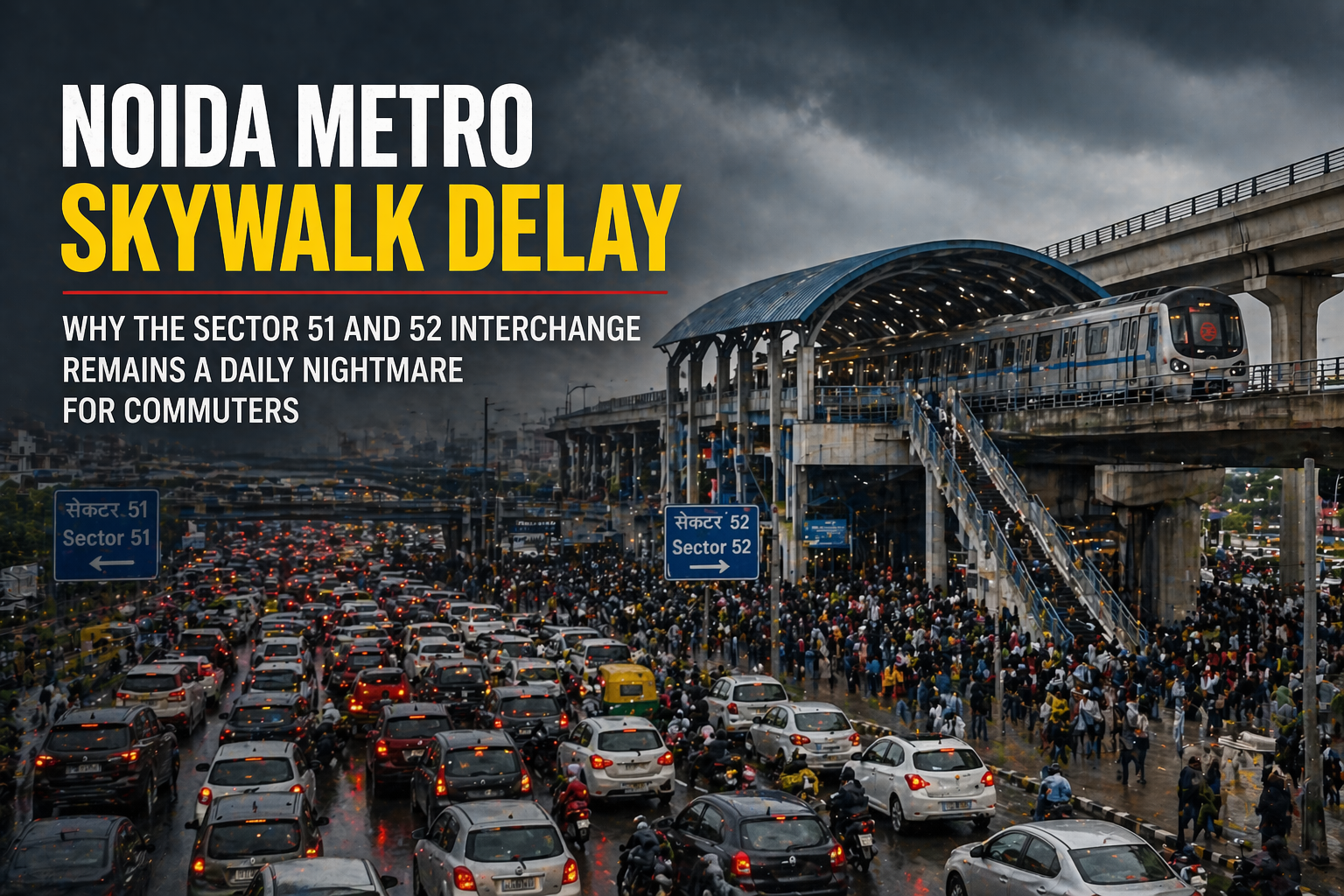
The rapid urbanization of the National Capital Region has been heavily supported by the aggressive expansion of the Delhi Metro and its adjoining regional networks. For the twin cities of Noida and Greater Noida, the introduction of the Aqua Line was hailed as a monumental infrastructural achievement, designed to seamlessly connect the burgeoning residential sectors and commercial hubs of Greater Noida with the rest of the capital. However, the true success of any vast public transit network relies entirely on the efficiency of its interchange nodes. Today, the most critical intersection in this entire regional network—the physical gap between the Delhi Metro Rail Corporation’s Blue Line and the Noida Metro Rail Corporation’s Aqua Line—stands as a glaring example of urban planning oversights and chronic execution delays.
The physical separation between the Sector 52 station on the Blue Line and the Sector 51 station on the Aqua Line has been a point of massive frustration since the latter first became operational in 2019. Thousands of daily commuters, including corporate professionals, college students, and industrial workers, rely on this specific transition point to cross between the two different metro systems. To solve the transit friction, authorities launched an ambitious infrastructure project to bridge the gap. Yet, more than a year past its original deadline, the highly anticipated Noida Metro skywalk remains entirely non-functional, leaving passengers stranded in a daily logistical nightmare.
When the skywalk project was officially greenlit and launched in March 2023, it was presented as the ultimate solution to the interchange chaos. The Noida Authority and the Noida Metro Rail Corporation committed approximately Rs 40 crore to develop a state-of-the-art pedestrian facility. The blueprint outlined a massive, 400-metre-long, L-shaped foot overbridge that would provide a completely enclosed, climate-controlled environment for transit users.
Recognizing that walking nearly half a kilometer between stations can be exhausting, especially for the elderly or differently-abled, the design heavily featured the installation of modern travelators. This moving walkway system was intended to drastically cut down the transit time between the Blue Line and the Aqua Line, effectively mirroring the seamless, indoor interchange experiences seen at major global airport terminals or central metropolitan transit hubs like the Hauz Khas or Rajiv Chowk stations. The original project timeline was set for a strict one-year completion, with authorities promising that commuters would be utilizing the air-conditioned skywalk by early 2024.
Despite the substantial financial investment and the clear public necessity, the construction of the Sector 51 and Sector 52 skywalk has been severely derailed by a cascading series of unforeseen hurdles. The delays highlight the immense complexities involved in executing large-scale civil engineering projects within already highly dense, fully operational urban corridors.
The initial setbacks were entirely regulatory. Like all major construction initiatives in the Delhi-NCR region, the skywalk project fell victim to the strict anti-pollution measures enforced by the National Green Tribunal. During the severe winter months, the implementation of the Graded Response Action Plan automatically halts all non-essential construction and demolition activities to curb atmospheric dust. These mandatory winter pauses ate into several crucial months of the initial construction schedule.
However, the most significant delays have been deeply technical in nature. During the primary excavation phase, engineering teams discovered a massive network of unmapped underground metro power cables directly in the path of the proposed structural foundations. This critical discovery forced a complete halt and a subsequent redesign of the skywalk’s fundamental architecture. The original blueprint called for a sleek, single-pillar support structure to minimize the ground-level footprint. To safely bypass the high-voltage underground utilities, engineers had to scrap this design and pivot to a much more complex two-column support system, requiring fresh approvals, new structural load testing, and extended construction timelines.
Just as the structural fabrication and the installation of the travelators neared completion, bringing the skywalk tantalizingly close to its inauguration, another massive oversight was uncovered. While the foot overbridge itself was physically ready, a massive, load-bearing concrete beam belonging to the existing Sector 51 metro station structure was found to be directly obstructing the primary entry and exit point of the new skywalk.
This architectural clash presented the authorities with an incredibly difficult engineering dilemma. The initial proposed solution was to simply demolish the obstructing beam to clear the pathway. However, structural engineers quickly determined that this beam was integral to the long-term stability and structural integrity of the main metro station building. Removing it could potentially compromise the safety of the entire Aqua Line terminal.
Faced with the unacceptable risk of compromising a live metro station, the Noida Authority and the DMRC had to abandon the demolition idea. Instead, they have been forced to initiate yet another modification to the project. The new strategy involves physically altering the route of the foot overbridge to curve around the load-bearing beam. This late-stage structural modification involves cutting through existing framework, pouring new concrete supports, and realigning the entry corridor. Consequently, this single architectural miscalculation has pushed the opening date back by at least another month and a half, extending the agony of the daily commuter well into the current year.
While authorities and engineers negotiate over structural beams and blueprints, the ground reality for the everyday commuter is nothing short of an absolute ordeal. When the Aqua Line first launched, passengers were provided with a temporary, ground-level covered walkway that offered basic protection from the sun and rain. However, this temporary structure had to be completely dismantled to make physical space for the heavy machinery required to build the new elevated skywalk.
Since the dismantling of that protective walkway, thousands of people have been forcefully pushed out into the open, navigating a dusty, poorly maintained 300 to 400-metre stretch that exposes them to the harshest elements of the NCR weather. During the peak summer heat waves, the walk between Sector 51 and Sector 52 becomes a grueling test of physical endurance. Conversely, during the monsoon season, the entire transit corridor transforms into a hazardous swamp.
The civic infrastructure along this connecting road has completely collapsed under the heavy footfall and lack of maintenance. Recent rains highlighted the severity of the situation, as the broken, unpaved stretches became deeply inundated with muddy water. Desperate commuters, dressed in professional corporate attire or school uniforms, were forced to carefully balance on loose bricks strategically thrown into the puddles just to reach the opposite station. The sheer indignity of having to wade through waterlogged, pothole-ridden streets to catch a modern, world-class metro train is a stark reminder of the glaring gaps in localized urban management.
The physical condition of the road is only half the battle; the other half is fighting through the intense, unregulated chaos that has entirely swallowed the interchange zone. A transit corridor meant exclusively for high-volume pedestrian movement has been aggressively encroached upon by an army of unauthorized street vendors, informal transport operators, and commercial establishments.
The edges of the broken pedestrian pathway are heavily lined with unregulated carts selling street food, lemonade, and books, actively eating into the already narrow walking space. Adding to the daily chaos is the absolute lack of any localized traffic regulation. The space directly between the two metro stations has been entirely taken over by unorganized auto-rickshaws and e-rickshaws. Following earlier drives to clear the main roads outside Sector 52, these three-wheelers simply relocated and parked themselves right in the middle of the pedestrian interchange route. During the frantic morning and evening peak transit hours, the aggressive honking and haphazard reversing of these vehicles create an incredibly dangerous environment for people trying to cross on foot.
Perhaps the most alarming aspect of the Sector 51 and Sector 52 metro skywalk delay is how commercial interests have been allowed to actively compromise public safety. The immediate vicinity of the interchange is experiencing heavy commercial real estate development, including the construction of a large-scale shopping mall situated right between the two transit hubs.
To facilitate this private construction, developers have erected massive iron sheet barricades that spill out onto the public right-of-way. These corrugated sheets have choked the already limited access, creating severe artificial bottlenecks that slow pedestrian movement to an agonizing crawl. Furthermore, numerous commercial establishments and restaurants operating near the Sector 51 station have actively barricaded designated passenger entry and exit points to carve out exclusive, unauthorized parking spaces for their private patrons.
Because of these artificial blockades, transit users are frequently forced to take extended detours, walking an additional 100 to 150 metres out of their way just to navigate around parked cars and construction fences. This is no longer just a matter of daily inconvenience; it has evolved into a highly critical safety hazard. By artificially narrowing the exits of a high-capacity metro station, the authorities have inadvertently created the perfect conditions for a catastrophic crowd crush. If a fire, security threat, or medical emergency were to occur during peak hours, the lack of a clear, wide dispersal route could easily result in a deadly stampede.
The continuous delays surrounding the Noida Metro skywalk have a ripple effect that extends far beyond the immediate frustration of the daily traveler. It directly impacts the broader perception of the region's urban mobility and its attractiveness as a premier real estate destination.
The entire premise of investing in property or establishing corporate headquarters in Greater Noida relies heavily on the promise of seamless, frictionless connectivity to central Delhi. The Aqua Line was built to be that vital artery. However, when the primary connecting valve between the two cities remains broken, chaotic, and dangerous, it actively discourages people from utilizing public transit. Many professionals who would otherwise take the metro are forced back into private vehicles to avoid the miserable Sector 51-52 interchange, contributing further to the massive traffic congestion and vehicular pollution on the Noida-Greater Noida Expressway.
Furthermore, as the NMRC looks toward the future, having recently secured central government approval for the massive extension of the Aqua Line up to the Boraki transit hub, the inability to finalize a simple 400-metre foot overbridge sets a deeply concerning precedent. If a relatively small connecting infrastructure project can be delayed for over a year due to misaligned beams and unmapped cables, it raises serious, valid concerns about the project management capabilities handling the multi-billion rupee network expansions currently in the pipeline.
As the newly revised timelines push the opening of the air-conditioned skywalk back by another several weeks, the patience of the transit-riding public has worn incredibly thin. The local administration and the metro corporations are now under immense public and media pressure to permanently resolve the structural alignment issues without any further excuses.
Until the final glass panes are installed, the travelators are powered on, and the barricades are permanently removed, the Sector 51 and Sector 52 interchange will remain a glaring civic failure. The ultimate completion of this foot overbridge will undoubtedly bring massive relief to millions of people annually, finally delivering the world-class, integrated transit experience that the citizens of Noida and Greater Noida were promised over half a decade ago. It stands as a powerful lesson for urban planners everywhere: in the complex world of metropolitan transit, the massive, multi-crore train networks are ultimately only as effective as the small pedestrian bridges that connect them.
