Published On:
February 5, 2026
Updated On:
February 5, 2026
Bulandshahr is shedding its rural identity to emerge as the NCR’s most significant industrial frontier. Driven by a massive logistics overhaul at Chola and its integration into the New Noida Master Plan, the district is now the primary destination for investors seeking high-yield land appreciation as the Noida International Airport nears completion.
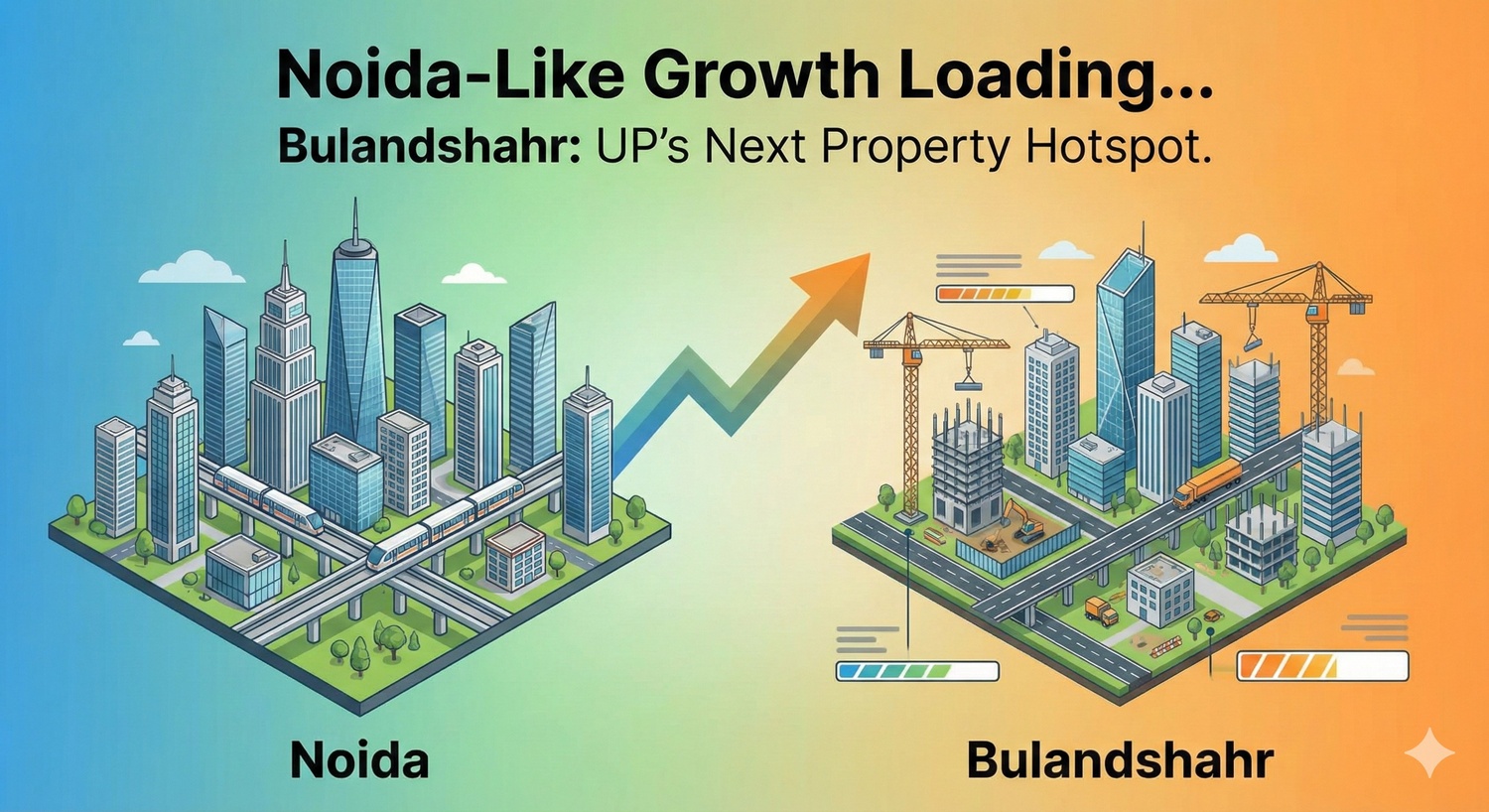
For decades, the real estate narrative of the National Capital Region (NCR) has revolved around a few predictable names: Noida, Greater Noida, and Gurugram. These cities transformed from barren lands into skyline-dominating economic powerhouses, creating immense wealth for early investors. However, as property rates in these established hubs hit saturation points, the market is aggressively scanning for the "next big thing"—a region that offers the low entry points of the early 2000s with the high-growth trajectory of the 2020s.
The search has seemingly ended at the doorstep of Bulandshahr.
Once viewed primarily as an agrarian district known for its dairy production and pottery, Bulandshahr is currently undergoing a structural metamorphosis. It is no longer just a neighbor to the development; it has become central to it. With the massive footprint of the Dadri-Noida-Ghaziabad Investment Region (DNGIR)—popularly known as "New Noida"—extending deep into its territory, and the strategic push to integrate it with the Noida International Airport, Bulandshahr is quietly positioning itself as the logistics and industrial backbone of Western Uttar Pradesh.
This blog decodes why this unassuming district is on the verge of a property boom and why smart capital is already moving towards the Chola, Sikandrabad, and Khurja corridors.
The single biggest catalyst for Bulandshahr’s rise is geography. The southern tip of the district shares a border with the site of the upcoming Noida International Airport (Jewar). In real estate, proximity to a global aviation hub is a guaranteed value multiplier.
Unlike Greater Noida, which is already priced in, the villages of Bulandshahr bordering Jewar offer land parcels at a fraction of the cost. The administration has recognized this potential, leading to the inclusion of 55 villages from the Bulandshahr district into the YEIDA Master Plan 2041. This is a significant administrative shift. It means these villages will no longer be developed haphazardly; they will now follow the world-class zoning, infrastructure, and urban planning norms of the Yamuna Expressway Industrial Development Authority (YEIDA).
For investors, this signals safety. Buying land in notified areas implies that the government has a vested interest in developing the infrastructure there, reducing the risk of stagnation.
While the airport grabs the headlines, the real economic engine for Bulandshahr is the Chola Railway Station.
The government has approved a game-changing rail link connecting the Jewar Airport directly to the Chola Railway Station. This is not just a passenger line; it is a strategic freight corridor. Chola sits on the Delhi-Howrah main line and the Eastern Dedicated Freight Corridor (EDFC). By linking the airport to Chola, the administration is creating a multi-modal logistics ecosystem where cargo flying in can be immediately transferred to high-speed freight trains and vice versa.
This connectivity has triggered a wave of warehousing and logistics developments around Chola and Khurja. Major logistics players are scouting for large land parcels here to set up distribution centers that can serve both the NCR consumption market and the export needs of Western UP. Consequently, demand for commercial land and industrial plots in this belt is witnessing a sharp uptick.
Perhaps the most ambitious project reshaping the district is the creation of New Noida. The Dadri-Noida-Ghaziabad Investment Region (DNGIR) is planned to be a smart city even larger than the current Noida.
A significant portion of the land acquisition for this mega-project involves villages in Bulandshahr and Gautam Buddha Nagar. The plan allocates roughly 40% of the land for industrial use, aiming to create a manufacturing hub that rivals global standards. As the authorities move forward with land pooling and acquisition, the "ripple effect" on surrounding property prices is inevitable. Landowners who are receiving compensation or developed plots in return are reinvesting in the local market, driving up demand for residential and commercial real estate in the district’s primary towns like Sikandrabad.
A property market cannot thrive on plans alone; it needs tarmac. Bulandshahr is currently the beneficiary of multiple high-profile infrastructure upgrades:
The massive Ganga Expressway, connecting Meerut to Prayagraj, passes through the district. To ensure seamless connectivity, a dedicated link expressway is being constructed to connect the Ganga Expressway with the Yamuna Expressway and the Jewar Airport. This effectively places Bulandshahr at the crossroads of UP’s two most important highways, making it a transit hub for the entire state.
Plans are underway to extend the Rapid Rail transit network to better serve the airport and its catchment areas. Once operational, this will slash travel times between Bulandshahr, Noida, and Delhi, making daily commutes feasible. This connectivity is crucial for the residential real estate market, as it allows the workforce of Noida’s offices to live in the more affordable townships of Bulandshahr.
A proposed railway loop connecting Rundhi (on the Delhi-Mumbai line) to Chola (on the Delhi-Howrah line) via Jewar Airport will encircle the region in a "rail ring." This loop will supercharge the industrial sectors of YEIDA and Bulandshahr, ensuring that raw materials and finished goods move without bottlenecks.
For those looking to enter this market, the opportunities are distinct but varied:
The story of Bulandshahr today is reminiscent of Greater Noida in 2010—the plans are approved, the infrastructure is breaking ground, but the prices are still grounded in reality.
The district offers a window of opportunity where the "entry ticket" is affordable for mid-segment investors. However, as the airport nears its operational date and the "New Noida" master plan translates into on-ground construction, this price arbitrage will vanish.
Bulandshahr is shedding its rural image to become the industrial backyard of the National Capital Region. For the astute investor, the writing is on the wall: The growth that defined Noida in the last two decades is loading right now in Bulandshahr. The question is not if it will happen, but whether you will be a part of it before the boom becomes headline news.
