Published On:
September 18, 2026
Updated On:
September 18, 2026
With the integration of a dedicated ₹20,640 crore Namo Bharat RRTS corridor and the ambitious Delhi-Varanasi high-speed bullet train, Noida International Airport is rapidly transforming into India’s most seamlessly connected multi-modal transit hub, promising unprecedented real estate and economic growth across the NCR.
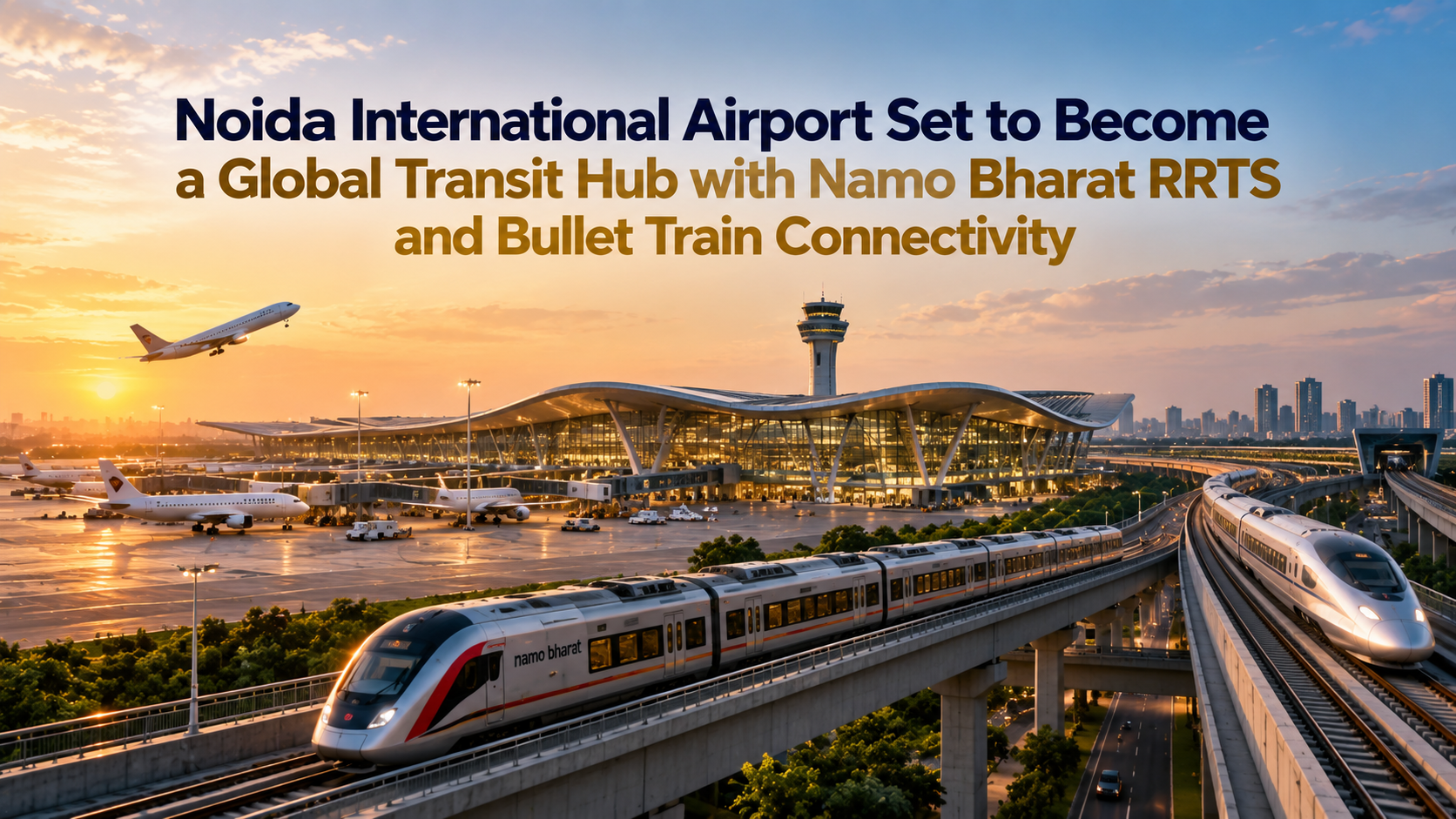
When commercial flights officially commenced at Noida International Airport in Jewar on June 15, 2026, it marked a historic milestone for the aviation sector in northern India. However, the true scale of the vision for this mega-infrastructure project extends far beyond the runways and terminal buildings. Urban planners and infrastructure developers are working aggressively on a master blueprint designed to transform Jewar into something the country has rarely seen: a fully integrated, multi-modal transport hub where global air travel seamlessly meets high-speed regional and national rail networks.
The strategy is clear. A passenger should be able to land at the airport, retrieve their luggage, and step directly onto a rapid transit rail line or a high-speed bullet train without ever needing to navigate a congested highway or hail a cab. With the Ghaziabad-Jewar Namo Bharat RRTS corridor now in its Detailed Project Report stage and the colossal Delhi-Varanasi bullet train securing substantial budgetary backing, the foundation for this transit revolution is officially being laid. For daily commuters, long-distance travellers, and real estate investors, these infrastructural leaps signify a massive shift in how the National Capital Region will operate over the next decade.
For years, accessing the Jewar region has primarily meant relying on the Yamuna Expressway. While the expressway is a marvel of modern road infrastructure, relying solely on road transport to feed a major international airport presents undeniable logistical challenges, particularly given unpredictable weather conditions, sudden traffic bottlenecks, and the sheer volume of anticipated passenger movement. The proposed Ghaziabad-Jewar Namo Bharat corridor aims to eliminate this unpredictability entirely.
Designed as the fourth regional rapid transit corridor under the wider RRTS programme, this 72.44-kilometre line is engineered for speed and efficiency. With trains designed to clock speeds of up to 180 kmph, the total travel time from Ghaziabad to the airport terminal will dramatically shrink to just 40 to 50 minutes. This is a journey that routinely takes well over an hour and a half by road during peak traffic hours.
Backed by an estimated project cost of ₹20,640 crore, the corridor will provide an eco-friendly, fixed-schedule, road-independent alternative for millions of residents spread across eastern Delhi, Ghaziabad, and the broader Gautam Buddha Nagar district. By moving into the Detailed Project Report phase, the project has crossed a critical threshold, meaning route alignments are being finalized, technical feasibility is being cemented, and the pathway to funding and heavy construction is being cleared.
The brilliance of the proposed RRTS corridor lies in its strategic alignment. It doesn't just connect point A to point B; it threads through the most vital residential, educational, and industrial belts of the region. A total of twelve stations have been carefully mapped out to maximize ridership and convenience.
Starting from the northern end at Ghaziabad and Ghaziabad South, the line will immediately cater to one of the most densely populated urban centres in Uttar Pradesh. The stations planned for Greater Noida West, specifically Sector IV and Sector II, will be a massive boon for the hundreds of thousands of residents living in this rapidly expanding residential powerhouse. For years, Greater Noida West has awaited a robust, high-speed public transit solution, and this alignment places its residents just a quick ride away from both the wider NCR and international airspace.
Moving southward, the corridor hits Knowledge Park V and Surajpur, serving as a vital transit node for the massive concentration of university students, faculty, and administrative professionals who travel to these institutional zones daily. Further down, Pari Chowk will serve as the master interchange. Already the bustling heart of Greater Noida, Pari Chowk’s RRTS station will integrate directly with the Noida Metro’s Aqua Line, allowing passengers from mainland Noida to effortlessly merge onto the high-speed airport route.
The final leg of the journey cuts through the region's industrial backbone. Stations at Ecotech VI, Dankaur, and the heavily anticipated YEIDA North (Sector 18) and YEIDA Central (Sector 21) will service upcoming manufacturing hubs and the highly publicized Noida Film City. Finally, the line terminates directly inside the Jewar Airport ecosystem, delivering passengers straight to their departure gates.
While the RRTS focuses on regional connectivity within the NCR, an even more ambitious project is quietly taking shape to connect the airport to the rest of northern and eastern India. The proposed Delhi-Varanasi high-speed rail corridor, widely referred to as the bullet train project, is an 813-kilometre engineering marvel that will radically alter intercity travel.
Unlike traditional rail lines that bypass airport infrastructure, this high-speed corridor is being explicitly designed to feature Noida International Airport as a premier, direct stop. The line will originate in Delhi, touch down in Jewar, and then race eastward through Mathura, Agra, Lucknow, and Prayagraj, before culminating in Varanasi.
The travel time metrics associated with this project are nothing short of revolutionary. If current projections hold, a passenger could board a bullet train at Jewar and arrive in Lucknow in a mere 40 minutes, a journey that currently takes hours by flight or overnight by conventional rail. Travel from central Delhi to the airport could be reduced to just over 20 minutes.
Furthermore, recent union budget announcements have indicated a strong intent to extend this high-speed corridor all the way from Varanasi to Siliguri in West Bengal, passing through key cities in Bihar such as Patna. This extension would effectively stitch the eastern and northern regions of the country together through a single, continuous high-speed artery, funnelling passengers directly from eastern India into the capital's newest aviation hub without the need for cumbersome domestic connecting flights.
When you strip away the billion-dollar price tags and the complex engineering jargon, the practical impact on the everyday commuter is profoundly transformative. The modern traveller demands predictability, and that is exactly what this multi-modal network delivers.
For the international tourist or the domestic business traveller, the friction of movement will essentially disappear. You no longer have to build in massive buffer times to account for Yamuna Expressway traffic jams or dense winter fog on the highways. A passenger flying in from London or Dubai can clear customs at Jewar, walk down to the integrated railway concourse, and immediately board a high-speed train to see the Taj Mahal in Agra or attend a business meeting in central Delhi.
The integration of these systems means fewer moving parts in a traveller's itinerary. There is no need to juggle multiple cab bookings, negotiate with private transport operators, or navigate confusing bus terminals. It creates a seamless, unified transit ecosystem where local metro lines feed into regional rapid transit, which in turn feeds into international air travel and national high-speed rail.
Infrastructure of this magnitude never arrives in a vacuum; it acts as a massive gravitational pull for real estate investment, commercial development, and job creation. Property markets operate heavily on future potential, and the areas surrounding the upcoming transit nodes are already experiencing a palpable surge in investor interest.
To understand the trajectory, one only needs to look at the economic ripple effects of the recently operational sections of the Delhi-Meerut RRTS corridor. Real estate data clearly indicates that residential and commercial properties situated within a one-kilometre radius of active RRTS stations have commanded a significant premium, often appreciating 15 to 20 percent more than comparable properties located further away. Ghaziabad, serving as a primary node for the Meerut line, witnessed extraordinary price growth over the four years since construction began in earnest.
This exact template is now being applied to the Ghaziabad-Jewar stretch. Greater Noida West, already a hotspot for end-users, is poised to see robust capital appreciation as its primary historical drawback—a lack of heavy rail public transport—is permanently solved. The real gold rush, however, is happening further down the line in the Yamuna Expressway Industrial Development Authority (YEIDA) sectors.
The YEIDA region, particularly around Sector 18 and Sector 21, is currently in the early stages of its development lifecycle. The confirmation of an RRTS station alongside the upcoming Film City and massive logistics parks makes this area one of the most lucrative investment destinations in the country. Commercial real estate developers are eagerly securing land banks along the corridor to construct hospitality projects, retail avenues, and corporate office parks, anticipating the heavy footfall these stations will inevitably generate. Companies are also rethinking their corporate footprints, recognizing that establishing headquarters near an integrated transit hub grants unparalleled access to both global markets and a massive regional talent pool.
The simultaneous development of Noida International Airport, the Namo Bharat RRTS, and the high-speed bullet train corridor represents a paradigm shift in Indian urban planning. Historically, major infrastructure projects have often been developed in silos, leading to disconnected airports, isolated railway stations, and disjointed highway networks.
The Jewar master plan breaks this mold by planning transit ahead of absolute demand. It is a proactive approach to city-building that seeks to shape where the next massive wave of economic and demographic growth will land in the NCR. By linking the deep residential pockets of Ghaziabad and Greater Noida, the educational hubs of Knowledge Park, the industrial stretches of the Yamuna Expressway, and the eastern states of India directly to international runways, the government is forging a unified economic engine.
While these massive rail corridors are still in the critical pre-construction phases—meaning alignments and exact timelines will undergo further refinement—the sheer political and financial momentum behind them is undeniable. When the dust finally settles and the tracks are laid, Jewar will not merely be known as Delhi-NCR’s second airport. It will stand as a global benchmark for connectivity, cementing its legacy as one of the most sophisticated, efficient, and well-connected multi-modal transport hubs in the world.
