Published On:
March 18, 2026
Updated On:
March 18, 2026
The impending launch of the Noida International Airport has triggered a massive real estate boom in the Yamuna Expressway region, resulting in a historic surge in industrial lease deeds, physical plot possessions, and active construction. With commercial operations imminent and major corporate investments flowing into the corridor, the area is rapidly cementing its status as India's premier industrial and residential growth hub.
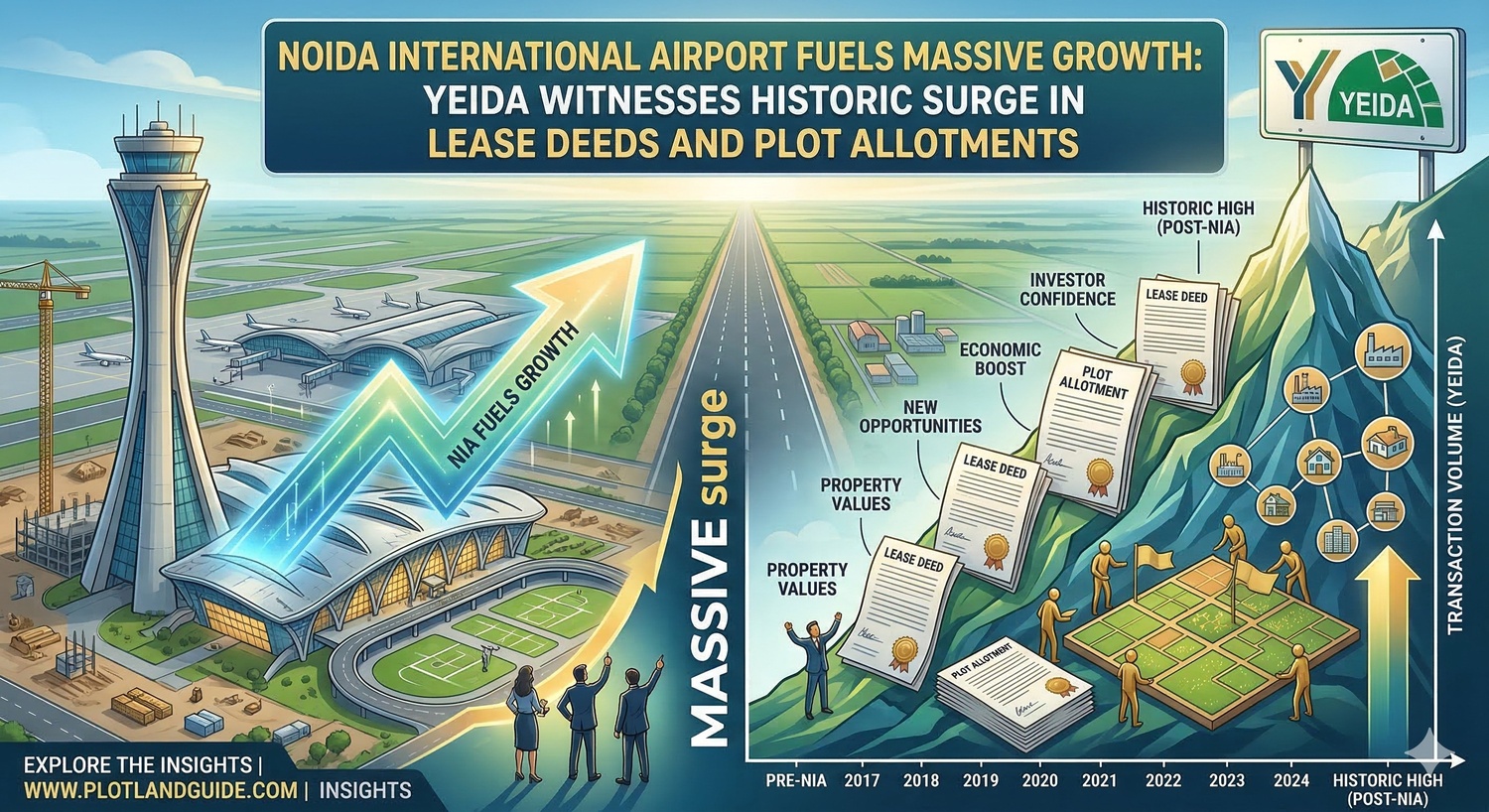
The intersection of massive infrastructure development and strategic urban planning is the most reliable catalyst for real estate wealth generation. For years, the Yamuna Expressway region was viewed primarily as a high-speed transit corridor connecting Greater Noida to Agra. Today, that narrative has been entirely rewritten. The landscape is undergoing an unprecedented transformation, evolving rapidly from a planned blueprint into a sprawling, active economic epicenter.
The primary engine powering this monumental shift is the Noida International Airport at Jewar. As the airport edges closer to full operational status, the Yamuna Expressway Industrial Development Authority, widely known as YEIDA, is recording a historic acceleration in ground-level real estate activity. Over the past twelve months, the region has witnessed more industrial momentum than the combined progress of the previous two and a half decades. From an explosive rise in executed lease deeds to a massive surge in physical plot possessions and active construction sites, the data points to a singular, undeniable reality: the Yamuna Expressway corridor has transitioned from a speculative investment destination to an active, high-yielding business and residential hub.
The turning point for the region’s real estate and industrial sector arrived in early March 2026. The Directorate General of Civil Aviation officially issued the aerodrome license for the Noida International Airport, a critical regulatory milestone that cleared the runway for commercial flight operations to commence within weeks.
This development has fundamentally altered the risk-reward matrix for institutional investors and private homebuyers alike. The certainty of a functioning international aviation hub eradicates the speculative risks typically associated with emerging micro-markets. Large corporations, logistics firms, and real estate developers are no longer waiting on the sidelines; they are aggressively finalizing their land acquisitions and establishing their ground presence. The airport is set to serve as a massive gravitational force, drawing in global supply chains, boosting export-oriented manufacturing, and creating a hyper-connected logistics network that bridges Northern India with international markets.
The most accurate barometer of a real estate market's health is the transition of land from paper allotments to legally binding lease deeds and physical possession. Official data from YEIDA reveals a staggering acceleration in this exact metric. By mid-March 2026, the authority's total industrial plot allotments surpassed three thousand, reaching 3,113. While the net addition of new allotments over the past year was relatively modest, the execution of existing land holdings tells a story of explosive growth.
Within a single year, the number of executed lease deeds jumped from 1,632 to 2,363, an increase of over seven hundred finalized agreements. This is a crucial metric because executing a lease deed requires the allottee to commit substantial capital for stamp duty, registration, and upfront lease premiums. It binds the owner to strict construction timelines mandated by the authority, effectively weeding out non-serious speculators and ensuring that only committed developers hold the land.
Simultaneously, the number of industrial units taking physical possession of their plots experienced a massive upward trajectory. The figures climbed from 990 units in March 2025 to nearly 1,800 units by March 2026. This aggressive push toward physical possession indicates that businesses are eager to break ground and begin operations before the airport initiates its first commercial flights, aiming to capitalize on the immediate infrastructural advantages.
Possession of land is merely the foundation; the ultimate objective of the Yamuna Expressway master plan is to foster operational industries that generate sustained economic output and mass employment. The past twelve months have definitively proven that companies are actively building rather than hoarding land.
The authority has processed and sanctioned an unprecedented number of industrial building plans, with approvals jumping from 318 to 716 in just one year. Consequently, the landscape is now dotted with active construction sites. The number of industrial projects actively under construction has nearly tripled, rising from 120 to 341.
This rapid pace of development is already yielding tangible results. The region has seen a sharp increase in completed industrial units, growing from 17 to 60, while fully operational factories jumped from 9 to 33 in the same timeframe. Correspondingly, mandatory registrations under the Factories Act have multiplied. Looking ahead, the developmental trajectory suggests that roughly four hundred industrial units are slated to become fully operational by the end of 2026. This mass operationalization will create thousands of new jobs, driving intense localized demand for housing, retail, and commercial amenities.
To prevent the chaotic, unorganized growth that plagues many older industrial cities, YEIDA has meticulously zoned the region into specialized clusters. The authority has successfully allotted prime parcels across dedicated zones, including the Apparel Park, Toy Park, and the highly anticipated Medical Devices Park. This strategic clustering allows businesses to leverage shared sector-specific infrastructure, reduce logistical friction, and build highly efficient local supply chains.
Beyond mid-scale manufacturing, the corridor is successfully attracting colossal corporate investments. The recent foundation-laying ceremony in February 2026 for a massive semiconductor manufacturing unit underscores the region's pivot toward advanced, high-tech industries. Furthermore, the aviation sector is establishing a deep-rooted presence, with major commercial airlines finalizing plans to construct extensive maintenance, repair, and overhaul facilities directly adjacent to the airport. The planned integration of an Artificial Intelligence hub by 2030 and the sprawling International Film City further diversify the economic ecosystem, ensuring long-term resilience against sector-specific downturns.
The explosive expansion of industrial and commercial enterprise is directly supercharging the residential real estate market. The influx of corporate executives, factory workers, and aviation professionals will require an extensive network of housing and social infrastructure. Seasoned investors understand that massive industrial job creation is the most potent and reliable driver of residential property appreciation.
Anticipating this demographic shift, the authority is continuously expanding its residential footprint. Upcoming YEIDA plot schemes are drawing phenomenal interest from across the country. For instance, the highly anticipated 2026 residential plot scheme aims to release nearly a thousand prime plots in highly coveted sectors like 15C, 18, and 24A. These sectors are strategically positioned in the immediate vicinity of the Noida International Airport, offering unparalleled future connectivity.
These residential plots, which typically range from 162 square meters to spacious 290 square meter layouts, provide investors with a transparent, government-backed entry point into a hyper-growth market. Historical data from the region highlights that land values along the expressway have already appreciated by nearly a hundred percent over recent years. As the airport becomes operational and the surrounding commercial hubs mature, these early-stage residential investments are positioned to deliver exceptional, market-beating long-term returns.
The true intrinsic value of the Yamuna Expressway corridor lies in its holistic connectivity network. The region is not relying on the airport alone. It is supported by a robust web of expressways, including direct linkages to the Eastern Peripheral Expressway, facilitating seamless cargo and passenger movement across Northern India without navigating the congested arteries of Delhi.
Furthermore, multi-modal transport solutions are actively being developed. Upcoming metro line extensions will integrate the airport city with the broader National Capital Region transit network. Plans for innovative transit systems, such as pod taxis connecting the airport directly to the Film City, showcase a forward-thinking approach to urban mobility.
For property investors and homebuyers, this represents a golden era of opportunity. The foundational infrastructure is largely complete, heavily mitigating the risks of project stagnation. Yet, despite the rapid price appreciation, the micro-market has not yet reached the pricing saturation evident in the older, established sectors of central Noida or Gurugram. This unique market phase allows investors to acquire high-potential assets at a highly competitive entry price, backed by visible, operational megaprojects.
The remarkable surge in lease deeds, plot allotments, and active construction within the YEIDA region is far more than a temporary market spike; it is the physical manifestation of India's most ambitious urban master plan coming to life. The Noida International Airport is effectively executing its role as a massive economic anchor, drawing in capital, global corporations, and a skilled workforce.
For real estate investors, industrial developers, and future residents, the Yamuna Expressway corridor has unequivocally proven its potential. The transition from paper plans to physical reality is happening at an unprecedented pace. The region is no longer just a promising market of the future; it stands today as the most dynamic, lucrative, and aggressively expanding real estate destination in the country. Investing here means securing a stake in an economic powerhouse that is destined to redefine the industrial and residential landscape of North India for decades to come.
