Published On:
May 3, 2026
Updated On:
May 3, 2026
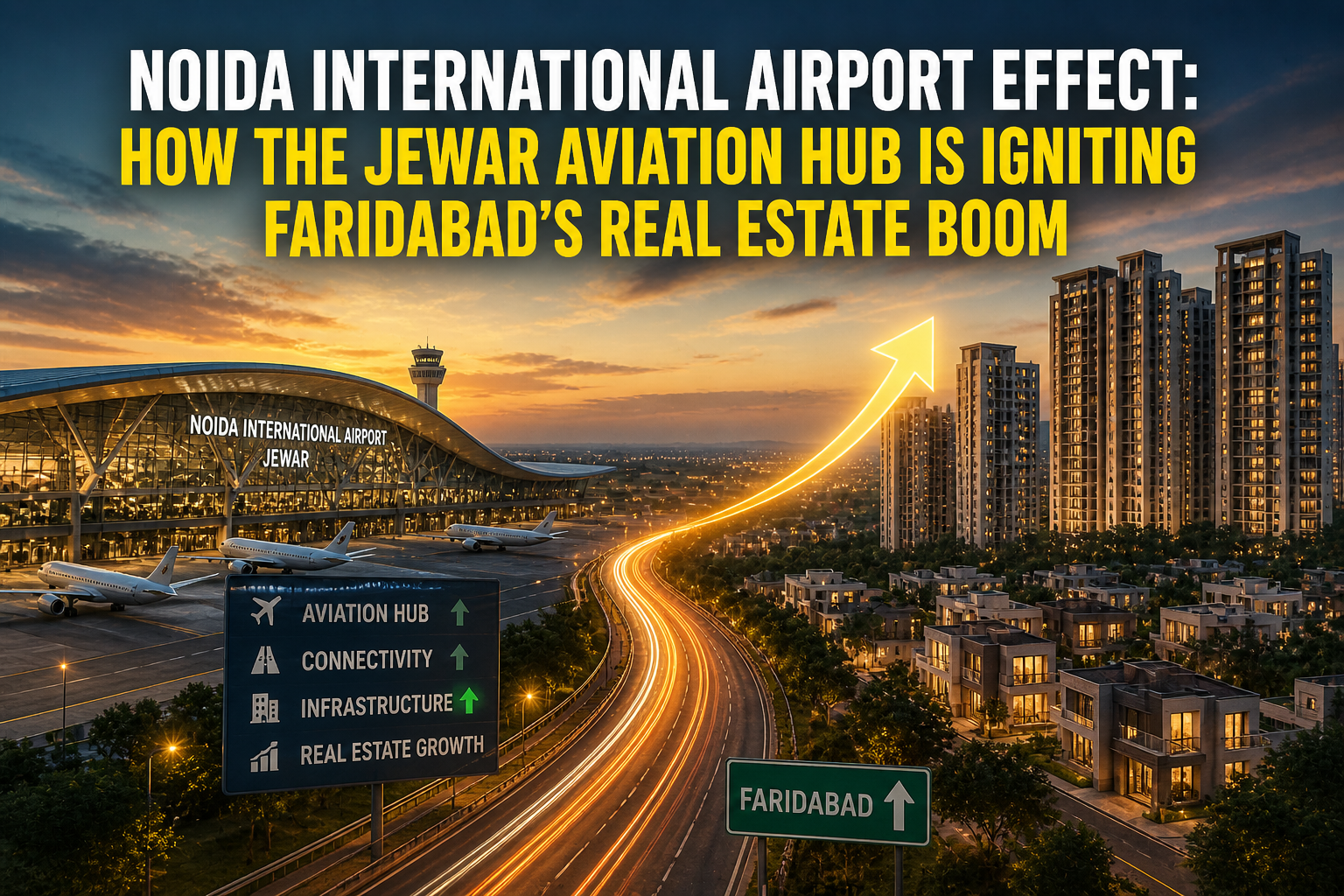
The upcoming Noida International Airport, supercharged by the new 31-kilometer Faridabad-Jewar Greenfield Expressway, is rapidly transforming Faridabad from an overlooked industrial sector into the NCR’s most lucrative real estate hub, offering unprecedented capital appreciation for plot lands and luxury housing through seamless regional connectivity.
For decades, the real estate narrative of the National Capital Region has been overwhelmingly dominated by two distinct powerhouses: the glittering, corporate-driven expansion of Gurugram and the hyper-planned, infrastructure-heavy sprawl of Noida and Greater Noida. Nestled comfortably between these two giants, and sharing a highly strategic, direct border with South Delhi, Faridabad has historically remained the quiet, industrious sibling. Despite offering excellent baseline connectivity and established industrial zones, the city’s residential and commercial property markets consistently lagged behind its flashier neighbors. Developers largely focused their capital elsewhere, and premium homebuyers often overlooked the region in favor of the Yamuna Expressway or Golf Course Road.
However, the geographic and economic landscape of the entire region is currently undergoing a massive, seismic correction. A singular, monumental infrastructure project is effectively redrawing the map of northern India, and Faridabad is positioned perfectly at the epicenter of this financial windfall. The rapid, ongoing development of the Noida International Airport in Jewar is acting as a massive catalyst, instantly unlocking decades of dormant real estate potential and transforming this historic industrial town into the hottest destination for high-yield plot lands, luxury townships, and elite commercial spaces.
To understand the sheer magnitude of Faridabad's ongoing real estate renaissance, one must first grasp the scale of the aviation project driving it. The Noida International Airport is not merely a regional transit strip; it is a sprawling, world-class aviation and economic hub designed to eventually handle an astounding 70 million passengers annually at full capacity. Beyond passenger transit, the surrounding zones are being rapidly developed into massive logistics parks, global commercial districts, and advanced manufacturing corridors.
Major market analysts and global property consultancies project that the broader impact zone of this airport will span over 20,000 square kilometers, directly influencing a regional population of nearly 50 million people and contributing significantly to the national GDP. Historically, in every mature global real estate market, large-scale infrastructure acts as the foundational bedrock for long-term value creation. By establishing an international gateway just a short distance away, the economic gravity of the entire NCR is shifting eastward, and Faridabad is the primary, established urban center ready to absorb this massive influx of capital, corporate interest, and residential demand.
The true magic of an international airport lies in how seamlessly the surrounding population can access it. Recognizing this, the government has fast-tracked one of the most crucial arterial roads in the region: the Faridabad-Jewar Expressway. This specific infrastructure development is the undeniable golden key unlocking Faridabad’s property market.
Executed under the ambitious Bharatmala Pariyojna with an estimated multi-crore budget exceeding ₹2,400 crore, this cutting-edge, six-lane greenfield expressway is a total game-changer. Currently, traveling from the heart of Faridabad to the Jewar region involves navigating a convoluted, 90-kilometer web of crowded local highways and district roads. Once this new 31.4-kilometer elevated and ground-level corridor becomes operational, that exhausting journey will be violently slashed to a breezy, 20 to 30-minute drive.
Starting from a massive interchange on the under-construction Delhi-Mumbai Expressway near Sector 65 in Ballabgarh, the road cuts a direct, high-speed path straight to Dayanatpur near the airport. For property investors and future residents, this metric is everything. Being able to access an international terminal in under half an hour effectively grants Faridabad the exact same logistical advantages that propelled Gurugram’s explosive growth when the Indira Gandhi International Airport expanded decades ago.
While the direct airport link is capturing the headlines, savvy real estate investors understand that property values thrive on multi-directional permeability. Faridabad’s sudden surge in attractiveness is anchored by how intelligently this new expressway integrates with the broader, existing highway grid.
The new corridor does not exist in isolation; it features strategic, highly engineered cloverleaf interchanges that seamlessly connect traffic to the Eastern Peripheral Expressway, widely known as the KGP. This allows massive freight trucks, commercial logistics fleets, and daily commuters to entirely bypass the notoriously gridlocked city centers of Delhi. Furthermore, this strategic positioning makes Faridabad uniquely equidistant to the national capital, the corporate hubs of Gurugram, and the tech parks of Noida, making it a highly centralized pivot point for the entire northern economy.
Local and inter-city mobility is also receiving a massive, simultaneous shot in the arm. Regional development authorities have recently greenlit the heavily anticipated, two-way, signal-free upgradation of the Kalindi Kunj corridor. For years, the Kalindi Kunj stretch has been a notorious bottleneck for professionals commuting between South Delhi, Noida, and Faridabad. Converting this route into a frictionless transit corridor will drastically reduce daily travel fatigue, making Faridabad a highly viable, attractive residential base for top-tier executives working in Noida's expanding Grade-A office spaces. Additionally, proposed rapid rail transit systems, specifically the Namo Bharat corridor intended to link Gurugram, Faridabad, and Greater Noida, are heavily reinforcing the city's status as a hyper-connected, future-ready metropolis.
This sudden, aggressive enhancement in regional mobility is fundamentally altering the DNA of Faridabad’s housing supply. For years, the city was primarily characterized by highly dense, unorganized, or mid-segment builder floors catering largely to the local industrial workforce. Today, the demographic profile of the prospective buyer is shifting rapidly, and prominent real estate developers are aggressively acquiring massive land parcels to meet this newly evolved demand.
The most intense focus for high-net-worth investors and real estate portfolios currently lies in the acquisition of premium plot lands and the development of massive, highly secure integrated townships, particularly in the sprawling, newly planned sectors of Greater Faridabad. Unlike the densely packed, land-scarce environments of South Delhi, these emerging sectors offer expansive, clean canvases for development. Affluent buyers who previously shied away from the city due to poor traffic management are now actively securing large plots of land to construct custom, ultra-luxury villas and independent residences.
Top-tier builders are responding to this institutional demand by launching ultra-luxury, high-rise residential projects equipped with global-standard amenities—ranging from temperature-controlled infinity pools and biometric security systems to expansive, manicured green zones. These modern communities are purposefully designed to attract a heavily widened buyer base, pulling in successful startup founders, corporate executives, and non-resident Indians who want proximity to the new global aviation hub without sacrificing an elite, resort-style living experience.
The real estate boom triggered by the Jewar airport is fiercely multi-dimensional, extending far beyond luxury apartments and residential plots. Because Faridabad already boasts a deeply entrenched identity as a manufacturing and MSME powerhouse, the improved connectivity to an international cargo hub is acting like rocket fuel for the local commercial sector.
Multinational corporations, massive e-commerce platforms, and third-party logistics providers are aggressively scouting the immediate vicinity of the new expressways for Grade-A warehousing and cold-storage facilities. The ability to manufacture goods in Faridabad’s industrial sectors and transport them to an international air-cargo terminal in under thirty minutes represents an unprecedented optimization of the global supply chain. Consequently, commercial land values along the Delhi-Mumbai Expressway spur and the Eastern Peripheral intersections are experiencing intense, aggressive bidding from institutional investors.
Simultaneously, the anticipated influx of tens of thousands of new residents and transit passengers is generating massive retail and hospitality demand. Developers are rapidly drafting blueprints for premium shopping malls, expansive high-street retail avenues, and luxury business hotels designed to cater to the upcoming wave of global business travelers and affluent local homeowners.
From a strict financial and investment perspective, the data surrounding this geographical corridor presents a highly compelling, undeniable narrative for wealth creation. Over the past five years, micro-markets situated in close proximity to the Yamuna Expressway and the immediate Jewar vicinity have witnessed property values nearly triple. This massive, historic surge was driven primarily by early speculative investment and the steady, highly publicized completion of various airport construction milestones.
Real estate market veterans and financial analysts confidently project that Faridabad is currently positioned at the exact starting line of a very similar, explosive trajectory. Because Faridabad is already an established, deeply inhabited micro-market—unlike the relatively raw, newly developing agricultural lands immediately surrounding the airport site—it offers an incredibly rare, dual advantage. It provides the immediate livability, existing schools, established hospitals, and civic infrastructure of a mature city, combined seamlessly with the massive, aggressive capital appreciation potential typically reserved only for brand-new, emerging frontiers.
Property consultants highly advise that cities successfully combining robust baseline infrastructure, high livability indexes, and relative value pricing invariably outperform their regional peers over the long term. While property rates in elite Gurugram sectors have reached astronomical, highly saturated peaks, Faridabad currently offers a massively superior entry point for investors seeking high-yield plot lands or premium square footage.
The real estate market is notoriously unforgiving to those who wait for maximum certainty before deploying capital. The current landscape in Faridabad represents a rapidly closing window of extraordinary opportunity. As the construction equipment clears out, the expressways open to public traffic, and the first commercial flights eventually take to the skies over Jewar, the entry prices for premium properties in this newly connected corridor will undoubtedly skyrocket out of reach for the average investor.
The definitive, permanent transition of Faridabad from a city lingering in the historical shadows of its neighbors to an absolute frontline economic powerhouse is no longer a speculative theory; it is an active, physical reality being poured in concrete and asphalt every single day. For strategic investors, massive developers, and aspirational homebuyers, the message is overwhelmingly clear. The entire structural dynamic of the National Capital Region has officially shifted, and those who secure their physical footprint in this booming, airport-connected corridor today will secure generational wealth and unmatched living standards for tomorrow.
