Published On:
November 8, 2025
Updated On:
November 8, 2025
Noida International Airport at Jewar will feature full road, rail, and bus integration — connecting expressways, high-speed trains, and public transport for seamless access across NCR. Phase 1 spans 1,334 hectares, with expansion plans to handle 300 million passengers annually.
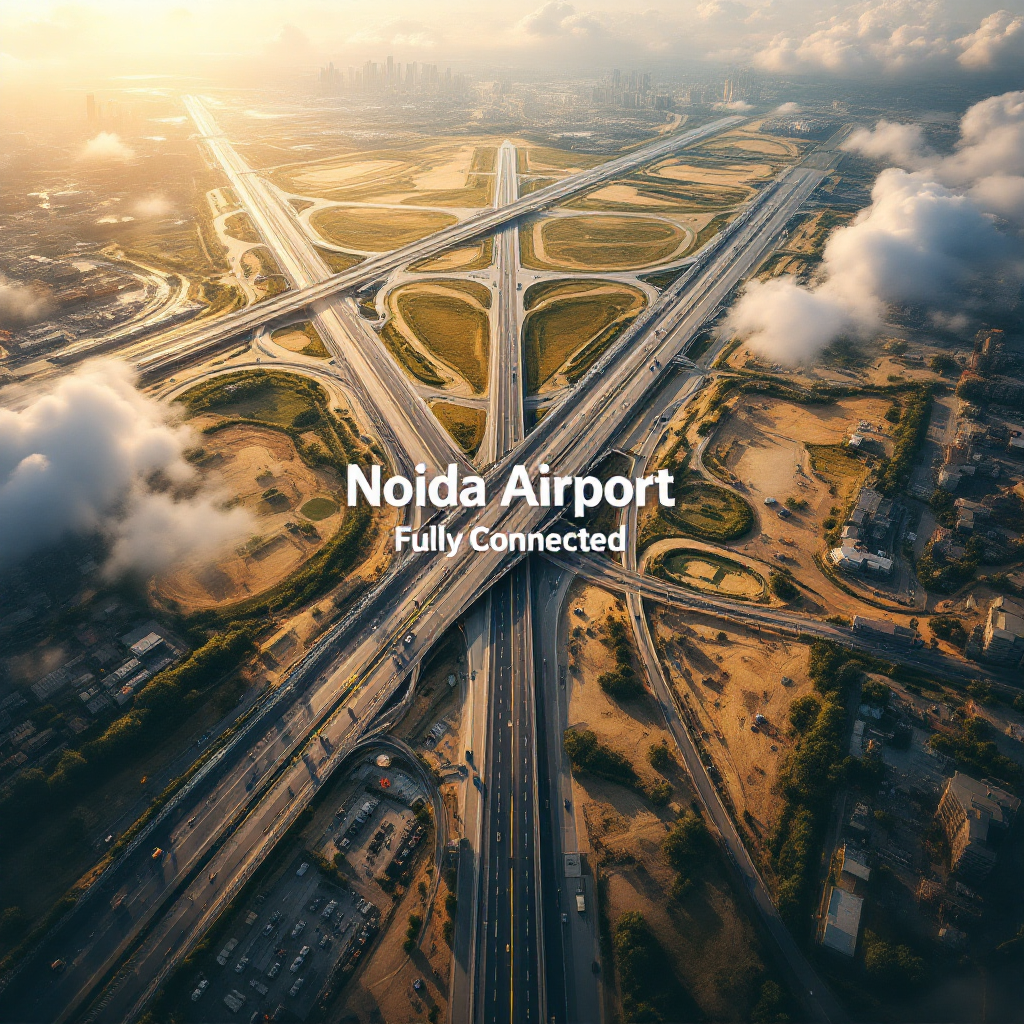
The Uttar Pradesh government has confirmed that the Noida International Airport (NIA) at Jewar will operate as a multi-modal transit hub, seamlessly linking road, rail, and bus systems. This is part of the state’s plan to position the airport as India’s first fully integrated greenfield aviation hub.
The airport is already connected to the Yamuna Expressway, while work is advancing on links to the Delhi–Mumbai Expressway, Eastern Peripheral Expressway, and the Noida–Greater Noida Expressway, ensuring access from major NCR and western UP cities like Ghaziabad, Meerut, Mathura, and Aligarh.
A 60-meter-wide sector road is being built in Sector 28 to directly connect local traffic with the airport terminal. Additional service roads and flyovers are planned to decongest key junctions and streamline cargo routes.
The National Capital Region Transport Corporation (NCRTC) has approved a Delhi–Jewar Rapid Rail Transit System (RRTS) corridor, offering a high-speed connection between Delhi and the airport. Separately, the Ministry of Railways plans a new Jewar station on the Delhi–Varanasi High-Speed Rail route, as well as an extension of the Chola–Rundhi line, to integrate long-distance train access.
The Uttar Pradesh State Road Transport Corporation (UPSRTC) will operate airport-linked intercity and interstate buses, providing direct routes to Delhi, Gurugram, Noida, Greater Noida, Ghaziabad, Agra, and Meerut. Future interstate links are planned to Uttarakhand, Haryana, and Rajasthan.
To promote green mobility, the government will deploy 500 electric buses along the Noida–Jewar corridor, ensuring low-emission last-mile connectivity.
The airport has partnered with Mahindra Logistics for managed taxi fleets and logistics, while Uber, Rapido, and MakeMyTrip have confirmed digital ride-hailing tie-ups. Ola is expected to join soon. Passengers will be able to book and track rides via integrated airport apps.
Phase 1 of the airport spans 1,334 hectares and includes one runway and one passenger terminal with an initial handling capacity of 12 million passengers annually. The long-term master plan covers over 5,000 hectares, expanding to five runways and a target capacity of 300 million passengers per year across four phases.
This comprehensive network will make Jewar one of India’s most accessible and commercially viable airports, addressing earlier distance concerns (approx. 75 km from Delhi) and reinforcing Noida’s position as a global investment destination.
