Published On:
February 17, 2026
Updated On:
February 17, 2026
Effective February 15, 2026, the Ministry of Road Transport and Highways (MoRTH) has mandated that commuters on partially operational expressways will only pay standard National Highway toll rates, waiving the 25% "expressway premium" until the project is fully complete. This significant amendment aims to encourage the use of new infrastructure, decongest parallel routes, and ensure fair pricing for road users.
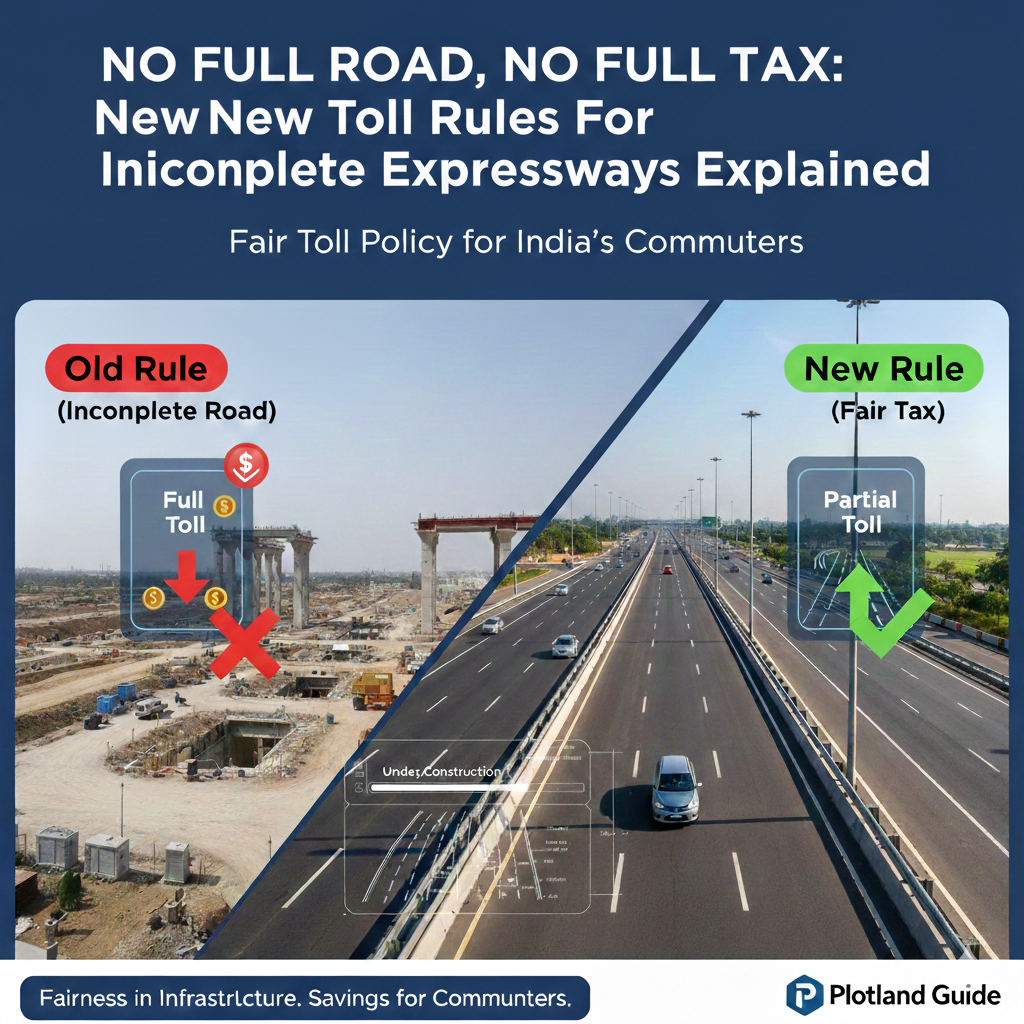
The open road is often synonymous with freedom, but for the modern Indian commuter, it has increasingly become synonymous with mounting costs. We have all been there: you merge onto a glittering new expressway, enjoying the smooth tarmac and the promise of a high-speed commute, only to be abruptly diverted off a few kilometers later because the road isn't finished. Yet, when you pass the toll plaza, the fee deducted from your FASTag often reflects the price of a world-class, fully completed infrastructure project.
For years, this disparity—paying a premium price for a partial service—has been a sore point for daily commuters and logistics companies alike. However, a landmark policy shift introduced in February 2026 is set to change the rules of the game.
The Ministry of Road Transport and Highways (MoRTH) has introduced a significant amendment to the National Highways Fee Rules, effectively barring toll operators from charging the "expressway premium" on incomplete projects. If the road isn't fully ready, you shouldn't have to pay the full premium price.
This comprehensive guide dives deep into what this new rule means for your wallet, why the government has implemented it now, and how it transforms the economics of road travel in India.
On February 15, 2026, a critical amendment to the National Highways Fee (Determination of Rates and Collection) Rules, 2008 came into effect. The core directive is simple yet profound: If a National Expressway is not operational end-to-end, the toll fee for the completed sections must be charged at standard National Highway rates, not the premium Expressway rates.
To understand the magnitude of this change, we first need to understand how toll pricing works in India.
In India, road infrastructure is categorized broadly into National Highways (NH) and National Expressways.
Historically, this premium has been approximately 25% higher than the standard National Highway base rate. The controversy arose because this 25% premium was often charged even when an expressway was opened in phases. Commuters using a small, isolated 20km stretch of a planned 300km expressway were paying the premium rate, despite not getting the full "expressway experience" of uninterrupted long-distance travel.
Under the new notification, this practice stops immediately for incomplete projects.
This relief is not permanent, but it is substantial. The rule states that this reduced pricing will remain in effect for one year or until the expressway becomes fully operational end-to-end, whichever happens first.
While this move is undoubtedly a relief for the common man, it is driven by hard economic and logistical logic from the central government. The decision addresses three critical bottlenecks that were plaguing India's road network.
India is currently in a massive construction boom, with projects like the Delhi-Mumbai Expressway and the Dwarka Expressway opening in phases. However, authorities noticed a peculiar trend. Despite new sections opening, traffic on the old, parallel National Highways remained high.
Why? Price sensitivity.Truckers and daily commuters often avoided the new, partially opened expressway sections because the time saved on a short 20km stretch didn't justify the 25% higher cost. They preferred to stay on the old, congested highway to save money. This defeated the very purpose of building the expressway, which was to siphon traffic away from existing roads.
By lowering the cost to match standard highways, the government is effectively incentivizing drivers to shift to the new road. It is a volume game: get more cars on the new infrastructure to clear up the old choke points.
Consumer forums and courts have long debated the fairness of toll collection. The Supreme Court and various High Courts have historically observed that toll fees must be commensurate with the service provided. Charging a premium for a "high-speed corridor" that forces you to exit into a traffic jam because the bridge ahead isn't built is inherently unfair.
This amendment aligns the toll policy with the service-level reality. If the connectivity is broken, the service is "standard," and thus the fee should be "standard." It restores trust between the user and the infrastructure provider.
India’s logistics cost as a percentage of GDP is significantly higher (13-14%) compared to developed economies (8-10%). High toll rates on fragmented road networks contribute to this. By rationalizing the cost on incomplete stretches, the government lowers the operational cost for freight movers. When a truck driver saves 25% on toll across multiple partial stretches, that saving eventually trickles down to the cost of goods—from vegetables to electronics.
While the headline is positive, prudent travelers should be aware of the nuances to ensure they aren't caught off guard.
The rule specifically applies to Expressways that are not fully operational. Once the National Highways Authority of India (NHAI) issues a completion certificate for the entire project length, the toll rates will revert to the full premium pricing. This means your current discount is temporary. It is a "construction phase" discount, designed to compensate you for the inconvenience of ongoing work.
The rule applies to National Expressways. It is crucial to distinguish between a "National Highway" that is being widened and a designated "Expressway." The relief is targeted at the latter category, which carries the specific access-controlled premium. Commuters on standard highways undergoing repairs or expansion face different sets of rules (often involving a 75% fee during expansion, though this is a separate clause).
You do not need to change your FASTag or apply for a refund manually. The toll plaza systems (ETC) are updated centrally. The deduction should automatically reflect the lower rate for the eligible sections. However, it is always wise to check your SMS alerts or FASTag statement to ensure the new rates are being applied correctly.
This reduction in toll rates for incomplete roads is just one piece of a much larger puzzle. The Indian tolling landscape is undergoing a technological revolution that aims to make physical toll plazas obsolete.
While the current rule fixes the price, the upcoming GNSS (Global Navigation Satellite System) technology aims to fix the method. The government is actively piloting satellite-based tolling, where you are charged strictly for the distance you travel—down to the exact meter.
In the current "open" toll system, you might pay a fixed fee for a 60km stretch even if you only travel 10km. The new incomplete-road rule is a stop-gap measure to ensure fairness in the current system. In the future, GNSS will likely render such debates moot because if a road is incomplete, you simply won't travel on the unfinished coordinates, and therefore, the satellite won't charge you for it.
Until that futuristic system is fully implemented nationwide, policy tweaks like the "No Premium on Partial Roads" rule serve as the bridge to a fairer transport ecosystem.
The implications of this rule extend beyond the highway and into the property market. Areas located along the fringes of upcoming expressways—such as the Dwarka Expressway in NCR or the Samruddhi Mahamarg connectors in Maharashtra—stand to benefit.
The February 2026 amendment to the toll rules is a rare instance of policy catching up with public sentiment. It acknowledges a fundamental frustration of the Indian driver: the pain of paying for a promise rather than a product.
By removing the expressway premium from incomplete projects, the government has struck a balance between revenue generation and consumer rights. It ensures that the NHAI and concessionaires can still recover basic costs to maintain the road, while the commuter is spared the "luxury tax" of an unfinished luxury product.
For the next time you drive past a "Work in Progress" sign on an expressway, you can take a small amount of comfort knowing that your toll fee reflects the reality of the road beneath your wheels. It’s a move towards accountability, one kilometer at a time.
