Published On:
January 29, 2026
Updated On:
January 30, 2026
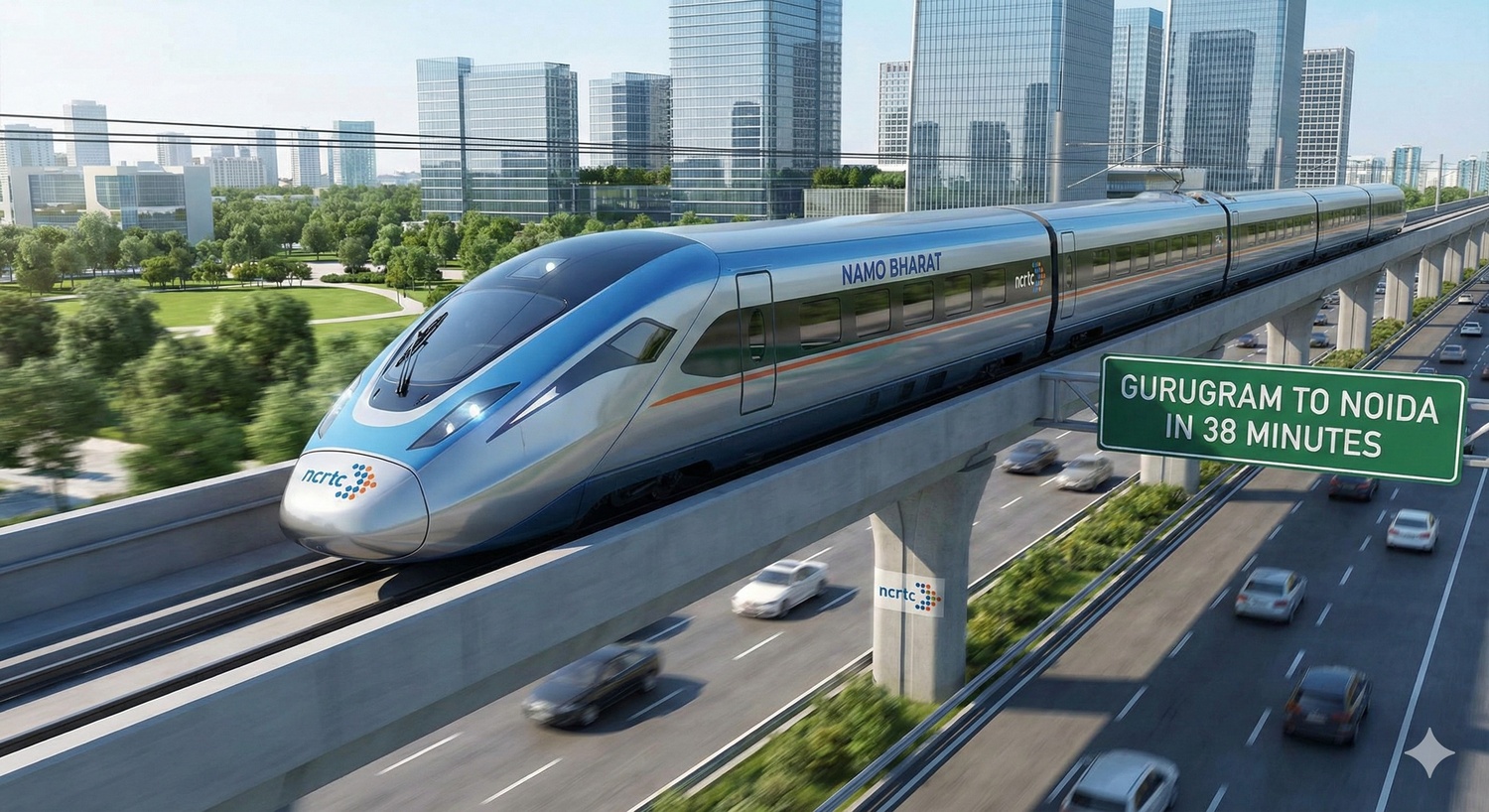
The National Capital Region is set for a massive infrastructure upgrade with 4 new Rapid Rail (RRTS) corridors. These high-speed "Namo Bharat" trains will connect 8 cities, slashing travel times drastically—including a 38-minute dash from Gurugram to Noida.
For anyone living in the National Capital Region (NCR), the daily battle with traffic is a shared trauma. Whether it's the gridlock at the Delhi-Gurugram border or the endless crawl on the DND Flyway, the friction of moving between cities often defines the quality of life here. But a transformative shift is on the horizon. The National Capital Region Transport Corporation (NCRTC) has unveiled a blueprint that promises to shrink distances and redraw the economic map of the region.
The headline grabbing the most attention is a new high-speed corridor that will transport commuters from Gurugram to Noida in just 38 minutes. However, this is just one part of a larger, ambitious network. Four major Rapid Rail (RRTS) lines are now in advanced planning or approval stages, designed to stitch together eight key cities—Delhi, Gurugram, Faridabad, Noida, Greater Noida, Ghaziabad, Panipat, and Alwar—into a seamless, high-velocity economic zone.
For years, travelling between the corporate hubs of Gurugram and Noida has been a logistical nightmare, often requiring a detour through Delhi’s congested arterial roads. The proposed Gurugram-Faridabad-Noida-Greater Noida RRTS corridor is set to change this permanently.
According to the Detailed Project Report (DPR) submitted to the Haryana government, this line will start at IFFCO Chowk in Gurugram and terminate at Surajpur in Greater Noida. The route is strategically designed to bypass Delhi entirely, creating a direct "southern loop" for the NCR.
The total travel time from IFFCO Chowk to the Noida sector is estimated at roughly 38 minutes. This velocity doesn't just save time; it unifies two distinct property markets, potentially allowing someone to live in the spacious sectors of Noida while working in Cyber City, Gurugram, without a punishing commute.
While the Gurugram line handles the east-west corporate traffic, the Ghaziabad to Jewar Airport line is the north-south spine designed for the future aviation boom. With the Noida International Airport at Jewar set to become operational soon, connectivity is critical.
This 72-kilometer corridor will act as a spur from the existing Delhi-Meerut RRTS line. Starting from the Ghaziabad station, it will traverse through Greater Noida West (Noida Extension) and Pari Chowk before hitting the airport.
The vision for the NCR involves four distinct lines. Apart from the two mentioned above, the network includes:
This line aims to extend the NCR's rapid transit footprint deep into Haryana. Starting from Sarai Kale Khan in Delhi, it will connect Sonipat, Panipat, and eventually Karnal. The goal is to decongest Delhi by allowing the workforce from these industrial towns to commute to the capital in under an hour, significantly reducing the pressure on National Highway 44.
Often seen as the most complex but economically vital line, this corridor connects the industrial powerhouse of Manesar, Dharuhera, and Bawal (SNB - Shahjahanpur-Neemrana-Behror) to Delhi and Gurugram. It will eventually extend to Alwar in Rajasthan. This line is crucial for the "Japan Zone" in Neemrana and the industrial belts of Bhiwadi, effectively turning them into outer suburbs of the capital.
While the excitement is palpable, the execution in Gurugram has hit a small speed bump regarding alignment. The NCRTC’s original plan proposed an elevated corridor along the NH-48 and Old Delhi-Gurugram road to keep costs manageable. However, local authorities and the Haryana government have strongly advocated for an underground alignment in specific stretches, particularly around Cyber City and IFFCO Chowk.
The rationale is clear: Gurugram’s surface infrastructure is already saturated. Constructing massive pillars for an elevated track could restrict future road widening or flyover projects. An underground route, while more expensive and time-consuming to build, preserves the precious surface rights for local traffic and green cover. This debate is currently being resolved to ensure the city gets world-class transit without choking its existing roads during the construction phase.
Infrastructure is the primary driver of real estate value, and the "Namo Bharat" effect is already visible.
The announcement of these four lines is not just a transport update; it is a vision for a "One NCR." By 2030, the boundaries between these eight cities will blur. The 38-minute journey from Gurugram to Noida will replace the 2-hour ordeal, giving residents the one luxury money can't buy: time. As the Detailed Project Reports turn into construction sites, the region is bracing for a decade of rapid transformation, where the tracks of the Namo Bharat train will likely dictate the path of economic growth.
