Published On:
July 12, 2026
Updated On:
July 12, 2026
The New Noida Master Plan 2041 (DNGIR) is officially moving forward, with land acquisition starting across 37 villages in its initial phase, offering farmers a lucrative hybrid compensation model while setting the stage for a world-class, heavily industrialized smart city in the NCR.
The National Capital Region is on the verge of its most significant urban expansion in decades. As the existing city of Noida rapidly approaches its geographic and developmental saturation points, the state government and urban planning authorities have officially set a visionary expansion into motion. Enter New Noida, officially designated as the Dadri-Noida-Ghaziabad Investment Region (DNGIR).
This is not merely an extension of the current city limits; it is a meticulously planned, world-class metropolitan project designed from the ground up to rival global manufacturing and residential hubs. Modeled along the lines of the Abu Dhabi industrial layout, New Noida will bring unprecedented economic, infrastructural, and real estate growth to the region.
With the recent finalization of the four-phase development timeline and the identification of the 37 villages slated for the crucial Phase 1 land acquisition, the project has officially transitioned from the drawing board to on-ground execution. For real estate investors, prospective homebuyers, and local landowners, this marks a monumental turning point. Here is an in-depth, comprehensive breakdown of everything you need to know about the New Noida Master Plan 2041, the compensation models for farmers, the village lists, and what this mega-city means for the future of Delhi-NCR.
To comprehend the magnitude of New Noida, one must look at the sheer scale of the land involved. The master plan spans a staggering 20,911 hectares, equating to roughly 209 square kilometers. This vast expanse of land will be carved out by integrating over 80 villages from the Gautam Buddha Nagar and Bulandshahr districts.
Unlike older cities in the region that suffered from organic, often chaotic, and unplanned urban sprawl, New Noida is defined by strict, forward-thinking zoning laws. The developmental blueprint reserves a massive 40 percent of the total land strictly for industrial purposes. This heavy industrial tilt is a strategic move designed to attract heavy manufacturing, logistics parks, data centers, and multinational corporations, ultimately creating a massive employment generation engine that will draw talent from across the country.
The remainder of the city will feature distinct zones for medium and high-density residential housing, commercial business districts, institutional areas for top-tier schools and hospitals, and sprawling green recreational spaces. Planners are anticipating a core residential population of around 6 lakh people. To ensure sustainable living, the blueprint incorporates vast environmental buffers, including the creation of lakes, ponds, and canals spanning over 150 hectares to maintain healthy groundwater levels and provide scenic urban aesthetics.
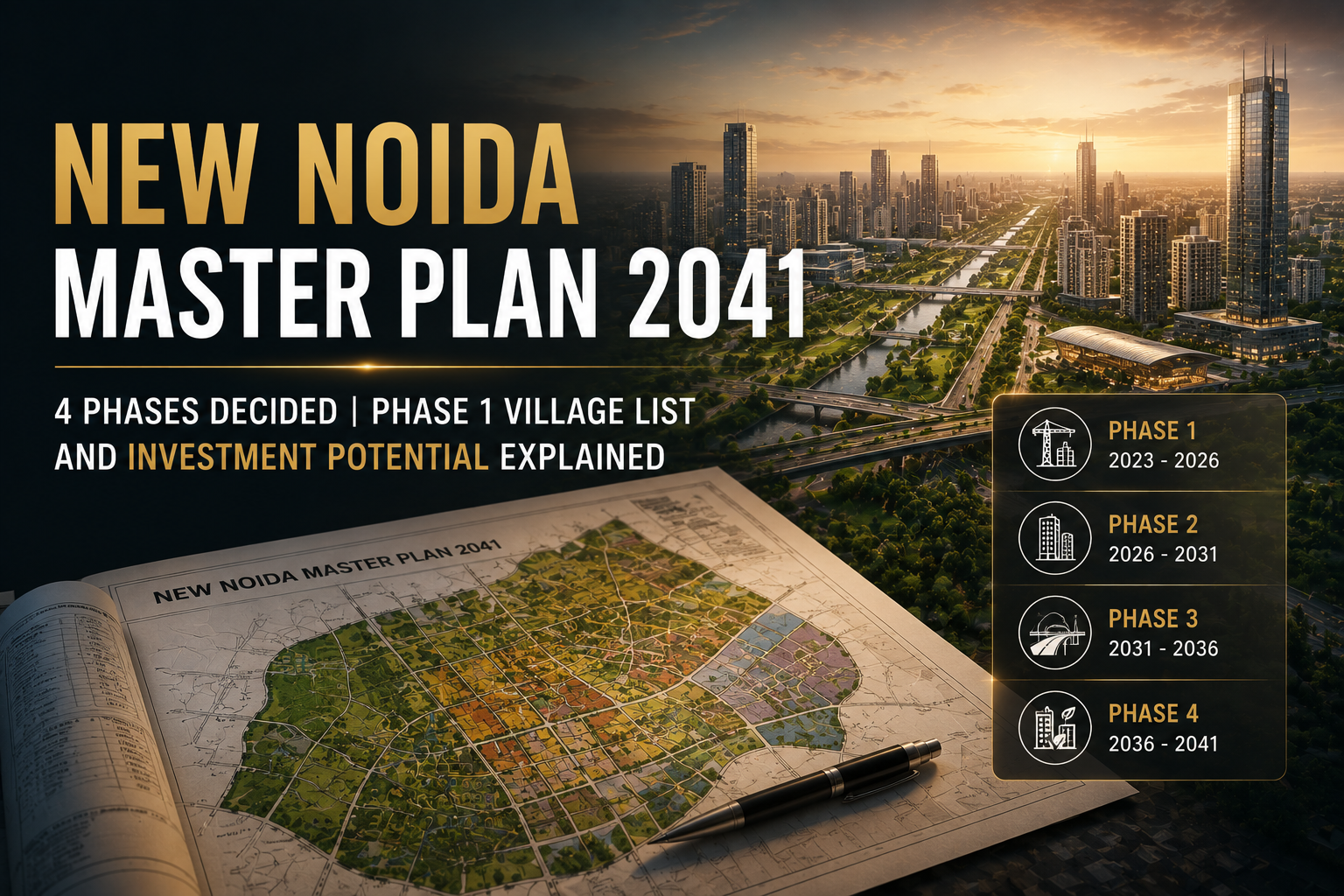
Building a metropolis from scratch requires immense logistical coordination. To manage this effectively, the development authority has divided the entire master plan into four distinct, sequential phases stretching over the next two decades.
The immediate focus of the authority is the execution of Phase 1, which targets the development of 3,165 hectares of land. This stage is heavily centered around initial land acquisition, digitizing local land records, and laying down the primary arterial and sub-arterial road networks. Without robust foundational infrastructure, a city cannot function. Therefore, Phase 1 is entirely about acquiring the core land pockets and building the essential roads, drainage, and power grids that will support the first wave of industrial and residential setups.
Once the basic infrastructure is operational, Phase 2 will commence, targeting an additional 3,798 hectares. This phase will push development toward the northern and southern peripherals of the newly acquired zones. The primary focus here will be the rapid expansion of industrial sectors. As the first factories and businesses begin operations from Phase 1, Phase 2 will ensure that allied industries, warehousing solutions, and immediate residential accommodations are ready to absorb the influx of the working population.
Phase 3 is the largest expansion window in terms of mid-term growth, covering a massive 5,908 hectares. During this period, the city will see the rise of high-end commercial complexes, massive trade centers, and specialized business parks. A significant portion of the industrial development in this phase will be strategically aligned along the Eastern Peripheral Expressway railway lines, optimizing logistics and freight movement for heavy industries. This is the phase where New Noida transitions from an emerging industrial town into a mature, bustling commercial hub.
The final leg of the master plan targets the remaining 8,230 hectares, primarily focusing on the southern extremities of the city. Phase 4 is dedicated to finishing out the remaining industrial clusters, finalizing expansive public spaces, and completing the high-density residential sectors that are already in advanced stages. By 2041, the vision is to have a fully functional, self-sustaining mega-city seamlessly integrated into the broader NCR grid.
The success of New Noida hinges on the smooth execution of Phase 1. To initiate this, the government has pinpointed 37 specific villages across two key districts to undergo the first wave of land acquisition and development. Out of these, 24 villages fall within the Bulandshahr district, while the remaining 13 belong to Gautam Buddha Nagar.
This specific geographical selection is highly strategic. These villages sit at crucial intersections that will allow for immediate connectivity to existing highway networks. Revenue teams are currently deployed on the ground in these areas, matching land ownership records, verifying farmer details, and mapping out natural features like existing village roads, ponds, and local canals using advanced geographic information system (GIS) technology.
Some of the most prominent villages included in this initial Phase 1 rollout include Fazilpur, Dastampur, Dhudhera, Anandpur, and Chayansa on the Bulandshahr side. Meanwhile, crucial areas heavily influenced by the Dadri and Greater Noida belt, such as Kalonda, Khandera, Tatarpur, Badalpur, Rampur Jagir, Patwari, Birondi, Sadullapur, Tilpata, and Roopvas, are also coming under rapid focus. Additional key locations slated for early integration include Barangpur (New Basti), Bill Akbarpur, Girirajpur, Kot, Milk Khandera, Nagla Kamru, Phulpur, and Sainthali.
For real estate investors, these specific 37 villages represent the ultimate early-mover advantage. Because development—including electricity, paved roads, and commercial zoning—will arrive here first, the land parcels in and around these influence zones are primed for the fastest and most aggressive capital appreciation over the next three to five years.
One of the biggest hurdles in any massive infrastructure project is land acquisition. Learning from past agrarian friction in the NCR, the development authority has adopted a highly progressive, farmer-friendly approach for New Noida. The government has made it abundantly clear that land will be acquired through mutual consent rather than forceful statutory imposition. To facilitate this, a substantial budget of nearly ₹1,000 crore has already been allocated to ensure immediate liquidity for payouts.
To make the transition seamless and profitable for local landowners, the authority is rolling out a hybrid compensation model, offering farmers two distinct choices tailored to their financial preferences.
The first option is a straightforward cash compensation package. Farmers who opt for a clean exit will receive ₹4,300 per square meter for their land. This provides immediate, significant liquidity that many rural landowners can use to purchase larger agricultural tracts further away or invest in alternative businesses.
The second option is a land-pooling mechanism designed for long-term wealth creation. Under this scheme, farmers will receive a slightly lower cash payout of ₹3,800 per square meter. However, in addition to this cash, they will be given back 7 percent of their acquired land in the form of a fully developed residential or commercial plot within the new city's limits.
This 7 percent developed plot option is incredibly lucrative. As the city matures and basic infrastructure is laid down, the value of that developed plot will skyrocket. It allows the original landowners to remain stakeholders in the region's modernization, benefiting from future real estate booms, higher rental yields, and prime commercial opportunities. To streamline this process, the administration is actively organizing village camps, facilitating direct dialogue between officials and farmers, and expediting mutual consent agreements.
The geographical positioning of New Noida is perhaps its most compelling asset. The city is not being built in isolation; it is being plugged into some of the most powerful logistical and transport corridors in the country.
First and foremost is its proximity to the upcoming Noida International Airport in Jewar. The new airport is set to become India's largest aviation hub, and New Noida will serve as a primary industrial and residential catchment area for the massive workforce the airport and its allied businesses will generate.
Furthermore, the city will be heavily integrated into the Delhi-Mumbai Industrial Corridor (DMIC) and the Western Dedicated Freight Corridor. This guarantees that manufacturing units set up in New Noida will have highly subsidized, incredibly fast freight access to the major seaports on the western coast of India.
Road connectivity is equally unparalleled. The city will be flanked by the Yamuna Expressway, the Eastern Peripheral Expressway, and the Noida-Greater Noida Expressway. Whether moving cargo to other states or commuting to Delhi for business, the residents and industries of New Noida will enjoy traffic-free, high-speed access in all directions.
Internally, the city is being designed as a 'Smart City' from day one. Instead of retrofitting old roads with new technology, the DNGIR will feature built-in smart traffic management systems, integrated public transport corridors, advanced automated waste management solutions, and real-time civic monitoring grids.
When you combine a 40 percent industrial allocation with world-class infrastructure and seamless global connectivity via the Jewar Airport, the real estate mathematics become highly favorable. New Noida is positioned to give severe competition to established corporate hubs like Gurugram.
For commercial investors, the opportunity to secure large floor-plate warehousing, cold storage facilities, and high-tech manufacturing plots at ground-zero prices is a rare generational opportunity. As major multinational corporations finalize their leases, the demand for ancillary services, retail spaces, and corporate offices will surge exponentially.
For residential homebuyers and investors, the Phase 1 villages offer a golden entry point. As the hybrid compensation model injects cash into the local economy, and as the initial waves of construction workers, engineers, and project managers move into the area, the demand for localized rental housing and affordable plots will spike. Investing in the influence zones around Dadri and the designated Bulandshahr villages today is akin to buying land in standard Noida or Greater Noida two decades ago.
The strict zoning laws also mean that residential neighborhoods will be protected from industrial pollution and chaotic traffic, ensuring a high quality of life. The emphasis on vast green belts, water bodies, and organized commercial districts ensures that the city will remain livable and aesthetically pleasing even as its population peaks.
The Dadri-Noida-Ghaziabad Investment Region is no longer just a futuristic concept on a planning document. With the Master Plan 2041 officially guiding the way, budget allocations cleared, and ground-level land acquisition camps actively engaging with the 37 Phase 1 villages, the foundational work of India's next great metropolis has begun.
For those keeping a close watch on the NCR real estate market, New Noida represents the ultimate frontier. It is a city designed to learn from the urban planning mistakes of the past, leveraging modern smart-city technology, equitable land pooling, and unmatched global connectivity. As the bulldozers roll in and the digital mapping concludes, the landscape of Gautam Buddha Nagar and Bulandshahr is set to change forever, bringing unprecedented prosperity and a world-class urban lifestyle to the region.
