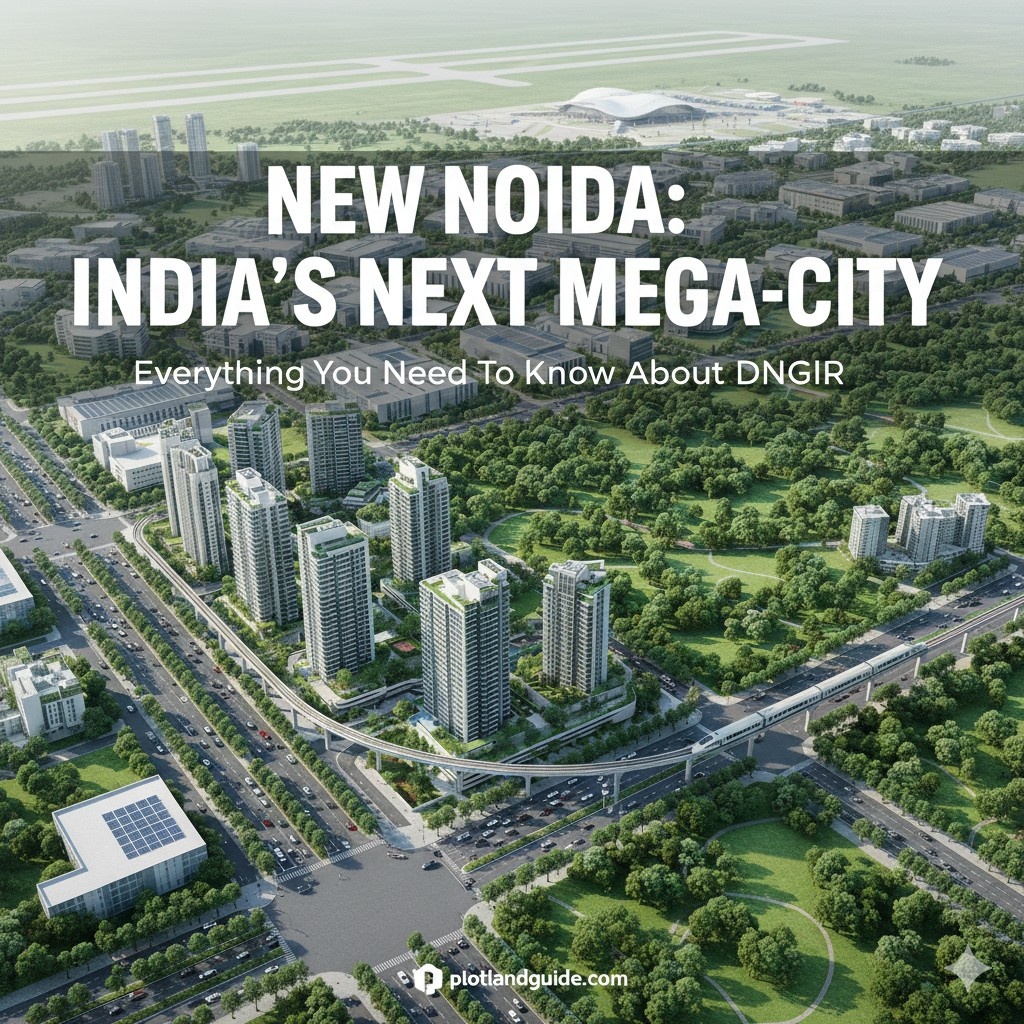
Complete guide to New Noida (DNGIR) - India's ambitious 21,000-hectare smart city project. Learn about development phases, investment opportunities, infrastructure, and master plan 2041.
What if a brand new city, comparable in size to current Noida, is being built from scratch right in the heart of NCR? A city that will house 6 lakh people, create 3 lakh jobs in its first phase alone, and become India's next industrial powerhouse by 2041. Welcome to the comprehensive guide on New Noida - India's most ambitious urban development project.
Introduction to New Noida {#introduction}
The Uttar Pradesh government has approved one of the most ambitious urban development projects in India's history - the New Noida Master Plan 2041. This isn't just an expansion; it's the creation of an entirely new city that will redefine the National Capital Region's landscape.
New Noida is being planned to solve a critical problem: Noida has reached 95% development saturation. There's simply no more room to grow. With the upcoming Noida International Airport in Jewar set to open, the region is poised to attract massive investments and industries, but where will they go? That's where New Noida comes in.
Key Facts at a Glance
- Official Name: Dadri-Noida-Ghaziabad Investment Region (DNGIR)
- Total Area: ~209 sq km (21,000 hectares)
- Villages Covered: 84 (21 from Gautam Buddha Nagar, 63 from Bulandshahr)
- Projected Population: 6 lakh by 2041
- Development Period: 2024–2041 (Four phases)
- Initial Budget: ₹1,000 crore for land acquisition
- Employment Generation: 3+ lakh jobs (Phase 1 alone)
What is DNGIR? {#dngir}
DNGIR stands for Dadri-Noida-Ghaziabad Investment Region, and it represents more than just a new city. It's a strategic industrial corridor that's part of India's larger infrastructure vision.
Strategic Importance
New Noida is being developed as a crucial component of the Delhi-Mumbai Industrial Corridor (DMIC), one of India's most ambitious infrastructure projects. This connection means New Noida will be directly linked to industrial hubs across northern and western India.
Additionally, DNGIR is integrated with the Western Dedicated Freight Corridor, providing vital logistics and transport links that will connect NCR's Uttar Pradesh region with industrial belts in Haryana and beyond. This connectivity is essential for facilitating the movement of goods and services, positioning New Noida as a major logistics and manufacturing hub.
Planning Excellence
The master plan has been prepared by the School of Planning and Architecture, drawing inspiration from urban models in Chicago and European cities, ensuring world-class planning standards. The Noida Authority received approval from the state government after extensive planning and stakeholder consultations.
Strategic Location and Connectivity {#location}
Location is everything in real estate, and New Noida's location is strategic genius. The city is positioned to benefit from proximity to the upcoming Noida International Airport in Jewar, which will be one of Asia's largest airports and is expected to become operational in the near future.
Major Connectivity Points
Expressways:
- Noida-Greater Noida Expressway
- Yamuna Expressway
- Delhi-Mumbai Expressway
- Eastern Peripheral Expressway
- DND Flyway
Nearby Infrastructure Projects:
- Industrial Township at Greater Noida
- Multi-Modal Transport Hub at Boraki
- Multi-Modal Logistics Hub at Greater Noida
- Noida International Airport, Jewar
These projects will create an integrated ecosystem that supports manufacturing, logistics, and commerce, making New Noida a powerhouse of economic activity.
Development Phases: 2024-2041 {#phases}
The development of New Noida is structured into four carefully planned phases, ensuring systematic and sustainable growth over 17 years.
Phase 1 (2024-2027)
Area: 3,165 hectares
Status: Currently underway
Focus: Foundation and infrastructure
This phase focuses on acquiring 1,432.71 hectares through direct land purchases and developing arterial and sub-arterial roads - the backbone of the city's transportation network. The Noida Authority has allocated approximately ₹1,000 crore for land acquisition in this phase alone.
Key Developments:
- Basic road network establishment
- Utility infrastructure setup
- Initial land acquisition
- Planning and zoning implementation
Phase 2 (2027-2032)
Area: 3,798 hectares (15% of total area)
Focus: Northern and southern expansion
The second phase will add another 3,798 hectares of development, focusing on the northern and southern parts of the planning area. The industrial areas in the north will be developed during this phase, establishing the foundation for New Noida's industrial ecosystem.
Key Developments:
- Industrial zone establishment
- Residential area development
- Educational institution setup
- Commercial center creation
Phase 3 (2032-2037)
Area: 5,908 hectares (28% of total area)
Focus: Major expansion and diversification
Phase three will be the largest expansion, developing 5,908 hectares. This phase will see substantial industrial and residential development, creating a balanced urban environment.
Key Developments:
- Major industrial units operational
- Mixed-use developments
- Healthcare facilities establishment
- Metro line extensions
Phase 4 (2037-2041)
Area: 8,230 hectares
Focus: Completion and integration
The final phase will bring the total developed area to 8,230 hectares by 2041. This phase will emphasize advanced development of industrial areas, public and semi-public spaces, and residential areas in the southern region.
Key Developments:
- Final infrastructure completion
- Full metro network operational
- Complete ecosystem integration
- Target population of 6 lakh reached
Land Distribution and Zoning {#zoning}
One of the most impressive aspects of the New Noida Master Plan is its thoughtful land distribution strategy. Here's how the 21,000 hectares will be utilized:
Detailed Land Allocation
- Industrial: 8,420.92 hectares (40%) — Manufacturing, SEZs, logistics
- Mixed-Use Industry: 165.2 hectares (0.8%) — Flexible industrial activities
- Residential: 2,810 hectares (13.4%) — Housing for all income groups
- Green Spaces: ~3,780 hectares (18%) — Parks, recreation, environment
- Commercial: 850 hectares (4%) — Retail, offices, business districts
- Educational: 1,662 hectares (9%) — Schools, colleges, training centers
- Transportation: ~3,150 hectares (15%) — Roads, metro, infrastructure
- Other Uses: Balance — Public facilities, utilities
Industrial Development - 40%
A massive 8,420.92 hectares - that's 40% of the total land - is dedicated to industrial purposes. This is a clear indication that New Noida is being positioned as an industrial powerhouse.
Residential Areas - 13%
Approximately 2,810 hectares (13.44%) is allocated for residential development, including:
- Economically Weaker Sections (EWS)
- Low Income Groups (LIG)
- Middle Income Groups (MIG)
- High Income Groups (HIG)
Around 7% of the residential area is specifically designated for informal settlements, ensuring inclusive development.
Green and Recreational Spaces - 18%
In a time when cities are choking on pollution, New Noida dedicates 18% of its land to green areas and recreational activities. This commitment to environmental sustainability sets it apart from conventional industrial townships.
Educational Institutions - 9%
A significant 1,662 hectares (9%) is allocated for educational institutes, with the vision of creating an "Education City" within New Noida.
Three-Zone Strategy
Northern Zone:
Primarily residential development, providing homes for the city's growing population.
Central Zone:
Balanced mix of residential and industrial development, creating integrated neighborhoods.
Southern Zone:
Primary industrial and logistics hub with major manufacturing units and warehouses.
Industrial Development {#industrial}
Industrial development is at the heart of New Noida's vision. The project aims to transform West Uttar Pradesh into an industrial powerhouse.
Special Economic Zones (SEZs)
The master plan includes provisions for creating specialized SEZs tailored for various sectors:
- Agriculture and Food Processing Industries
- FMCG Manufacturing
- Technology and IT Services
- Automotive and Component Manufacturing
- Pharmaceuticals and Healthcare Products
Employment Generation
Phase 1: 3 lakh jobs
By 2041: Several lakh jobs across all sectors
This massive employment generation will transform the economic landscape of West Uttar Pradesh and provide opportunities for skilled and unskilled workers alike.
Logistics Advantage
The integration with the Western and Eastern Dedicated Freight Corridors means industries in New Noida will have:
- Direct access to major markets across India
- Reduced transportation costs
- Faster delivery times
- Enhanced export potential through Jewar Airport proximity
Investor Benefits
The Uttar Pradesh government is offering:
✓ Flexible land allotment policies
✓ Favorable trade and export policies
✓ Streamlined approval processes
✓ Tax incentives and subsidies
✓ Single-window clearance system
Existing Industrial Presence
The presence of leading MNCs like HCL, Tech Mahindra, and Microsoft in nearby Sector 22 D demonstrates the region's attractiveness to global corporations and sets the stage for New Noida's success.
Residential Planning {#residential}
New Noida's residential planning focuses on creating inclusive, sustainable, and livable communities.
Affordable Housing Focus
One of the key considerations in planning New Noida was providing housing solutions for the increasing population, especially the industrial workforce. Affordable housing zones are strategically placed near industrial areas to ensure workers can live close to their jobs at reasonable rates.
Mixed-Income Communities
The plan envisions an even distribution of residential areas catering to all income categories - from EWS to HIG. This approach:
- Prevents economic segregation
- Promotes social integration
- Creates diverse neighborhoods
- Ensures balanced community development
Integrated Townships
The master plan includes provisions for integrated townships that combine residential, commercial, and recreational facilities:
Township Features:
- Modern amenities and infrastructure
- Green spaces and parks within walking distance
- Community centers and shopping complexes
- Schools and healthcare facilities nearby
- Recreational facilities
- Sports complexes
Smart Housing Features
As part of the Smart City Initiative, residential areas will incorporate:
- Smart home automation systems
- Energy-efficient building designs
- Rainwater harvesting systems
- Comprehensive waste management
- High-speed internet connectivity
- Solar energy installations
- EV charging infrastructure
Housing Distribution
Approximately 7% of residential land is reserved for informal settlements, ensuring that all economic classes have access to housing in New Noida.
Educational and Healthcare Facilities {#facilities}
Education City Vision
With over 1,600 hectares allocated for educational institutions, New Noida aims to become a major education hub in North India.
Planned Educational Infrastructure:
Universities and Colleges
- Multi-disciplinary universities
- Engineering and technology institutes
- Medical colleges
- Management schools
- Law colleges
- Arts and science colleges
K-12 Schools
- International schools
- CBSE and state board schools
- Special education facilities
- Sports academies
- Residential schools
Vocational Training
- Skill development centers aligned with industrial needs
- ITI and polytechnics
- Technology training institutes
- Continuing education facilities
Research and Innovation
- R&D centers
- Innovation labs
- Startup incubators
- Knowledge centers
This focus on education ensures that:
- The workforce remains skilled and competitive
- Residents have access to quality education
- The region becomes a knowledge hub
- Innovation and entrepreneurship flourish
Healthcare Infrastructure
The master plan emphasizes comprehensive healthcare provision throughout the city.
Healthcare Facilities:
Major Hospitals
- Multi-specialty hospitals with 500+ beds
- Super-specialty hospitals
- Medical research centers
- Teaching hospitals
Primary Healthcare
- Community health centers in each sector
- Primary health centers
- 24/7 emergency services
- Ambulance networks
Specialized Care
- Diagnostic centers
- Specialty clinics
- Rehabilitation centers
- Mental health facilities
- Geriatric care centers
Accessibility Standards
- Healthcare facility within 15 minutes from any residential area
- Emergency services within 10 minutes
- Pharmacy access within walking distance
Skill Development Ecosystem
Recognizing the need for a trained workforce aligned with industrial requirements:
- Industry-Academia Partnerships: Collaboration between training centers and industries
- Apprenticeship Programs: On-the-job training opportunities
- Technology Training: Focus on emerging technologies like AI, IoT, robotics
- Continuous Learning: Upskilling programs for working professionals
Transportation Infrastructure {#transport}
New Noida's transportation network is designed to be multi-modal, efficient, and future-ready.
Three-Tier Road Network
Arterial Roads:
- Connect major zones
- Link to expressways
- High-capacity corridors
- Wide right-of-way
Sub-Arterial Roads:
- Secondary connectivity
- Inter-sector connections
- Medium capacity
- Commercial frontage
Local Roads:
- Neighborhood access
- Residential connectivity
- Pedestrian-friendly design
- Last-mile connectivity
Metro Network
The master plan outlines an extensive metro system:
Planned Metro Lines:
- Lines connecting different sectors within New Noida
- Extensions of existing Noida-Greater Noida corridor
- Connections to Delhi, Ghaziabad, and other NCR regions
- Metro stations integrated with commercial hubs
- Park-and-ride facilities
Expected Benefits:
- Reduced traffic congestion
- Lower pollution levels
- Efficient mass transit
- Improved connectivity
Expressway Connectivity
Major Expressway Access:
- Yamuna Expressway: Direct access to Agra and beyond
- Delhi-Mumbai Expressway: National connectivity
- Eastern Peripheral Expressway: Ring road benefits
- DND Flyway: Quick access to Delhi
- Noida-Greater Noida Expressway: Regional connectivity
Airport Proximity
The proximity to Noida International Airport in Jewar is a game-changer:
- Travel time: 30-40 minutes from New Noida
- Direct airport connectivity via expressways
- Potential for air cargo facilities
- Enhanced export-import capabilities
- Business travel convenience
Public Transportation
To reduce traffic congestion and pollution:
Planned Systems:
- Electric bus rapid transit (BRT) systems
- Bicycle-sharing programs
- E-rickshaw networks
- Pedestrian-friendly pathways
- Last-mile connectivity solutions
- Integrated ticketing systems
Parking and Traffic Management
- Multi-level parking facilities
- Smart parking systems
- Traffic signal optimization
- Real-time traffic monitoring
- Congestion management systems
Smart City and Sustainability {#smart}
New Noida is being designed as a smart and sustainable city from the ground up, incorporating cutting-edge technology and eco-friendly practices.
Smart City Technologies
Intelligent Infrastructure:
- Smart traffic signals with real-time management
- IoT-based city monitoring systems
- Intelligent parking management
- Crowd management systems
- 24/7 surveillance and security
- High-speed fiber optic network
- 5G connectivity readiness
E-Governance:
- Digital citizen services
- Online permit and license systems
- Grievance redressal portals
- Real-time service tracking
- Mobile apps for civic services
- Transparent administration
Smart Utilities:
- Smart electricity meters
- Water management systems
- Waste collection optimization
- Energy consumption monitoring
- Automated street lighting
Environmental Sustainability
Green Initiatives:
Extensive Green Cover (18% of total area)
- Parks in every sector
- Green belts along major roads
- Urban forests
- Biodiversity zones
- Tree plantation drives
Water Management:
- Mandatory rainwater harvesting
- Sewage treatment plants
- Water recycling systems
- Groundwater recharge
- Protection of existing water bodies
- Zero liquid discharge for industries
Waste Management:
- Segregated waste collection
- Recycling facilities
- Composting plants
- Waste-to-energy projects
- E-waste management centers
- Plastic waste management
Renewable Energy:
- Solar panels on government buildings
- Wind energy where feasible
- Green building certifications mandatory
- Energy-efficient street lighting
- Net-zero energy buildings
Air Quality Management
Recognizing existing pollution issues from brick kilns in some villages:
- Strict emission control regulations
- Green buffer zones
- Air quality monitoring stations
- Transition of brick kilns to cleaner technologies
- Vehicle emission norms
- Construction dust control measures
Walkable City Design
Creating pedestrian and cyclist-friendly environments:
- Shaded walkways and footpaths
- Dedicated bicycle tracks
- Parks within 10-minute walk
- Reduced vehicle dependency
- Mixed-use development
- Street furniture and lighting
- Safe pedestrian crossings
Climate Resilience
- Heat island mitigation strategies
- Flood management systems
- Drought-resistant landscaping
- Climate-adaptive building codes
- Emergency preparedness systems
Investment Opportunities {#investment}
New Noida presents unprecedented opportunities for various types of investors, from large corporations to individual homebuyers.
For Industrial Investors
Advantages:
- Large land parcels available (40% of total area)
- Excellent logistics connectivity (freight corridors, airport)
- Access to skilled workforce from education hub
- Government incentives and tax breaks
- Proximity to major consumption markets (Delhi NCR)
- SEZ benefits in designated zones
- Lower land costs compared to established areas
Suitable For:
- Manufacturing units
- Warehousing and logistics companies
- Food processing plants
- FMCG manufacturers
- Automotive component makers
- Pharmaceutical companies
- IT and technology firms
For Real Estate Developers
Opportunities:
- Massive demand for residential properties (6 lakh population target)
- Affordable housing segment with government support
- Commercial real estate development potential
- Integrated township projects
- Rising property values as development progresses
- Early-mover advantage in pricing
- Clear zoning and approved master plan
Development Options:
- Residential apartments (EWS to HIG)
- Gated communities
- Commercial complexes
- Retail spaces
- Office buildings
- Educational institutions
- Healthcare facilities
For Individual Investors
Investment Types:
Residential Property:
- Apartments for self-use or rental
- Plots for future construction
- Studio apartments near industrial zones
- Luxury villas in premium sectors
Commercial Property:
- Retail shops in high-footfall areas
- Office spaces for IT companies
- Showrooms on main roads
- Restaurant and hospitality spaces
Land Investment:
- Residential plots
- Commercial plots
- Industrial land (for small units)
Benefits:
- Early-stage investment opportunities
- Property appreciation potential (5-15 year horizon)
- Rental income from industrial workforce
- Future capital gains
- Lower entry prices vs. established areas
- Government-backed development assurance
Investment Timeline Considerations
Short-term (1-3 years):
- Higher risk, speculative
- Land appreciation near Phase 1 areas
- Pre-launch project bookings
Medium-term (3-7 years):
- Moderate risk
- Properties in Phase 1 and Phase 2
- Rental income starts flowing
- Some capital appreciation
Long-term (7-15 years):
- Lower risk, stable returns
- All phases benefit
- Significant capital appreciation
- Mature rental markets
- Complete infrastructure
Risk Factors to Consider
⚠️ Timeline Risks: Delays in development phases
⚠️ Market Risks: Real estate market fluctuations
⚠️ Policy Risks: Changes in government policies
⚠️ Liquidity Risks: Long-term commitment required
⚠️ Infrastructure Risks: Dependency on promised infrastructure
Investment Tips
✓ Research thoroughly before investing
✓ Verify RERA registration of projects
✓ Check developer track record
✓ Visit the site physically
✓ Understand payment plans and timelines
✓ Consult with real estate experts
✓ Don't invest more than you can afford to lock in
✓ Diversify across property types
✓ Keep long-term perspective
Challenges and Considerations {#challenges}
While New Noida presents a compelling vision, there are several challenges that need to be addressed:
Land Acquisition Challenges
Complexities:
- Acquiring land from 84 villages
- Negotiations with multiple landowners
- Fair compensation mechanisms
- Rehabilitation of displaced families
- Balancing development with farmer interests
- Legal disputes and litigation risks
Government Approach:
- Direct land purchase model
- Market-rate compensation
- Rehabilitation packages
- Employment opportunities for affected families
- Transparent acquisition process
Environmental Concerns
Existing Issues:
- Air pollution from brick kilns in several villages
- Need to preserve some agricultural land
- Water table management
- Ecological impact assessment
Mitigation Measures:
- Strict emission control regulations
- Transition of brick kilns to cleaner technologies
- Green buffer zones (18% of total area)
- Water conservation and recycling
- Environmental impact studies
- Pollution monitoring systems
Infrastructure Development
Challenges:
- Massive capital investment required (₹1,000 crore+ just for Phase 1)
- Coordination between multiple agencies (Noida Authority, PWD, utilities)
- Phased development execution complexity
- Maintaining quality standards
- Skilled labor availability
- Material procurement and logistics
Solutions:
- Structured four-phase approach
- Clear timelines and milestones
- Public-Private Partnership models
- Quality monitoring mechanisms
- Regular audits and reviews
Social and Inclusive Development
Concerns:
- Employment for local population
- Affordable housing availability
- Displacement of existing communities
- Cultural integration
- Skilling local workforce
Measures:
- 7% land for informal settlements
- EWS/LIG housing quotas
- Skill development programs
- Local employment preferences
- Community engagement initiatives
Timeline Adherence
Risks:
- Meeting ambitious 2041 deadline
- Coordinating four phases effectively
- Managing multiple stakeholders
- Adapting to changing economic conditions
- Policy changes at state/central level
Monitoring:
- Regular progress reviews
- Penalty clauses for delays
- Incentives for early completion
- Transparent reporting
- Stakeholder accountability
Financial Sustainability
Considerations:
- Revenue generation for ongoing development
- Land monetization strategy
- Infrastructure maintenance costs
- Return on investment timeline
- Market demand fluctuations
Economic Impact {#economy}
The economic implications of New Noida extend far beyond the city limits, impacting the entire NCR region and Uttar Pradesh state.
Regional Growth Engine
DNGIR is positioned as the growth engine of West Uttar Pradesh.
Direct Economic Impact:
- Employment: 3+ lakh jobs in Phase 1 alone
- Industrial Output: Billions in annual manufacturing value
- Tax Revenue: Significant increase in state revenues
- Per Capita Income: Boost in regional income levels
- Investment Attraction: Both domestic and international capital
Multiplier Effects:
- Ancillary industries development
- Service sector growth
- Retail and hospitality expansion
- Construction industry boom
- Transportation and logistics growth
Real Estate Market Impact
Price Appreciation:
- Current Noida: Expected 20-30% appreciation
- Greater Noida: 25-35% growth potential
- New Noida: Early investors could see 2-3x returns
- Yamuna Expressway: Significant value increase
Market Dynamics:
- New investment hotspots emergence
- Rental market expansion
- Commercial real estate boom
- Increased construction activity
- Developer interest surge
Regional Impact:
- Ghaziabad connectivity improvement
- Bulandshahr economic transformation
- GB Nagar overall appreciation
- NCR integration strengthening
Infrastructure Development Cascade
Triggered Developments:
- Highway upgrades and new roads
- Metro network extensions
- Hospital and medical college construction
- School and university expansion
- Shopping mall and entertainment complex development
- Hotel and hospitality infrastructure
- Airport-related development
Utility Infrastructure:
- Power generation capacity increase
- Water supply infrastructure
- Sewage treatment expansion
- Telecom tower installation
- Gas pipeline networks
State Government Benefits
Revenue Streams:
- Stamp duty from property transactions
- Industrial taxes and fees
- Property taxes
- GST collection increase
- Land monetization revenue
Development Benefits:
- Employment generation
- Skill development
- Industrial base expansion
- Export growth
- Foreign investment attraction
Comparison: Before and After New Noida
- Population:
- Before: Noida saturated at ~1 million
- After (2041): Additional 6 lakh in New Noida
- Industrial Land:
- Before: Limited availability
- After: 8,420+ hectares available
- Employment:
- Before: Growth stagnating
- After: 3+ lakh new jobs
- Investment:
- Before: Diverted to other regions
- After: Retained in NCR
- Property Prices:
- Before: Plateauing
- After: New growth trajectory
- Infrastructure:
- Before: Congested
- After: Modern, planned expansion
Long-term Economic Vision (2041 and Beyond)
By 2041:
- New Noida fully operational
- 6 lakh population
- Multiple SEZs functioning
- Complete metro network
- Jewar Airport matured
- Self-sustaining economy
Post-2041 Potential:
- Further expansion possible
- Technology hub development
- Research and innovation center
- Export-oriented growth
- Smart manufacturing hub
- Logistics excellence
Key Takeaways {#takeaways}
Here are the most important points about New Noida that every investor, resident, and stakeholder should know:
1. Scale and Ambition
- 209 square kilometers (21,000 hectares)
- Comparable to current Noida in size
- 84 villages across two districts
- 17-year structured development (2024-2041)
2. Industrial Powerhouse
- 40% land dedicated to industries (8,420+ hectares)
- Part of Delhi-Mumbai Industrial Corridor
- Integration with freight corridors
- 3+ lakh jobs in Phase 1 alone
3. Inclusive and Balanced Planning
- Housing for all income groups (EWS to HIG)
- 13% residential, 18% green spaces
- 9% for educational institutions
- Mixed-use development approach
4. Smart and Sustainable
- Built with smart city features from day one
- 18% green cover commitment
- Water recycling and rainwater harvesting
- Renewable energy integration
- Walkable neighborhoods
5. Strategic Connectivity
- Proximity to Noida International Airport (Jewar)
- Multiple expressway connections
- Planned metro network
- Part of national freight corridors
- 30-40 minutes to airport
6. Education Hub
- "Education City" vision
- 1,662 hectares for institutions
- Universities, schools, training centers
- Skill development focus
7. Government Backing
- UP government-approved master plan
- ₹1,000 crore initial budget
- Noida Authority execution
- School of Planning and Architecture designed
- Clear policy framework
8. Investment Potential
- Early-stage entry opportunity
- Multiple asset classes (residential, commercial, industrial, land)
- Long-term appreciation potential
- Rental income opportunities
- Government-assured development
9. Phased Development
- Phase 1 (2024-27): 3,165 hectares
- Phase 2 (2027-32): 3,798 hectares
- Phase 3 (2032-37): 5,908 hectares
- Phase 4 (2037-41): 8,230 hectares
- Systematic, planned growth
10. Regional Transformation
- West UP growth engine
- NCR expansion and integration
- Employment generation
- Economic development
- Infrastructure cascade effect
Critical Success Factors
✓ Timely execution of four phases
✓ Successful land acquisition
✓ Infrastructure development as planned
✓ Investor confidence maintenance
✓ Government policy continuity
✓ Environmental sustainability achievement
✓ Inclusive development realization
Frequently Asked Questions {#faqs}
Q1: What is New Noida officially called?
Answer: New Noida is officially known as DNGIR - Dadri-Noida-Ghaziabad Investment Region. It's a planned city being developed by the Noida Authority under the approval of the Uttar Pradesh government.
Q2: How big is New Noida?
Answer: New Noida will cover approximately 209 square kilometers (21,000 hectares) across 84 villages - 21 from Gautam Buddha Nagar district and 63 from Bulandshahr district. This makes it comparable in size to the existing Noida city.
Q3: When will New Noida be completed?
Answer: New Noida is being developed in four phases:
- Phase 1: 2024-2027
- Phase 2: 2027-2032
- Phase 3: 2032-2037
- Phase 4: 2037-2041
The complete city is expected to be operational by 2041.
Q4: How much land is allocated for industries?
Answer: A massive 40% of the total land (8,420.92 hectares) is dedicated to industrial purposes, making New Noida a major industrial hub. An additional 165.22 hectares is allocated for mixed-use industry.
Q5: What is the projected population of New Noida?
Answer: By 2041, New Noida is expected to accommodate approximately 6 lakh people (600,000 residents).
Q6: How many jobs will New Noida create?
Answer: In Phase 1 alone, New Noida is projected to create over 3 lakh jobs. By 2041, the total employment could reach several lakh across various sectors including manufacturing, services, IT, retail, and logistics.
Q7: Is New Noida connected to the Noida International Airport?
Answer: Yes, New Noida is strategically located with excellent connectivity to the upcoming Noida International Airport in Jewar. The travel time is approximately 30-40 minutes via expressways.
Q8: What is the budget for New Noida development?
Answer: The Noida Authority has allocated approximately ₹1,000 crore for land acquisition in Phase 1 alone. The total budget across all phases will be significantly higher and will be announced progressively.
Q9: Will there be affordable housing in New Noida?
Answer: Yes, the master plan includes provisions for all income categories including:
- Economically Weaker Sections (EWS)
- Low Income Groups (LIG)
- Middle Income Groups (MIG)
- High Income Groups (HIG)
Approximately 7% of residential land is reserved for informal settlements, ensuring inclusive development.
Q10: What makes New Noida different from current Noida?
Answer: Key differences include:
- Planned from scratch vs. organic growth
- 40% industrial focus with clear SEZs
- Smart city features from day one
- 18% green spaces mandatory
- Structured development in four phases
- Modern urban planning inspired by Chicago and European cities
- Integrated transport (metro + roads + airport)
Q11: Is New Noida part of any national project?
Answer: Yes, New Noida (DNGIR) is part of:
- Delhi-Mumbai Industrial Corridor (DMIC)
- Western Dedicated Freight Corridor
- Smart City Initiative
This integration ensures strategic importance and government support.
Q12: What percentage of land is for green spaces?
Answer: 18% of the total land area is dedicated to green spaces and recreational activities, demonstrating strong commitment to environmental sustainability.
Q13: Will there be a metro in New Noida?
Answer: Yes, the master plan includes an extensive metro network that will:
- Connect different sectors within New Noida
- Extend the existing Noida-Greater Noida metro corridor
- Link to Delhi, Ghaziabad, and other NCR regions
- Integrate with residential and commercial hubs
Q14: What expressways connect to New Noida?
Answer: New Noida has excellent connectivity through:
- Noida-Greater Noida Expressway
- Yamuna Expressway
- Delhi-Mumbai Expressway
- Eastern Peripheral Expressway
- DND Flyway
Q15: Are there educational institutions planned?
Answer: Yes, 9% of total land (1,662 hectares) is allocated for educational institutions, with plans to create an "Education City" featuring:
- Universities and colleges
- K-12 schools
- Vocational training centers
- Research facilities
- Skill development centers
Q16: Is it a good time to invest in New Noida?
Answer: For long-term investors (5-15 years), New Noida offers:
Pros:
- Early-stage entry at lower prices
- Government-backed master plan
- Strong infrastructure commitment
- Employment generation driving demand
- Part of national industrial corridors
Cons:
- Long development timeline
- Execution risks
- Market fluctuations
- Liquidity constraints
Recommendation: Suitable for investors with long-term perspective who can afford to lock in investments. Always consult financial advisors and do thorough research.
Q17: What is the RERA status of New Noida?
Answer: The master plan has been approved by the Uttar Pradesh government and the Noida Authority. Individual projects within New Noida will have their own RERA registrations. Always verify RERA registration before investing in any project.
Q18: How will New Noida manage environmental concerns?
Answer: The master plan includes:
- 18% mandatory green cover
- Rainwater harvesting in all buildings
- Sewage treatment plants
- Air quality monitoring
- Transition of brick kilns to cleaner tech
- Renewable energy installations
- Waste-to-energy projects
Q19: Who designed the New Noida master plan?
Answer: The master plan was prepared by the School of Planning and Architecture, drawing inspiration from urban planning models in Chicago and European cities.
Q20: Can I buy land directly in New Noida?
Answer: Land acquisition is currently being handled by the Noida Authority. For individual investors:
- Wait for official land allotment schemes
- Invest in RERA-registered projects
- Consider residential/commercial properties from developers
- Avoid unauthorized dealers and unverified plots
Always verify all documentation and deal only through official channels.
Conclusion
New Noida represents more than just another urban development project. It's a vision for India's future - a city designed from scratch with modern planning principles, smart technology, sustainable practices, and inclusive development at its core.
With the Noida International Airport opening soon, the region is poised for explosive growth. New Noida will be the engine driving this transformation, creating hundreds of thousands of jobs, providing homes for lakhs of people, and establishing Uttar Pradesh as a major industrial hub in India.
The structured four-phase development approach, clear land zoning, strong government backing, and integration with national industrial corridors make this one of the most promising urban development projects in India today.
Key Highlights:
✓ 21,000 hectares of planned development
✓ 6 lakh population by 2041
✓ 3+ lakh jobs in Phase 1 alone
✓ 40% industrial land for manufacturing excellence
✓ 18% green spaces for sustainable living
✓ Smart city features from inception
✓ World-class connectivity to airport and expressways
✓ Government-backed master plan
Whether you're an investor looking for long-term appreciation, a business seeking to establish operations, or simply someone interested in India's urban future, New Noida is a project that deserves serious attention.
The development has already begun. The vision is clear. The opportunity is now.