Published On:
November 2, 2025
Updated On:
November 2, 2025
The 30-km Delhi–Jewar Expressway, approved under Bharatmala Phase-II, will connect Delhi directly with Noida International Airport at Jewar. Costing ₹2,700 crore, it will reduce travel time to under 45 minutes and drive major real estate growth along the Yamuna belt.
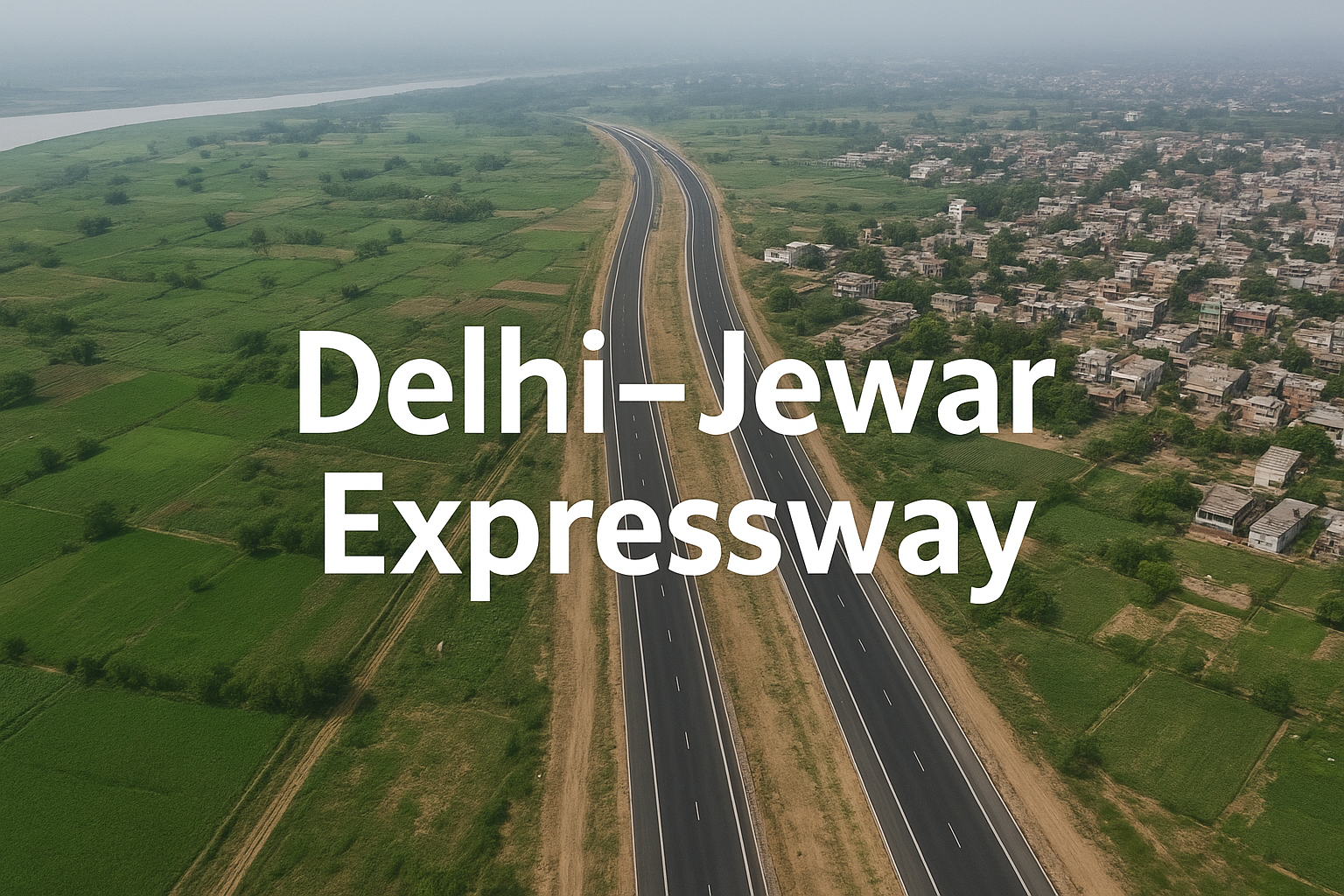
A new 30-kilometre expressway has been officially approved to link Delhi, Noida, Greater Noida, and Jewar Airport, forming part of a ₹40,000 crore connectivity master plan around the Noida International Airport (NIA).
The expressway will decongest the existing Noida–Greater Noida Expressway, which currently carries about five lakh vehicles per day, while establishing a direct, high-speed corridor to Jewar Airport.
This project, known interchangeably as the Delhi–Jewar Expressway or the New Delhi–Noida Expressway, is set to become one of the most critical infrastructure links in North India.
The expressway will run parallel to the existing Noida–Greater Noida Expressway, following the Yamuna River alignment.
It will connect Pushta Road in Delhi with both the Yamuna Expressway and the Noida–Greater Noida Expressway, bypassing the central Noida sectors that face heavy daily congestion.
Key sectors affected by land acquisition include Sector 150, 151, and 162, where notifications have already been issued and land transfer is nearly complete.
The alignment will also relieve pressure on the current expressway while opening new corridors for residential and commercial townships along the Yamuna belt.
The primary goal is to create a seamless Delhi–Jewar Airport corridor that enhances passenger and cargo movement.
By cutting travel time between Delhi and Jewar from nearly 2 hours to under 45 minutes, the project will drastically improve accessibility and efficiency for both business and tourism.
It’s part of a broader plan to turn the Yamuna Expressway region into a high-growth hub for logistics, warehousing, hospitality, and mixed-use development.
For the government, it also strengthens the case for Jewar Airport as NCR’s next major aviation and industrial node.
The estimated cost of the New Delhi–Noida Expressway is ₹2,700 crore, according to early figures from the National Highways Authority of India (NHAI).
Originally planned under the Uttar Pradesh Expressways Industrial Development Authority (UPEIDA) through a cost-sharing model with Noida and Greater Noida authorities, the project was later brought under the Bharatmala Phase-II programme.
This ensures 100% central government funding, and Union Minister Nitin Gadkari has confirmed that funds will not be a constraint.
NHAI will now be responsible for design, execution, and long-term maintenance.
The new expressway is an integral part of the Delhi–Jewar Economic Corridor, a larger plan to connect major NCR cities through high-speed road and logistics infrastructure.
It will link with the FNG (Faridabad–Noida–Ghaziabad) loop and the Dwarka Expressway, offering direct connectivity from Gurugram, Dwarka, Faridabad, and South Delhi to Jewar Airport.
This network integration will drastically shorten intercity travel times and enable direct cargo and passenger flow between Delhi’s business hubs and the upcoming airport.
The Delhi–Jewar Expressway is one of several major infrastructure projects worth over ₹1.2 lakh crore being implemented across NCR.
These include the Noida International Airport, logistics zones, data centres, and industrial clusters designed to push the Delhi–Noida–Jewar axis into becoming the new economic core of North India.
Together, these projects are reshaping real estate demand, transport efficiency, and employment generation across the region.
1. Property Price Surge:
With direct connectivity to Delhi and the airport, property prices along the Yamuna Expressway, Noida Extension, and Sector 150 corridor are projected to rise 30–50% within two years.
2. Shift to Premium Projects:
Top developers are launching luxury residential and commercial projects, anticipating strong appreciation as infrastructure catches up.
The area is transitioning from mid-income housing to premium integrated townships and commercial hubs.
3. Investor Magnet:
Proximity to the Jewar Airport and inclusion in a government-backed corridor makes this stretch one of NCR’s most attractive investment zones.
It’s already drawing interest from institutional investors, warehousing firms, and IT developers.
4. From Peripheral to Prime:
Once dismissed as “too far from Delhi,” the Yamuna Expressway and Noida Extension zones are quickly emerging as NCR’s new growth axis, comparable to Gurugram’s boom two decades ago.
While the Delhi–Jewar Expressway presents strong fundamentals, a few execution risks remain:
The New Delhi–Noida Expressway (Delhi–Jewar Expressway) stands as one of the most transformative infrastructure projects in NCR’s history.
It promises faster travel, cleaner alignment, and unmatched regional integration — linking Delhi, Noida, Greater Noida, Gurugram, and Jewar Airport into one continuous economic corridor.
For investors, developers, and residents alike, this expressway is not just another project — it’s the backbone of NCR’s next decade of growth.
