Published On:
September 12, 2026
Updated On:
September 12, 2026
The BMC’s new Occupation Certificate amnesty scheme offers a lifeline to Mumbai housing societies, provided they can furnish foundational approvals like the IOD, Commencement Certificate, and a mandatory developer NOC to prove the building's authenticity.
For decades, navigating the labyrinth of Mumbai real estate has been a daunting task for homebuyers. While acquiring a property in the financial capital is a dream realised for many, the aftermath often brings administrative nightmares, the most prominent being the absence of an Occupation Certificate. An Occupancy Certificate, commonly referred to as an OC, is the ultimate civic document certifying that a building has been constructed according to approved plans and is safe for human habitation. Yet, across the city, an estimated 12 lakh homeowners residing in approximately 25,000 buildings are living without this crucial document.
To resolve this massive urban backlog, the Brihanmumbai Municipal Corporation introduced a much-awaited OC amnesty scheme, frequently referred to as the Abhay Yojana. However, as the civic body rolled out the Standard Operating Procedure for the scheme, it delivered a stern reality check. The amnesty is not a free pass. Housing societies cannot simply demand regularisation because they have been occupying a building for years. To benefit from this relief, societies must navigate a strict checklist of foundational approvals, ensuring that only authentic, legally initiated projects are regularised.
To truly understand the importance of this amnesty scheme, one must look at the heavy toll exacted on residents living in buildings devoid of an OC. In the eyes of the civic administration, occupying a building without this certificate is technically unauthorised. To penalise this, the municipal body levies exorbitant water charges, often double the standard residential rate, alongside significantly inflated property taxes. Over the years, these elevated utility and tax bills bleed the financial reserves of housing societies.
The challenges extend far beyond monthly maintenance bills. A flat without an OC sits in a legal grey area, directly impacting its marketability. Potential buyers struggle to secure home loans from major nationalised banks, leading to a drastic drop in the property's resale value. Furthermore, the absence of an OC acts as a massive roadblock for older societies looking to undergo redevelopment or secure a deemed conveyance deed. Without the certificate, transferring the land title from the builder to the housing society becomes an arduous, sometimes impossible, legal battle.
For the thousands of residents caught in this limbo, the BMC OC amnesty scheme was envisioned as the ultimate problem solver. It promised to regularise these structures, slash penalties by up to half, and integrate these buildings back into the formal real estate economy. But the civic body is treading carefully to ensure this generosity is not exploited by the land mafia or builders of entirely illegal structures.
When the framework for the amnesty scheme was announced, a misconception spread that any building lacking an OC could simply pay a regularisation fee and walk away with the certificate. The latest circular from the municipal authorities completely dispels this myth.
The civic body has made it abundantly clear that the mere absence of an OC does not automatically qualify a housing society for relief. The primary objective of the scheme is to help legitimate projects that got stuck at the very last mile of compliance. Often, developers construct a building properly but abandon the project before applying for the final OC due to minor deviations, unpaid premium dues, or sheer negligence. The amnesty scheme is designed for these specific scenarios.
It is strictly not a mechanism to regularise buildings that were erected illegally without the civic body’s knowledge. If a structure was built without any initial permission, it remains unauthorised, and the amnesty scheme will offer no protection against potential demolition or legal action.
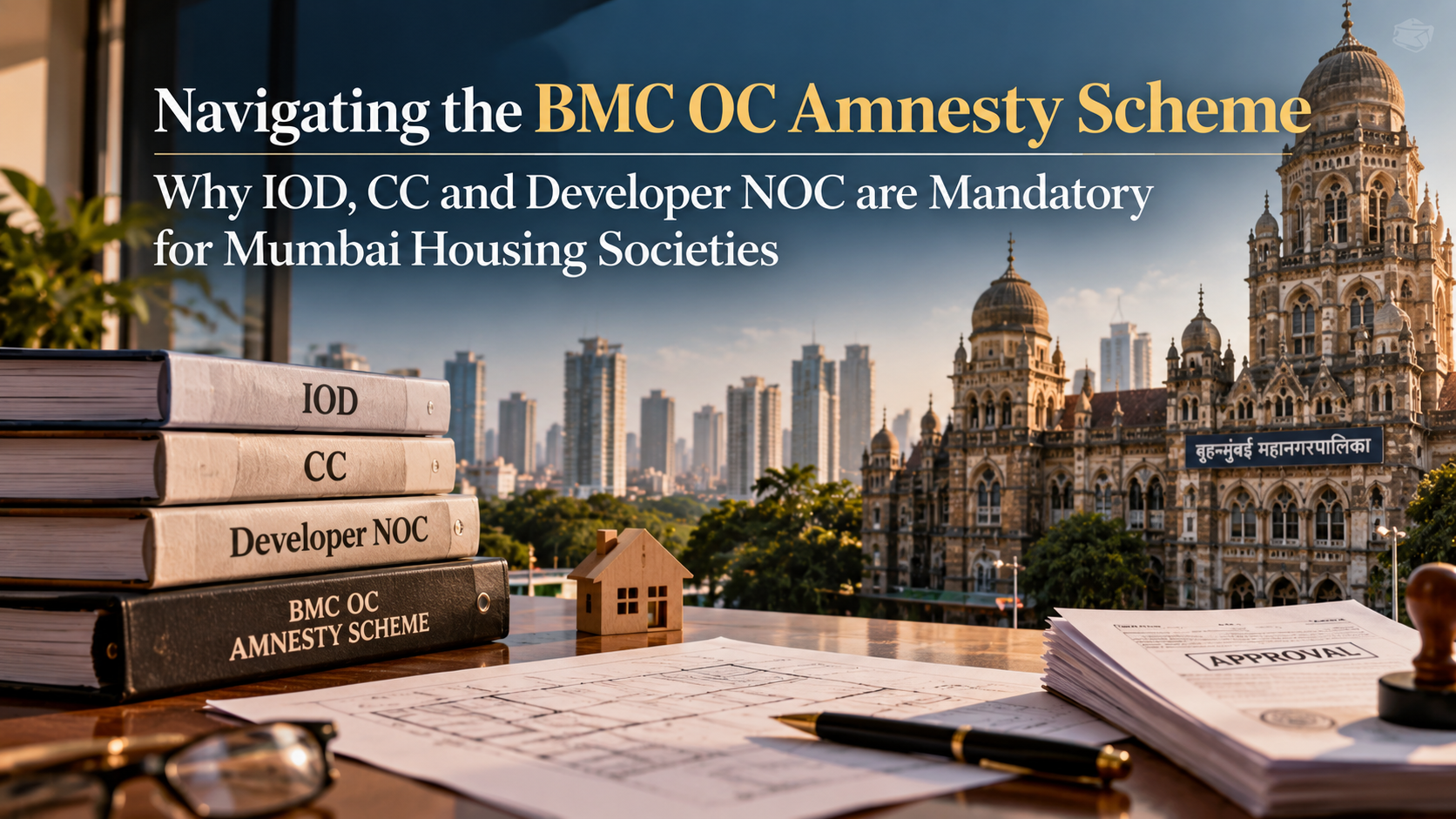
To establish the absolute authenticity of a building, the Standard Operating Procedure mandates that housing societies present the foundational paperwork linked to the original construction. An application submitted under the amnesty scheme will only be processed if it is backed by three critical documents.
First is the Intimation of Disapproval, widely known as the IOD. In Mumbai’s unique civic terminology, an IOD is essentially a conditional building permit. It states that the municipal corporation disapproves of the proposed construction unless the developer fulfills a long list of conditions. These conditions range from environmental clearances and fire safety norms to structural stability certificates. Securing an IOD is the first major milestone in any Mumbai real estate project.
Second are the formally approved building plans. These blueprints, stamped and sanctioned by the municipal town planning department, dictate the exact dimensions, layout, and structural limits of the building. The civic body needs these plans to verify whether the physical structure standing today matches what was originally permitted, allowing them to calculate regularisation fees for any minor, condonable deviations.
The third and most vital document is the Commencement Certificate. Often referred to as the CC, this is the official green light that allows a builder to break ground and begin actual construction. The CC is usually granted in stages, permitting construction up to a specific floor once previous conditions are met.
By insisting on a valid IOD, approved plans, and a CC, the municipal corporation is ensuring a foolproof filtering process. Only projects that were legally vetted at the time of conception are allowed to step through the amnesty doors.
While gathering the IOD and CC is a matter of digging through civic archives or society records, the scheme introduces another requirement that has left many housing societies deeply concerned. The application for the Occupancy Certificate must be accompanied by a No-Objection Certificate from the original developer, the property owner, or the entity holding the development rights.
From an administrative standpoint, the civic body’s demand makes sense. The municipal authorities want to ensure there are no overlapping legal claims, pending litigation, or unpaid municipal dues tied to the builder before they hand over the OC to the residents. However, on the ground, this requirement presents a monumental challenge.
Many of the buildings eligible for this scheme were constructed decades ago. Over the years, numerous development firms have gone bankrupt, dissolved, or simply vanished. In other cases, developers who are still active deliberately withhold the NOC, using it as leverage to extort exorbitant sums of money from desperate housing societies. Expecting ordinary residents to track down defunct builders or negotiate with hostile developers threatens to derail the very purpose of the amnesty initiative.
Anticipating the chaos the developer NOC requirement could cause, the civic authorities have baked a contingency plan into the Standard Operating Procedure.
If a housing society manages to gather its IOD, CC, and approved plans, but hits a brick wall regarding the developer’s NOC, they can still move forward. Upon receiving such an application, the municipal corporation will directly issue a formal notice to the original developer under the provisions of the Mumbai Municipal Corporation Act of 1888, demanding their compliance or an explanation for withholding consent.
Furthermore, the civic body recognises that simply sending notices to untraceable builders is a futile exercise. To permanently resolve this bottleneck, municipal authorities have written to the Maharashtra state government, proposing a formal amendment to the MMC Act. If passed, this amendment would grant the civic chief the discretionary power to entirely bypass the developer's NOC in genuine cases where the builder is absconding, defunct, or unreasonably withholding permission. This proposed legislative tweak is being viewed as a massive victory for consumer rights in the real estate sector.
Timing is everything when it comes to municipal relief schemes, and the Abhay Yojana is no exception. The amnesty is strictly time-bound and retroactive, targeting older legacy buildings that have suffered for years.
To be eligible, a housing society must prove that the building was fully occupied prior to November 17, 2016. The civic authorities have set this specific cut-off date to draw a line between older unregulated projects and modern developments that fall under the stringent oversight of the Real Estate (Regulation and Development) Act, which came into full force around the same era.
Proving occupancy is a straightforward process. Housing societies are required to submit historical documentary evidence, which can include municipal property tax receipts, electricity bills, or water bills generated before the November 2016 deadline. Buildings constructed and occupied after this date will have to follow the standard, more rigorous penal procedures for obtaining an OC, as they do not qualify for the current amnesty waivers.
The sheer scale of the Abhay Yojana makes it one of the most ambitious urban regularisation programs attempted in the city. Beyond just handing out certificates, the process has been modernised. Eligible societies and their appointed architects can submit their documentation through the Auto-DCR system, an automated online platform designed to fast-track real estate approvals and eliminate the bureaucratic delays traditionally associated with civic ward offices.
By offering heavy discounts on regularisation premiums and penalty waivers for the first few months of the scheme, the municipal corporation is actively incentivising compliance. This is a win-win scenario. The civic body stands to collect a massive influx of regularisation revenue, which can be redirected toward upgrading the city's infrastructure. Simultaneously, thousands of properties will be brought into the legal fold, finally giving homeowners absolute, undisputed legal title to the flats they paid for.
For housing societies currently living in the shadows of unauthorised occupancy, the path forward is clear but rigorous. The time for waiting is over. Managing committees must immediately begin the legwork of retrieving their original building plans, securing their Commencement Certificates, and rallying their residents. While the demand for a developer NOC adds a layer of friction, the civic body's proactive stance on issuing notices and seeking legislative amendments proves that the government is serious about clearing this backlog.
Ultimately, the OC amnesty scheme is not just about a piece of paper. It is about restoring the true financial value of thousands of homes, ending years of inflated municipal billing, and granting Mumbaikars the peace of mind they deserve.
