Published On:
June 2, 2026
Updated On:
June 2, 2026
An ultra-luxury apartment in Mumbai’s Oberoi Three Sixty West has been leased by Radhakishan Damani’s firm to the Sanjay Ghodawat Group for a record ₹27.5 lakh per month. This historic transaction underscores the meteoric rise of India’s premium residential rental market, matching the per-square-foot yields of prime corporate real estate.
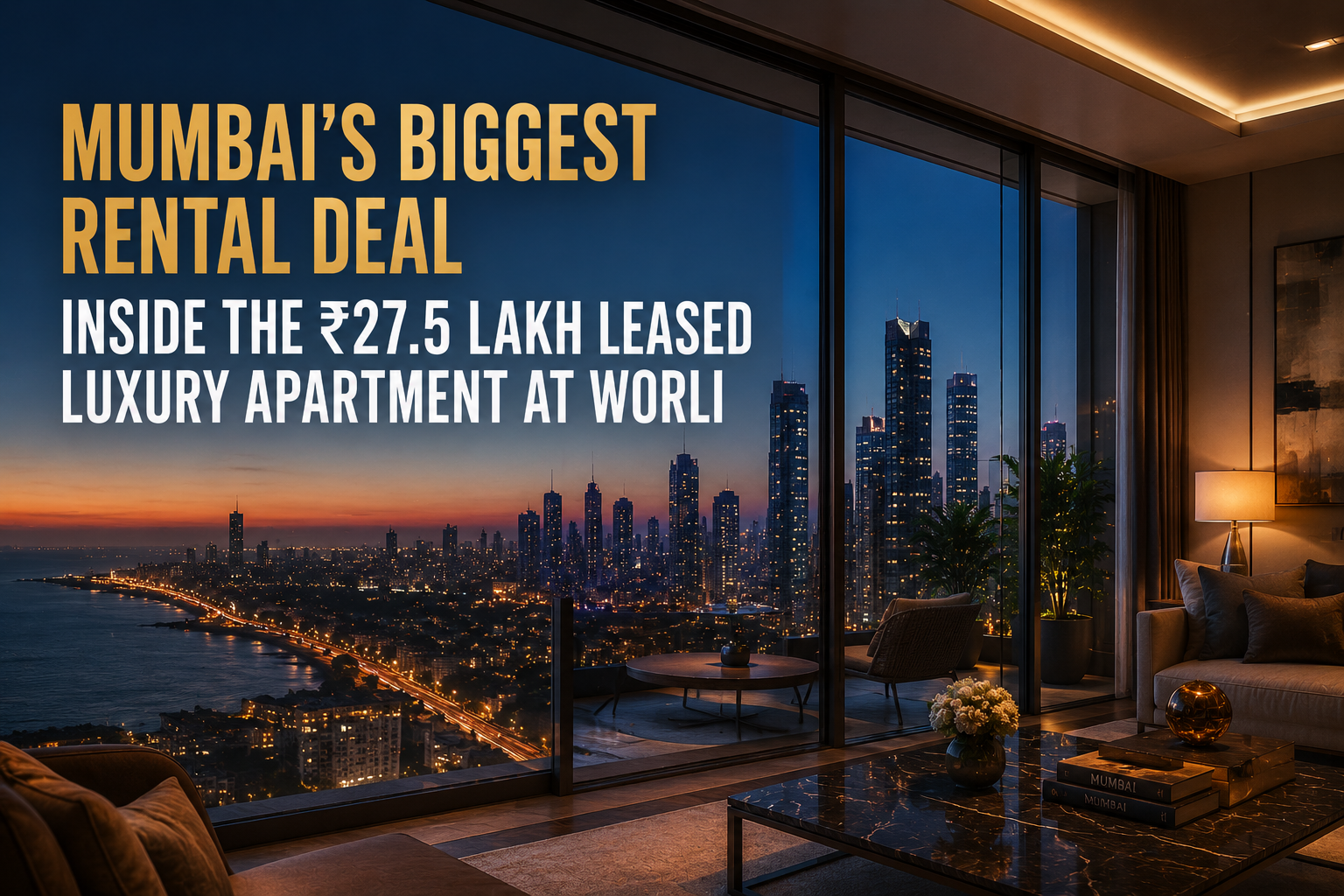
Mumbai’s real estate market has always possessed a flair for the dramatic, constantly pushing the boundaries of valuation, exclusivity, and sheer scale. However, recent developments in the city's ultra-luxury residential sector are rewriting the fundamental rules of property investment and leasing. A monumental transaction has recently captured the attention of market watchers, setting a completely new benchmark for residential rentals in the financial capital. An entity connected to retail billionaire Radhakishan Damani has leased a sprawling luxury apartment in Worli to a prominent corporate group for an astounding monthly rent of ₹27.5 lakh.
This transaction is far more than a simple tenancy agreement between two corporate heavyweights. It represents a definitive watershed moment for India's high-end property segment. Historically, astronomical rental figures were exclusively the domain of vast commercial office spaces in central business districts. Today, individual residences are commanding identical financial velocity, signalling a deep structural shift in how ultra-high-net-worth individuals and corporate entities view premium residential assets.
To truly understand the magnitude of this deal, one must look closely at the underlying numbers and the strict structuring of the lease. The property in question is a massive 6,831-square-foot apartment situated on a higher floor of the iconic Oberoi Three Sixty West development in Worli. The property was leased by Derive Trading and Resorts Private Limited, a firm where the DMart founder serves as a director, to One SGG Ventures LLP, a key operating entity of the Kolhapur-headquartered Sanjay Ghodawat Group.
The financial commitments outlined in the lease documentation are staggering. At ₹27.5 lakh per month, the base rent places this apartment among the most expensive residential leases ever executed in the country. But the financial depth of the agreement extends much further. The lease has been structured for a long-term tenure of five years and includes a standard five percent annual escalation clause. When factoring in this steady yearly increase, the total rental payout over the five-year period will comfortably exceed ₹18 crore.
Securing the property required a substantial upfront commitment, with a security deposit of ₹1.65 crore laid down by the tenant. The lease also grants the occupant exclusive access to four designated car parking spaces within the premium complex. Such long-term, high-value corporate leases provide immense stability and highly predictable yields for property owners, mimicking the cash flow reliability usually associated with Grade-A commercial real estate portfolios.
The physical setting of this transaction is just as significant as the financial terms. Three Sixty West has rapidly established itself as the most coveted residential address in Mumbai, effectively creating a new "Billionaires' Row" along the Arabian Sea. The project comprises two soaring towers on Dr. Annie Besant Road, integrating bespoke residential living with world-class hospitality, as one of the towers houses the luxurious Ritz-Carlton hotel while the other features residences managed by the same premium hospitality brand.
The development derives its name from its soaring height of approximately 360 metres and the sweeping, unobstructed west-facing views of the ocean. It was designed from the ground up to cater exclusively to the absolute upper echelon of Indian society. The floor plates are massive, with the project primarily offering expansive four and five-bedroom configurations, alongside sprawling duplexes and custom penthouses.
What sets this development apart is the sheer scale of wealth and influence concentrated within its walls. Capital values for apartments in this complex routinely range between ₹85 crore and ₹90 crore, heavily dependent on the floor level, the specific orientation, and the total square footage. The building has become a magnet for top-tier corporate executives, successful entrepreneurs, and leading figures from the entertainment industry, making it an incredibly exclusive vertical community. The complex has attracted heavyweights from the Indian film industry, with prominent actors securing massive duplexes and sprawling apartments. This celebrity influx adds a distinct layer of glamour to the address, driving up the aspirational value of the project and ensuring that the demand for any available rental unit remains exceptionally high.
The leasing of this specific apartment cannot be viewed in isolation; it is part of a much broader, highly aggressive real estate acquisition strategy executed by Radhakishan Damani and his associates. While the retail magnate is best known for building a phenomenally successful supermarket empire, his moves in the property market have been equally bold and heavily capital-intensive.
In early 2023, the market witnessed one of the most audacious bulk residential purchases in Indian history. The Damani family, along with close associates, acquired an astonishing 28 luxury apartments within the Three Sixty West project. This massive block purchase was executed for a total consideration of over ₹1,200 crore. The total carpet area absorbed in this single transaction amounted to over 1.8 lakh square feet.
This acquisition was not merely a random investment but a highly calculated move that provided a crucial financial lifeline to the initial partners involved in the project, allowing them to clear substantial debt obligations. This demonstrates how ultra-high-net-worth individuals possess the capital density to act as true market makers, influencing the financial stability of massive developments. By holding such a significant portion of a single prime asset, the investors command immense pricing power, effectively controlling the supply of available rental units within the tower and setting the absolute benchmark for lease negotiations.
Furthermore, this aggressive acquisition strategy extends beyond this single building. Over the past few years, investments linked to the billionaire have spanned multiple major Indian cities, securing prime land parcels, massive retail spaces, and premium residential assets across Mumbai, Thane, Pune, Bengaluru, and Hyderabad. The leasing of the Worli apartment is a clear demonstration of how these aggressively acquired assets are now being rapidly monetised to generate formidable, high-yielding passive income.
One of the most fascinating aspects of this ₹27.5 lakh monthly rental is what it reveals about the shifting economics of property yields in Mumbai. Breaking down the numbers, the rental value of this apartment translates to approximately ₹400 per square foot per month.
In the Indian real estate context, achieving ₹400 per square foot is a massive milestone. Historically, this pricing velocity was strictly reserved for the most premium, Grade-A commercial office spaces in highly sought-after business districts like the Bandra Kurla Complex or Nariman Point. The fact that an individual, privately held residential home can command the exact same per-square-foot premium as a corporate headquarters is a profound shift.
Achieving commercial-grade yields on residential property completely upends traditional portfolio management theory. Typically, wealth managers advise clients to expect a modest two to three percent rental yield from residential properties in India, relying almost entirely on long-term capital appreciation for real returns. However, when a residential asset begins generating substantial, immediate cash flow that mirrors a corporate office building, it becomes an incredibly potent wealth preservation tool. This high yield, combined with the inherent capital appreciation of a sea-facing Worli property, creates an unmatched dual-return mechanism that is drawing deep-pocketed investors away from traditional commercial investments.
The profiles of the entities involved in this transaction highlight a growing trend where ultra-luxury residential leasing is increasingly functioning as a sophisticated business-to-business transaction. The landlord operates as an investment vehicle for immense private wealth. On the other side of the agreement, the tenant operates as a key arm of a massively diversified conglomerate.
The Sanjay Ghodawat Group commands deep business interests spanning aviation, energy, consumer goods, education, textiles, and real estate. For conglomerates of this scale, leasing ultra-luxury properties in the heart of Mumbai's financial and cultural districts serves several highly strategic purposes. These sprawling apartments are frequently utilised as high-end guest houses for visiting international delegates, elite accommodation for top-tier C-suite executives, or dedicated spaces for hosting highly private, exclusive corporate gatherings.
Entering into a long-term, five-year lease provides the corporate tenant with stability and a prestigious address without the immense capital lock-up required for a direct purchase. For a business group, deploying ₹90 crore to buy the apartment outright might not represent the most efficient use of capital, especially when those funds could be reinvested into core business operations, manufacturing expansion, or debt reduction. Renting the property for ₹27.5 lakh a month, therefore, becomes a highly calculated, capital-efficient operational expense.
The location of this record-breaking lease is no coincidence. Over the past two decades, Worli has undergone a spectacular urban metamorphosis, transitioning from an industrial hub dominated by sprawling textile mills into the absolute epicentre of Mumbai’s wealth.
Worli’s primary advantage has always been its geography. It sits perfectly at the nexus between the historic wealth and colonial charm of South Mumbai and the aggressive corporate energy of the northern suburbs and the Bandra Kurla Complex. The operationalisation of the Bandra-Worli Sea Link and the ongoing coastal road infrastructure drastically altered the neighborhood’s connectivity, making it the most strategically located micro-market for business leaders who need seamless access to both the airport and the traditional financial districts.
Developers recognized this geographical goldmine early on and began acquiring defunct mill lands to construct towering, hyper-luxurious residential complexes. Today, the Worli skyline is defined by these architectural marvels, offering expansive sea views and world-class amenities. The concentration of wealth in this specific pin code has created a self-sustaining ecosystem of exclusivity. High-profile buyers actively seek properties here not just for the physical building, but for the immense social capital and networking opportunities that come from sharing elevator banks with industry titans and financial heavyweights.
This transaction also shines a bright light on a broader behavioural shift among high-net-worth individuals and large corporate houses: a growing preference for renting ultra-luxury homes rather than purchasing them.
While it might seem counterintuitive that individuals or companies capable of paying nearly ₹3 crore in annual rent wouldn't simply buy the property, the financial logic is incredibly robust. Purchasing a property valued near the ₹100 crore mark in Mumbai involves massive friction costs. Stamp duty, registration charges, and complex taxation can easily add several crores to the final acquisition price before the buyer even turns the key. Furthermore, tying up that level of capital in a highly illiquid, single physical asset severely limits financial agility.
By choosing to rent, high-net-worth individuals and corporate entities maintain total capital liquidity. They can direct their massive financial resources into high-growth business ventures, private equity, or more diversified asset portfolios that generate returns far exceeding residential capital appreciation. Renting also offers unparalleled flexibility. As business needs evolve, team sizes change, or lifestyle preferences shift, a tenant can simply conclude their lease and move to a newer development, whereas offloading an ultra-luxury asset on the secondary market can take months, if not years, to find the right buyer.
The implications of a ₹27.5 lakh monthly rental deal extend far beyond the borders of Worli. It serves as a powerful confidence booster for the broader Indian luxury real estate market. Developers operating in other major metropolitan areas like the National Capital Region, Bengaluru, and Hyderabad are closely monitoring these Mumbai benchmarks to understand the upper limits of tenant spending power.
This level of tenant willingness to pay extraordinary premiums validates the strategy of building heavily amenitised, large-format residential projects. Developers are realizing that the modern wealthy buyer or renter is completely uncompromising. They demand massive floor plates, total privacy, private elevators, integrated smart home technology, and hospitality-grade services managed by international hotel chains.
The success of the Worli project has emboldened developers to export this highly successful ultra-luxury model to other rapidly growing markets. Prominent developers are actively evaluating plans to launch similarly positioned flagship projects in the National Capital Region, specifically targeting the affluent buyer base in Gurugram. By introducing the concept of branded, massive-scale luxury living to new geographies, the real estate sector is actively attempting to recreate the Mumbai magic nationwide. These upcoming projects are expected to feature similar pricing strategies, commanding significant premiums per square foot and setting entirely new benchmarks for their respective cities.
The Indian real estate market has officially entered an era where premium residential homes are evaluated with the exact same financial rigor as prime commercial assets. A home is no longer just a place to live; at the absolute top end of the market, it is an incredibly powerful financial instrument, a calculated corporate utility, and the ultimate symbol of arrival. This historic Worli transaction is not an anomaly; it is the definitive blueprint for the future of ultra-luxury real estate in the country.
