Published On:
July 26, 2026
Updated On:
July 26, 2026
The Maharashtra Real Estate Regulatory Authority has established that homebuyers can demand a full refund for undelivered project amenities like a clubhouse if the developer fails to build them within a reasonable timeframe post-possession.
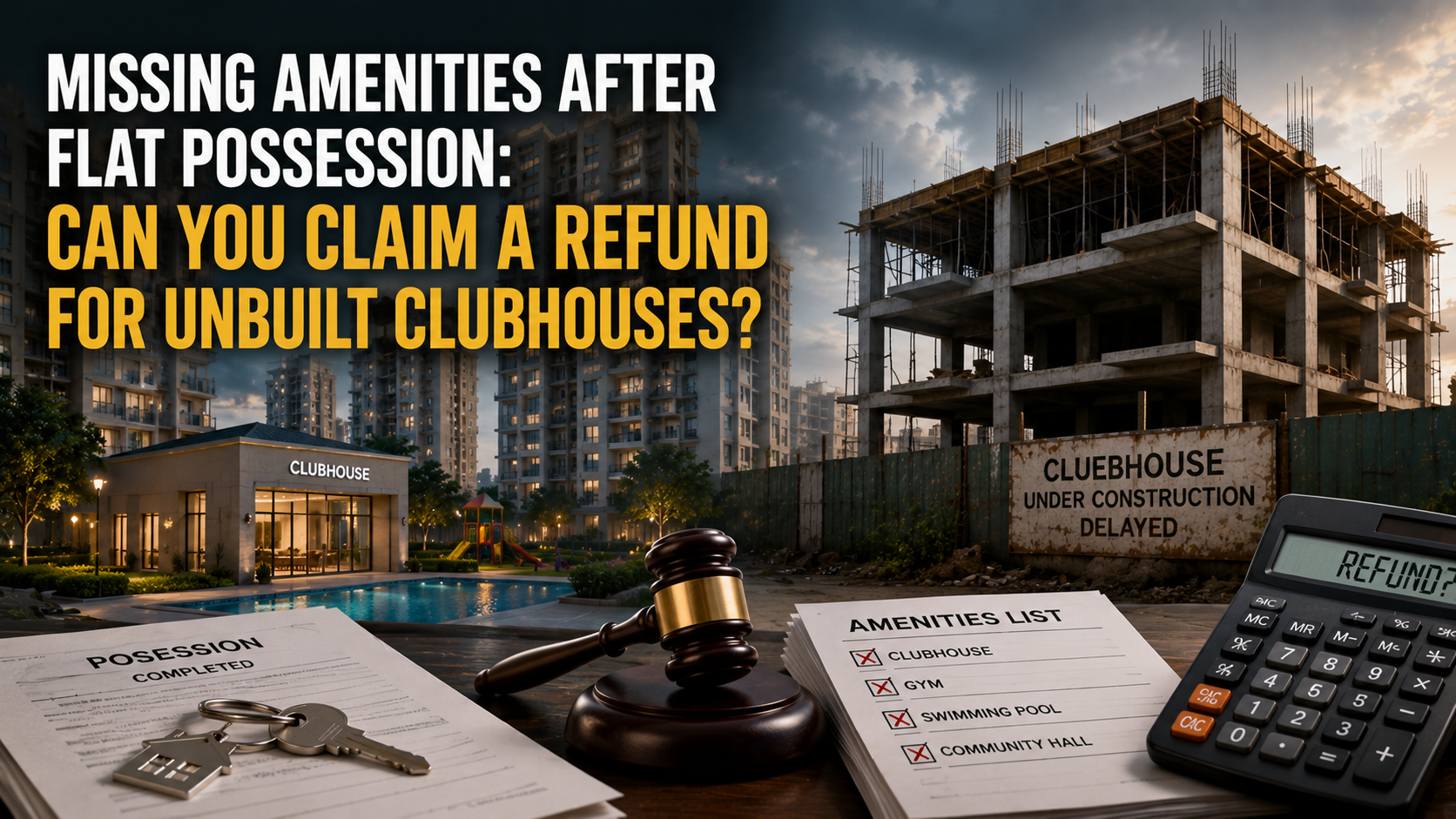
Taking possession of a new home is one of the most rewarding milestones in a homebuyer’s life. After years of paying monthly mortgage installments, tracking construction updates, and finalizing legal documentation, moving into your apartment feels like the ultimate victory. However, that excitement quickly sours when you look around the residential complex and realize that key elements of the promised lifestyle are missing.
It is an all-too-common reality in urban real estate: you receive the keys to your flat, but the sprawling clubhouse, swimming pool, or gymnasium showcased in the glossy sales brochures remains a dusty, undeveloped patch of land. Developers frequently collect substantial upfront fees—often running into lakhs of rupees—under heads like clubhouse membership, amenity development, or advance facility charges during the possession process. Years pass, families settle into their routines, yet the promised recreational space is nowhere to be seen.
This leads to a critical legal and financial dilemma for property owners. Once you have accepted the physical keys to your apartment and started living in the building, do you still have legal recourse to demand your money back for an undelivered amenity? A recent, landmark ruling by the Maharashtra Real Estate Regulatory Authority provides definitive clarity on this issue, establishing a vital precedent for homebuyer rights across the country.
The issue of delayed or abandoned amenities was put to the test when a homebuyer in a Mumbai residential project approached the real estate regulatory authority seeking justice. The homebuyer had purchased an apartment, executed the agreement for sale, and successfully taken physical possession of the property. During the possession process, the developer collected a lump-sum amount of five lakh rupees specifically earmarked as clubhouse membership charges.
More than six years elapsed following the handover of the flat, yet the developer failed to construct the clubhouse or provide residents with any access, membership rights, or recreational benefits. The buyer, realizing that a significant portion of their hard-earned money was being retained without any service delivered in return, filed a formal complaint requesting a full refund of the five lakh rupees along with accrued interest.
In its defense, the real estate developer presented arguments commonly heard in large-scale housing developments. The builder contended that the project in question was merely one phase of a much larger, multi-phase integrated redevelopment scheme. According to the developer, the proposed clubhouse was envisaged as a centralized, common amenity meant to serve the entire larger layout, rather than being exclusive to that single building phase. They argued that constructing the clubhouse depended on achieving substantial completion across the broader layout, and therefore, collecting the charges at possession was completely aligned with the contractual arrangement.
The regulatory authority meticulously evaluated the arguments and scrutinized the registered agreement for sale. The authority observed that while the agreement did not lay out a rigid, day-by-day construction schedule for the clubhouse, it explicitly recognized the facility as an integral part of the development plan. Crucially, the agreement included a specific clause stating that if the promoter failed to construct the clubhouse within five years from the execution date, the collected membership fee would be returned to the buyer.
Recognizing that the builder had far exceeded a reasonable timeframe without delivering the facility, the authority ordered the developer to refund the entire five lakh rupees to the homebuyer within sixty days. However, adhering strictly to the specific terms outlined in the sale contract, the regulatory body declined to award interest on the amount, as the signed agreement expressly stated that any eventual refund of clubhouse fees would be processed without interest. This ruling sends an unmistakable message to the real estate sector: promoters cannot indefinitely hold onto funds collected for facilities that exist only on paper.
To understand why this decision is so impactful, one must look at how property law treats project amenities. Before the introduction of the Real Estate (Regulation and Development) Act of 2016, buyers had very little leverage when builders reneged on peripheral promises. Developers frequently treated clubhouses, sports courts, and landscaped gardens as secondary add-ons that could be delayed indefinitely or modified without consequence.
The enactment of real estate regulation fundamentally changed this dynamic by legally binding a developer to the sanctioned layout plans and promises made at the time of booking. Under the regulatory framework, an amenity is not a discretionary bonus; it is a contractual component of the asset you purchased.
When a developer registers a project with the state real estate authority, they are legally required to upload the sanctioned site plans, layout approvals, and a detailed list of common facilities. Section 11 of the governing act mandates that the promoter must strictly adhere to these approved plans. If a clubhouse or community hall is marked on the sanctioned layout submitted to the government, it becomes a legally enforceable promise.
Section 12 of the regulatory act goes a step further by protecting buyers from false representations. If an individual advances money based on statements made in a prospectus, model flat display, or marketing brochure, and the developer subsequently fails to deliver those features, the promoter is legally liable to compensate the buyer. A missing clubhouse that was actively used as a selling point is classified as a failure of representation, giving the buyer clear grounds to seek financial redressal.
A major loophole that developers historically exploited was omitting specific completion dates for common amenities in the agreement for sale. While the flat delivery date was clearly stated, the clubhouse timeline was left intentionally vague.
Legal precedents have systematically closed this loophole. Courts and regulatory tribunals have established that in the absence of an explicit contractual deadline, an obligation must be fulfilled within a reasonable period. Allowing six years to pass after handing over physical apartments without pouring a single column for a promised clubhouse easily breaches the threshold of reasonable time.
Understanding why builders stall the construction of common facilities helps buyers anticipate potential red flags in their own housing projects. In multi-phase developments, delaying amenities is rarely accidental; it is often a calculated financial and logistical decision by the developer.
One primary reason is capital allocation. During the active phase of a project, developers face intense pressure to finish individual residential towers to meet flat delivery deadlines, avoid heavy interest penalties for delayed possession, and unlock final buyer payments. Consequently, construction capital and labor are diverted entirely toward the residential units, while non-generating assets like clubhouses and swimming pools are pushed to the back burner.
In larger, phased township developments, land allocation creates another major hurdle. The plot of land designated for the central clubhouse might sit in an area currently occupied by temporary site offices, labor camps, material storage yards, or transit accommodations for existing land occupants. Until subsequent phases are cleared and constructed, the physical footprint for the clubhouse remains blocked.
Furthermore, builders often prefer to construct the clubhouse at the very end of a master plan so that it can be marketed as a brand-new, modern selling point for the final, most expensive residential phases. While this strategy serves the developer's sales pipeline, it leaves the early buyers living on a construction site for years without the lifestyle features they paid for upfront.
Recognizing that vague amenity timelines were generating endless disputes, real estate regulatory bodies have taken aggressive steps to enforce transparency right at the booking stage.
In recent regulatory updates, authorities made it mandatory for real estate developers to explicitly disclose the exact completion dates for all common facilities and amenities in the project layout. When a developer registers a project or launches a new phase today, they cannot simply state that a clubhouse will be provided in the future. They are legally required to publish a clear timeline specifying when each specific facility—whether it is a community hall, children's play area, or swimming pool—will be completed and handed over to the residents' welfare association.
This mandatory clause is non-negotiable and forms a permanent part of the standard agreement for sale. For prospective homebuyers, this regulatory shift provides a powerful tool during the purchase process, allowing them to track amenity deadlines with the same legal precision used for tracking flat possession dates.
If you are planning to purchase a flat or are currently waiting for promised amenities in a recently completed project, taking a proactive approach can save you from years of frustration and financial loss.
Before signing any binding property contract, carefully review the fine print regarding common amenities. Ensure that the agreement includes a dedicated section listing every promised facility. Check if there is a specific date assigned for the handover of the clubhouse. Pay special attention to refund clauses: does the contract specify what happens if the amenity is delayed? Is there a provision for returning your money if the facility is not built within a set period?
Never rely solely on glossy sales brochures or verbal assurances from real estate agents. Visit your state's official real estate regulatory website and search for the project using its registration number. Download the approved layout plans and review the declared completion schedule for common areas. If the developer's online filings do not list a clubhouse, or if the timeline extends decades into the future, treat it as a major warning sign.
Always demand itemized receipts for every charge levied by the developer during the purchase and possession process. If the developer collects a specific fee for clubhouse membership, advance facility usage, or amenity development, ensure that the receipt explicitly states that description. Avoid lump-sum, unclassified payments. These official, itemized receipts serve as concrete evidence if you ever need to file a claim for a refund before a regulatory tribunal.
If you have taken possession of your flat and notice that the promised amenities are making zero progress, start building a documented paper trail. Take time-stamped photographs of the site designated for the clubhouse. Send formal written inquiries to the developer's customer care team asking for construction updates and official completion dates. Keep a meticulous record of all email exchanges, as these documents will prove that you actively raised the issue and that the builder repeatedly defaulted on their commitments.
The real estate landscape is shifting decisively toward consumer accountability. The era where developers could treat project amenities as optional, decorative promises in a sales pitch has come to an end.
If you have taken possession of your flat and find yourself waiting indefinitely for an unbuilt clubhouse, you are not powerless. As established by recent regulatory precedents, developers do not have a legal right to retain your money for services they have failed to provide within a reasonable timeframe. By understanding your contractual rights, leveraging state regulatory mechanisms, and demanding absolute transparency, you can ensure that your real estate investment delivers not just four walls, but the complete, uncompromised lifestyle you were promised.
