Published On:
January 29, 2026
Updated On:
January 30, 2026
The Uttar Pradesh government has expedited land acquisition for the 76-km Bulandshahr Link Expressway. This new greenfield corridor will connect the Yamuna Expressway to the Ganga Expressway, reducing travel time between Meerut and Noida International Airport to just 45 minutes and triggering a massive real estate boom in the region.
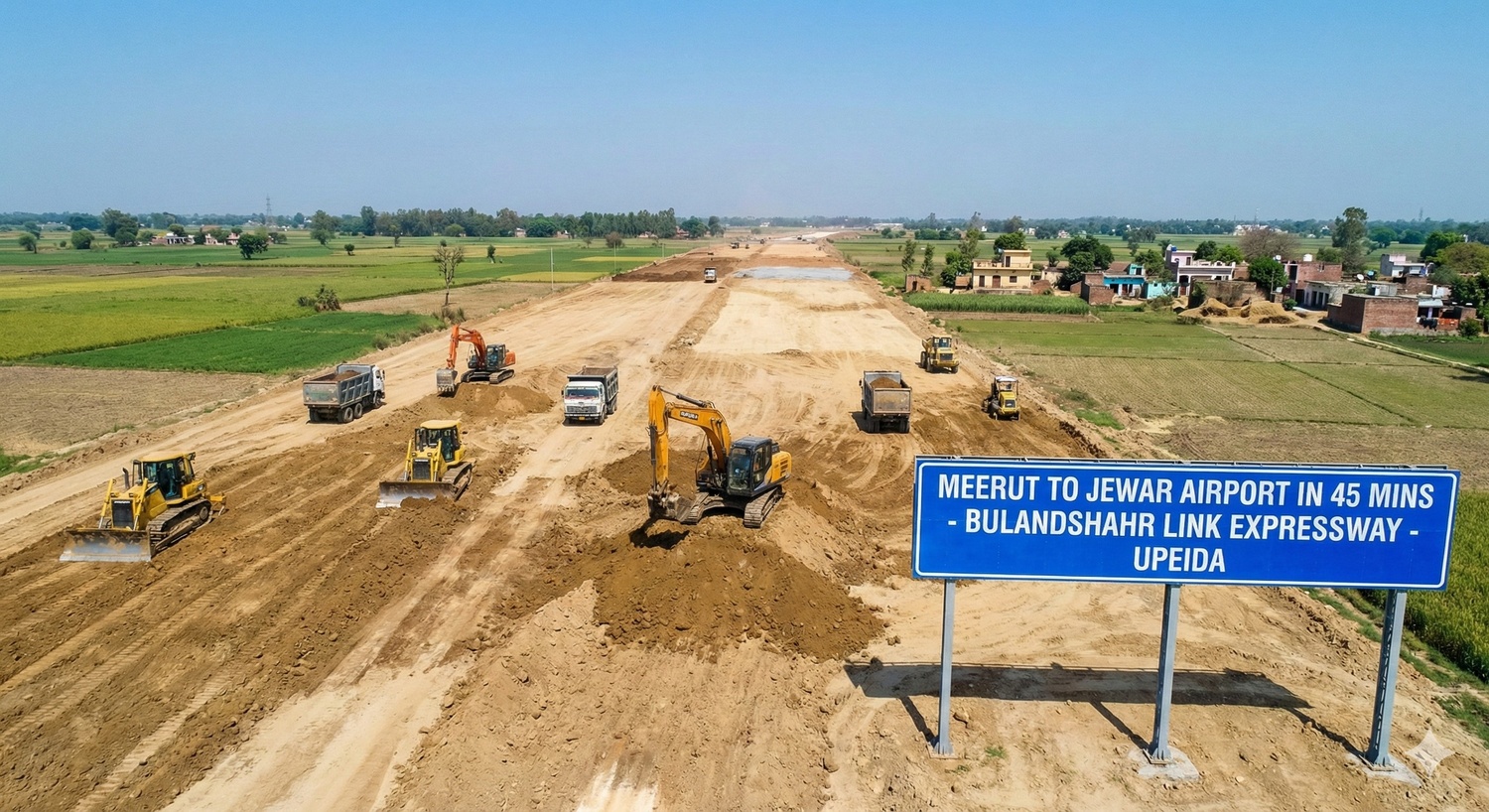
The infrastructure landscape of Uttar Pradesh is witnessing a transformation that is nothing short of a revolution. For years, the narrative of development in the region has been dominated by isolated pockets of growth—Noida thriving on one end, and historic cities like Meerut and Bulandshahr developing at their own pace on the other. However, a massive shift is currently underway, one that promises to stitch these isolated hubs into a seamless economic corridor.
The latest catalyst in this story is the "Bulandshahr Link Expressway," a project that has moved past the drawing board and into a decisive execution phase as of January 2026. This is not just another road project; it is the final piece of a puzzle that connects the mighty Ganga Expressway with the Yamuna Expressway, effectively creating a "Golden Triangle" of high-speed connectivity centered around the upcoming Noida International Airport in Jewar.
With the state government fast-tracking land acquisition and allocating significant funds, the promise is bold but tangible: a journey from Meerut to Jewar, which currently demands a grueling 2.5 hours of navigating congested local highways, will soon be a breezy 45-minute drive. This blog delves deep into the mechanics, the economics, and the future impact of this game-changing infrastructure project.
At its core, the Bulandshahr Link Expressway is a 76-kilometer Greenfield project. The term "Greenfield" is significant here—it means the road is being built from scratch on land that has never been used for infrastructure before. Unlike "Brownfield" projects that widen existing roads and often face bottlenecks from encroachments and existing traffic, a Greenfield expressway offers the luxury of modern engineering, straighter alignments, and higher speed limits from day one.
Designed as a high-speed corridor, this 6-lane highway (expandable to 8 lanes) is engineered for a top speed of 120 km/h. It is strictly access-controlled, meaning local traffic, tractors, or cattle will not impede the flow of high-speed vehicles. The engineering focus is on safety and speed, mirroring the standards set by the Yamuna Expressway.
The route has been meticulously planned to serve as a bridge between two of India’s most critical infrastructure arteries:
As of early 2026, the project has hit a critical milestone: land acquisition. Infrastructure projects in India often stall at this stage, but the Bulandshahr Link Expressway is moving at a blistering pace. The state government has signaled its intent by allocating approximately ₹1,246 crore in the supplementary budget specifically for this purpose.
The acquisition covers a vast swathe of land across 56 villages. The geographical split is heavily tilted towards the Bulandshahr district, which accounts for 48 of these villages, while the remaining 8 fall under the Gautam Buddh Nagar district. This distribution highlights the project's dual role: while it benefits the airport in Gautam Buddh Nagar, its primary economic impact will likely be unlocking the potential of Bulandshahr’s rural belt.
To prevent delays and litigation, a generous compensation model has been adopted. Farmers are being offered a 25% premium on market rates to encourage voluntary land handover. The deadline for completing this acquisition is set for March 2026, a tight timeline that underscores the administration's urgency to have this link operational by the time the Jewar Airport enters its second phase of expansion in 2027.
The headline benefit of this project is the reduction of travel time between Meerut and Jewar to 45 minutes. But to understand the true impact, one must look beyond the convenience of a shorter commute.
Time is currency in logistics. Currently, cargo trucks moving from the industrial hubs of Meerut, Haridwar, or even Uttarakhand have to navigate the congested NH-334 or take long detours to reach the cargo terminals at Jewar Airport. This new link acts as a "freight superhighway." Perishable goods from Western UP’s agricultural belt can be transported to the airport's cargo hold in under an hour, significantly reducing spoilage and transport costs.
For decades, traffic from Western UP heading towards Agra or Mathura had to invariably pass through or skirt the edges of Delhi and Ghaziabad, adding to the NCR’s notorious pollution and gridlock. By providing a direct diagonal cut from Meerut to Jewar, this expressway allows traffic to bypass the Delhi-Meerut Expressway (NH-9) and the Eastern Peripheral Expressway entirely. It creates a dedicated bypass for airport-bound traffic, relieving pressure on the existing arterial roads of the National Capital Region.
The link facilitates a seamless tourism circuit. A traveler landing at Jewar Airport can now head to the holy sites of Garhmukteshwar or further east to Prayagraj via the Ganga Expressway without facing the friction of city traffic. This ease of access is expected to boost religious and heritage tourism significantly.
The announcement of infrastructure is almost always followed by a surge in real estate speculation, and the Bulandshahr-Jewar belt is currently witnessing a "land rush."
The YEIDA BoomThe immediate beneficiaries are the sectors of the Yamuna Expressway Industrial Development Authority (YEIDA), specifically Sectors 22D, 28, and 29. These areas, already buzzing due to the airport, are now seeing a secondary wave of appreciation. Investors realize that these sectors are no longer just "near the airport" but are now the "crossroads" of Uttar Pradesh, connected to every major city in the state via the expressway grid. Market reports suggest property prices in these specific pockets have appreciated by 30% to 40% in the last year alone.
Awakening BulandshahrHistorically, Bulandshahr has been a tier-2 real estate market, overshadowed by its flashy neighbors like Noida and Ghaziabad. This expressway changes the equation. Towns like Siyana and Khurja are suddenly viable locations for warehousing, logistics parks, and affordable housing townships. With the commute to the airport reduced to minutes, these towns offer a low-cost living alternative for the workforce that will power the Jewar industrial ecosystem. We are already seeing large land parcels being aggregated by developers anticipating a demand for "logistics cities" along this corridor.
The vision for this expressway extends beyond moving people; it is about moving the economy. The connectivity it provides is the backbone for several mega-industrial projects currently in the pipeline:
As we look at the timeline, the next 12 to 18 months are crucial. With the land acquisition deadline of March 2026 looming, the focus will shift rapidly to the tendering process for civil construction. The major earthworks and paving are expected to commence by mid-2026.
If the construction pace of the Ganga Expressway is any indicator, we can expect this link to be operational by late 2027. This timing is intentional. It aligns perfectly with the operational scaling of the Noida International Airport. The government’s master plan is clear: by the time the airport hits its stride with millions of passengers and tons of cargo, the road network must be ready to support it.
The Bulandshahr Link Expressway is more than just 76 kilometers of asphalt; it is a symbol of a mature infrastructure mindset. It represents a shift from "building roads" to "building networks." By bridging the gap between Meerut and Jewar, the state is effectively shrinking distances, not just in kilometers, but in economic opportunity.
For the farmer in Siyana, the trader in Meerut, and the global investor in Jewar, this expressway opens up new horizons. As the heavy machinery rolls into the fields of Bulandshahr later this year, it brings with it the promise of a connected, faster, and more prosperous Western Uttar Pradesh. The days of the 3-hour ordeal are numbered; the era of the 45-minute sprint is about to begin.
