Published On:
May 3, 2026
Updated On:
May 3, 2026
The Uttar Pradesh Housing and Development Board has approved a monumental ₹4,173 crore budget featuring a massive ₹4,500 crore land acquisition drive to develop highly integrated, modern townships in Varanasi and Mau. This strategic urban expansion is designed to curb unplanned city growth, meet surging residential demand, and aggressively propel the state toward its trillion-dollar economy vision.
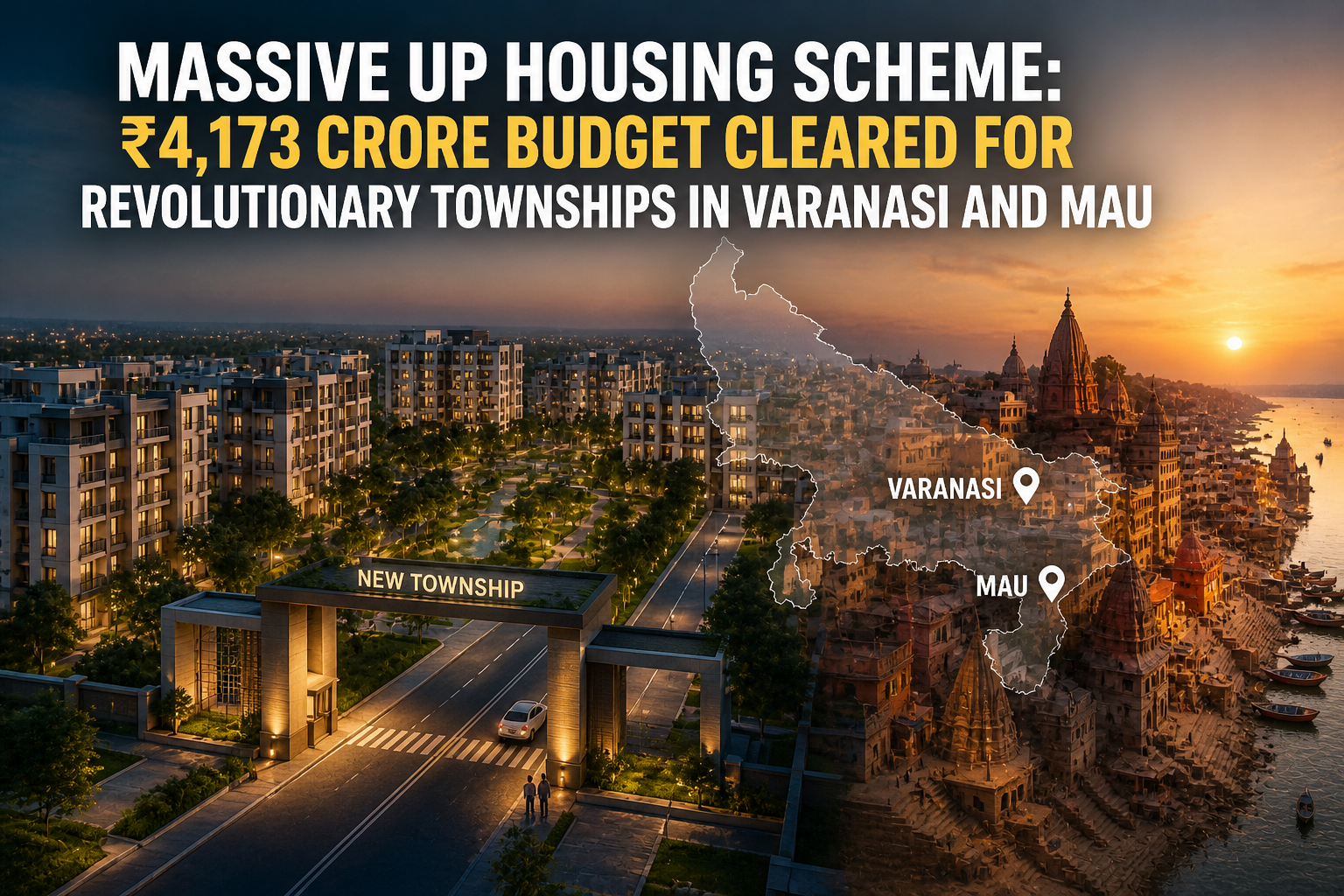
Uttar Pradesh is currently undergoing an unprecedented urban and economic transformation. As the state aggressively chases its ambitious target of becoming a trillion-dollar economy, real estate and regional infrastructure development have taken absolute center stage. Recognizing the critical need for well-structured urban spaces to seamlessly support this rapid economic surge, the state’s primary housing and development authority has officially rolled out a monumental financial blueprint. A massive ₹4,173 crore budget has been formally cleared for the upcoming fiscal year, setting off a wave of eager anticipation across the northern real estate sector.
However, the most headline-grabbing aspect of this comprehensive fiscal roadmap is the staggering ₹4,500 crore allocated explicitly for an aggressive land acquisition drive. Moving away from the traditional focus on established metropolitan hubs like Lucknow and Noida, the government has decisively locked its crosshairs onto the rapidly growing eastern regions of the state, with the primary focus resting heavily on Varanasi and Mau. This initiative aims to completely reshape the residential and commercial real estate landscape of Eastern Uttar Pradesh, setting a new benchmark for tier-two and tier-three urban expansion in India.
Understanding the sheer scale of this new UP housing scheme requires a close look at the fiscal strategies underpinning the announcement. The newly approved ₹4,173 crore budget represents a highly calculated shift toward creating high-growth geographic zones. Historically, housing boards have struggled with balancing the initiation of new development projects against the burden of completing existing ones. This time, the fiscal roadmap finalized by senior housing officials prioritizes a dual approach: aggressively finishing ongoing residential developments while simultaneously acquiring massive land banks for future townships.
The financial architecture of this plan is built on smart debt management and the strategic liquidation of existing assets. A significant portion of the planned expenditure will be comfortably offset by generating revenue from the sale of the board's current unsold property inventories. By actively pushing existing residential and commercial units into the market, the state plans to organically reinvest this capital back into the broader housing ecosystem. This cyclical economic model ensures that the board remains a highly credible and financially stable entity, capable of servicing its existing loan obligations without slowing down its expansion momentum.
Furthermore, this multi-crore capital injection is expected to act as a massive catalyst for the regional economy. Large-scale township projects require immense logistical support, raw materials, and manpower. Consequently, the expenditure is projected to heavily stimulate the local construction sector, creating thousands of direct and indirect employment opportunities ranging from skilled engineering positions to daily wage labor, thereby providing a substantial boost to the grassroots economy.
It is no surprise that Varanasi is the primary target for this massive land acquisition investment. As one of the world's oldest continuously inhabited cities, Varanasi has always been a global center for spiritual tourism. However, recent years have witnessed an absolute explosion in the city's economic and demographic profile. Driven by major infrastructure overhauls, most notably the highly successful Kashi Vishwanath Dham corridor and massive upgrades to local transit networks, the city is experiencing a sustained surge in domestic and international footfall.
This rapid transformation from a purely cultural heritage site to a bustling, modern economic powerhouse has naturally led to a severe housing deficit. The city's ancient, densely packed urban core simply cannot accommodate the massive influx of new residents, hospitality staff, corporate professionals, and investors looking to capitalize on the tourism boom. This has triggered a sharp, immediate demand for highly planned, modern residential colonies located just outside the traditional city limits.
Through the newly allocated funds, the government intends to build entirely self-sustaining, comprehensive townships in Varanasi. These are not merely standard housing blocks; the vision encompasses holistic urban environments equipped with premium, modern amenities. The blueprints involve creating vast networks of significantly wider roads to prevent the traffic bottlenecks that plague older neighborhoods. Planners are also prioritizing massive expanses of green spaces, public parks, and dedicated commercial zones so that residents have immediate access to retail spaces, healthcare, and entertainment without having to commute into the congested city center. This approach ensures that the historical sanctity of ancient Varanasi is beautifully preserved while seamlessly offering a modern, world-class standard of living on its immediate periphery.
While the investments in Varanasi are driven by immediate, overwhelming demand, the heavy financial focus on Mau represents a masterclass in proactive urban planning. Often overshadowed by its larger, more famous neighbors, Mau is currently being systematically built up to serve as a major, highly efficient backup city for the region.
In the realm of modern urban development, the concept of a satellite or backup city is incredibly crucial. When a primary hub like Varanasi experiences explosive economic growth, it naturally attracts a massive influx of rural-to-urban migrants. If left unchecked, this migration inevitably leads to the total collapse of civic amenities and the dangerous rise of unauthorized, deeply congested slums. By aggressively acquiring land and pouring infrastructure investments into Mau right now, the government is preemptively absorbing this demographic shockwave.
The strategy is clear: develop Mau into a highly attractive, fully functional urban center that offers excellent living standards and robust employment opportunities. By doing so, the state can effectively distribute the population load, preventing Varanasi from buckling under the pressure of its own success. This long-term foresight guarantees that middle-class families are not completely priced out of the real estate market. The development in Mau is specifically designed to ensure that standard, high-quality housing remains financially accessible to everyday citizens, fostering a highly stable, deeply rooted local community.
One of the most insidious threats to developing economies is the rapid spread of unplanned urban sprawl. When city populations outpace authorized housing projects, unregulated developers and land mafias often step in, carving up agricultural land into messy, illegal colonies completely lacking in basic civic necessities like proper sewage, paved roads, or reliable electricity.
The ₹4,500 crore land acquisition push is a direct, aggressive countermeasure against this phenomenon. By securing massive tracts of land legally and early in the development cycle, the state government is fundamentally taking control of the urban narrative. This preemptive land grabbing completely sidelines unauthorized developers, ensuring that all future city growth occurs strictly within the boundaries of a legally sanctioned, highly regulated master plan.
When the housing board develops these newly acquired zones, the infrastructure is laid down long before the first brick of a house is even placed. This means that future residents of these townships will not have to endure years of waiting for basic municipal connections. It represents a total paradigm shift from reactive city management—where authorities scramble to provide water and roads to already populated illegal colonies—to proactive, highly intelligent city building.
A truly world-class urban development scheme cannot simply cater to the affluent or the middle class; it must be inherently inclusive. The recent budgetary approvals heavily reflect this crucial social responsibility. Woven seamlessly into the grand design of these new townships are targeted social housing initiatives purposefully designed to uplift the most marginalized sections of society.
A prime example of this inclusive approach is the heavy financial integration of the Atal Residential Schools within the new township frameworks. These specialized institutions are designed to provide entirely free, high-quality education and secure boarding facilities specifically for the children of registered construction workers and orphaned youths. By placing these state-of-the-art schools directly within the newly developed urban zones, the government is ensuring that underprivileged children have access to the exact same high-quality environment, safety, and modern civic infrastructure as the rest of the township's population.
Furthermore, the board has explicitly mandated that the infrastructure push in Varanasi and Mau goes far beyond just constructing residential towers. A massive portion of the budget is strictly dedicated to deep, foundational civic engineering. This includes the implementation of highly advanced, flood-resistant underground drainage networks, robust electrification grids capable of handling future technological loads, and highly sustainable, multi-source water supply systems. This guarantees that the new townships are highly resilient against climate challenges and capable of supporting complex, modern lifestyles without straining natural resources.
Historically, the process of purchasing property through state housing boards in India has been a notoriously tedious, heavily bureaucratic nightmare. Endless paperwork, opaque allotment processes, and the unavoidable presence of exploitative middlemen often alienated genuine homebuyers. Recognizing that modern townships require modern administrative systems, the newly cleared budget incorporates significant capital for a total digital overhaul of the property allotment process.
The state is currently moving aggressively toward highly transparent, completely digital solutions. Significant provisions have been made to dramatically upgrade the central online portal used for property registration, tracking, and final allotment. The ultimate goal is to create a frictionless, entirely user-friendly digital interface where a prospective buyer can view property layouts, submit necessary documentation, process massive financial transactions, and track their application status right from their smartphone.
By eliminating the need for physical visits to government offices, this digital leap completely removes corrupt middlemen and brokers from the equation. It democratizes the buying process, ensuring absolute fairness and transparency in how homes are allotted. Additionally, the board has issued strict directives to radically speed up the physical handover process. Homebuyers who have successfully completed their financial payments will no longer be subjected to arbitrary administrative delays, ensuring that they can take immediate, legal possession of their new homes.
For astute real estate investors and prospective homebuyers, this multibillion-rupee announcement acts as a massive, highly visible green light. The sheer volume of capital being injected into Eastern Uttar Pradesh guarantees that property values in and around Varanasi and Mau are positioned for exceptional, long-term appreciation.
For the everyday homebuyer, the upcoming launch of these new schemes over the next few months represents a golden opportunity to secure premium, highly regulated real estate at introductory, government-backed prices. Unlike dealing with private developers where project delays are a constant risk, these state-backed townships offer a high degree of financial security and legal clarity. Buyers can invest with total confidence, knowing that the structural integrity, legal compliance, and civic amenities of their future homes are fully guaranteed by the state.
For commercial investors, the creation of these townships opens up incredibly lucrative avenues in retail, healthcare, and education. As tens of thousands of new families move into these planned cities, the immediate demand for supermarkets, private clinics, entertainment zones, and private schools will absolutely skyrocket, creating a highly fertile ground for long-term commercial leasing and business expansion.
The Uttar Pradesh government’s decision to clear a ₹4,173 crore budget and aggressively pursue a ₹4,500 crore land acquisition strategy in Varanasi and Mau is far more than just a standard housing announcement. It is a highly aggressive, deeply calculated masterstroke in regional urban planning. By actively shifting the developmental focus toward Eastern UP, preemptively halting illegal urban sprawl, and investing heavily in holistic, digitally integrated townships, the state is effectively future-proofing its cities.
This massive infrastructure push perfectly aligns with the broader macroeconomic goal of establishing Uttar Pradesh as a dominant, trillion-dollar economic force. As the physical foundations of these massive townships are laid down over the coming months, they will undoubtedly set a revolutionary new standard for how modern, inclusive, and highly sustainable cities are built across the Indian subcontinent.
