Published On:
May 8, 2026
Updated On:
May 8, 2026
The newly approved decongestion plan for three major road corridors connecting Delhi to Gurgaon and Faridabad aims to drastically reduce travel times through signal-free routes, double-decker flyovers, and strategic underpasses. This massive infrastructure overhaul will not only ease daily commutes but is also projected to trigger significant growth in the regional real estate market.
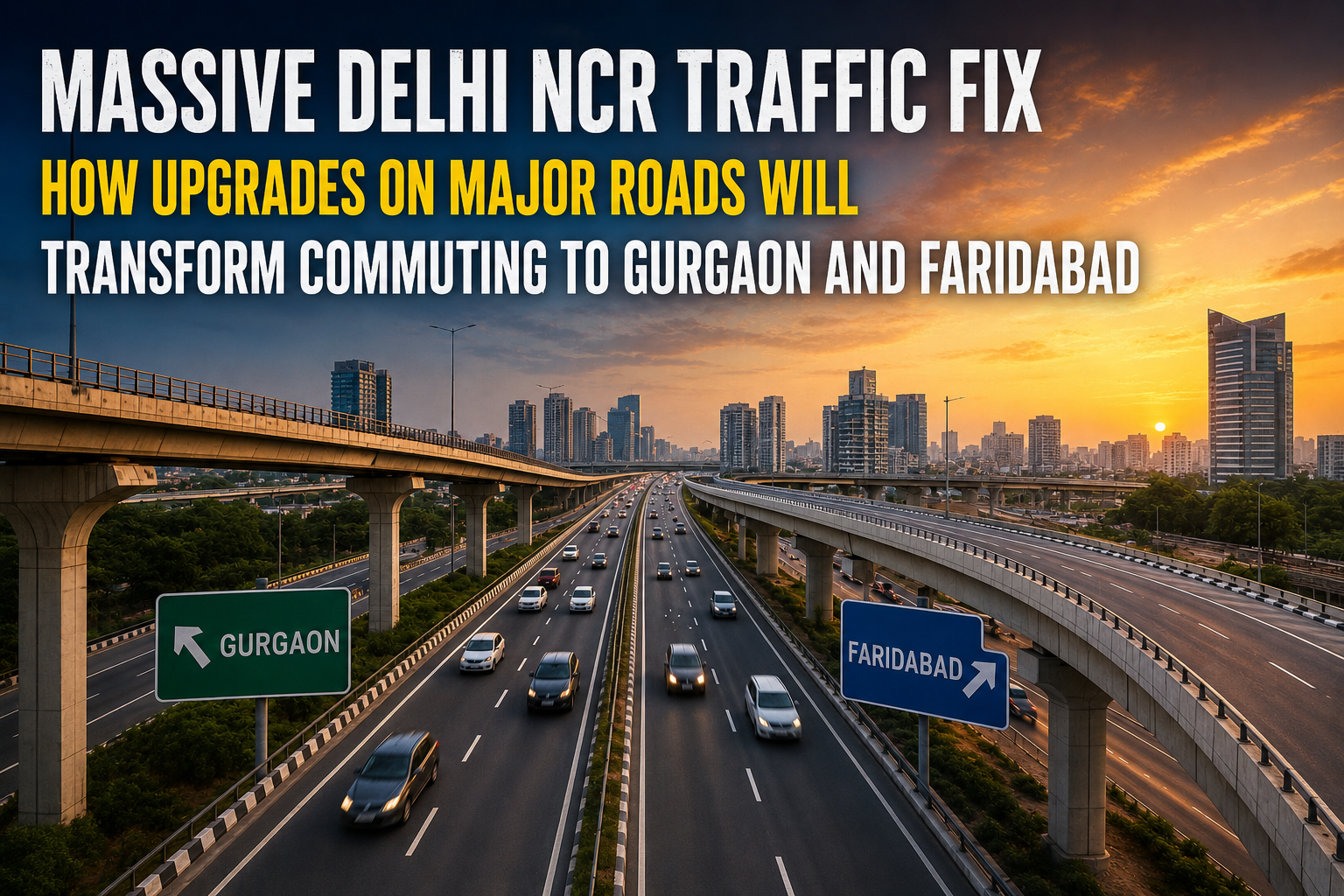
For millions of professionals and families living across the National Capital Region, the daily commute is often synonymous with frustration, delays, and endless lines of idling vehicles. Navigating the borders between Delhi, Gurugram, and Faridabad has long been a test of patience, with critical arterial roads choked by a mix of local city traffic, interstate commercial trucks, and heavy passenger vehicles. However, a sweeping infrastructure transformation is finally on the horizon. Authorities have stepped in with a massive, multi-crore traffic fix designed to untangle the region's most notorious bottlenecks. By completely overhauling three primary road networks, planners are aiming to create a seamless, signal-free urban corridor that could cut travel times by nearly forty percent. This ambitious overhaul is set to redefine urban mobility and reshape the real estate landscape across South Delhi and its neighboring satellite cities.
To understand the magnitude of this upcoming infrastructure upgrade, one must first look at the sheer volume of traffic traversing these borders daily. Over the past two decades, Gurugram and Faridabad have exploded into massive commercial and residential hubs. While the expansion of the metro network has absorbed a significant portion of daily commuters, the arterial surface roads have struggled to keep pace with the exponential rise in private vehicle ownership.
During peak morning and evening hours, the boundaries connecting South Delhi to Haryana transform into severe choke points. The core issue lies in the convergence of different traffic streams. Local residents running daily errands, office-goers rushing to corporate hubs like Cyber City, and heavy interstate freight carriers all funnel into the same narrow stretches. The result is a bumper-to-bumper nightmare where a mere ten-kilometer journey can easily take upwards of an hour. Frequent stops at poorly managed traffic signals further exacerbate the problem, leading to massive fuel wastage and severely contributing to the region's deteriorating air quality. Recognizing that minor road widening and patchwork repairs are no longer sufficient, the government has tasked national and local public works departments to execute a comprehensive, large-scale structural overhaul.
One of the primary focal points of this massive Delhi-Gurgaon traffic fix is the heavily utilized Mehrauli-Gurgaon corridor. Serving as a critical lifeline for professionals traveling between the capital and the corporate sectors of Haryana, MG Road is notorious for its crawling pace. The daily build-up is particularly severe around specific transit nodes, including Sultanpur, Ghitorni, Arjangarh, and the approach toward Sikanderpur.
The current infrastructure along this stretch is severely compromised by feeder roads that spill unmanaged local traffic directly onto the main highway. Even commuters utilizing the metro network face difficulties, as the areas immediately surrounding the stations are often gridlocked by shared autos, e-rickshaws, and unregulated roadside parking. The new decongestion strategy aims to fundamentally alter how traffic moves along this route. Planners are working to eliminate disruptive intersections and reduce the number of stoppage points, creating a near signal-free experience. By implementing strategic U-turns, regulated slip roads, and potentially localized underpasses, the goal is to allow the main highway traffic to flow continuously while safely segregating the slower-moving local transit vehicles. This uninterrupted flow is expected to be a major daily relief for office goers, significantly reducing the stress and unpredictability of the morning commute.
Perhaps the most ambitious and financially significant component of the entire regional traffic plan is the complete transformation of the Mehrauli-Badarpur Road. MB Road serves as a vital connector cutting across the southern part of the city, linking dense neighborhoods to key NCR hubs like Faridabad. It weaves through high-traffic zones such as Saket, Khanpur, Tigri, and Tughlaqabad. Because it passes through mixed land-use areas where residential clusters, bustling street markets, and pedestrian walkways compete for limited space, the road capacity has long been exhausted.
To solve this deeply ingrained infrastructure issue, a massive budget of over ₹1,471 crore has been approved for a state-of-the-art integrated elevated transit corridor. Instead of simply widening the existing road—which is impossible due to heavy encroachment—engineers have designed a 12-kilometer architectural marvel. A significant portion of this project will feature a cutting-edge double-decker structure. This innovative design optimizes limited urban space by placing a new metro rail line on the highest tier, supported by a massive six-lane elevated roadway immediately below it.
This multi-level approach allows long-distance commuters to completely bypass the chaotic ground-level markets and local intersections of Sangam Vihar and Khanpur. To further streamline vehicular movement, two major underpasses are slated for construction, including a critical one near Saket's G-Block and another along the busy Bus Rapid Transit corridor intersection. By segregating the fast-moving intercity traffic from the local neighborhood flow, this specific project is poised to become the gold standard for urban road engineering in densely populated metropolitan environments.
While the Gurugram borders receive heavy attention, the routes leading toward Faridabad are also undergoing a massive revamp. Mathura Road, a historical and critical artery for both passenger and freight movement toward Agra and Faridabad, is heavily congested with a mix of slow-moving trucks and daily commuters. Long waits at poorly synchronized traffic signals turn this stretch into a highly inefficient corridor.
The intervention here focuses on heavy engineering to create an uninterrupted pathway. Recent administrative budgets have outlined extensive plans for new elevated corridors and flyovers specifically designed to ease the pressure on the Gurugram-Faridabad transit stretch. Structures are being proposed at key junctions to carry highway traffic high above the local city bottlenecks. For instance, bypassing crowded intersections near the Faridabad border will allow professionals commuting between the two Haryana cities to bypass the surface-level chaos entirely. When massive volumes of traffic can glide over intersections rather than stopping at red lights, the overall carrying capacity of the road network increases exponentially.
While South Delhi and Haryana connectivity dominates the headlines, the decongestion masterplan also extends to crucial western borders, specifically the Rohtak Road and Tikri border stretch. This route is a vital conduit connecting Delhi with Bahadurgarh and broader regions of Haryana. Similar to the southern borders, this corridor suffers from the volatile mix of heavy industrial vehicles, intercity buses, and local passenger cars.
The strategy for this route involves heavy structural reinforcement and smart traffic segregation. By smoothing out the merging points where city roads meet the national highway, the plan will prevent the sudden braking and lane-switching that causes miles-long backups. Facilitating a smoother transition for heavy freight not only speeds up the delivery of goods but creates a much safer and faster environment for everyday commuters navigating the western fringes of the capital.
Historically, the introduction of massive, transformative infrastructure projects triggers a profound and immediate reaction within the local real estate ecosystem. The promise of cutting the Delhi-Gurugram or Delhi-Faridabad commute down by thirty to forty percent is already shifting the dynamics of housing demand across the National Capital Region.
For years, many homebuyers have hesitated to invest in peripheral or longer-distance residential pockets simply because the daily travel toll was too high. However, as the blueprints for these signal-free corridors and double-decker flyovers become reality, areas previously considered too remote are suddenly highly attractive. Real estate markets in South Delhi locations like New Friends Colony, as well as expansive residential sectors near the Gurugram and Faridabad borders, are expected to see a sharp spike in interest.
When a commuter knows they can access an elevated expressway and reach their corporate office in Cyber City or their business hub in Faridabad in a fraction of the traditional time, the appeal of living in these connected zones skyrockets. This enhanced connectivity translates directly into increased property valuations and higher rental yields. Developers are highly aware of this infrastructure timeline, and the market is already seeing a strategic positioning of new residential and commercial projects designed to capitalize on the upcoming ease of access.
The benefits of untangling these three major roads extend far beyond individual convenience; they have significant macroeconomic and environmental implications. One of the most immediate and positive outcomes of creating signal-free corridors is the dramatic reduction in vehicular emissions. Tens of thousands of cars idling at traffic lights or inching forward in first gear produce massive amounts of localized air pollution. By enabling vehicles to maintain a steady, continuous speed, these infrastructure upgrades will play a vital role in lowering the region's overall carbon footprint and improving the breathable air quality for surrounding neighborhoods.
Economically, the efficiency gained from smoother logistics cannot be overstated. When commercial trucks and delivery vehicles spend less time stuck in border traffic, the cost of transporting goods decreases, and supply chains become highly reliable. Furthermore, reclaiming millions of lost man-hours previously wasted in traffic jams directly boosts the overall productivity of the regional workforce. The construction phase of these massive projects itself acts as a massive economic engine, generating extensive employment opportunities for engineers, project managers, and skilled labor over several years.
Executing engineering projects of this magnitude, particularly in a region as densely built as Delhi-NCR, requires meticulous planning and seamless coordination among multiple state and central agencies. Projects like the double-decker corridor on MB Road involve highly complex structural integration with the existing metro network, requiring precise alignment and shared foundational engineering.
While certain components of these massive traffic fixes have already received administrative and financial clearance, and in some cases, foundation work has commenced, the overarching transformation is a multi-year endeavor. Many of these elevated roads and underpasses are slated for completion toward the end of 2027, subject to the smooth acquisition of necessary statutory clearances and environmental approvals. Concurrently, authorities are also focusing on rehabilitating older, structurally vulnerable flyovers across the city to ensure the entire transport backbone remains robust.
As these highly anticipated projects transition from detailed project reports to active construction sites, regular commuters are bracing for a period of temporary disruption. However, the long-term vision is clear. The days of accepting endless gridlock as an unavoidable part of living in the capital region are slowly coming to an end. Through strategic investment in elevated corridors, smart underpasses, and integrated transit systems, the roadmap for the future promises a significantly faster, cleaner, and more efficient commuting experience across the entire Delhi-NCR landscape.
